

In brief:
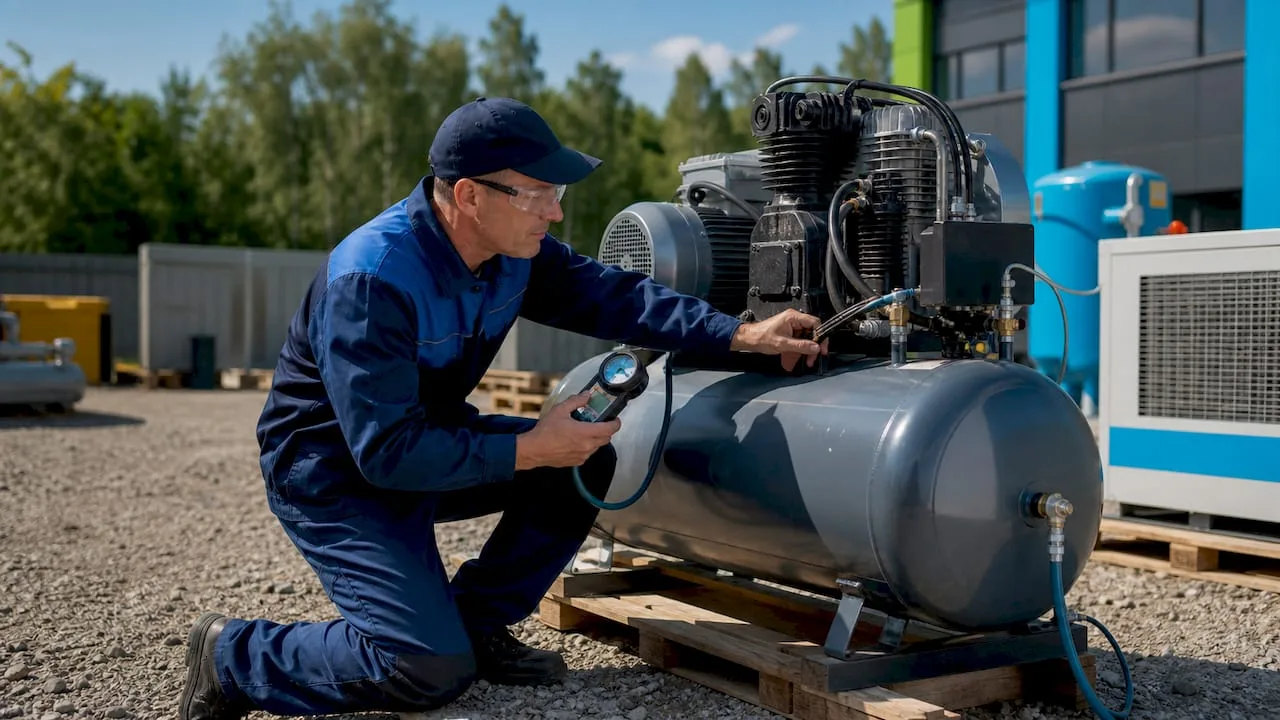
- The compression stage is the fundamental functionality of a compressor, which determines the pressure-efficient compression of air. Proper configuration and regular maintenance extend service life and increase the efficiency of the entire system. The choice between a simpler and a multi-stage solution depends on the required pressure and operating conditions.
A compression stage is defined as one functional unit of a compressor, in which air passes through one compression cycle from a lower pressure to a higher pressure. This parameter determines how efficiently the equipment compresses air, what output pressure it achieves, and how long it will run without failures. For technicians and professionals in the compressed air field, understanding the compression stage is the basis for proper selection, operation, and maintenance of the entire system. Single-stage and multi-stage configurations differ in performance, energy consumption, and suitability for specific industrial applications.
How does a compression stage work and what is its structural significance?
A compression stage operates on the principle of reducing the volume of air in the working space, which increases its pressure. In piston compressors, the piston compresses air in the cylinder during its movement, valves control the air intake and outlet, and each cycle corresponds to one compression stage. Screw compressors use rotating screw rotors, which gradually compress air along the axis of the machine.
The structural arrangement of stages directly affects the force load on the crankshaft, vibrations, and power drop. The W-shaped configuration in three-stage piston compressors minimizes torsional vibrations and extends bearing life. Technicians who underestimate this relationship face premature failures and higher repair costs.
Basic types of piston compressor arrangements:
- Inline arrangement: simple, suitable for single-stage machines with lower pressure
- V-configuration: two cylinders at an angle, better force balance than the inline arrangement
- W-configuration: three cylinders, significantly lower vibrations, typical for multi-stage industrial compressors
- Radial arrangement: multiple cylinders evenly distributed around the crankshaft, maximum balance
Each arrangement affects bearing life, noise level, and the frequency of service interventions. Proper stage configuration reduces vibrations and torsional oscillations, which directly extends the service life of the equipment and saves maintenance costs.
Professional tip: When selecting a compressor for continuous operation, always check the cylinder configuration. W-configuration or radial (star) arrangement are significantly more reliable for 24-hour operation than a simple in-line design.
The working principle of a piston compressor is described in more detail in the technical analysis of piston compressors, where you will also find the effect of configuration on operation and maintenance.
What is the compression ratio and why does it determine performance?
The compression ratio is a number expressing the ratio of the working chamber volume before compression to the volume after compression. In internal combustion engines it is referred to as the engine compression ratio and directly determines the thermodynamic efficiency of the entire cycle. The same logic applies to industrial compressors: a higher ratio means greater compression of air in a single stage.
A higher compression ratio brings higher energy efficiency and performance, but requires control of fuel sensitivity to autoignition and material properties. For compressors, this means higher thermal load on components and the need for quality cooling. Without sufficient cooling, the temperature of the compressed air rises to levels that damage seals, lubricant, and the cylinders themselves.
Strict compression ratio regulations in motorsport show how critical precise monitoring and control of the compression ratio is for achieving optimal performance without exceeding specified limits.
A practical example comes from motorsport. From 1 June 2026, FIA will measure engine compression ratios when heated to 130 °C to prevent illegal increases in compression above the 16:1 limit. This measure was introduced because the difference in compression ratio between a cold and operating engine can be significant and affects energy utilization. Industrial technicians should learn a lesson from this approach: measuring the compression ratio only when cold is not enough.
| Parameter | Low compression ratio | High compression ratio |
|---|---|---|
| Output pressure | Lower | Higher |
| Energy efficiency | Lower | Higher |
| Thermal load | Lower | Higher |
| Cooling requirements | Minimal | High |
| Risk of self-ignition | Low | Higher |
| Suitability | Light-duty applications | Industrial operation |
Single-stage vs. multi-stage compressors: what determines the choice?
Choosing between a single-stage and multi-stage compressor depends on the required pressure, air volume and operating profile. Each type has clearly defined strengths and limitations.
Single-stage compressors
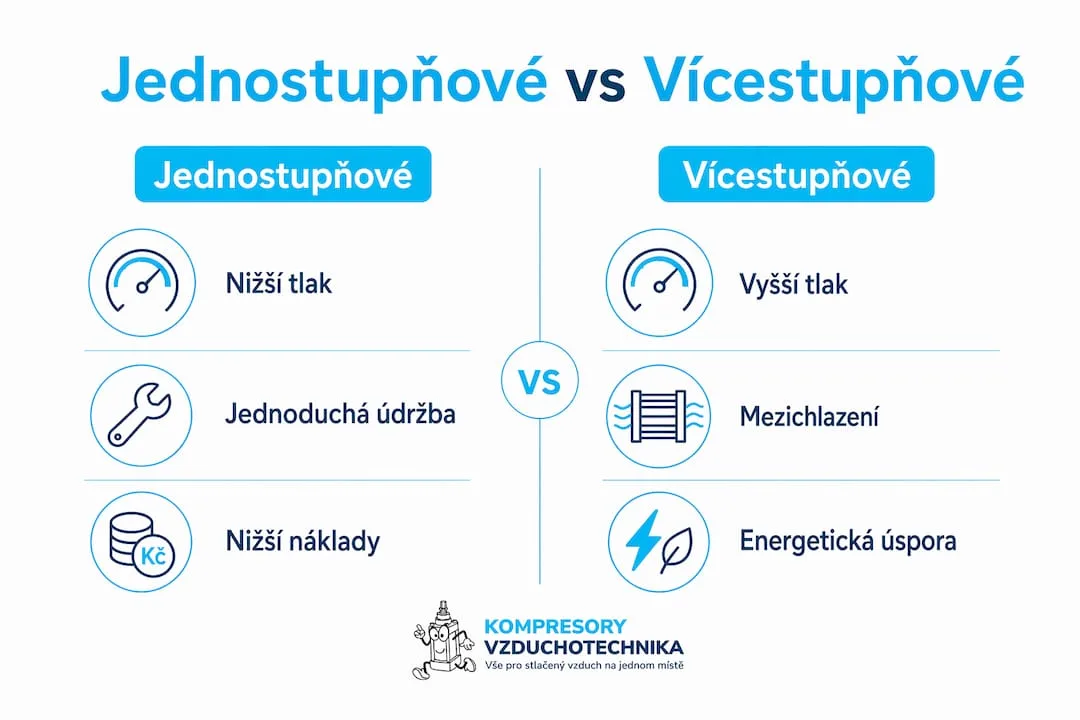
A single-stage compressor compresses air in a single step directly to the outlet pressure. Single-stage compressors achieve a pressure range of 100–150 psi and are suitable for light to medium-duty applications. Typical uses include auto repair shops, workshops, construction work and pneumatic tools with lower air consumption.

The advantage of single-stage machines is simple design, lower purchase price and easy maintenance. The disadvantage is higher compressed air temperature and lower energy efficiency at higher pressures.
Multi-stage compressors
A multi-stage compressor divides compression into two or more steps with intercooling between stages. Intercooling reduces the air temperature between stages, increases air density and thus improves the efficiency of the entire compression process. The outlet pressure of multi-stage machines exceeds 200 psi, which is necessary for industrial applications, painting, manufacturing or the food industry.
Intercooling is not just about reducing temperature. The higher air density after cooling allows the next stage to operate with lower energy loss. Regular intercooler maintenance is therefore essential for stable long-term operation.
- Check the intercooler at every scheduled maintenance. Fouling reduces efficiency and increases outlet temperature.
- Monitor the pressure difference between stages. A deviation from the manufacturer's specification indicates wear on valves or piston rings.
- Measure the outlet air temperature from each stage separately. Uneven values reveal a problem before it causes a failure.
- Replace air filters based on operating hours, not just the calendar. A dusty environment significantly shortens filter life.
| Compressor type | Pressure range | Typical use | Maintenance costs |
|---|---|---|---|
| Single-stage | 100–150 psi | Workshop, auto repair shop, construction | Low |
| Two-stage | 150–200 psi | Industry, paint shop, manufacturing | Medium |
| Multi-stage (3+) | above 200 psi | Heavy industry, special applications | Higher |
Professional tip: A two-stage compressor with intercooling consumes less energy for the same output than a single-stage machine operating at the limit of its pressure range. If your operation requires continuous pressure above 10 bar, a two-stage solution will pay back in energy savings within two years.
For a detailed comparison and the advantages of two-stage machines, see the article on the efficiency of two-stage compressors.
Practical applications and recommendations for technicians in operation
Choosing the correct compression stage for a specific application prevents most operational problems. A technician who knows the requirements of their operation will select the right machine and set it up to work within the optimal range.
The most common mistakes in selection and operation:
- Underestimating the required pressure: a compressor operating continuously at the upper limit of its range wears out faster and consumes more energy
- Ignoring the duty cycle: a machine designed for intermittent operation fails prematurely when run continuously
- Neglecting cooling: insufficient cooling of the compressor space increases intake temperature and reduces efficiency
- Incorrect lubricant choice: unsuitable lubricant carbonizes at high temperatures and fouls the valves
- Overlooking cylinder configuration: choosing a single-stage machine where a multi-stage one is needed leads to overloading and shortened service life
Selecting the right compressor for industrial use involves more parameters than just pressure and flow. Factors for selecting an industrial compressor include the operating profile, network quality, air purity requirements, and the maintenance plan.
Setting the compression stage correctly delivers measurable results. It reduces energy consumption, extends intervals between service interventions, and increases the reliability of compressed air supply. Technicians who regularly check the pressure parameters and temperatures of individual stages detect wear before it causes an unplanned shutdown. Tips for saving energy with a compressor show how correctly setting the compression stage directly affects operating costs.
Key takeaways
A correctly selected and set compression stage is the foundation for energy-efficient, reliable, and long-term sustainable operation of every compressor system.
| Point | Details |
|---|---|
| Definition of a compression stage | A single functional unit of the compressor providing one cycle of compressing air from a lower to a higher pressure. |
| Impact of configuration on service life | W-configuration and radial (star) arrangement minimize vibrations and extend bearing service life. |
| Compression ratio and performance | A higher compression ratio increases efficiency but requires good cooling and control of thermal load. |
| Benefit of intercooling | Intercooling in multi-stage compressors increases air density and reduces energy losses. |
| Maintenance as prevention | Regular inspection of the intercooler, valves, and pressure differentials between stages prevents unplanned shutdowns. |
Compression stage in practice: what I've learned over years in the field
Technicians most often make mistakes when selecting a compressor based on catalog pressure and flow rate, overlooking the stage configuration. I've seen workshops where a single-stage machine was permanently running at 10 bar because "that's how it's always been." The result was overheated valves, reduced lubricant lifespan, and service intervention every three months instead of once a year.
The second thing that surprised me in practice is the underestimation of intercooling. Technicians only clean the intercooler when the compressor starts overheating. Properly, the intercooler should be part of every scheduled inspection, because fouling of just 20% significantly reduces the efficiency of the entire second stage.
The future of compression systems is moving toward integrated sensors that monitor the pressure and temperature of each stage in real time. Machines with this feature enable predictive maintenance and eliminate unplanned shutdowns. For technicians, this means that knowledge of the compression stage is no longer just mechanical, but also data-driven.
I recommend every technician: learn to read your compressor's pressure diagram. A deviation from the normal pattern between stages is the first sign of a problem, long before it manifests as a failure.
— Zdeněk
Technical solutions for compression systems from Kompresory-vzduchotechnika
Kompresory-vzduchotechnika offers technical equipment for professionals who need reliable tools for operating and maintaining compression systems. The range includes pneumatic and hydraulic components suitable for both single-stage and multi-stage applications.
For technicians working with compressed air, the Professional KIT of blow guns for compressed air is available, containing tools for the everyday operation of compression systems. Additional pneumatic and hydraulic components cover the needs of industrial operations, from basic maintenance to demanding applications. The Kompresory-vzduchotechnika team provides technical support in selecting the right equipment for a specific compression system.
Frequently Asked Questions
What is a compression stage in a compressor?
A compression stage is one functional unit of a compressor in which air goes through one cycle of compression from a lower to a higher pressure. Each stage operates with its own valves, piston or rotor, and cooling system.
What is the difference between a single-stage and a two-stage compressor?
A single-stage compressor compresses air in one step to a pressure of 100–150 psi, while a two-stage compressor divides the compression into two steps with intercooling and reaches a pressure above 200 psi. A two-stage machine is more energy-efficient at higher pressures.
Why is intercooling important in multi-stage compressors?
Intercooling reduces the air temperature between stages and increases its density, allowing the next stage to operate with lower energy loss. A neglected intercooler reduces compression efficiency and shortens the service life of components.
How does the compression ratio affect compressor performance?
A higher compression ratio increases energy efficiency and discharge pressure, but at the same time increases the thermal load on components. Without sufficient cooling, damage occurs to seals, lubricant, and cylinders.
How can you tell that a compression stage needs servicing?
A signal is a deviation of the pressure differential between stages from the values stated by the manufacturer, increased discharge air temperature, or unusual vibrations. Regular monitoring of these parameters allows wear to be detected before it causes a failure.
Recommended
- Definition of the compressor duty cycle: a guide for technicians - Kompresory-Vzduchotechnika.cz
- Checklist of accessories for compressors: a guide for technicians - Kompresory-Vzduchotechnika.cz
- Compressor bleeding procedure: a guide for technicians - Kompresory-Vzduchotechnika.cz
- The role of lubrication in a compressor: a guide for technicians - Kompresory-Vzduchotechnika.cz