
Cast iron piston compressor WK550-4-0/270P input power 3 kW, intake 530 l/min, pressure 10 bar, air receiver 270 l, voltage 400/50 V/Hz
Code: WK550-4-0/270P


Related products


Product detailed description
WALTER WK550-4,0/270P cast-iron piston compressor
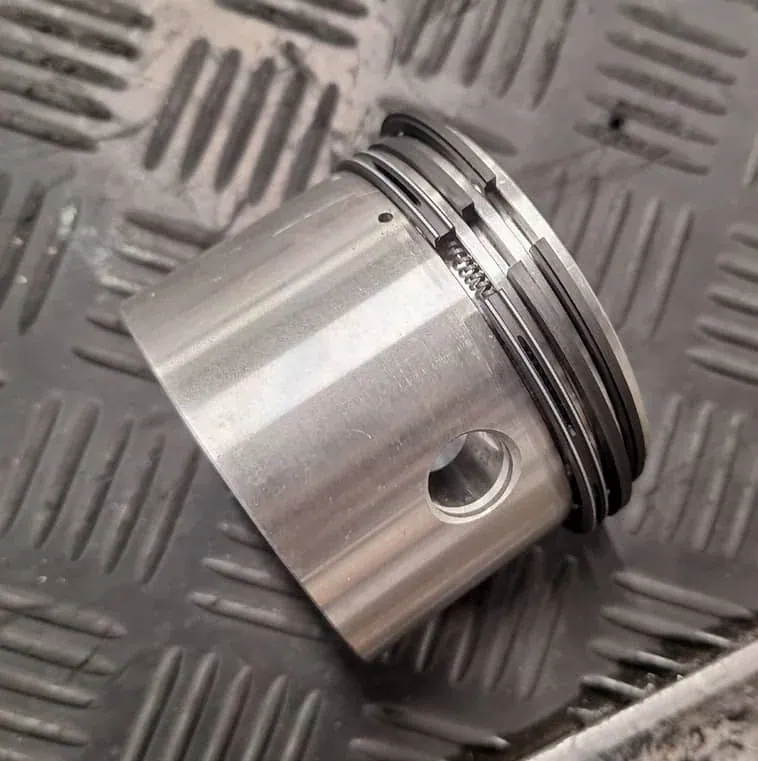
The WK550-4,0/270P is the pinnacle of the WALTER three-kilowatt class. The cast-iron three-cylinder in a 3W configuration has a power input of 3.0 kW, an intake of 530 l/min and an effective delivery of 440 l/min at 10 bar, and runs at 1,202 rpm. The horizontal tank with a volume of 270 l is the largest fitted to this unit. Power supply 400 V / 50 Hz, noise level approx. 80 dB(A), 3-year warranty after registration at waltercesko.cz.
A 270 l tank combined with 530 l/min intake corresponds to the upper limit of the recommended reserve-to-performance ratio (160 to 270 l), which is the entire purpose of this configuration: the motor switches on less frequently than any other three-kilowatt variant and maintains pressure in the distribution system even during prolonged work. It is a typical machine for a tyre shop with a single bay or a workshop where compressed air is used for several hours a day.
Configuration of this machine
- Cast-iron unit — 3W · 1,202 rpm · single-stage compression
- Pressure vessel — 270 l · horizontal
- Horizontal design
- Three-phase 400/50 V/Hz
- Standard pressure of 10 bar for common pneumatic tools
Why choose this model

Lowest number of starts in the entire three-kilowatt class
A 270 l tank provides approximately 540 litres of free air per cycle with a 2 bar differential between the cut-in and cut-out pressures. With a continuous consumption of 200 l/min, this results in roughly 12 starts per hour, compared to 16 for the 200 l version and 33 for the 100 l version. The machine thus spends more time working and less time starting up.

Pressure that remains stable during impact wrench use
A 1/2" impact wrench consumes 300 to 400 l/min for short periods, which is close to the 440 l/min delivery. With a 540-litre reserve in the tank, the pressure practically does not fluctuate during a series of impacts — tyre changing wheel by wheel is not hindered by waiting for recharging, which is the primary reason tyre shops choose this model.

Stable pressure from a large tank
The 3W configuration divides the work into three smaller strokes, resulting in more, smaller compression cycles per revolution and lower output pulsations. Combined with the 270 l volume, which smooths out any remaining fluctuations, the pressure in the distribution system remains stable even during long spray applications — this shows first in the quality of the finish.

Same tank as the most requested model in the range
The 270 l volume is also the one used by the most frequently requested model in the range, the WK650-5,5/270P. This machine therefore offers the same reserve and equally stable pressure in the distribution system at a lower power input — with a delivery of 440 l/min instead of 550 l/min.
Who is it for
The most typical buyer is a tyre shop with a single bay or a car repair shop where one person works with compressed air, but for practically the entire shift. It also suits smaller body shops, metalworking shops with a fixed distribution system, or joinery workshops with several pneumatic machines that are not used at the same time. This is the last step at which you can make do with a three-kilowatt power input; as soon as two people need to work at the same time, delivery becomes the deciding factor and it is time to move up a class.
Typical applications
- Tyre changing and 1/2" impact wrench in a single-bay tyre shop
- Tyre changer, wheel balancer and other pneumatically operated service equipment
- Tyre inflation including truck and agricultural dimensions
- Pressure testing of wheels, valves and pneumatic components
- Pneumatic jack and other workshop equipment powered by compressed air
- Powering a fixed workshop air network with several non-simultaneous outlets
When to choose a different model
Two people need to work at the machine simultaneously
A delivery rate of 440 l/min supports one continuous draw. For the simultaneous use of two tools, such as a grinder and an impact wrench, you will need a four-kilowatt platform with 550 l/min — it features the same 270 l tank, but with a more powerful unit that additionally runs under 1,000 rpm.
The 270 l tank does not fit in your workshop
The vertical VWK550-4,0/90P has the same three-cylinder unit and the same delivery rate, but with a vertical 90 l tank and approximately half the floor space requirement. The trade-off is a significantly lower reserve and more frequent motor switching.
Your equipment requires more than 10 bar
For higher pressure, the range includes the high-pressure HWK700-5,5/270P: 13 bar, intake 600 and delivery 500 l/min at 817 rpm, on the same 270 l tank. It is purchased for the pressure prescribed by your equipment, not for a greater volume of air.
What the figures tell you — calculated values
The values are calculated and are meant for comparing the models with each other, not as guaranteed figures.
Design and technology

Related models and alternatives
WK550-4,0/200P
Same unit with a smaller tank — slightly more starts, but a smaller footprint.
WK650-5,5/270P
Same 270 l tank, one class higher: 550 l/min and rpm under 1,000 for the first time.
VWK550-4,0/90P
Vertical version of the same unit for workshops with limited floor space.
HWK700-5,5/270P
High-pressure option: 13 bar and 500 l/min delivery on the same 270 l tank.
Frequently asked questions
- What is the difference compared to the 200 l version?
- In terms of performance, there is no difference — both versions have the same three-cylinder unit, the same 440 l/min delivery and the same 1,202 rpm. They differ only in reserve: 540 litres of free air per cycle versus 400, which means approximately 12 motor starts per hour instead of 16 at a draw of 200 l/min. The trade-off is a larger footprint and a longer initial pressurisation time.
- How long does it take to fill the 270 l tank?
- The calculation gives approximately 6.1 minutes from zero to 10 bar without draw — the longest time in the 3.0 kW class. This is an isothermal estimate based on the formula volume times pressure divided by effective delivery; in reality, filling takes slightly longer. However, throughout the day, it only needs to top up by 2 bar.
- Is it sufficient for all-day tyre changing?
- For a single-bay workshop, yes. An impact wrench draws 300 to 400 l/min short-term, and the 540-litre reserve covers this peak without a drop in pressure, so there is no waiting between wheels. For two bays operating simultaneously, it is not — two impact wrenches running at once exceed the 440 l/min delivery, making a four-kilowatt platform appropriate.
- How can I tell if the unit is wearing out?
- By three indicators: the time to fill the tank from zero increases (for this machine, it should be approximately 6.1 minutes), oil consumption rises, and more oil appears in the tank condensate. In a three-cylinder unit, wear occurs gradually — one cylinder loses power before the others, so the machine initially just fills more slowly. The cylinder liner is machinable and the rings are replaceable, so this is resolved by repair, not by replacing the machine.
- What needs to be done immediately after installation?
- Place the machine on a level surface with sufficient space for unit cooling, check the oil level, and record the start-up date. After the first 8 hours of operation, tighten the cylinder head bolts to a torque of 25 Nm; change the oil after the first 100 hours. Most importantly, register the machine at waltercesko.cz — without registration, you only receive the statutory warranty period instead of 3 years.
The machine comes with a 3-year warranty after registration with the importer. Warranty terms, the maintenance schedule and a comparison of all 28 models are in the category WALTER cast-iron piston compressors.
Ventilek’s tip
Tyre-change season is a test of nerves — the compressor shouldn't be another one. This one holds pressure even when it's wheel after wheel.
Additional parameters
| Category: | Air compressors |
|---|---|
| Warranty: | 2 years |
| EAN: | 5905122000127 |
| Compressor type: | Piston compressor |
| Pressure: | 10 bars |
| Suction power: | 530 l/min |
| Air delivery: | 440 l/min |
| Pressure vessel volume: | 270 L |
| Design of pressure vessel: | Lying down |
| Connecting: | Quick coupling DN 7.2, Ball valve 1/2" |
| Motor power: | 3.0 kW |
| Mains voltage: | 400/50 V/Hz |
| Speeds: | 1,202 rpm |
| Number of cylinders: | 3 |
| Number of grades: | 1 – single-stage compressor |
| Lubrication: | Oleic |
| Noise: | 80dB(A) |
| Dimensions: | 1650 × 660 × 1120 mm |
| Weight: | 156 kg |
| Accessories: | Pressure regulator, Wheels, Handle, Quick coupler, Ball cock |
| Engine: | Electric |
| Soundproofed: | No |
| Drive: | V-belts |
| Air dryer: | No |
| Retrieved from: | Professional |
| Development: | Mobile |


Product rating
Be the first who will post an article to this item!
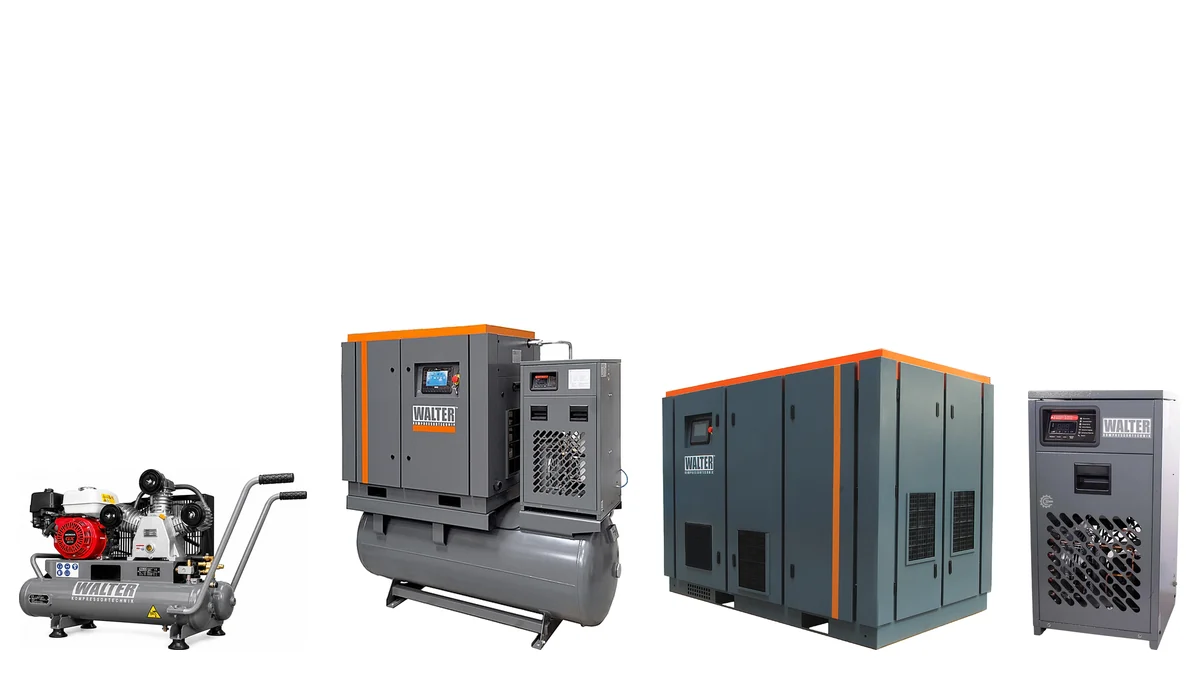
WALTER Kompressortechnik is a manufacturer of compressors and compressed air treatment based in Łódź, Poland. We offer its cast-iron piston compressors, screw compressors in seven series and WDF refrigeration dryers with built-in filters, plus spare elements and WKTT oil.
The cast-iron piston machines have a low-speed pump unit that copes with daily use in a workshop, tyre service or paint shop. The screw compressors are built for continuous operation: fixed speed or with an inverter, two-stage, on an air receiver or with a dryer.
 From 2.2 to 315 kW
WALTER series: piston, screw and dryers
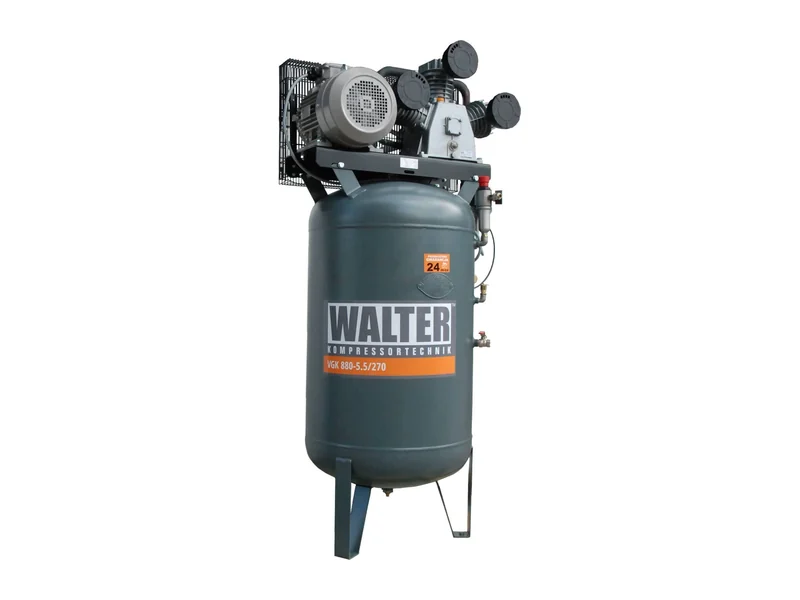
Cast-iron piston WK, VWK and HWK
For workshops, tyre services and paint shops. The low-speed cast-iron pump unit copes with daily use and can be repaired.
- 2.2 to 7.5 kW, 29 models
- horizontal, vertical or base-plate unit
- HWK for 13 and 15 bar, WKM 700 on petrol
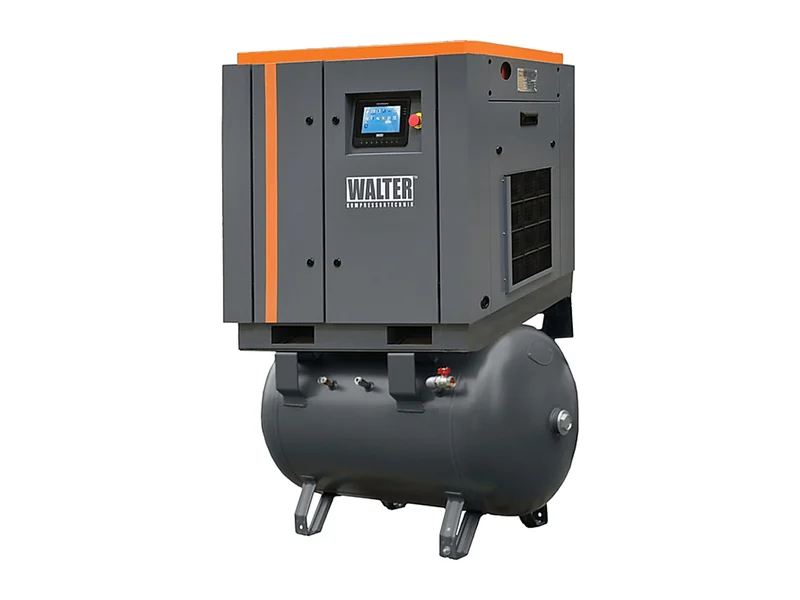
SK SP and SKTG SP — belt drive
High output in a small footprint. Fixed speed, 5.5 or 7.5 kW, standalone or on a receiver.
- delivers 0.85 and 1.15 m³/min at 8 bar
- receiver 270, 300 or 500 l
- COMBO with dryer and filters
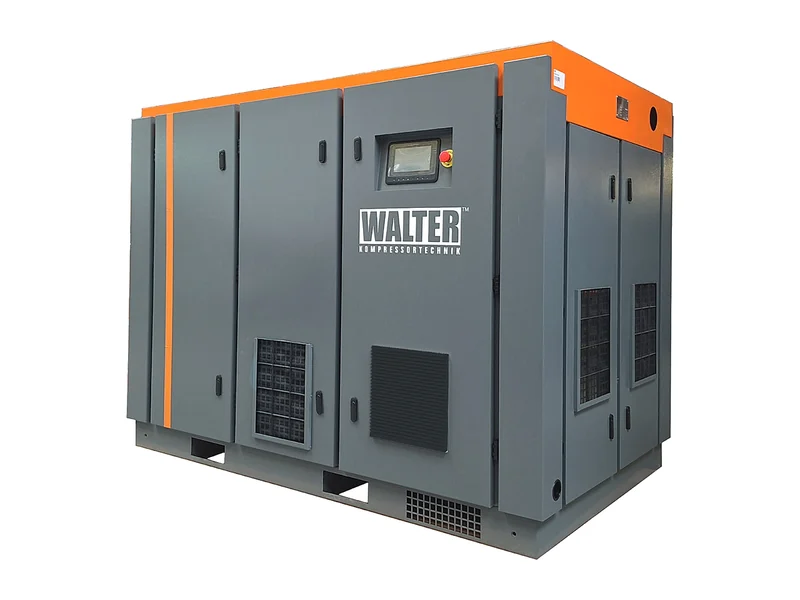
SK KSP — fixed speed
For steady air demand. The airend is connected to the motor by a coupling, with no belt.
- 11 to 315 kW, 17 models
- pressure 8, 10 or 13 bar
- max. 3 ppm oil mist in the air
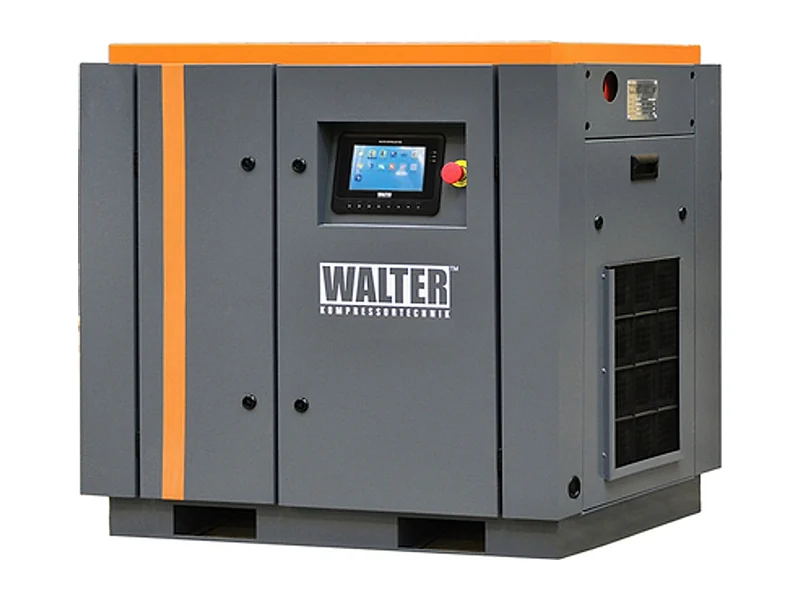
SF KSP — variable speed drive
When demand varies during the shift. The inverter matches the speed to demand, so the machine does not idle.
- 5.5 to 315 kW, 19 models
- up to 35% less energy with varying demand
- IE4 motor, IE5 as an option
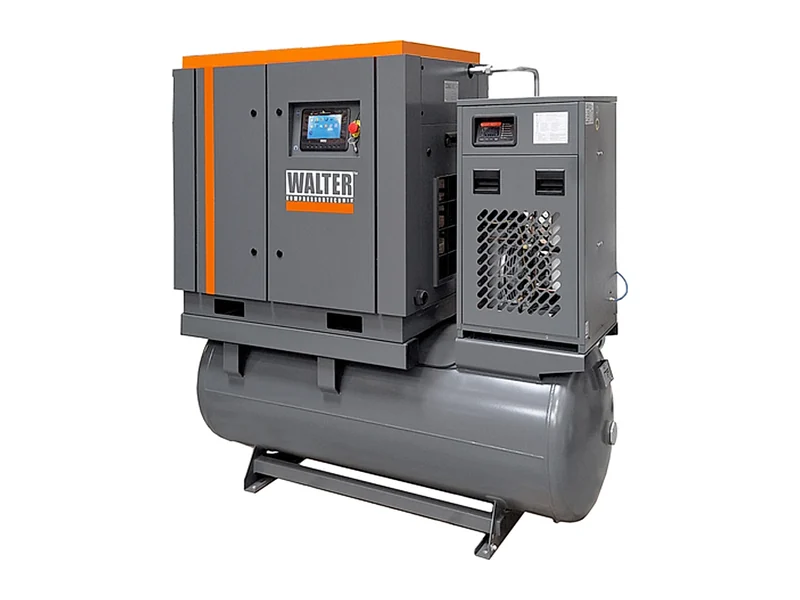
SFTG KSP — inverter on a receiver
A complete package in one unit. The inverter compressor sits directly on the pressure vessel.
- 5.5 to 15 kW, 14 models
- receiver 270, 300 or 500 l
- COMBO with dryer and filters
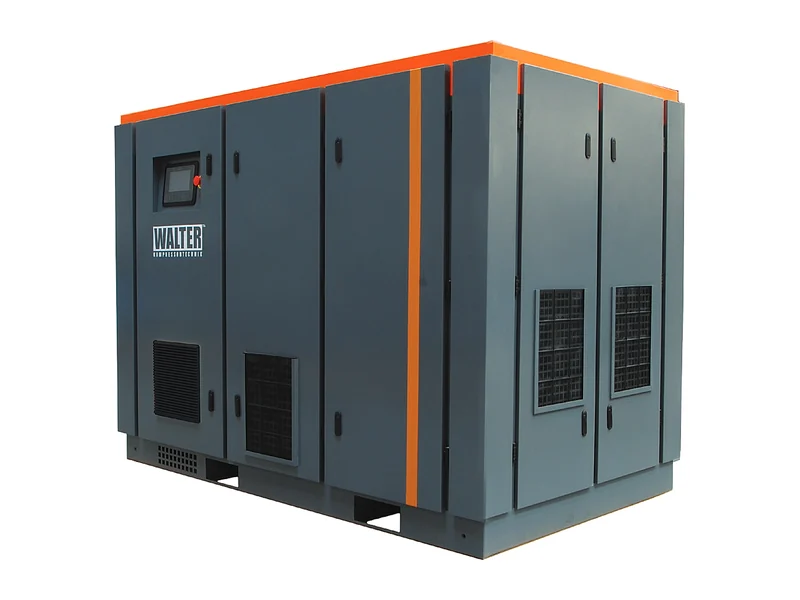
SF DSP — two-stage compression
For machines that run whole shifts. Two compression stages and an IE5 magnetic motor with inverter.
- 22 to 315 kW, 13 models
- on average 12% more air than a single-stage machine
- direct 1:1 drive, no belt
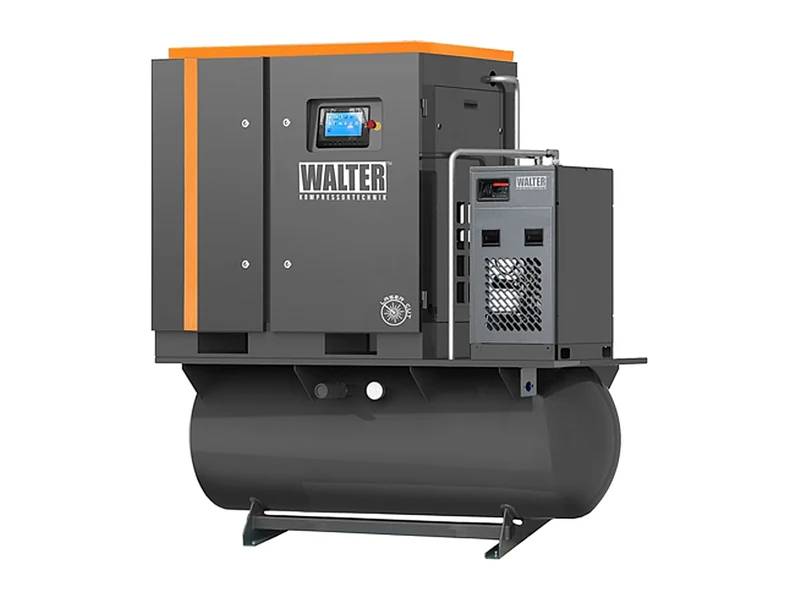
SLC Laser Cut — 16 and 20 bar
Air as the cutting gas for lasers. Higher pressure than a normal workshop needs, in three models.
- 15 to 22 kW
- SLC 22 with inverter for 16 or 20 bar
- SLCTG 15 with dryer and five filters
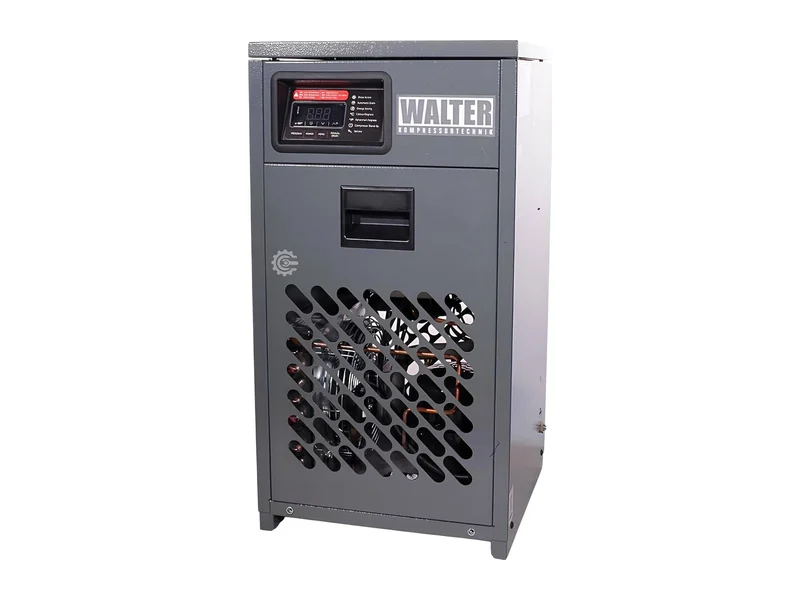
WDF refrigeration dryers
A dryer and two filters in one cabinet. Dries compressed air to a +3 °C dew point and filters it straight away.
- 22 sizes, 383 to 97,500 l/min
- pre-filter 1 µm and fine filter 0.01 µm
- spare elements in FE KIT sets
Not sure whether you need a piston or a screw compressor? The selection calculator works out the output you need from your tools and suggests a machine.
Choose a compressorWALTER compressors side by side
| Series, design, power, pressure and version | ||||
|---|---|---|---|---|
| Series | Design | Power | Pressure | Version |
| Cast-iron WK, VWK, HWK | piston, cast-iron pump unit | 2.2–7.5 kW | 10, 13 and 15 bar | horizontal, vertical, base-plate unit |
| WKM 700-7/38 | piston, Honda petrol engine | 4.3 kW | 10 bar | two 19 l tanks on a wheel |
| SK SP and SKTG SP | screw, belt, fixed speed | 5.5 and 7.5 kW | 8, 10, 13 bar | standalone, on a receiver, COMBO |
| SK KSP | screw, direct drive, fixed speed | 11–315 kW | 8, 10, 13 bar | standalone machine |
| SKTG KSP | screw, direct drive, fixed speed | 11 and 15 kW | 8, 10, 13 bar | on a 500 l receiver, COMBO |
| SF KSP | screw, direct drive, inverter | 5.5–315 kW | 8, 10, 13 bar | standalone machine |
| SFTG KSP | screw, direct drive, inverter | 5.5–15 kW | 8, 10, 13 bar | on a 270–500 l receiver, COMBO |
| SF DSP | two-stage screw, inverter | 22–315 kW | 8, 10, 13 bar | standalone machine |
| SLC Laser Cut | screw, for laser cutting | 15–22 kW | 16 and 20 bar | standalone, COMBO with dryer |
For most screw machines you choose 8, 10 or 13 bar. The higher the pressure, the less air the compressor delivers.
How to choose a WALTER compressor
1. Work out the demand
Add up the tools that run at the same time and allow about 30% for leaks and future extensions. Choose by free air delivery, not by intake volume.
2. Piston or screw
If you use air intermittently, a cast-iron piston compressor is enough. If the compressor runs for most of the shift, choose a screw compressor.
3. Fixed speed or inverter
With steady demand, the fixed-speed SK series is enough. If demand varies during the shift, the SF series with inverter saves up to 35% energy.
4. Dry and maintain
For dry air, add a WDF dryer after the compressor or choose the COMBO version straight away. WALTER screw compressors are serviced every 2,000 operating hours.
Frequently asked questions
- What does the number in a WK piston compressor name mean?
- The number after the letters is the approximate intake in l/min, the number after the dash is the motor power in horsepower, not kilowatts. WK430-3,0 has a 2.2 kW motor, WK650-5,5 a 4.0 kW motor. Choose by free air delivery: 340 to 1,100 l/min across the range.
- Is there a difference between WK and the older GK?
- Mechanically no, it is the same platform in a new generation. WK430 = GK420, WK550 = GK530, WK650 = GK630, WK900 = GK880 and WK1500 = GK1400. The old designation on the label helps when ordering spare parts.
- What do the abbreviations in screw compressor names mean?
- F = inverter, TG = on a receiver, KSP = direct drive without a belt, SP = belt drive, DSP = two-stage compression and COMBO = with dryer and filters. The number before the slash is the power in kW, after the slash the receiver volume in litres.
- When is an inverter worth it?
- When air demand varies during the shift. The inverter matches the speed to demand and saves up to 35% energy compared with a fixed-speed machine. With steady demand, a simpler fixed-speed machine pays off.
- Do you have a compressor that needs no electricity?
- Yes, the petrol WKM 700-7/38 with a Honda GX200 engine: 316 l/min, 10 bar, two 19 l tanks on a wheel. Because of the exhaust fumes, it may only be used outdoors.
- How often are the WDF dryer elements replaced?
- When the controller shows the FIL alarm, otherwise once a year, and always both elements together. Choose the FE KIT set by dryer size and the marking on the cap of the old element.
Free air delivery of the screw compressors is given to ISO 1217, Annex C. Technical data of the WDF dryers come from the manufacturer’s manual and website. WALTER is a brand of WALTER Kompressortechnik Polska, based in Łódź.
| Manufacturing company : | Walter Kompressortechnik Polska Sp. z o.o. |
|---|---|
| Address : | ul. Świętej Teresy od Dzieciątka Jezus 180, 91-222 Łódź, Poland |
| E-mail : | biuro@walterpolska.pl |