
Tandem Pro Line B59B, B60 and B70 compressors — two pump units on one tank
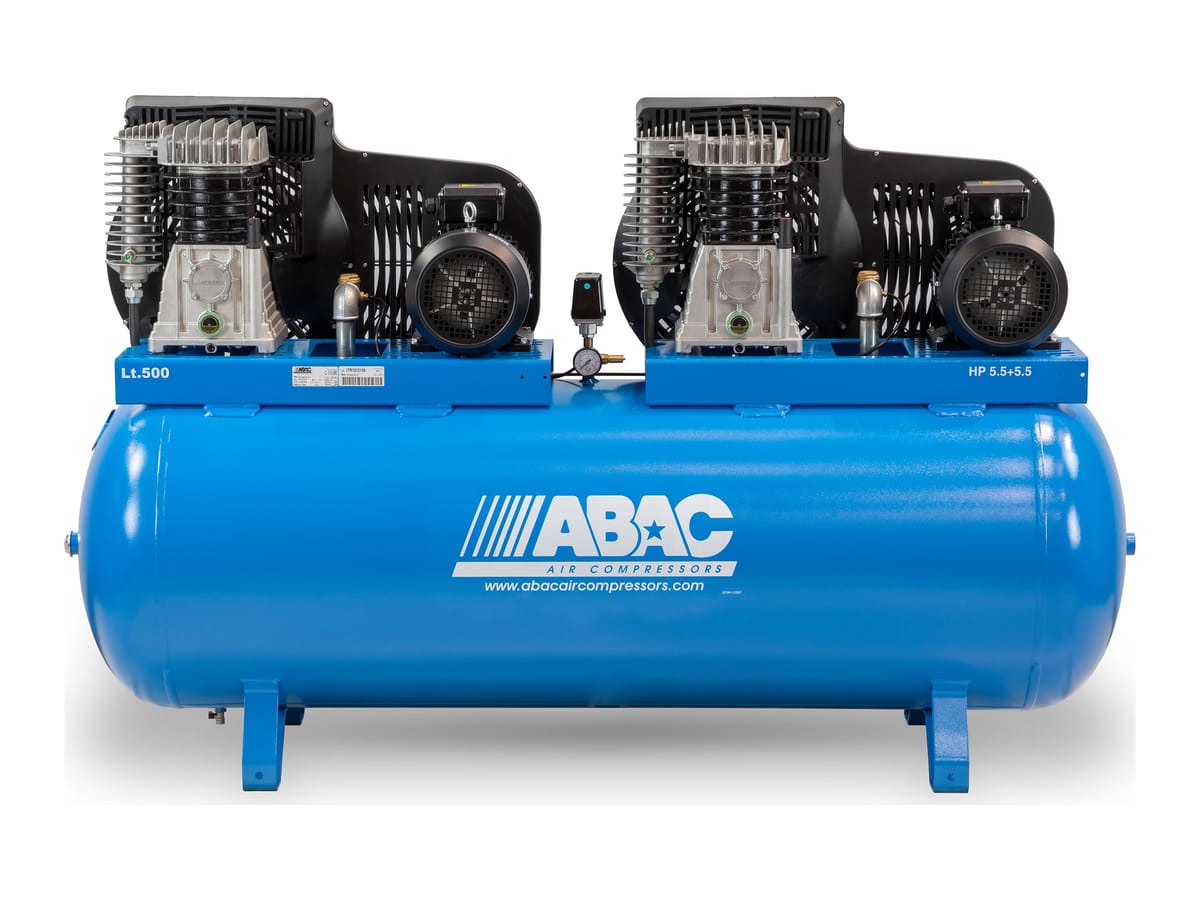 B59B, B60 and B70 · two pump units · 500 / 900 l · 11 bar · 400 V
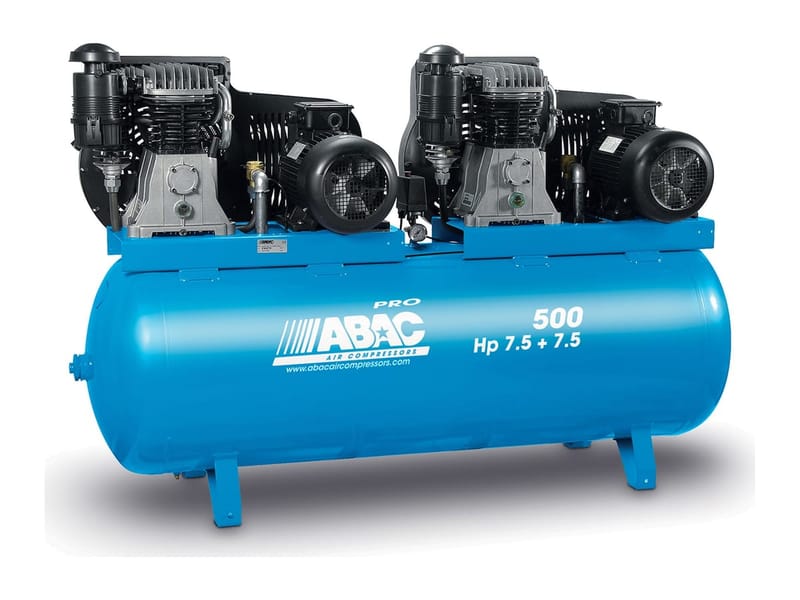
Six ABAC tandem compressors: on one horizontal 500 or 900 l tank sit two identical cast-iron two-stage pump units — B59B, B60 or B70 — each with its own 400 V motor. Under normal demand one pump unit is enough, the second joins in for the peak — and when one is out for service, the workshop runs on the other. That is the reason for a tandem rather than one bigger machine. Displacement of 1,306 to 2,420 l/min depending on the pump units, 11 bar on all six; both motors are controlled by a shared pressure switch with a timer relay, which starts the second motor after a delay. We service the ABAC brand.
Which tandem — pump units, tank and mode of operation
All six machines share the same build: two pump units, two motors, one switch, one tank. You choose by how much air the two pump units have to deliver together, how big a reserve the tank should hold and how often the pipework will need both at once.
B59B, B60 or B70 pump units — 1,306 to 2,420 l/min
The same cast-iron two-stage pump units as on the single-motor machines, only twice over. The B59B-2x4-500FT draws in 1,306 l/min through two B59B pump units with 4 kW motors at 1,400 rpm. The B60-2x4-500FT gives 1,320 l/min from two B60 pump units with 4 kW motors at 1,100 rpm; the B60-2x5.5-500FT and B60-2x5.5-900FT 1,654 l/min with 5.5 kW motors at 1,400 rpm. The B70-2x5.5-500FT draws in 2,046 l/min through two B70 pump units with 5.5 kW motors at 1,100 rpm, and the B70-2x7.5-900FT 2,420 l/min with 7.5 kW motors at 1,300 rpm. Noise 100 dB Lwa and 80 dB at 4 m on the four tandems with B59B and B60 pump units, 105 dB Lwa and 85 dB at 4 m on both B70 tandems.
A 500 or 900 l tank
Four tandems stand on a 500 l tank with a footprint of 2,030 × 670 mm — the same as a single-unit machine on 500 l. The B60-2x5.5-900FT and B70-2x7.5-900FT have a 900 l tank on 2,070 × 800 mm. The tank does not add displacement; it holds a reserve for short peaks, extends the pauses between starts and, with 900 l, lets both pump units run longer at a stretch, which does them more good than frequent short cycles. Where the air is drawn in bursts, 500 l is enough; where the peaks are long and there are many draw-off points, the B60 and B70 belong on the 900.
One pump unit or both — by demand
The pressure in the tank is monitored by one shared pressure switch, and a timer relay starts the second motor after a delay so that the starting currents do not add up; the pump units cut in according to how much air the pipework is drawing. If your demand is low for most of the shift and only occasionally doubles, a smaller tandem will do; if you have both pump units running all afternoon, you are at the limit of what a piston machine can deliver and should look at a screw compressor.
Six tandems side by side
| Pro Line tandem B59B, B60 and B70 — six ABAC machines with two pump units, 500 and 900 l | ||||||||
|---|---|---|---|---|---|---|---|---|
| Model | Pump units | Tank | Pressure | Motor power | Air displacement | Speed | Noise Lwa / at 4 m | Weight |
| B59B-2x4-500FT | 2 × B59B | 500 l | 11 bar | 2 × 4 kW (8 kW) | 1,306 l/min | 1,400 rpm | 100 / 80 dB | 323 kg |
| B60-2x4-500FT | 2 × B60 | 500 l | 11 bar | 2 × 4 kW (8 kW) | 1,320 l/min | 1,100 rpm | 100 / 80 dB | 325 kg |
| B60-2x5.5-500FT | 2 × B60 | 500 l | 11 bar | 2 × 5.5 kW (11 kW) | 1,654 l/min | 1,400 rpm | 100 / 80 dB | 387 kg |
| B70-2x5.5-500FT | 2 × B70 | 500 l | 11 bar | 2 × 5.5 kW (11 kW) | 2,046 l/min | 1,100 rpm | 105 / 85 dB | 425 kg |
| B60-2x5.5-900FT | 2 × B60 | 900 l | 11 bar | 2 × 5.5 kW (11 kW) | 1,654 l/min | 1,400 rpm | 100 / 80 dB | 500 kg |
| B70-2x7.5-900FT | 2 × B70 | 900 l | 11 bar | 2 × 7.5 kW (15 kW) | 2,420 l/min | 1,300 rpm | 105 / 85 dB | 538 kg |
All of them: two identical two-stage pump units with cast-iron cylinders and an intercooler, oil-lubricated, each with an oil sight glass, each with its own three-phase 400 V motor with thermal overload protection; V-belt drive under sheet-metal belt guards, an aftercooler on the outlet of each pump unit, a shared pressure switch with a gauge and a timer relay, a horizontal tank on feet with a safety valve, a ball valve outlet and a condensate valve in the bottom. Motor power is the sum of both motors, air displacement the sum of both pump units. Noise: the first figure is the sound power level Lwa, the second the sound pressure at 4 m from the machine. The same pump units on single-motor machines have their own categories — the links are further down.
#showmore#
Tandem, or one bigger machine — what two pump units give you extra
A tandem has no pump unit of its own: we also carry the B59B, B60 and B70 singly on horizontal 270 and 500 l tanks. The difference is that the second pump unit runs only when you need it, and that the workshop is not left without air while one of them is being serviced.
Two motors, two starts, one tank
A machine with one B70 pump unit and a 7.5 kW motor, such as the B70-7.5-500FT, draws in 1,210 l/min, and the whole machine starts every time the pressure drops. The B70-2x5.5-500FT tandem has, on the same 2,030 × 670 mm footprint, two B70 pump units with 5.5 kW motors: under normal demand one runs, for the peak the second joins in, and together they give 2,046 l/min. The timer relay starts the two motors one after the other, so the supply never has to take two motor starts at once.
Standby for service and breakdowns
An oil change, a valve plate or a belt on a single-unit machine means a workshop without air. On a tandem you shut down one pump unit and the other keeps running — it gives half the displacement, that is 653, 660, 827, 1,023 or 1,210 l/min depending on the type, which is enough for normal operation without peaks. We carry the B59-PK1, B60-PK1 and B70-PK1 service kits separately, and they are the same as for the single-unit machines.
When one machine is the better choice, and when a screw compressor
If your demand is the same all day and lower than the displacement of one pump unit, a single machine on 500 l will do — say the B60-5.5-500FT. If, on the other hand, you need air for the whole hall without pauses for the whole shift, even a tandem is at the limit of a piston machine, which works in cycles; that is the point where you move on to screw compressors.
Two pump units, two motors, one switch — what is inside
B59B, B60 and B70 pump units
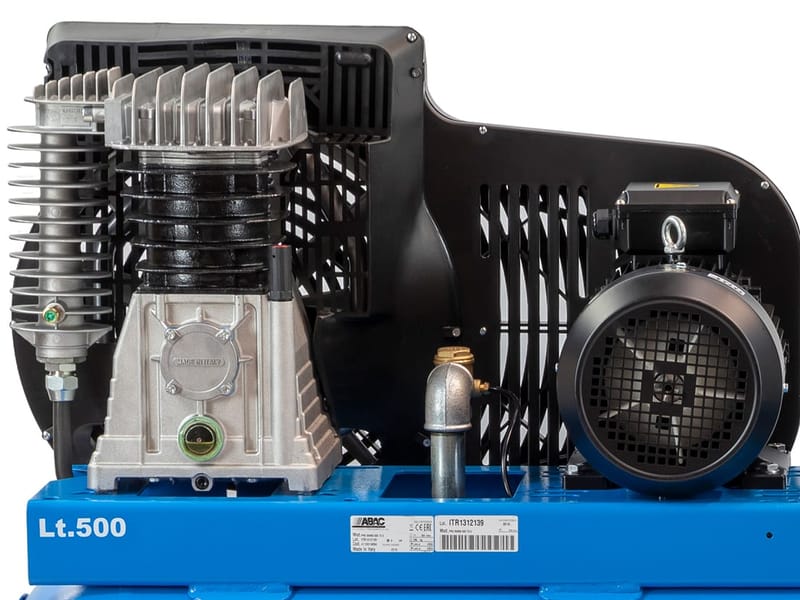
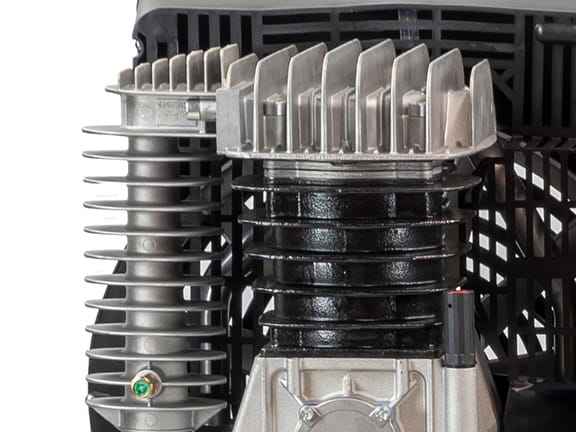
Two-stage pump units with cylinders cast in iron: the first cylinder compresses the air to an intermediate pressure, the air passes through a finned intercooler and the second, smaller cylinder takes it up to 11 bar. The B59B gives 653 l/min at 1,400 rpm; the B60 827 l/min at 1,400 rpm, or 660 l/min at 1,100 rpm with a 4 kW motor; the B70 1,210 l/min at 1,300 rpm, or 1,023 l/min at 1,100 rpm with a 5.5 kW motor. In a tandem there are always two of the same.
Two motors, belts and sheet-metal guards
Each pump unit is driven by its own three-phase 4, 5.5 or 7.5 kW motor with thermal overload protection through V-belts under a perforated sheet-metal belt guard. The compressed air leaves each pump unit through the aftercooler tube into the tank; it cools down on the way, and in the tank the first of the condensate drops out of it. You replace the belt and the intake filter on each pump unit separately.
A shared switch and a timer relay
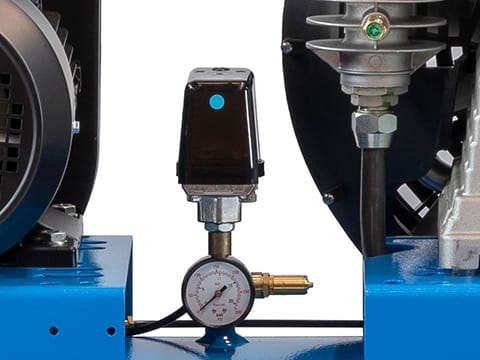
The pressure in the tank is monitored by one pressure switch with a gauge between the pump units; a timer relay starts the second motor after a delay so that the starting currents do not add up, and the pump units cut in according to the air consumption. When one pump unit is being serviced, the other keeps running. The supply, the protection and the wiring of both motors to the switch are a job for a qualified electrician.
A horizontal 500 or 900 l tank on feet
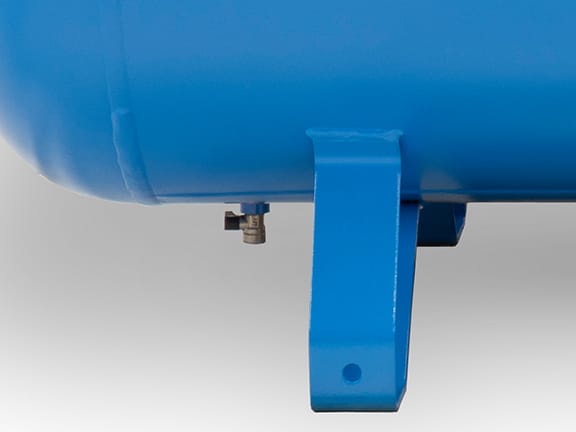
The tank stands on feet with holes for bolting down; a tandem has no castors or handle. The air leaves through a ball valve into the pipework or a hose; the regulator with a filter belongs at the workstation, where everyone sets their own pressure. The safety valve sits by the switch, and the condensate is drained through a valve in the bottom of the tank. The machine belongs on a level floor in the compressor room, not next to the bench.
Oil, filters and service
Each pump unit has its own crankcase with oil and an oil sight glass, its own intake filter and its own belt — maintenance is done twice, but it need not be done at the same time, because the other pump unit keeps running in the meantime. The AirTube QR code on the tank opens service videos. We carry the B59B, B60 and B70 pump units and the service kits as separate items.
Equipment, operation and maintenance
What you get with every machine
- Two two-stage B59B, B60 or B70 pump units with cast-iron cylinders and an intercooler, oil-lubricated, each with an oil sight glass; V-belt drive under sheet-metal belt guards
- Two three-phase 4, 5.5 or 7.5 kW electric motors on 400 V with thermal overload protection
- Shared pressure switch with a gauge and a timer relay — the motors start one after the other, the pump units cut in according to the air consumption
- Aftercooler on the outlet of each pump unit
- Horizontal 500 or 900 l tank on feet with holes for bolting down, safety valve, condensate drain valve in the bottom
- Air outlet through a ball valve into the pipework or a hose
- AirTube QR code on the tank opens service videos; 2-year warranty, 10 years on the tank against rusting through; extension to 3 years for a 5% surcharge
Three pump units, two tanks
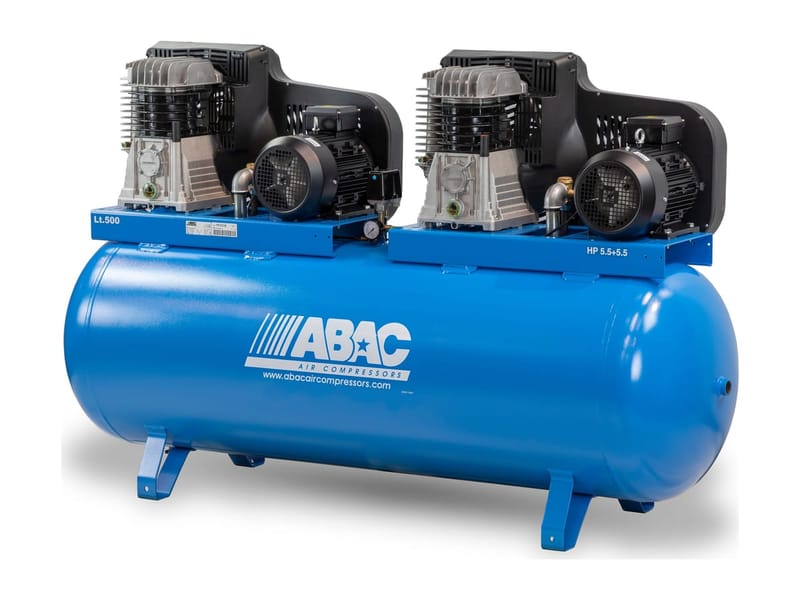
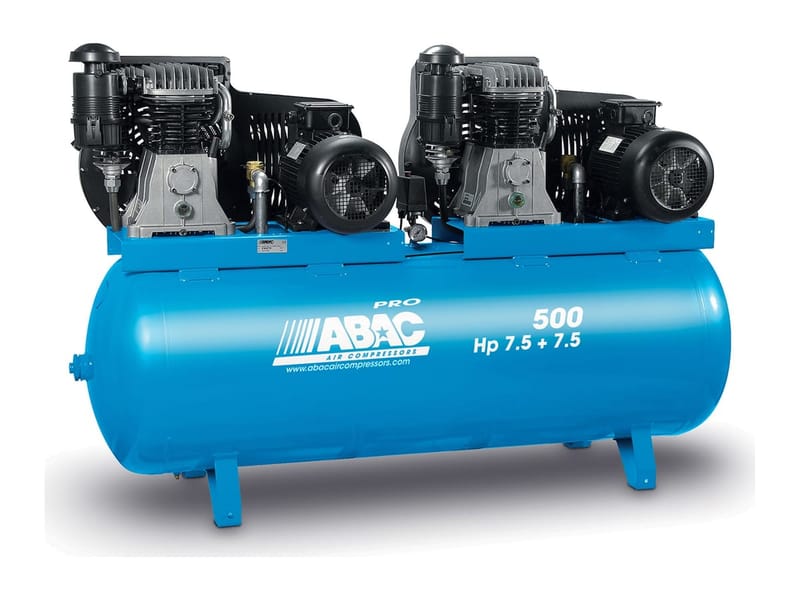
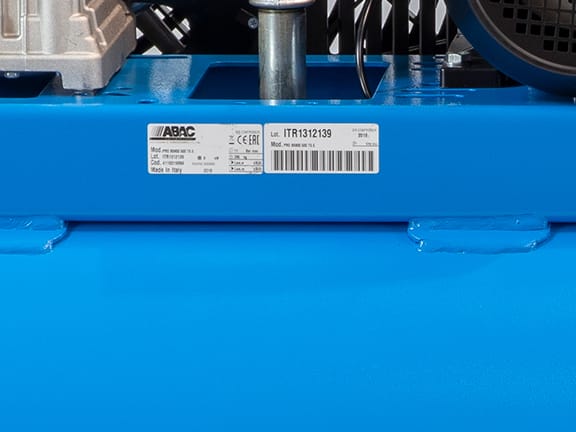
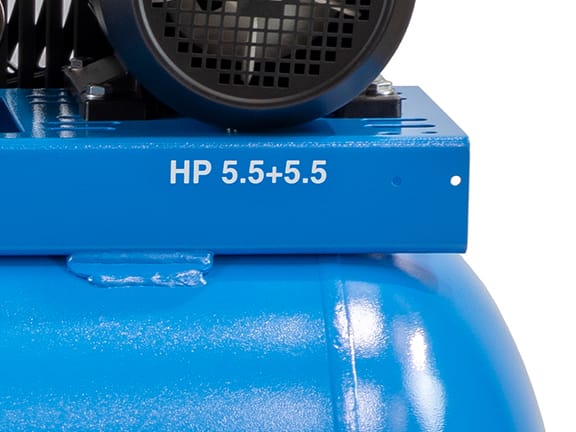
Machine details (B59B-2x4-500FT)
Where two pump units pay off
Shift production with demand peaks
The first line starts up in the morning, the second after lunch, and for an hour in the afternoon both are running: the B70-2x7.5-900FT gives 2,420 l/min at the peak with both pump units and runs on one for the rest of the shift. Between starts the 900 holds a reserve for the whole pipework; where 1,654 l/min is enough, the B60-2x5.5-900FT does the same.
Truck tyre shop, body shop, sandblasting
Impact wrenches on truck wheels, a sander and a paint gun draw air in bursts, but two or three at once: the B70-2x5.5-500FT with 2,046 l/min or the B60-2x5.5-500FT with 1,654 l/min cover the peak with both pump units and in slack periods run on one. Upstream of the gun goes a regulator with a filter at the workstation.
An operation where the air must not fail
Where the whole workshop stops without air — a packing line, a paint shop, a metalworking shop — the second pump unit is the insurance: the oil is changed or a valve plate replaced while the other one runs. The B59B-2x4-500FT with 1,306 l/min or the B60-2x4-500FT with 1,320 l/min are the smallest machines that can do it.
Accessories and service
A tandem has only a ball valve on the tank; the regulator with a filter, the hoses and the quick couplings belong at the workstation. ABAC belongs to the Atlas Copco group and is one of the brands we repair in our own service workshop; we carry the B59B, B60 and B70 pump units and the service kits as separate items — a tandem needs two kits.
- pressure regulator with a filter — A regulator with a filter at every workstation — it sets the pressure and catches oil and water from the pipework.
- spiral hoses — Hoses from the pipework to the tool, with DN 7.2 quick couplings.
- impact wrenches — Impact wrenches for the tyre shop — tools that draw air in bursts, and at the peak all at once.
- spray guns — HVLP and LVLP guns for a paint shop with the tandem behind the door.
- pressure switches — Replacement pressure switches for piston compressors; we will advise which one goes with a tandem.
- B59B compressor pump — Replacement pump unit for the B59B-2x4-500FT.
- B60 compressor pump — Replacement pump unit for the three B60 tandems in the table.
- B70 compressor pump — Replacement pump unit for the B70-2x5.5-500FT and B70-2x7.5-900FT.
- B59-PK1 service kit — Valve plate, gaskets and an intake filter for a major service of the B59B pump unit — two kits for a tandem; the oil is bought separately.
- B60-PK1 service kit — The same set of parts for the B60 pump unit.
- B70-PK1 service kit — The same set of parts for the B70 pump unit.
- ABAC compressor service — Warranty and post-warranty repairs of ABAC machines in our workshop; on a tandem, one pump unit is serviced while the other runs.
Where next if a tandem is not the right fit
The tandems are the B59B, B60 and B70 pump units in pairs on one tank. If you want the same pump unit just once, on castors, with a dryer, on a vertical tank, at 15 bar or in a sound-insulated cabinet, ABAC has the siblings; machines of other brands by tank, motor power and version are in the parameter categories further down. You will find the whole range, with filters by output, tank and voltage, among all compressors.
- single-unit B59B, B60 and B70 compressors — The same cast-iron pump units singly on horizontal 90 to 500 l tanks — CT machines on castors and FT machines on feet.
- low-speed B60-4, B70-5.5 and B79-7.5 compressors — The B60 with 4 kW and the B70 with 5.5 kW at 1,100 rpm, singly — the same pump units as on the B60-2x4-500FT and B70-2x5.5-500FT tandems.
- compressors with a dryer — The B59B, B60 and B70 with a refrigerant dryer on the tank — ABAC does not offer a tandem with a dryer; the dryer goes into the pipework.
- vertical VT compressors — The B59B and B60 pumps on a vertical 200 or 270 l tank — where floor space is short.
- B60 and B70 compressors at 15 bar — The B60 and B70 with a horizontal 500 l tank at 15 bar — there is no tandem at 15 bar.
- sound-insulated ABAC Silent compressors — The B59B, B60 and B70 pumps in a sound-insulated cabinet, where the compressor has to stand next to people.
- compressors with a 500 l tank — 500-litre machines across brands — the tank of four of the six tandems.
- compressors with a 900 l tank — 900-litre machines across brands — the tank of the B60-2x5.5-900FT and B70-2x7.5-900FT.
- compressors with 11 kW of motor power — Machines with 11 kW across brands — this is where the tandems with 2 × 5.5 kW motors belong.
- compressors with 15 kW of motor power — Machines with 15 kW across brands — this is where the B70-2x7.5-900FT belongs.
- 11 bar compressors — Eleven-bar machines across brands.
- stationary compressors — Machines on feet across brands — piston and screw.
- two-stage compressors — Two-stage machines across brands — all six tandems have two-stage pump units.
- industrial piston compressors — Bigger piston machines across brands for operations with pipework.
- screw compressors for a draw without pauses — For a draw without pauses for the whole shift, where even a tandem of piston pump units reaches its limit.
Ventilek advises
Two pump units instead of one bigger one: at the peak they draw in twice as much, for the rest of the day one runs, and nobody stands idle during service — that is the whole point of a tandem. For shift production I take the B70-2x7.5-900FT, for a truck tyre shop the B70-2x5.5-500FT, for a metalworking shop where everyone stops without air the B59B-2x4-500FT. If both pump units run all afternoon without switching off, a piston machine is no longer enough — look at a screw compressor.
Frequently asked questions
- What is a tandem compressor, and when does it make sense instead of one bigger machine?
- Two identical pump units with their own motors on one tank. It pays off where the demand for most of the day does not exceed the displacement of one pump unit and only jumps to double at peaks, and where the workshop must not be left without air during service. A single bigger machine starts as a whole every time the pressure drops; on a tandem the second motor cuts in according to the air consumption and after a delay, so under normal demand one pump unit works and the other only kicks in for the peak. If your demand is the same all day, choose a single machine by displacement — how to go about it is described in our article on two-stage compressors.
- Do both pump units run at once, or do they take turns?
- According to consumption. The pressure in the tank is monitored by one shared pressure switch; a timer relay starts the second motor after a delay so that the starting currents do not add up, and the pump units cut in according to how much air the pipework is drawing. Under normal demand one pump unit works, for the peak the second joins in; for service one pump unit is shut down and the other keeps running.
- Can I take one pump unit out for service and carry on?
- Yes — that is the main reason a tandem exists. The other pump unit keeps running and gives half the displacement: 653 l/min on the B59B-2x4-500FT, 660 on the B60-2x4-500FT, 827 on the B60-2x5.5-500FT and B60-2x5.5-900FT, 1,023 on the B70-2x5.5-500FT and 1,210 l/min on the B70-2x7.5-900FT. That is enough for an oil change, a valve plate, a filter or a belt on one pump unit; for service we carry the B59-PK1, B60-PK1 and B70-PK1 kits.
- Can a tandem handle a draw without pauses for the whole shift?
- A piston machine works in cycles of topping up the tank and pausing, and two pump units change nothing about that — they only share the cycles between them. If both run all afternoon without switching off, the demand is above what a piston machine with its cycles is built for, and a screw compressor is next in line — the link is further down among the siblings. A tandem is the answer for peaks and standby, not for a sustained draw above the displacement of one pump unit.
- 500 or 900 litres?
- The tank does not add displacement, it only extends the time the pipework draws air before the motor has to cut in, and with two pump units it also decides how often they start. We carry 500 l on the B59B-2x4-500FT, B60-2x4-500FT, B60-2x5.5-500FT and B70-2x5.5-500FT — for workshops where the air is drawn in bursts. The 900 l on the B60-2x5.5-900FT and B70-2x7.5-900FT holds a reserve for longer peaks and lets both pump units run longer at a stretch instead of frequent short starts. The 900 measures 2,070 × 800 mm instead of 2,030 × 670 mm.
- Why do the B60-2x4-500FT and B70-2x5.5-500FT run at 1,100 rpm?
- They have the B60 and B70 pump units with a smaller motor — 4 kW instead of 5.5 and 5.5 kW instead of 7.5 — and the belt drive turns them at 1,100 rpm instead of 1,400 or 1,300. The displacement is lower (660 and 1,023 l/min per pump unit respectively), the pistons make fewer strokes a minute and the pump unit runs cooler. We carry the same pump units singly as the B60-4-500FT and the B70-5.5-500FT.
- Is a 230 V socket enough?
- No. All six tandems have two three-phase motors on 400 V; the motor power is the sum of both motors — 8 kW on the B59B-2x4-500FT and B60-2x4-500FT, 11 kW on the three machines with 5.5 kW motors and 15 kW on the B70-2x7.5-900FT; the timer relay starts the second motor after a delay, so the starting currents do not add up. The supply and the protection are designed by a qualified electrician, who wires both motors to the switch.
- How much air does a tandem deliver?
- We quote the air displacement of both pump units together: 1,306 l/min (B59B-2x4-500FT), 1,320 (B60-2x4-500FT), 1,654 (B60-2x5.5-500FT and B60-2x5.5-900FT), 2,046 (B70-2x5.5-500FT) and 2,420 l/min (B70-2x7.5-900FT). When only one pump unit is running, it is half. How much air the tool gets depends on the pressure, on the tank and on how long it draws air at a stretch.
- How loud is a tandem, and where should it stand?
- The four tandems with B59B and B60 pump units are rated at 100 dB Lwa and 80 dB at 4 m, both B70 tandems at 105 dB Lwa and 85 dB at 4 m. A tandem belongs in the compressor room or behind a wall — two pump units and two motors do not belong next to the bench, and the air goes to the people through the pipework. How to set the machine up in the compressor room and how to route the air is described in our article on setting up a compressor. If you need a compressor next to people, ABAC has the B59B, B60 and B70 pumps in a sound-insulated cabinet in the Silent range.
- How much room does a tandem need, and how is it moved?
- The 500 takes up 2,030 × 670 mm of floor and is 1,400 mm tall, the 900 2,070 × 800 mm and 1,570 mm. Leave room around the machine for access to both pump units, to the switch and to the outlet valve. A tandem has no castors; it is moved with a pallet truck or a forklift and stands on a level floor on its feet, which have holes for bolting down.
- How does the B70-2x5.5-500FT differ from the B70-7.5-500FT with the same tank?
- Both stand on a 500 l tank with the same 2,030 × 670 mm footprint. The B70-7.5-500FT has one B70 pump unit with a 7.5 kW motor and draws in 1,210 l/min; the tandem has two B70 pump units with 5.5 kW motors at 1,100 rpm and 2,046 l/min together — under low demand one runs with 1,023 l/min, at the peak both. The single machine is the choice for a steady demand, the tandem for peaks and standby during service.
- What does the code B70-2x7.5-900FT mean?
- The pump unit, then 2x and the power of one motor in kW, the tank volume in litres and the version: F is a stationary machine on feet, T a three-phase 400 V motor. So the B70-2x7.5-900FT is two B70 pump units, each with a 7.5 kW motor, on a 900 l tank. An overview of all the ranges is in the ABAC PRO Line guide.
- What is the warranty and what does maintenance involve?
- Two years on the machine, an extension to three years for a 5% surcharge, and ten years on the tank against rusting through. Maintenance as per the manual: draining the condensate through the valve in the bottom of the tank and, on each pump unit separately, checking the oil level in the sight glass, changing the oil, cleaning the intake filter and checking the belt tension; for a major service we carry the B59-PK1, B60-PK1 and B70-PK1 service kits — two per tandem.
- Where do I find the service videos, and who does the servicing?
- On the tank there is an AirTube sticker with a QR code — scanned with a phone, it opens instructional and service videos for the pump unit. Repairs, belts, filters and oil are handled by our workshop, on a tandem one pump unit at a time while the other runs; the other ranges, from the suitcase models to the screw compressors, are in the ABAC brand guide.
All values apply to a 50 Hz supply. Air displacement is the sum of the air drawn in by both pump units; how much of it reaches the tool depends on the pressure and the tank. Motor power is the sum of both motors. Noise is given as the sound power level Lwa and the sound pressure at 4 m from the machine. The dimensions given are those of the machine without packaging. A piston compressor works in cycles (topping up the tank and pausing), not continuously.


