
ABAC compressor pump: a standalone unit for your compressor
A compressor pump — also called a compressor unit, or simply the block — is the part of a compressor that actually compresses the air. Everything else around it on the machine only stores, cools and distributes that air. When the unit wears out or seizes, you do not have to buy a whole new compressor: you replace the block and the rest of the machine keeps working. We stock nine ABAC pumps from 255 to 1,210 l/min of intake, for motors from 1.5 to 7.5 kW.
What a compressor pump is
The pump is a cast-iron block with cylinders, a crankshaft and a pulley — no motor, no tank, no electrics. It is supplied as a separate part and coupled to an electric motor with V-belts on the machine. All our pumps are twin-cylinder, oil-lubricated and built for professional use.
There are two reasons to buy one. Either as a spare part, when the original unit is worn out and the rest of the compressor is sound — common on stationary machines and far cheaper than a new compressor. Or as a building block, when someone assembles a machine to their own spec: block, motor, tank and fittings to suit.
What the block looks like
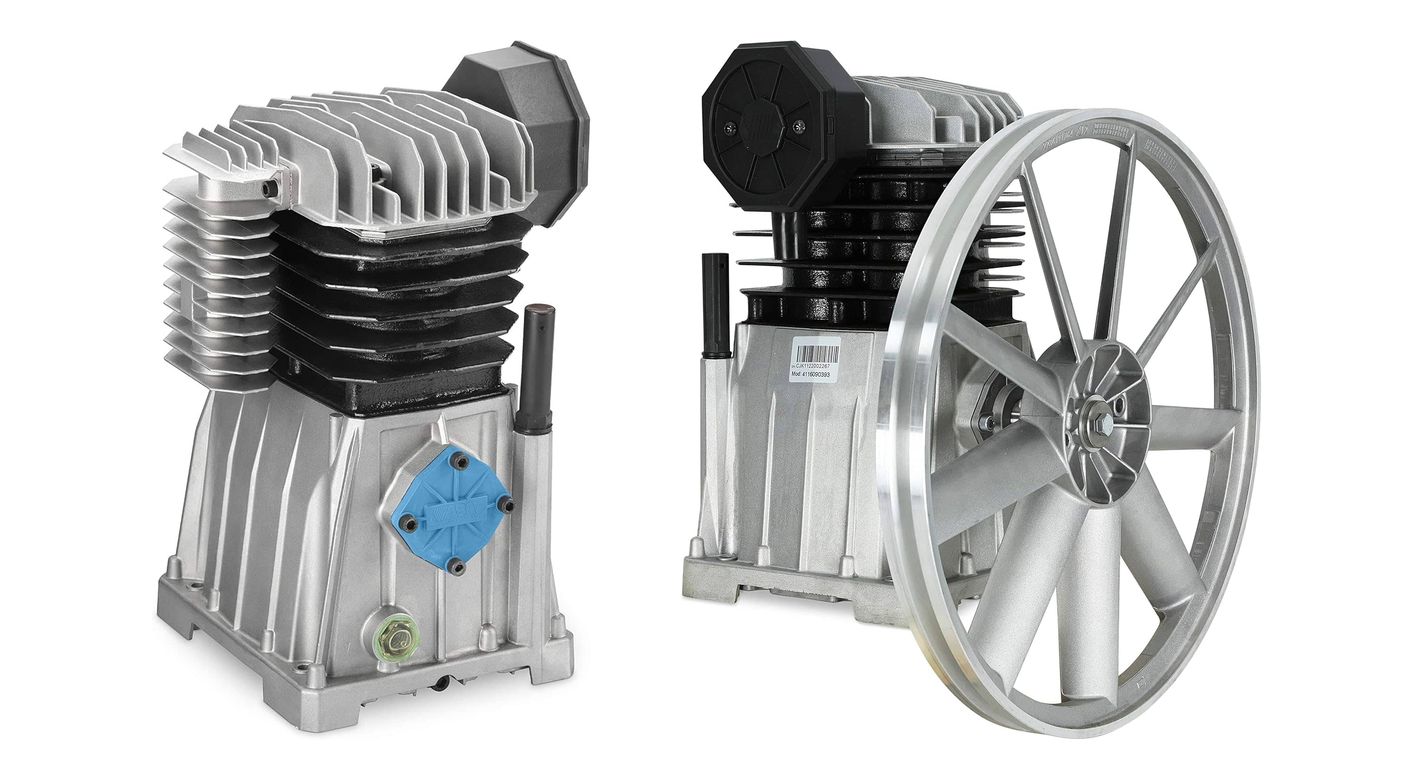
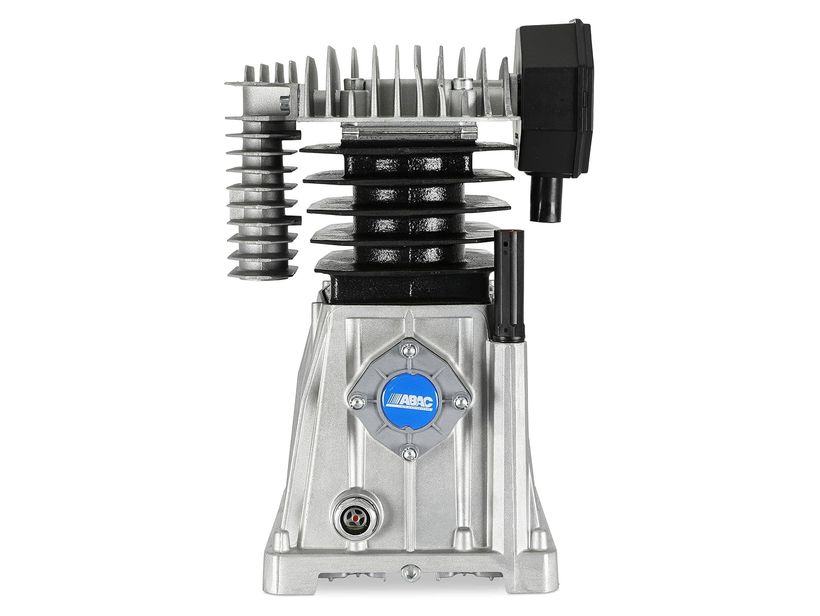
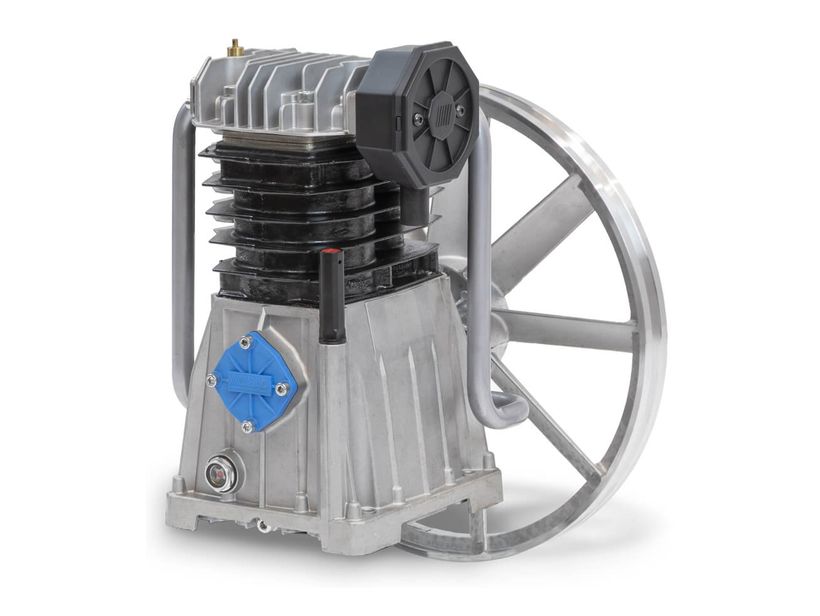
Finned cylinder heads carry the heat away, the blue cover protects the valve plate, and the oil dipstick sticks out of the side. The pulley on the shaft doubles as a flywheel and a fan.
Single-stage or two-stage
That is the first question, and the letter in the code does not answer it. We stock both designs, and they differ in how many times the air is compressed before it leaves the block.
Single-stage — 10 bar
The air is compressed in one step and goes straight to the tank. Simpler construction, lower purchase price, pressure up to 10 bar. In our range these are A29, A29B, A39 and A39B, with intake from 255 to 486 l/min.
Two-stage — 11 bar
The air passes through two cylinders in sequence: the first pre-compresses it, the second finishes the job. It is cooled between the stages, so compression is more efficient and the block takes less punishment. These reach 11 bar and higher outputs — A49B, B59B, B60, B79 and B70, from 595 to 1,210 l/min.
Pump overview
| Standalone ABAC compressor pumps — output, motor and speed | |||||||||
|---|---|---|---|---|---|---|---|---|---|
| Order code | Stages | Pressure | Intake | Output | Motor | Speed | Outlet | Pulley | Oil capacity |
| A29 | single-stage | 10 bar | 255 l/min | 184 l/min | 1,5 kW | 1,075 rpm | 3/8" | 330 mm | 0.478 l |
| A29B | single-stage | 10 bar | 320 l/min | 230 l/min | 2,2 kW | 1,300 rpm | 3/4" | 330 mm | 0.478 l |
| A39 | single-stage | 10 bar | 393 l/min | 283 l/min | 2,2 kW | 1,050 rpm | 1/2" | 390 mm | 0.889 l |
| A39B | single-stage | 10 bar | 486 l/min | 350 l/min | 3,0 kW | 1,300 rpm | 3/4" | 390 mm | 0.889 l |
| A49B | two-stage | 11 bar | 595 l/min | 458 l/min | 4,0 kW | 1,400 rpm | 3/4" | 390 mm | 1.111 l |
| B59B | two-stage | 11 bar | 653 l/min | 503 l/min | 4,0 kW | 1,400 rpm | 1 1/4" | 430 mm | 1.667 l |
| B60 | two-stage | 11 bar | 827 l/min | 637 l/min | 5,5 kW | 1,400 rpm | 1 1/4" | 430 mm | 2.556 l |
| B79 | two-stage | 11 bar | 1,130 l/min | 870 l/min | 7,5 kW | 900 rpm | 1 1/4" | 430 mm | 5.111 l |
| B70 | two-stage | 11 bar | 1,210 l/min | 932 l/min | 7,5 kW | 1,300 rpm | 1 1/4" | 430 mm | 4 l |
Every pump is twin-cylinder, oil-lubricated, V-belt driven and built for professional use, so the rows do not repeat it. Intake is the volume of air drawn in, output is what actually leaves the block — the difference between them is normal and is the volumetric efficiency.
The pulley diameter comes from our own catalogue. It is there for anyone replacing a block in an existing machine who needs to know whether it will match the motor. Check it on your own machine before ordering. Oil capacity is the amount the block takes when filled; you will find the same figures with the oils. The outlet is the thread the compressed air leaves through; both pulley and outlet follow the supplier catalogue.
#showmore#
Careful: the same block exists at several speeds
This is easy to miss when choosing. ABAC sells the same block in several versions that differ in speed — and with the speed, both the intake and the motor the block needs change. A slower-running version delivers less air but gets by with a smaller motor; a faster one delivers more and needs a bigger one.
The figures in the table above are the configuration we stock — that is, what you will actually receive. If you are replacing a block in an existing machine, compare the speed and output against the original unit, not just the designation. The same code does not yet mean the same machine. If you are unsure, send us the compressor type and we will check it.
Replacing the unit
When it pays off
When the rest of the machine is sound — the motor turns, the tank holds pressure, the electrics work — and only the block is worn. On stationary compressors this tends to be considerably cheaper than a new machine, and it also saves you the trouble of scrapping a pressure vessel. Typical signs of a worn-out block: falling output, overheating and oil in the compressed air.
What else you will need
The block is supplied on its own. When replacing it, it is worth buying a new intake filter and oil at the same time, because the old filter does not belong on a new block and the oil gets changed after running-in anyway. Check the V-belts and their tension too — worn belts take their toll on a new block quickly.
Running-in
A new block needs running in. Let it run unloaded first, then the first few hours under light duty, and change the oil after running-in — it carries particles from the rings bedding in. Later intervals then follow the oil and the duty.
What goes with it
Replacing a unit usually calls for these as well.
- Compressor oils — the fill for a new block and the change after running-in
- Intake filters — a new block deserves a new filter
- Service kits — oil, filters and gaskets in one box
- Check valves — between the unit and the tank
- Air receivers — when you are building a machine from scratch

Ventilek says
A seized unit does not mean the compressor is finished.
Folks, this is probably the best news in the whole accessory range: when your block goes, you do not have to buy a whole machine. The motor, the tank, the switch and the fittings usually carry on, and you replace only the cast-iron part that does the work. Two pieces of advice with that. First: compare the speed, not just the code — the same block is made in several versions, and the slower one delivers less air. Second: fit a new intake filter and fresh oil with the new block, and change the oil once more after running-in. It is a small outlay that decides whether the new unit lasts years.
Frequently asked questions about compressor pumps
- What is a compressor pump and how does it differ from a compressor?
- The pump is only the block that compresses the air — cast-iron cylinders, a crankshaft and a pulley. It has no motor, no tank and no electrics. The compressor is the whole machine: the pump plus a motor, an air receiver, a pressure switch and fittings.
- Is it worth replacing the unit, or buying a new compressor?
- If the rest of the machine is sound, replacing the block tends to be considerably cheaper, and it saves you scrapping a pressure vessel. On stationary machines it is the usual route. But when the motor is also on its way out, or the tank inspection has expired, a new machine is often the sensible call.
- How do I tell whether the unit is worn out?
- Usually by three things: the output falls (the machine takes longer to fill than it used to), it overheats, and oil appears in the compressed air. On their own these can have other causes — a clogged intake filter or a leaking check valve — so it is worth ruling those out first.
- Single-stage or two-stage?
- A single-stage pump compresses the air in one step and reaches 10 bar. A two-stage pump takes it through two cylinders in sequence with intercooling, is more efficient and reaches 11 bar and higher outputs. When replacing, go by what the original machine had — on the same tank and motor that is the safest choice.
- Is the same designation as on the old block enough?
- Not always. The same block is made in several versions that differ in speed, and with the speed both the intake and the motor needed change. So compare the speed and the output, not just the code. The figures in the table above are the configuration we stock.
- What will I need for a new block?
- A new intake filter, an oil fill and V-belts you have checked. Change the oil once more after running-in — it carries particles from the piston rings bedding in.
The figures given match the product parameters in our catalogue. Intake is the volume drawn in; output is the volume leaving the block.


Product sorting
List of products

The highest-output single-stage pump in the range. For a workshop in daily use where one tool follows another.

The smallest pump in the A series. Suits smaller workshops where the compressor runs intermittently — blowing down, inflating and light air tools.

The entry-level two-stage pump of the B series. For duty where the compressor runs most of the shift and consumption is steady.

A mid-range single-stage pump for a workshop in regular use — spraying, impact wrenches, longer draws.

A two-stage pump on the A-series pulley — the step between workshop and industrial duty. Higher pressure than the single-stage pumps and more efficient compression.

The stronger sibling of the A29 on the same pulley. Same installation envelope, higher output — the one to pick when the existing block has stopped keeping up and the motor and...

A two-stage pump for higher draws — several workstations at once, or one more demanding tool.

The highest-output pump we stock as standard. For industrial duty with continuous draw.

A slow-running version with output close to the B70 but at lower speed. Lower speed means less wear and smoother running at comparable output.