
Pressure vessels and air receivers from 1000 to 3000 l
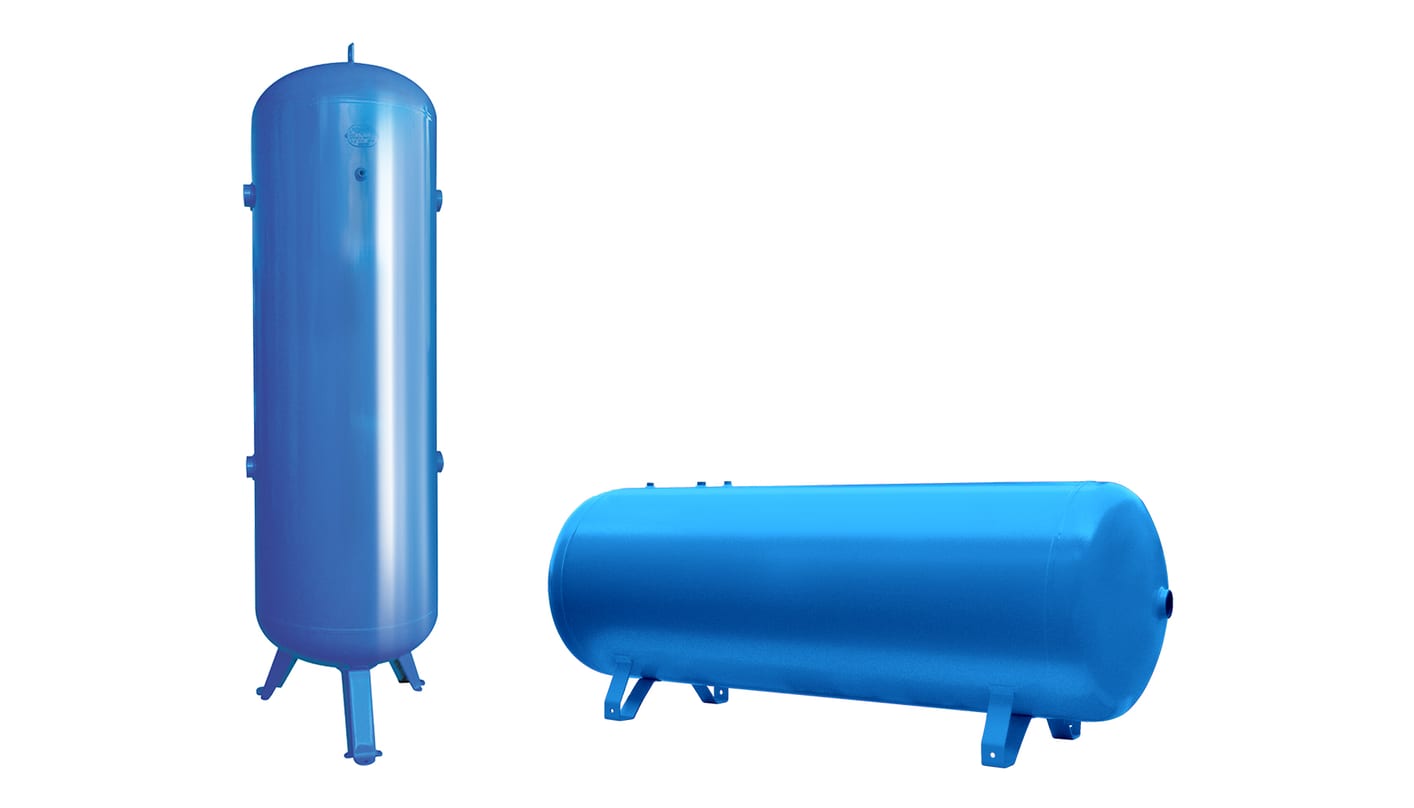
Large air receivers from 1000 to 3000 litres for the central compressed air reserve downstream of screw compressors, for compressor stations with several machines and for storing nitrogen.
Choose from vertical and horizontal vessels rated for 12 or 16 bar, painted in blue RAL 5015, galvanised or with an internal coating for the food industry. They are made by the Italian Baglioni group from carbon steel, to Directive 2014/68/EU on pressure equipment.
Vertical or horizontal
Vertical vessels are made in all four sizes for both 12 and 16 bar. Horizontal ones also come in all four sizes for 12 bar, and in 1000, 2000 and 3000 l for 16 bar. The choice comes down mainly to where the vessel will stand.
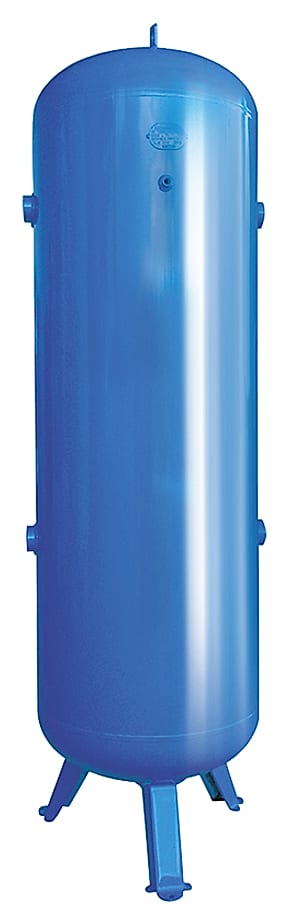
Vertical VVP
Its footprint is a circle 800 to 1200 mm in diameter, but it stands 2.3 to 3 metres tall. It rests on three legs and has connections in both ends and on the sides at two heights; the 3000-litre size has one more in the middle of the shell.
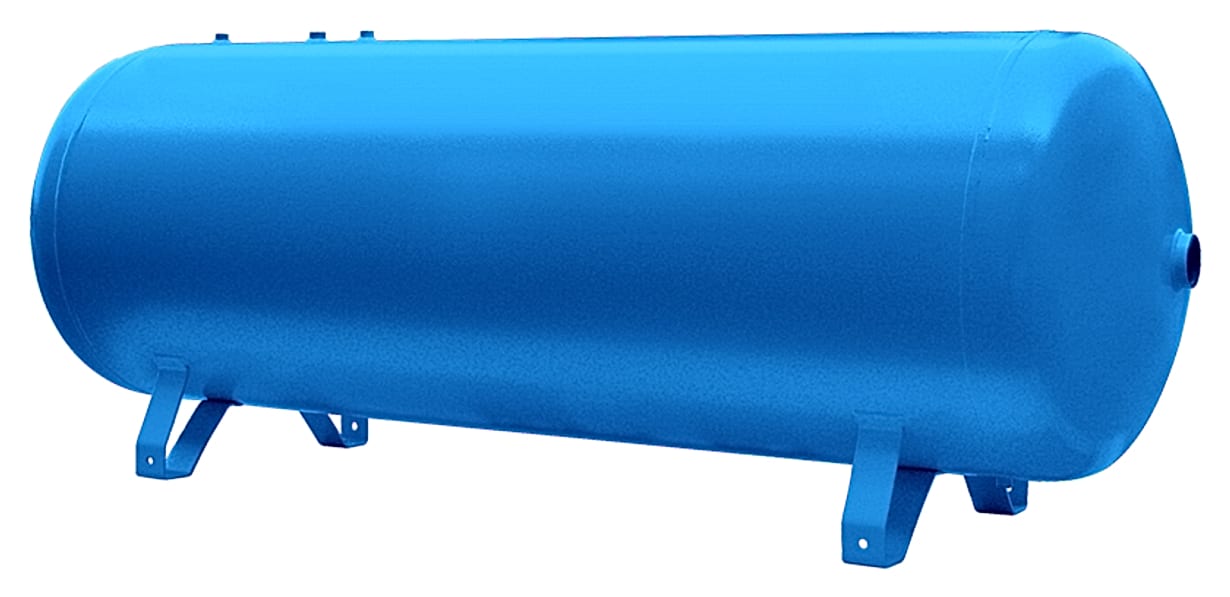
Horizontal VHP
It is 0.9 to 1.3 metres high and 2.1 to 2.9 metres long, on two saddle feet. It has its x connections in both ends, more on top and one on the underside for draining condensate.
Painted, galvanised and internally coated
The painted version is made in all sizes. Almost all vertical vessels also come galvanised and with the ALM internal coating; horizontal ones only for 12 bar in 1000, 2000 and 3000 l. You can tell the versions apart by the third letter of the order code: P is painted, G galvanised and A has the ALM internal coating.
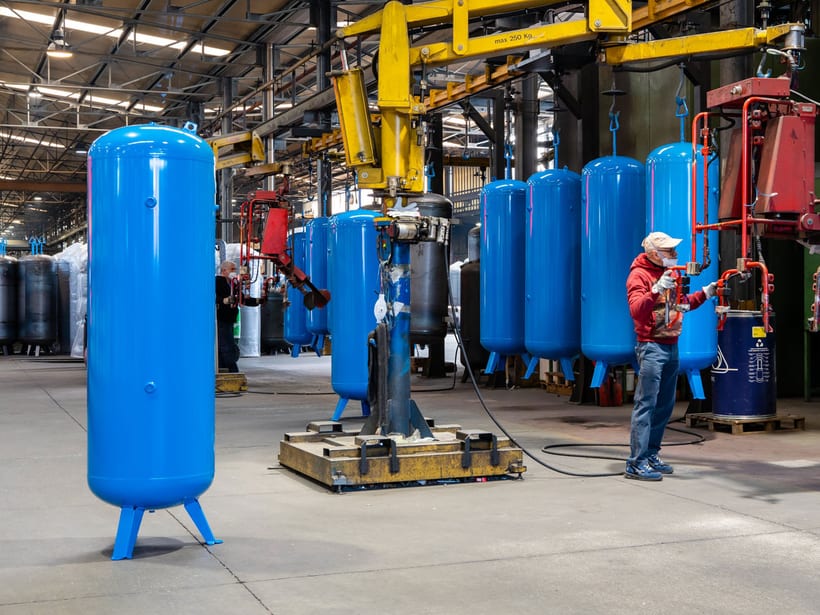
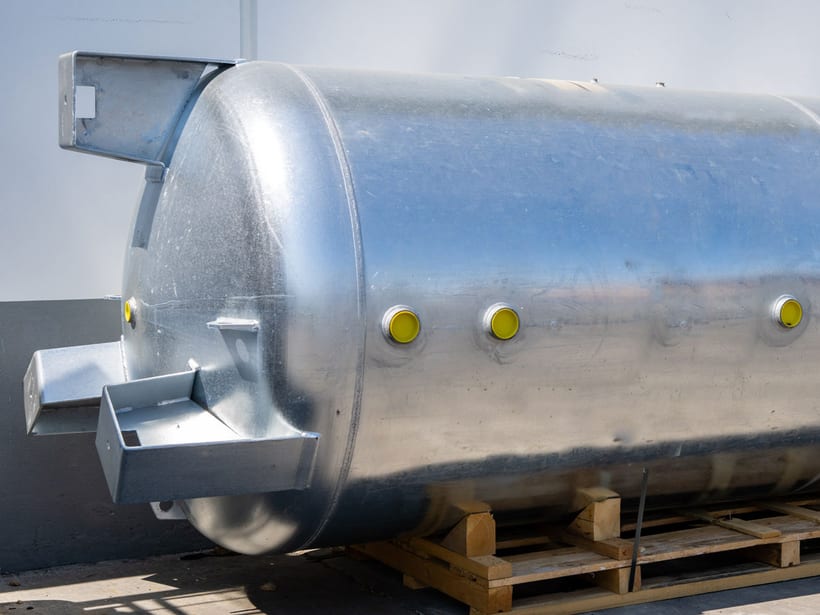
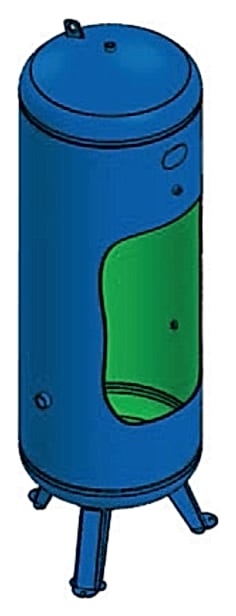
Painted (P)
Blue RAL 5015 powder coating on the outside, bare steel inside. The standard version for dry, heated compressor rooms; you will find all painted vessels on the page for painted pressure vessels.
Galvanised (G)
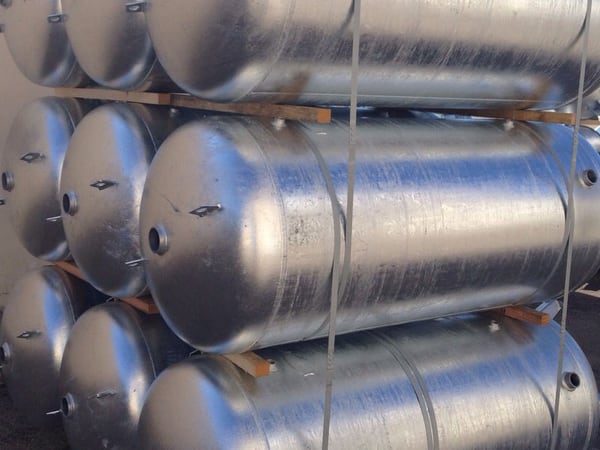
Hot-dip galvanised inside and out, so condensate cannot corrode the steel from the inside either. Suitable for damp rooms and for operations that produce a lot of condensate. For an overview, see the page for galvanised pressure vessels.
ALM internal coating (A)
Inside, an ALM epoxy coating approved for contact with food; outside, blue RAL 5015 paint. For food and beverage production and anywhere the air comes into contact with the product, see our vessels with ALM coating.
Galvanised vessels are 4 to 6 kilograms heavier than painted ones, with the same dimensions and connections. Only the vertical 1000 l vessel for 16 bar has its bottom connection 5 mm higher in the galvanised version.
All sizes
You will also find the vessels of each volume, across both series, on separate pages for 1000 l, 1500 l, 2000 l and 3000 l.
| Vertical VVP vessels — 1000 to 3000 l | |||||||||||||||
|---|---|---|---|---|---|---|---|---|---|---|---|---|---|---|---|
| Order code | Volume | Pressure | Ø × height | Ground clearance A | Side connection heights B / C | Weight | 1 | 2 | 3 | 4 | 5 | 6 | 7 | 8 | Versions |
| VVP1000-12 | 1000 l | 12 bar | Ø 800 × 2350 mm | 145 mm | 770 / 1720 mm | 210 kg | 2" | 2" | 2" | 3/8" | 3/8" | 2" | 2" | – | P, G, A |
| VVP1500-12 | 1500 l | 12 bar | Ø 1000 × 2305 mm | 170 mm | 680 / 1780 mm | 320 kg | 2" | 2" | 2" | 1/2" | 1/2" | 2" | 2" | – | P, G, A |
| VVP2000-12 | 2000 l | 12 bar | Ø 1100 × 2490 mm | 200 mm | 770 / 1970 mm | 388 kg | 2" | 2" | 2" | 1/2" | 1/2" | 2" | 2" | – | P, G, A |
| VVP3000-12 | 3000 l | 12 bar | Ø 1200 × 2990 mm | 140 mm | 830 / 2250 mm, D 1540 mm | 594 kg | 2" | 2" | 2" | 1/2" | 1/2" | 2" | 2" | 2" | P, G, A |
| VVP1000-16 | 1000 l | 16 bar | Ø 800 × 2350 mm | 145 mm | 770 / 1720 mm | 245 kg | 2" | 2" | 2" | 3/8" | 3/8" | 2" | 2" | – | P, G, A |
| VVP1500-16 | 1500 l | 16 bar | Ø 1000 × 2305 mm | 170 mm | 680 / 1780 mm | 423 kg | 2" | 2" | 2" | 1/2" | 1/2" | 2" | 2" | – | P, G |
| VVP2000-16 | 2000 l | 16 bar | Ø 1000 × 2740 mm | 170 mm | 770 / 2185 mm | 450 kg | 2" | 2" | 2" | 1/2" | 1/2" | 2" | 2" | – | P, G, A |
| VVP3000-16 | 3000 l | 16 bar | Ø 1200 × 2990 mm | 140 mm | 830 / 2250 mm, D 1540 mm | 630 kg | 2" | 2" | 2" | 1/2" | 1/2" | 2" | 2" | 2" | P, G, A |
| Horizontal VHP vessels — 1000 to 3000 l | ||||||||||||
|---|---|---|---|---|---|---|---|---|---|---|---|---|
| Order code | Volume | Pressure | Ø × length | Axis height H | Foot spacing B | Weight | x | y | k | j | z | Versions |
| VHP1000-12 | 1000 l | 12 bar | Ø 800 × 2158 mm | 500 mm | 1014 mm | 210 kg | 2" | 3/4" | 1" | 1/2" | 1/2" | P, G, A |
| VHP1500-12 | 1500 l | 12 bar | Ø 1000 × 2135 mm | 608 mm | 900 mm | 325 kg | 2" | 1/2" | 1/2" | – | 1/2" | P |
| VHP2000-12 | 2000 l | 12 bar | Ø 1100 × 2252 mm | 652 mm | 1100 mm | 394 kg | 2" | 1/2" | 1/2" | – | 1/2" | P, G, A |
| VHP3000-12 | 3000 l | 12 bar | Ø 1200 × 2850 mm | 698 mm | 1265 mm | 605 kg | 2" | 1/2" | 1/2" | – | 1/2" | P, G, A |
| VHP1000-16 | 1000 l | 16 bar | Ø 800 × 2158 mm | 500 mm | 1014 mm | 253 kg | 2" | 3/4" | 1" | 1/2" | 1/2" | P |
| VHP2000-16 | 2000 l | 16 bar | Ø 1000 × 2570 mm | 608 mm | 1350 mm | 395 kg | 2" | 1/2" | 1/2" | – | 1/2" | P |
| VHP3000-16 | 3000 l | 16 bar | Ø 1200 × 2850 mm | 698 mm | 1265 mm | 640 kg | 2" | 1/2" | 1/2" | – | 1/2" | P |
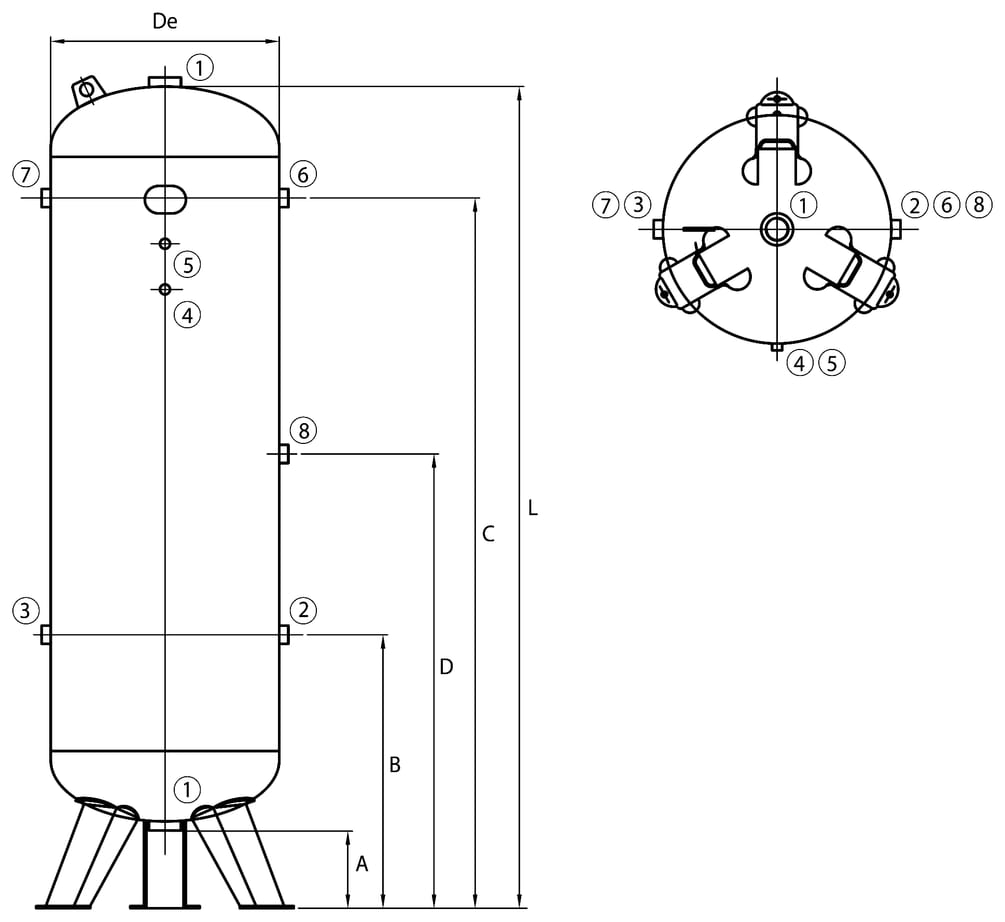
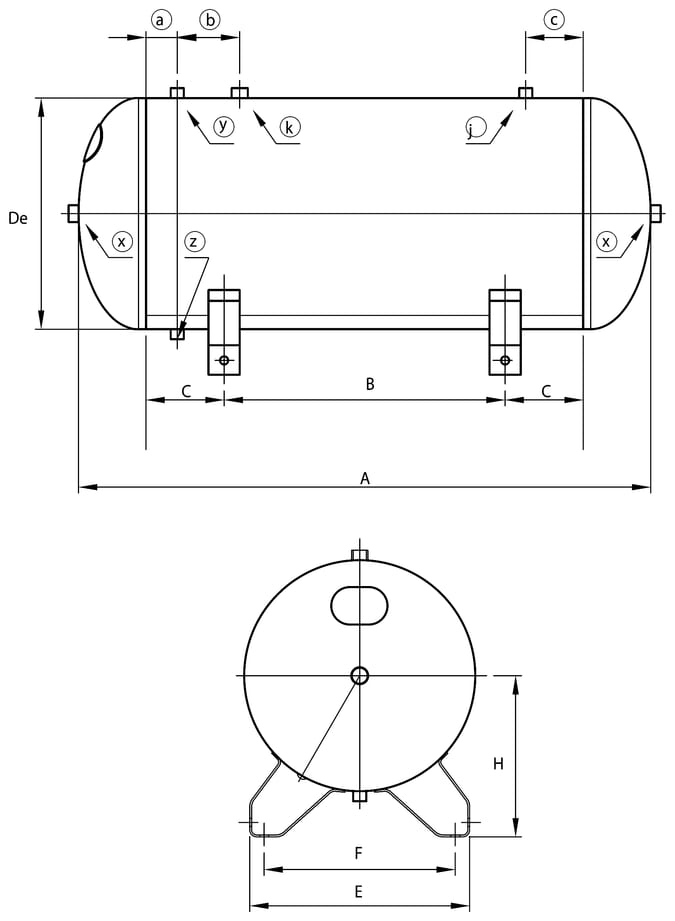
Connection numbers and letters correspond to the drawings; a dash means that a vessel of that size does not have the connection. The dimensions and connections in the table apply to the painted version. Ground clearance A of a vertical vessel is measured from the floor to the bottom connection, B and C are the heights of the side connections above the floor (for 3000 l, also D for connection 8), H is the axis height of a horizontal vessel and B is the spacing of its feet.
#showmore#
Typical uses
- Central air receiver of a compressor station. It balances the difference between compressor output and air demand, so the compressors start less often and the pressure in the air network is steadier.
- Several compressors on one air network. A shared vessel combines the output of several machines and gives the compressor control time to respond to changes in demand.
- Condensate separation upstream of the dryer. In a large vessel, the air slows down and cools, some of its moisture condenses and the dryer works under a lighter load.
- Large peaks in demand. Blasting, filling or starting up large machines draws air from the vessel before the pressure in the air network drops.
- Nitrogen and food processing. The vessels are designed for both compressed air and nitrogen, and the ALM-coated version is suitable wherever the air comes into contact with food.
The compressor’s maximum pressure must not exceed the vessel’s pressure rating. A 12-bar vessel is suitable for compressors that cut out at no more than 11 bar; a compressor rated at 13 or 15 bar belongs with a 16-bar vessel.
What to buy with the vessel
The vessels are supplied without fittings. For operation, they need at least a safety valve, a pressure gauge, a shut-off valve and a condensate drain.
Fittings kit
For the 12-bar vertical vessels, both painted and galvanised, there are ready-made kits with a safety valve set to 10.5 bar, a pressure gauge and two ball valves. They suit compressors up to 10 bar, and you will find them among our fittings kits for pressure vessels.
Safety valve
It must be set no higher than the vessel’s pressure rating, and its flow capacity must cover the full output of the compressors. For 12-bar vessels, use our safety valves for compressors; for 16-bar vessels, choose a valve with a higher set pressure from our range of HEROSE safety valves.
Pressure gauge
It shows the pressure in the vessel, and its range should extend above the working pressure. Choose one to match the thread of a free connection, for example from our pressure gauges for compressed air.
Condensate drain
A large vessel collects a lot of condensate, and it should be drained every day. The reliable way to do this is with an automatic condensate drain; by hand, you can drain it with a condensate drain valve.
Shut-off valve
The main connections have a 2" thread; choose the valve to match the bore of the air network. It isolates the vessel from the air network and from the compressor during maintenance and inspections; you can choose one from our ball valves for compressed air.
Transport and installation
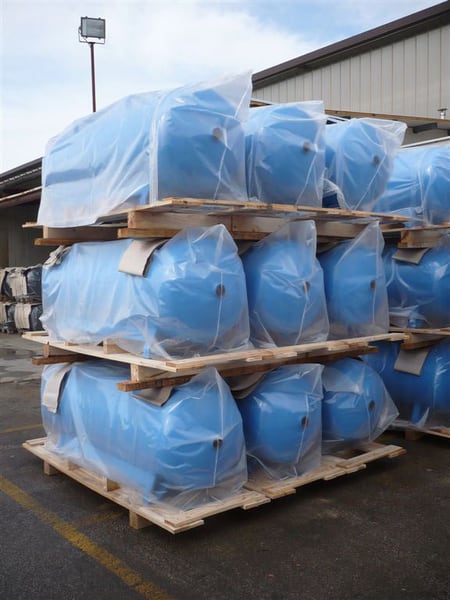
The vessels weigh 210 to 640 kg and travel lying flat on a pallet; vertical ones are stood upright on site. Plan for a forklift or a crane and for wide enough doorways. You will find the transport dimensions of each size on its product page.
The floor must carry the weight concentrated on the three foot plates of a vertical vessel or the four foot plates of a horizontal one. Vibration dampers belong under the foot plates. In line with the manufacturer’s instructions, the vessel must not be rigidly anchored to the floor or to any structure.
The working temperature of the vessels is −10 to +50 °C. Air from a compressor without an aftercooler tends to be hotter, so install the vessel downstream of a cooler.
Documents and inspections
Each vessel comes with a declaration of conformity stating its data-plate details, with the instructions for use and maintenance on the back. The product of pressure and volume of these vessels exceeds 10000 bar·l, so they are manufactured to Directive 2014/68/EU on pressure equipment (PED) and bear the CE marking.
Manufacture follows the European directive, and the declaration of conformity is valid throughout the EU. In-service inspections, however, are set by each country. In the Czech Republic, vessels of this size count as designated pressure equipment, and the operator must have them inspected regularly: an operational inspection once a year, an internal inspection every five years and a pressure test roughly every nine to ten years. Elsewhere, local regulations apply. You will find the Czech details in our article on operator obligations under Czech law.
How the vessels are made
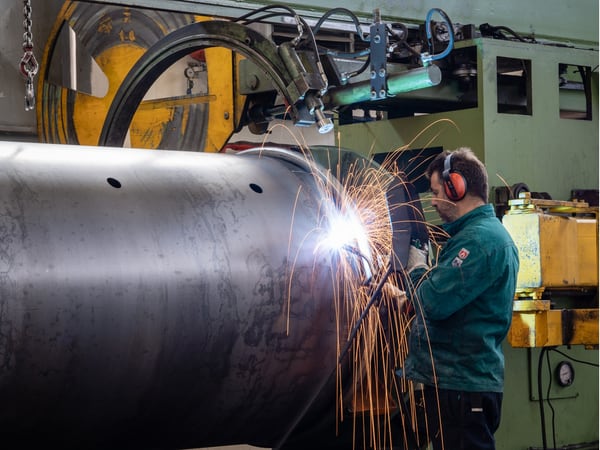
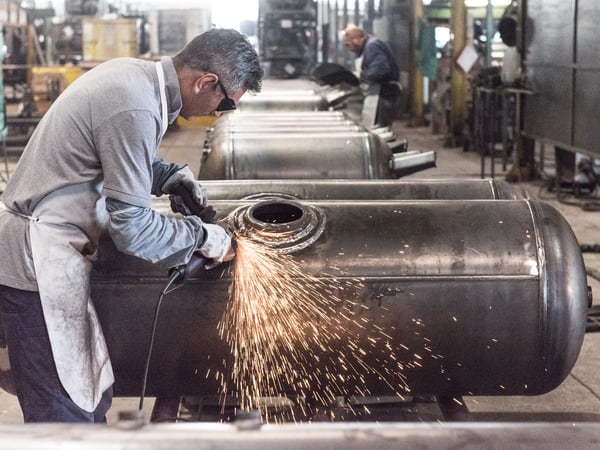
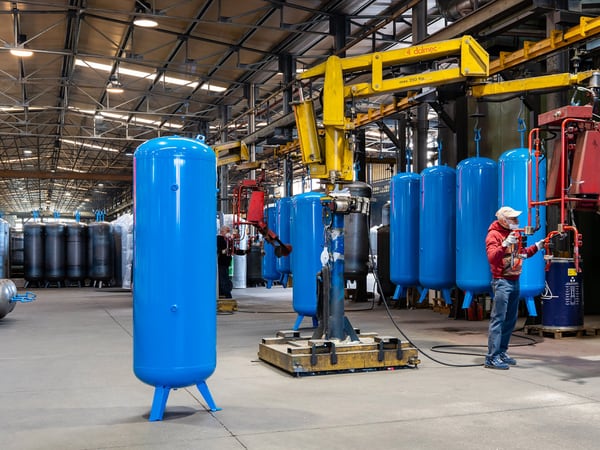
The vessels are made by the Italian Baglioni group. The shell is rolled from sheet steel, the longitudinal and circumferential seams are made by automatic submerged-arc welding, and the legs, feet and sockets are welded on separately. Each vessel undergoes a hydrostatic pressure test at one and a half times the pressure on its data plate. Painted vessels receive a powder coating 80 to 120 µm thick, while galvanised vessels are dipped whole in molten zinc, so the zinc covers the wall inside and out.
For smaller volumes, see our pressure vessels from 100 to 720 l, and for vessels with the fittings already mounted, see our fully equipped pressure vessels. The whole range is shown in our overview of pressure vessels.
Ventilek’s tip
A large air receiver belongs as close to the compressor as possible. In it, the air slows down and cools, and some of the water condenses before it reaches the dryer. The bottom connection is then the place for an automatic condensate drain.
- What size of air receiver do I need?
- It depends on the output of the compressors, how they are controlled and how much the air demand fluctuates. Vessels from 1000 l are chosen for larger screw compressors and for compressor stations with several machines. Our advice centre explains how to work it out; the link is in Ventilek’s tip.
- Vertical or horizontal?
- A vertical vessel takes up less floor space but stands 2.3 to 3 metres tall. A horizontal one is only 0.9 to 1.3 metres high but needs over 2 metres of length. The 1500 l size for 16 bar is not made in a horizontal design.
- When do I need a 16-bar vessel?
- When the compressor cuts out above 11 bar, typically at 13 or 15 bar. The vessel’s pressure rating must always be at least as high as the maximum pressure the compressor can deliver into it.
- How do I transport and install the vessel?
- It travels lying flat on a pallet and weighs 210 to 640 kg, so a forklift or a crane is needed on site. Vibration dampers belong under the foot plates, and the vessel is not anchored rigidly.
- Does the vessel have an inspection opening?
- Not as standard; all connections are threaded, and the main ones are 2".
- What documents come with the vessel?
- A declaration of conformity with the vessel’s data-plate details, together with the instructions for use and maintenance. The vessel bears the CE marking under Directive 2014/68/EU.
- Does the vessel need regular inspections?
- Yes, but the intervals are set by each country; the European directive covers only manufacture and the declaration of conformity. In the Czech Republic, vessels of this size count as designated pressure equipment: an operational inspection once a year, an internal inspection every five years and a pressure test roughly every nine to ten years. Elsewhere, local regulations apply.
- What temperature can the vessel withstand?
- The working temperature is −10 to +50 °C. Air from a compressor without an aftercooler tends to be hotter, so install the vessel downstream of a cooler.
- Why do these vessels fall under the PED?
- The product of their pressure and volume exceeds 10000 bar·l, the limit of the directive on simple pressure vessels. That is why they are manufactured to Directive 2014/68/EU on pressure equipment.
Manufactured to Directive 2014/68/EU on pressure equipment (PED). Medium: compressed air and nitrogen. Working temperature −10 to +50 °C.


