
TL;DR:
- Safety valves protect pressure systems against exceeding the maximum pressure and prevent accidents. Correct selection, installation and regular maintenance ensure their reliability and long service life. Neglected valves can lead to serious damage, danger to people and costly repairs.
Safety valves are among the safety components that technicians and operators of pressure systems often overlook until a problem occurs. Yet why use safety valves is not a complicated question at all. A correctly sized, working safety valve, referred to in normative terminology as an overpressure safety valve (pressure relief valve), is the only thing standing between controlled overpressure and destructive failure of the entire pressure circuit. This article covers operating principles, types, selection criteria, installation and maintenance. All of it with a focus on industrial and construction applications.
Key takeaways
| Point | Details |
|---|---|
| Safety function of valves | The safety valve protects the system against exceeding the maximum allowable pressure and prevents accidents. |
| Selection according to standards | The correct valve type and capacity must comply with the EN standards and with the specific parameters of the system. |
| Installation is decisive | Most failures come from incorrect assembly, not from a manufacturing defect of the valve itself. |
| Regular maintenance | Function tests and visual checks at least once a year are the key to long-term reliability. |
| Operating records | Records of inspections, tests and service work are a condition for safe operation and for periodic inspections. |
Why use safety valves: principle and function
Safety valves work on a simple mechanical principle. A spring in the valve body holds the disc on the seat with a set force. As soon as the pressure of the medium in the pipework or the vessel exceeds the set opening pressure, it overcomes the resistance of the spring and the valve opens. The medium (air, steam or liquid) is discharged out of the system until the pressure falls back to a safe level.

An important technical detail: the closing pressure is 0,8 times the opening pressure. A valve set to an opening pressure of 0,63 MPa therefore closes only after the pressure has dropped to 0,50 MPa. This behaviour must be taken into account when sizing and setting up the whole system.
When does the valve have to act? There are several typical situations:
- An unexpected pressure rise caused by a control fault or a blocked outlet
- Thermal expansion of the medium in a closed circuit
- Recoil or water hammer in the pipework network
- Overloading of a compressor or boiler beyond its rated parameters
A faulty valve, blocked by limescale or deposits, cannot act at the critical moment. The result may be burst pipework, a ruptured vessel or physical danger to the operator.
Professional tip: Never confuse a safety valve with an overflow valve. The safety valve is a safety device and must be sized so that the discharged flow matches the maximum output of the source. An overflow valve serves to regulate pressure during normal operation, and these functions cannot be combined.
Types of safety valves and selection criteria
Choosing the right valve starts with understanding which medium and which type of system the valve is intended for. The basic division covers three main categories:
| Valve type | Typical medium | Standard | Example application |
|---|---|---|---|
| Steam and hot water safety valve | Steam, hot water | EN 12828, EN 13445 | Boiler rooms, steam systems |
| Compressed air safety valve | Compressed air | EN ISO 4126 | Compressors, air tanks |
| Liquid safety valve | Hydraulic fluids, water | EN 13480 | Hydraulics, water mains |
The calculation of the opening pressure and of the valve capacity is based on normative requirements, specifically on the EN 1488 standard and the relevant product standards. The capacity must be sufficient for the valve to discharge the full output of the source without any further pressure rise in the system.
The risks of a wrong choice run both ways. An undersized valve cannot discharge enough flow, so the pressure keeps rising even after it has opened. An oversized valve may chatter, repeatedly opening and closing during small pressure fluctuations and wearing out the seat, which leads to permanent leaks.

Specifically for compressors and air tanks, the set opening pressure must be higher than the maximum working pressure of the compressor, but must not exceed the maximum allowable pressure (PS) of the vessel or the system. Detailed technical parameters for the correct selection of a safety valve are described by Kompresory-vzduchotechnika in its expert guide.
Professional tip: When choosing a valve for a compressed air application, always check that the valve is certified and marked with a PS value equal to or higher than the maximum working pressure of the air tank. Using a valve intended for liquids in a pneumatic system can lead to a slow response and to loss of function.
Principles of correct safety valve installation
Most safety valve failures are not caused by a manufacturing defect. The cause is incorrect installation or improper commissioning. The key principles that technicians must follow are described below:
-
Mechanical support of the pipework. Pipework must not transfer its weight or thermal expansion onto the valve body. Transferred pipe loads deform the seat and the valve permanently loses its tightness.
-
Correct orientation. Safety valves are installed only in a vertical position, with the outlet pointing downwards or to the side depending on the design. Horizontal or inverted mounting disturbs the function of the spring and the reliability of opening.
-
Cleanliness of the installation. Welding slag, burrs or any dirt in the pipework will damage the valve seat at the first opening. Even minimal contamination causes permanent leaks and loss of the safety function.
-
Sizing of the discharge pipework. The cross-section of the pipework downstream of the valve (the discharge line) must be large enough for the back pressure not to exceed 10 % of the opening pressure. A discharge line that is too narrow or too long reduces the flow capacity of the valve.
-
Professional assembly and commissioning. The assembly must be carried out by a qualified person. After installation, a function test and an entry in the operating documentation are mandatory.
-
Regular inspections. Inspection and testing intervals are governed by the EN 12828 and EN 13445 standards. The inspection includes a visual check, a function test and verification of the set pressure value.
Poor installation practice has a direct impact on the service life of the valve. The procedure for the correct installation of a safety valve is described in detail in the Kompresory-vzduchotechnika guide, which also captures the most common mistakes from practice.
Maintenance and regular valve inspections
Safety valves are passive safety devices. They do not act until they are needed. That is exactly why regular inspections are irreplaceable. The technician must verify the function before a real emergency occurs.
The most common causes of failure in operation include:
- Limescale and deposits. Limescale in the valves of heating systems is a problem that escapes attention until the valve fails to open at the critical moment or, conversely, stays permanently open.
- Mechanical damage to the seat. Repeated opening or dirt in the medium leads to scoring or erosion of the sealing face.
- Corrosion of the spring or the body. Chemically aggressive media or moisture speed up degradation.
- Broken setting seal. Safety valves are set and sealed. Every broken seal means that recertification by qualified personnel is required.
The recommended inspection intervals depend on the application, but the minimum is:
- A visual inspection once a quarter (checking for leaks, corrosion and the pipe connection)
- A manual function test once a year using the lifting lever, if the valve is fitted with one
- A full inspection including disassembly according to the EN standards, at intervals set by the manufacturer or by the operating rules
Regular function tests are the cheapest way of preventing accidents. The cost of a preventive inspection is a fraction of the cost of repairing damaged pressure equipment or of shutting down the whole plant.
Professional tip: Always record the date, the result and the name of the person carrying out each inspection or test. Documentation is a requirement of the standards and at the same time the only way to prove proper operation in the event of an insurance claim or a state inspection.
Use of safety valves in industry and construction
The practical scenarios in which a safety valve decides about safety are varied. Below are specific examples from industrial and construction operations:
-
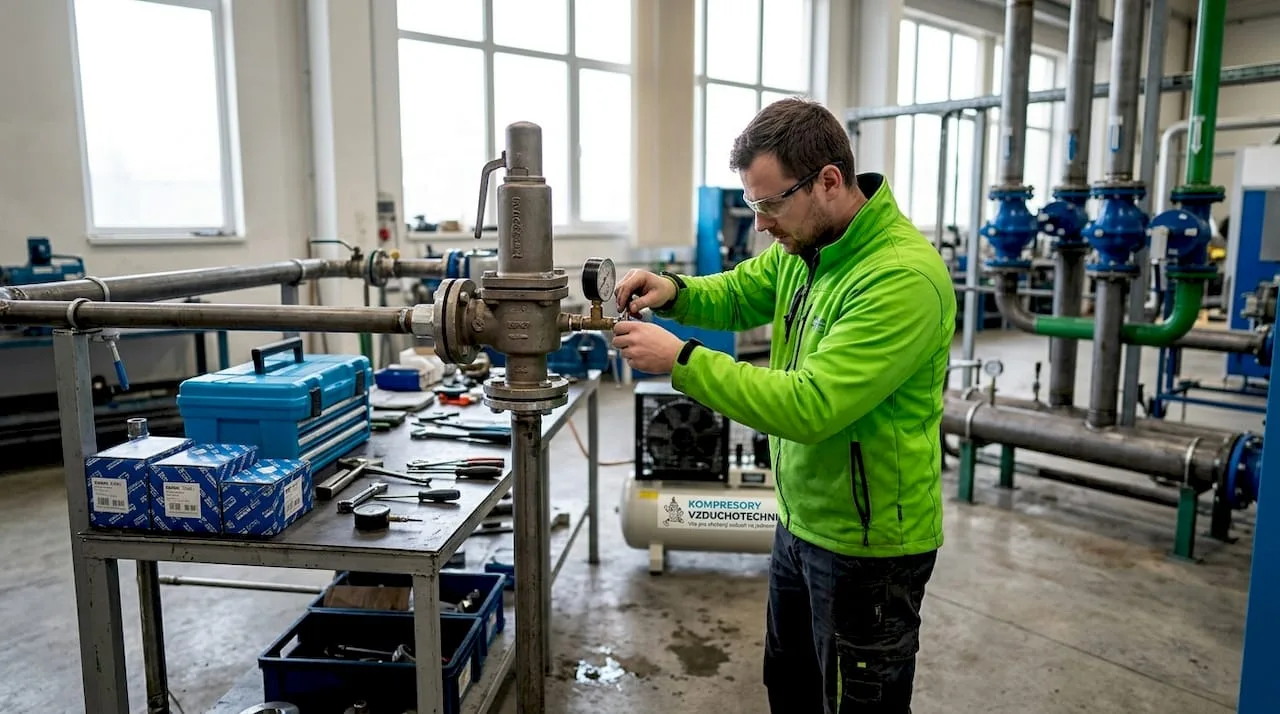
Air tanks and compressor stations. A compressed air tank must have a safety valve set at most to the PS value of the vessel. If the pressure regulator of the compressor fails, the valve is the only barrier against destruction of the vessel.
-
Steam and hot water boiler rooms. The safety valve on a boiler protects against critical overpressure when the regulator fails or the outlet is blocked. A valve blocked by limescale is a real risk, not a theoretical threat.
-
Hydraulic presses and production machines. Exceeding the set pressure in a hydraulic circuit damages the seals, the cylinders or the whole hydraulic power unit. The safety valve protects the function of the system and at the same time signals a control fault.
-
Construction machinery and mobile compressors. On site, safety valves are found in compressed air pipework systems, in pneumatic tools and in the hydraulic systems of excavators and cranes. Vibration and mechanical shocks accelerate degradation of the seat, so inspections before every season are a necessity.
-
Pressure vessels for hazardous substances. In the chemical industry or when handling technical gases, failure of a safety valve is a direct safety risk for the operator and for the surroundings.
The benefits of safety valves show up not only during an accident. A properly working valve reduces the overall wear of the system, because it eliminates repeated pressure surges that gradually damage joints, seals and fittings. The cost of unplanned repairs and downtime significantly exceeds the investment in a quality valve and its regular inspection.
A technician's view from practice
From my experience with industrial and construction installations, one thing holds true: technicians pay attention to safety valves either too little or at the wrong time. Most often they are remembered only after an accident or during an inspection.
I have come across cases where the valve on an air tank was physically blocked with a piece of wire, because “it dripped now and then and that was annoying”. That is an extreme example, but smaller versions of the same thing happen all the time. A valve that does not open during a manual test, or that leaks after closing, is a non-functional safety device. A system with such a valve is not protected at all.
What really works is a combination of two things: correct installation from the very start and documented regular maintenance. Correct installation eliminates 90 % of later problems. Regular maintenance catches the rest before it grows into a failure.
I understand that in a plant under time pressure, valve checks get postponed. But a preventive check takes minutes and can prevent a shutdown lasting days. Financially it is a clear calculation. In terms of the safety of people it is an obligation, not a choice.
Technicians who do not underestimate this area have fewer unplanned outages, lower insurance costs and a clearer conscience when handing the equipment over to the next operator.
— Zdeněk
Product range and advice from Kompresory-vzduchotechnika
Kompresory-vzduchotechnika offers safety valves and accessories for industrial, construction and service applications. The range includes valves for compressed air, steam and liquids in various pressure classes and connection sizes.
Customers can make use of expert technical advice when choosing the right valve according to the parameters of their system. The Kompresory-vzduchotechnika team will help determine the correct opening pressure, the flow capacity and the suitable valve type for a specific application. The offer also includes MARK compressors and accessories, where safety valves and safety components are part of the complete delivery of compressed air equipment. For compressed air distribution there is also a range of pipes and components for distributing compressed air, including accessories. Enquiries and individual requests are welcome through the contact form or by phone.
FAQ
What is a safety valve and how does it work?
A safety valve is a safety fitting that opens when the set pressure is exceeded and discharges the medium out of the system. It closes after the pressure drops to the closing pressure, which is usually 0,8 times the opening pressure.
How often are safety valves inspected?
A visual check is carried out at least quarterly, a manual function test once a year. A full inspection with disassembly is governed by the EN standards and by the operating rules of the equipment.
Why do safety valves fail?
The most common causes are limescale and deposits blocking the movement of the disc, mechanical damage to the seat, corrosion and incorrect installation. Most failures come from improper assembly, not from a manufacturing defect of the valve.
Does the installation have to be carried out by a professional?
The installation and commissioning must be carried out by a qualified person. Safety valves are set and sealed by the manufacturer. Any unauthorised intervention or broken seal requires recertification.
Which safety valve to choose for a compressor air tank?
The valve must have its opening pressure set above the maximum working pressure of the compressor, but not exceeding the PS value of the air tank. The flow capacity must be sized for the total output of the source. Detailed selection criteria are covered in the valve selection guide from Kompresory-vzduchotechnika.
Recommended
- Safety valves: Function, selection and the right capacity - Kompresory-Vzduchotechnika.cz
- How air valves work: key role and effective solutions - Kompresory-Vzduchotechnika.cz
- The importance of multi-way valves in industrial systems - Kompresory-Vzduchotechnika.cz
- Safety valves for reliable release of medium overpressure