
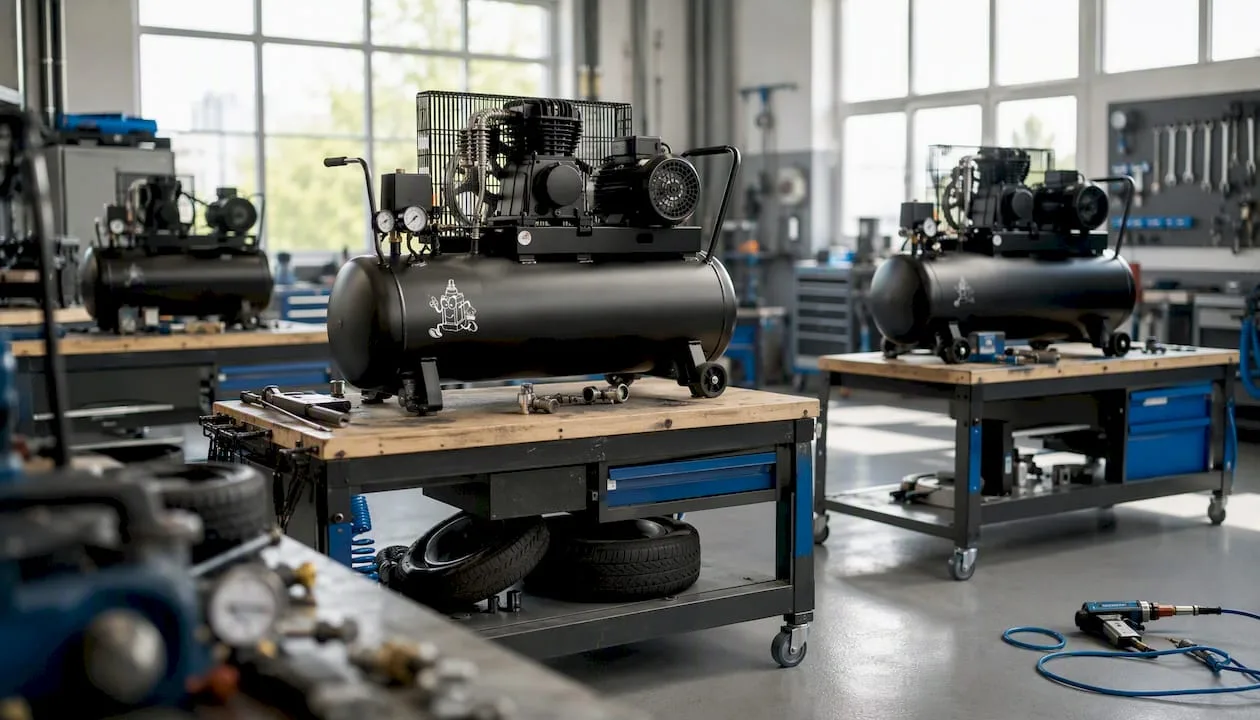
For a hobby workshop, a basic oil-free compressor with a smaller tank range and a delivery rate suitable for basic work at standard pressure is sufficient. For an auto repair shop or painting, an oil-lubricated piston machine with a larger air tank and higher delivery rate is more suitable. A demanding industrial operation with continuous running requires a screw compressor. The key parameter when choosing is not the suction rate stated on the packaging, but the delivery (free air delivery) rate at 6–7 bar — this is the figure that determines whether the tool will actually run.
Quick overview by primary use:
- Inflating tyres and small jobs: oil-free compressor, 24–30 l tank, delivery rate from 100 l/min, noise level below 75 dB
- Impact wrench and pneumatic grinder: oil-lubricated piston compressor, 50 l tank, delivery rate 200–300 l/min at 6 bar
- Paint spraying and lacquering: oil-lubricated compressor with water separator and filtration, 50–100 l tank, delivery rate 300+ l/min, stable pressure 6–8 bar
- Industrial operation, multiple tools at the same time: screw compressor with inverter, sized with a 20–30% margin above the total tool consumption
Professional tip: Before buying, always note down the delivery rate value (l/min) at 6 or 7 bar from the technical data sheet — not the suction rate. If the seller cannot document this value, look elsewhere. Kompresory-vzduchotechnika offers free technical consultation and will help you verify whether the selected model meets your requirements.
Contents
- What compressor do you need? Approximate parameters by use
- How to choose a compressor for your workshop: checklist and questions for the seller
- Technical parameters you need to know: suction vs. delivery rate, flow rate and duty cycle
- Oil-lubricated vs. oil-free compressor: advantages, disadvantages and maintenance plan
- How to properly place a compressor in your workshop and ensure safe operation
- What types of compressors does Kompresory-vzduchotechnika offer for your workshop?
- How much does a compressor cost and where to buy one in the Czech Republic?
- Key takeaways
- Why a cheap compressor without service ends up costing more
- Kompresory-vzduchotechnika: advice, service, and complete solutions for your workshop
- Useful resources for verifying parameters and further reading
- Frequently asked questions
Which compressor do you need? Approximate parameters by application
Correct sizing starts with the specific tool, not with the compressor's price tag. Every pneumatic tool has its own requirement for air flow and minimum pressure — and the compressor must cover these values with a margin.
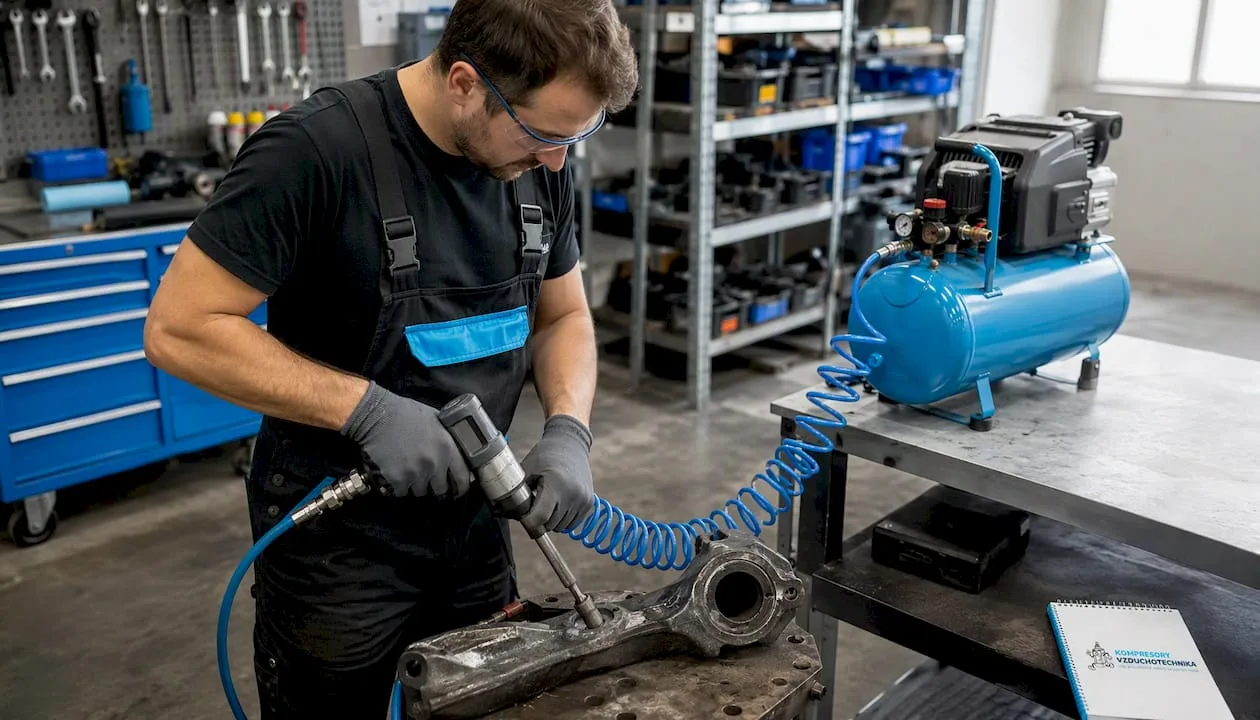
An impact wrench consumes air during operation within a range corresponding to common average values. A pneumatic grinder and a spray gun also have delivery rate requirements, which depend on the specific tool and application. When operating multiple devices at the same time, the combined air consumption must be taken into account.
| Application | Approximate delivery rate at normal working pressure | Pressure (bar) | Approximate tank size |
|---|---|---|---|
| Inflating and minor tasks | delivery rate from 100 l/min | standard pressure | 24–30 l tank |
| Impact wrench and pneumatic tools | delivery rate 200–300 l/min at 6 bar | usual working pressure | 50 l tank |
| Painting and spraying | delivery rate 300+ l/min, stable pressure 6–8 bar | recommended pressure range | 50–100 l tank |
| Demanding workshop with multiple tools | high filling capacity sized to the sum of consumptions, 20–30% reserve | higher working pressure | 90–100 l tank |
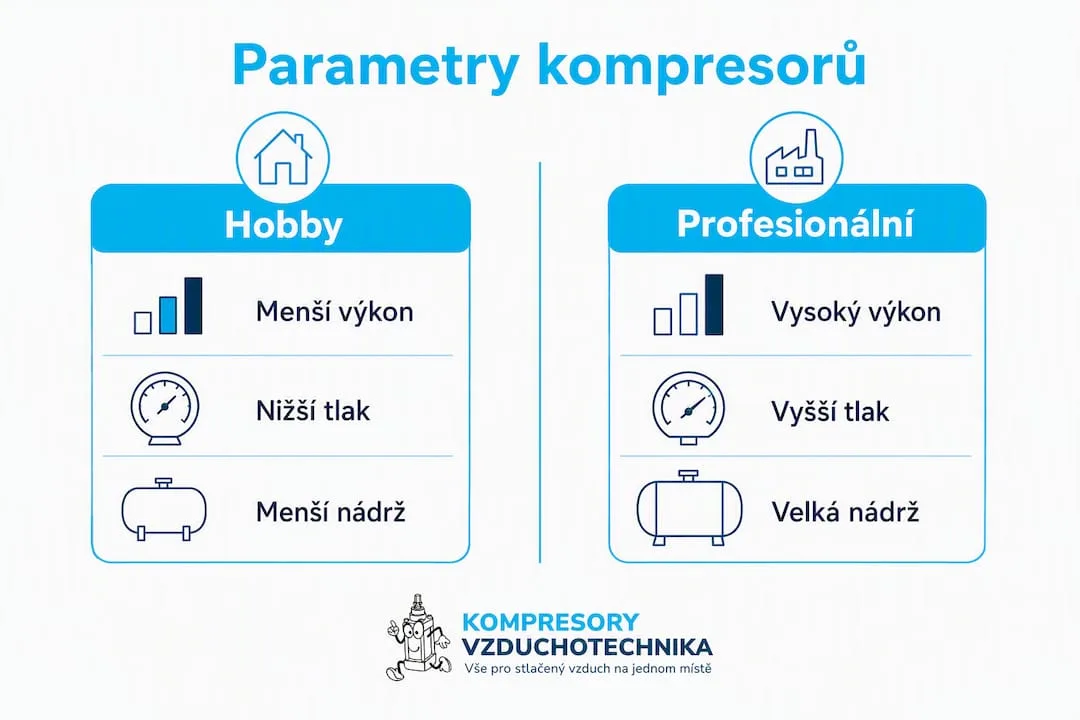
Tank volume affects how often the motor switches on. A 50 l tank is suitable for hobby use and spraying smaller surfaces; 90–100 l is recommended for more demanding and semi-professional use, where frequent motor cycling is disruptive and shortens the machine's service life.
Noise level is a crucial parameter in an enclosed workshop or garage in a built-up area. Quiet oil-free compressors reach 69–74 dB, standard piston machines exceed 90 dB. A 20 dB difference in practice means that a standard machine sounds approximately four times louder. If you work in a populated area or share the space with other people, noise below 75 dB is a real requirement, not just a comfort feature.
Practical examples of compressor use in workshops and production can be found in the application guide.
How to choose a compressor for your workshop: checklist and questions for the seller
Choosing a compressor becomes easier when you proceed systematically. Below is a procedure that eliminates the most common mistakes.
- Make a list of tools and their air consumption. Find the free air delivery (l/min) of each tool from the technical sheet or from the manufacturer. Add up the consumptions and include a 20–30% reserve.
- Determine the type of compressor. An oil-lubricated piston compressor for more demanding and longer operation; an oil-free one for a clean environment, occasional use, or where noise level matters; a screw compressor for continuous industrial operation.
- Determine the maximum permissible noise level. Enclosed workshop in a residential area: look for under 75 dB. Industrial hall: 85–95 dB is acceptable.
- Measure the available space and electrical connection. Larger oil-lubricated machines require a three-phase power supply (400 V); hobby models run on 230 V.
- Check the availability of service and spare parts. A cheap compressor without a service network in the Czech Republic is a bad investment.
Questions to ask the seller:
- What is the free air delivery at 6 and 7 bar (not the intake capacity)?
- What is the recommended duty cycle — how many minutes out of every hour can the machine run?
- Where is the nearest authorized service center and what is the availability of spare parts?
- What is the length of the warranty and does it cover the compressor head?
- Is a manual in Czech and a service plan included in the delivery?
Warning signs when buying: the seller states only the intake capacity without the free air delivery; there is no noise level data in dB; the machine has no condensate drain or pressure gauge; the documentation is only in a foreign language without translation.
Real-world tests show that the difference between suction performance and delivery performance can be very significant for hobby compressors. For example, on a tested two-cylinder compressor, a delivery performance of 148 l/min at 7 bar was measured, while the declared suction performance reached 412 l/min. If you were to size your tools based on the suction performance, the compressor would not be sufficient.
Technical parameters you need to know: suction vs. delivery performance, flow, and duty cycle
Suction performance describes how much air the compressor head draws in per minute under ideal conditions. Delivery (supplied) performance indicates how much compressed air it actually delivers to the network at the working pressure. For tool selection, only the delivery performance at 6–7 bar is decisive.
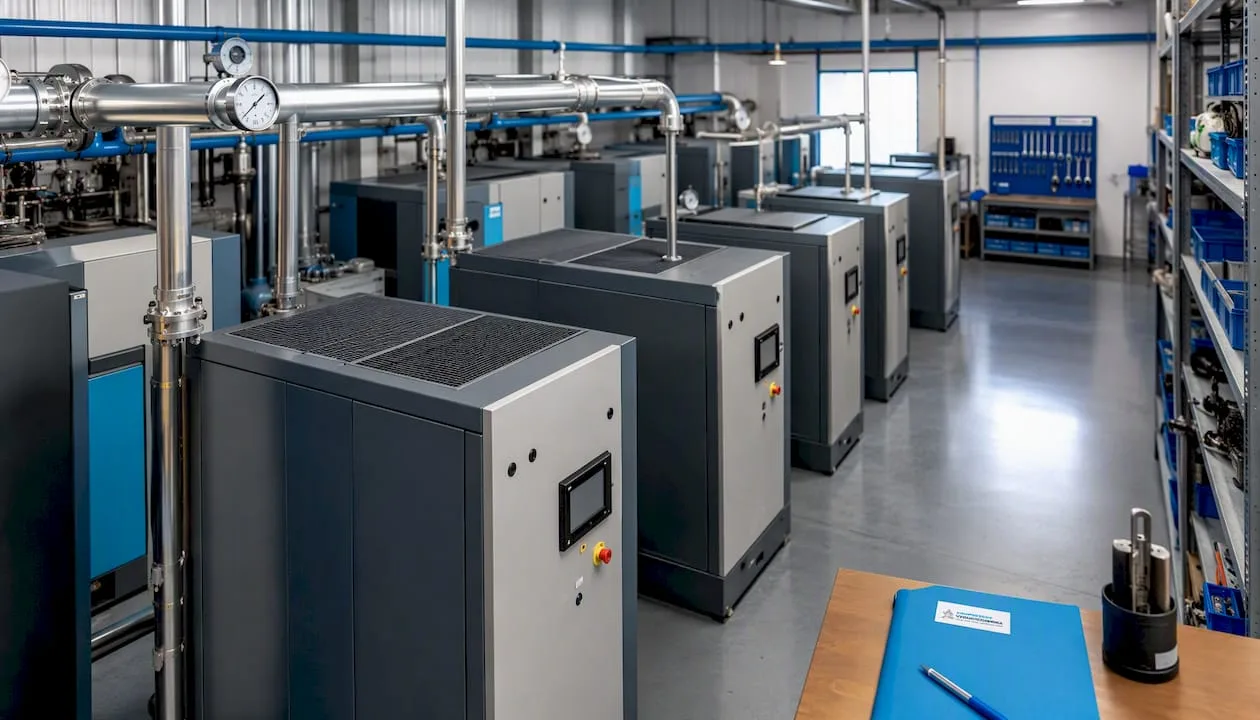
For hobby compressors, suction performance can be tens of percent higher than the actual delivery performance. Manufacturers state this figure because it looks better on the packaging. The result is frustration: the tool doesn't work properly, the motor overheats, and the machine cycles too often.
How to read the duty cycle
The duty cycle expresses what portion of the operating time the compressor can run without a break. A value of 50% means 30 minutes of running and 30 minutes of cooling out of every hour. Oil-free compressors typically have a duty cycle of 50–70%, oil-lubricated piston compressors 60–80%, while screw compressors can handle 100% continuous operation. A detailed technical reference on duty cycle is available in the guide for technicians.
Calculation example for a tool combination
Impact wrench: 180 l/min + pneumatic grinder: 250 l/min = 430 l/min. With a 25% margin, you need a compressor with a delivery performance of at least 540 l/min at 6 bar. That is a performance a hobby machine for CZK 4,000 cannot deliver.
Overview of air consumption for common tools
| Tool | Air consumption (l/min) | Min. pressure (bar) |
|---|---|---|
| Tyre inflator | 30–80 | 8 |
| Impact wrench | 100–200 | 6 |
| Pneumatic grinder | 200–300 | 6 |
| Spray guns | 200–400 | 4–6 |
| Air hammer | 300 | 6 |
| Sandblasting | 400 | 6–8 |
For paint spraying and fine work, it is essential to install a water separator and filtration as close as possible to the point of use. Moisture condenses in the tank and in hoses, and without filtration it will damage both the surface and the tool.
Screw compressors have a higher purchase price, but lower operating costs during continuous operation thanks to lower energy consumption and a longer service life. For industrial operation with multiple points of use, investing in a screw machine is more economically advantageous than operating several piston units.
Oil-lubricated vs. oil-free compressor: advantages, disadvantages, and maintenance plan
The choice between an oil-lubricated and an oil-free machine depends on the intensity of operation, requirements for air purity, and willingness to spend time on maintenance.
Oil-lubricated compressors:
- Longer service life of the compressor head thanks to lubrication
- Suitable for intensive and long duty cycles
- Lower noise level at comparable performance
- Require regular oil changes and level checks
- Risk of oil mist transfer into the air (unsuitable for the food industry or precision painting without filtration)
Oil-free compressors:
- Clean air with no risk of oil contamination
- Zero or minimal maintenance of the lubrication system
- Higher noise level on standard models; quiet variants (69–74 dB) are available
- Shorter compressor head lifespan under intensive operation
- Suitable for occasional use, clean operations, and noise-sensitive environments
Service plan for oil-lubricated compressor
| Task | Frequency |
|---|---|
| Oil level check | Before each start-up |
| Draining condensate from the tank | After each use or daily |
| Cleaning of the air filter | Every 50–100 operating hours |
| First oil change | After ~100 operating hours |
| Subsequent oil changes | Every 6 months |
| Checking valves and seals | Annually or as specified by the manufacturer |
Regular oil changes, filter inspection, and condensate drainage are essential preventive procedures. Neglecting them leads to seizure and premature compressor failure. Always keep a spare air filter and oil with the viscosity specified by the manufacturer on hand — universal oils may lose their lubricating properties at high temperatures.
In dusty environments, oil degrades faster. Shorten the change intervals by half and check the filter every 25–50 hours. The benefits of regular diagnostics for extending machine lifespan are described in the compressor diagnostics guide.
Professional tip: Do not drain condensate into the sewer system without verifying local regulations — oil condensate is hazardous waste and its disposal is subject to specific rules.
How to properly position a compressor in the workshop and ensure safe operation
The placement of the compressor directly affects noise levels, machine lifespan, and operational safety. Here are several principles worth following.
- Stable, flat floor: the compressor must not vibrate or move; for larger machines, use anti-vibration pads or floor-mounted bolts
- Distance from work areas: the further from the work area, the lower the perceived noise level; ideally a separate room or a corner placement
- Access to the condensate drain valve: it must be freely accessible, not hidden behind a shelf
- Ventilation: the compressor requires a supply of cool air and heat dissipation; an enclosed, unventilated cabinet leads to overheating and shortened lifespan
- Electrical connection: ensure proper circuit protection and grounding; high-power 400 V machines require professional installation
A noise level of 65–75 dB corresponds to the volume of normal conversation or an office environment. Values of 85–95 dB are comparable to the operation of a lawn mower — prolonged exposure requires hearing protection. If the compressor cannot be placed in a separate room, acoustic wall insulation or a portable soundproof enclosure can help.
The basic requirements for compressor room installation, including ventilation and safety rules, are summarized in the compressor room guide.
Safety rules for daily operation:
- Never exceed the maximum operating pressure stated on the tank
- Before servicing, always release the pressure from the tank and disconnect the power supply
- Regularly check the safety valve — it must open at overpressure
- Have the air receiver regularly inspected in accordance with applicable regulations (in the Czech Republic according to ČSN EN 286 and Government Regulation No. 26/2003 Coll.)
Professional tip: Place the compressor on an anti-vibration rubber pad at least 10 mm thick. Vibration transfer to a concrete floor amplifies noise throughout the whole room — this simple adjustment will reduce perceived noise without any structural modifications.
What types of compressors does Kompresory-vzduchotechnika offer for your workshop?
Kompresory-vzduchotechnika offers a complete range for both hobby and industrial use. The choice of category depends on the intensity of operation and the specific application.
- Mobile oil-free compressors (24–30 l tank): suitable for inflating, small pneumatic jobs and work in multiple locations; low weight, easy transport, noise level of quiet models below 75 dB
- Oil-lubricated piston compressors (50–100 l tank): the basis for auto repair shops, workshops and spraying; longer duty cycle, lower operating costs than oil-free compressors under intensive use
- Twin-cylinder oil-lubricated compressors: higher filling capacity for more demanding tools and multiple outlet points; suitable for semi-professional and trade operations
- Screw compressors: for continuous industrial operation; lower energy consumption during long-term operation, quieter than piston machines of comparable output; an overview of the advantages of screw units is provided by this guide
In addition to the compressors themselves, Kompresory-vzduchotechnika provides the design of compressed air distribution systems, installation of filtration and separators, service interventions, and energy audits. For corporate customers, registration with individual pricing and priority service is available.
Availability of spare parts and warranty terms are part of every delivery. Before purchasing a larger solution, it is possible to arrange a free technical consultation and verification of sizing directly with the experts at Kompresory-vzduchotechnika.
How much does a compressor cost and where can you buy one in the Czech Republic?
Compressor prices in the Czech Republic range widely depending on power, type, and intended use. The approximate price bands will help you set realistic expectations.
| Price range | Type / use | What you get for the price |
|---|---|---|
| Up to 4,000 Kč | Hobby use, inflation, minor tasks | Oil-free compressor, 24–30 l tank, delivery rate 80–150 l/min, 230 V |
| — | Mid-range, workshop | Oil-lubricated piston compressor, 50 l tank, delivery rate 200–300 l/min, more robust construction |
| — | Semi-professional, auto repair shop | Oil-lubricated two-cylinder, tank 90–100 l, filling capacity 250–400 l/min |
| — | Professional, industrial | Screw compressor, continuous operation, inverter control, lower operating costs |
When purchasing, check: whether oil is included in the delivery, what the warranty conditions are for the compressor head (not just the tank), whether the dealer provides service in the Czech Republic, and how quickly spare parts are delivered.
Screw compressors have a higher purchase price, but lower operating costs during continuous operation. Low-speed motors and inverter control reduce energy consumption at partial load — this is reflected in the electricity bill, especially for machines running more than 4 hours a day. An overview of savings with screw units can be found on the SCR energy savings page.
Purchasing through the Kompresory-vzduchotechnika e-shop provides direct access to technical advice, a service network, and spare parts in the Czech Republic. Corporate customers can request registration and obtain individual pricing terms.
Key takeaways
A correctly sized compressor with documented filling capacity at 6–7 bar, proper maintenance, and available service in the Czech Republic is an investment that will pay off in reliable operation for years to come.
| Point | Details |
|---|---|
| Filling capacity is decisive | Always require the filling capacity at 6–7 bar, not the suction capacity — the difference can be tens of percent. |
| Size with a reserve | Add up the consumption of all tools and add a 20–30% reserve for reliable operation. |
| Noise level below 75 dB for enclosed spaces | Quiet oil-free models reach 69–74 dB; standard piston machines exceed 90 dB. |
| Maintenance extends the service life | First oil change after ~100 hours; drain condensate daily. |
| Kompresory-vzduchotechnika | Offers oil-lubricated, oil-free, and screw compressors, turnkey design, installation, and service in the Czech Republic. |
Why a cheap compressor without service ends up costing more
The most common mistake I see in practice is sizing the compressor based on suction capacity or on price. The result is a machine that cannot keep up with the tools, overheats, and ends up in service within two years — or straight in the scrap heap.
The second recurring issue is neglected maintenance. A small investment in a proper filter and regular oil changes extends the compressor's service life far more than choosing the "cheapest" model. A machine costing 8,000 CZK with regular servicing will last longer than a machine costing 12,000 CZK with no care at all.
The third problem is the absence of filtration during painting. Moisture and oil mist in the hoses ruin both the surface finish and expensive tools. A water separator and a filter mounted as close as possible to the spray gun are mandatory equipment, not optional accessories.
If you are unsure about sizing or selection, consult the experts. Choosing correctly at the start is cheaper than fixing a wrong decision a year later.
Kompresory-vzduchotechnika: consulting, service and complete solutions for your workshop
Kompresory-vzduchotechnika covers the entire process from selection to operation. The range includes oil-lubricated piston, oil-free and screw compressors for both hobby and industrial use, complemented by complete accessories: filtration, water separators, compressed air distribution systems and pneumatic tools.
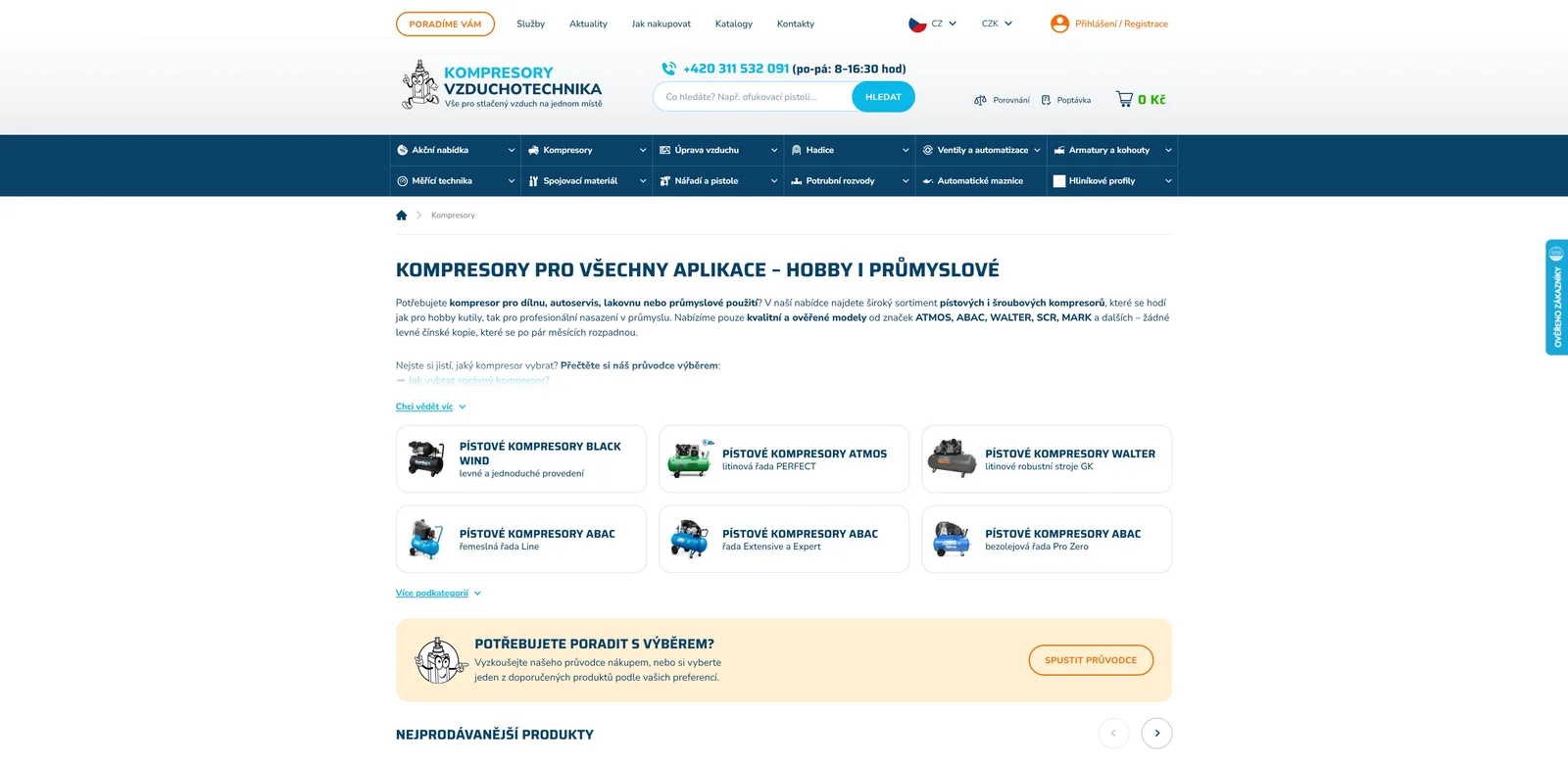
Services include turnkey solution design, installation of distribution systems, filtration installation, service interventions and energy audits. For corporate customers, 24/7 service and priority spare parts delivery are available. When purchasing a larger solution, a free technical consultation and sizing verification can be arranged.
Take a look at SCR screw compressors for industrial use, or contact the Kompresory-vzduchotechnika team for a specific solution design tailored exactly to your workshop.
Useful resources for verifying parameters and further reading
- Factors for selecting an industrial compressor — sizing and technical factors for industrial use
- Overview of compressor filters — types of filters and separators for various applications
- Two-stage compressor: higher efficiency for industry — technical comparison for demanding operations
- List of the best compressors 2026 — overview of categories and recommendations available in the Czech Republic
- To verify noise levels: look for the dB(A) value both at idle and under load — manufacturers sometimes state only the more favorable of the two values
- To verify filling capacity: compare the l/min value at 6 or 7 bar from the technical data sheet with the requirements of your tools
Frequently asked questions
What is the difference between a compressor's suction capacity and delivery capacity?
Suction capacity describes how much air the compressor head draws in under ideal conditions; delivery capacity indicates the actual volume supplied at the working pressure (6–7 bar). For tool selection, only the delivery capacity is decisive.
What noise level compressor is suitable for a workshop in a built-up area?
For an enclosed workshop or garage in a residential area, we recommend models with noise levels below 75 dB. Quiet oil-free compressors reach 69–74 dB, while standard piston machines exceed 90 dB.
How large a tank do I need for spray painting?
For painting smaller surfaces, a 50 l tank is sufficient; for more demanding and semi-professional spraying, 90–100 l is recommended so the motor doesn't cycle too often and pressure remains stable.
When is it worth choosing a screw compressor instead of a piston compressor?
A screw compressor pays off for continuous operation of more than 4–6 hours a day or when operating multiple tools simultaneously. Lower operating costs and quieter operation offset the higher purchase price.
Where in the Czech Republic can I find service and spare parts for a compressor?
Kompresory-vzduchotechnika provides service interventions, spare parts, and technical consultation throughout the Czech Republic, including 24/7 service for corporate customers.
Recommended
- List of the best compressors 2026: a buying guide - Kompresory-Vzduchotechnika.cz
- Basic requirements for a compressor room: guide 2026 - Kompresory-Vzduchotechnika.cz
- Factors for selecting an industrial compressor: a 2026 guide - Kompresory-Vzduchotechnika.cz
- A list of safety rules for working with a compressor in automotive 2026 - Kompresory-Vzduchotechnika.cz