
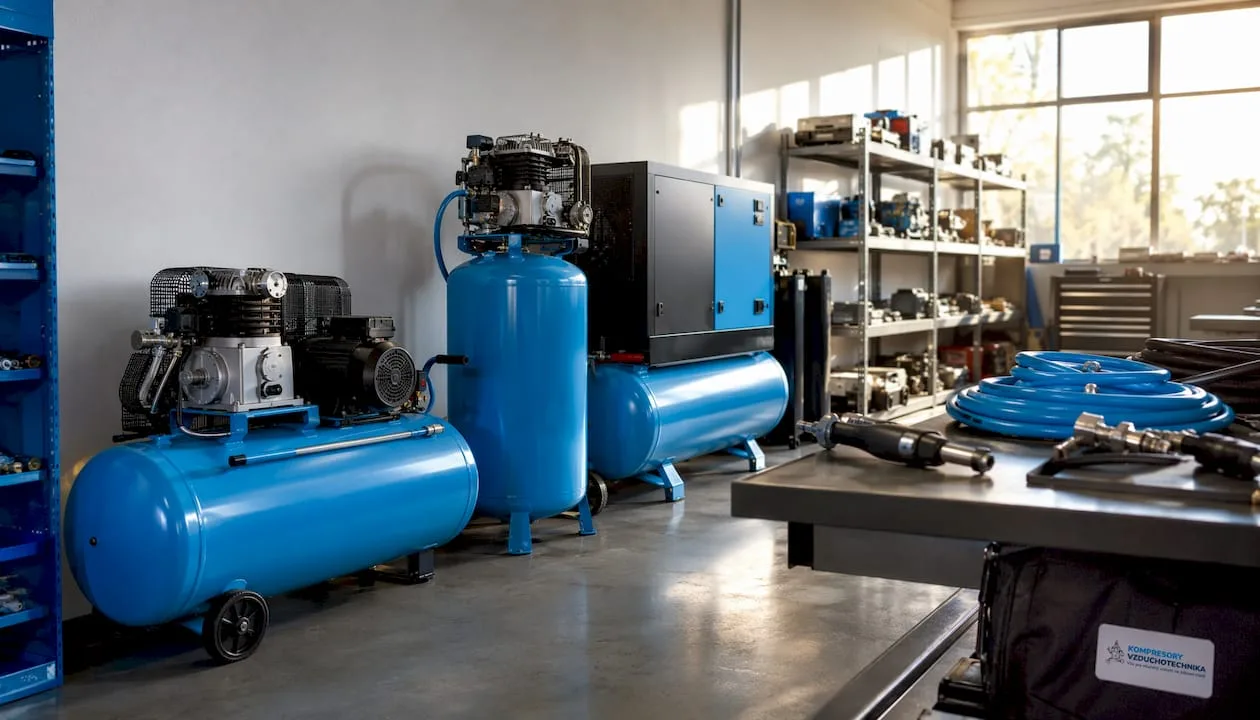
For hobby use and home workshops, a piston compressor at 230 V with a sufficiently large air tank suitable for hobby and home use is sufficient. For auto repair shops or continuous operation, choose a screw compressor at 400 V with an air receiver of 100 l or more. This basic rule applies in the vast majority of cases and will save you from unnecessary overspending or, conversely, undersizing.
Quick overview by purpose:
- Hobby and inflation: piston oil-lubricated or oil-free, 230 V, air tank 24–50 l, flow rate 50–160 l/min
- Workshop and auto repair shop: piston twin-cylinder or screw compressor, 400 V, air tank 50–100 l, flow rate 160–260 l/min
- Industry and continuous operation: screw compressor 400 V, air receiver 100 l or more, flow rate from 260 l/min
If you are not sure what power your operation actually needs, Kompresory-vzduchotechnika offers technical consulting and turnkey solution design.
Contents
- What types of air compressors exist and when to choose which one?
- Which technical parameters in the datasheet are actually important?
- What power and size of compressor do you need for your purpose?
- How much does an air compressor cost in the Czech Republic and where to buy one?
- What service and warranty should you require when purchasing a compressor?
- What accessories do you really need for an air compressor?
- Checklist: what to verify before buying a compressor
- Key takeaways
- Why customers buy an unsuitable compressor
- Kompresory-vzduchotechnika: sales, installation and service in the Czech Republic
- Useful resources for choosing and operating a compressor
- Frequently asked questions
What types of air compressors exist and when should you choose which one?
The basic division is simple: piston and screw. Each type has a different operating profile and different acquisition and operating costs.
Piston compressors are the most widespread for hobby use and workshops. They have a lower purchase price, simpler maintenance, and can handle intermittent operation. The disadvantage is higher noise level, 80–90 dB for standard models, and a limited duty cycle. However, for regular short-term air draw-off, they are fully sufficient.
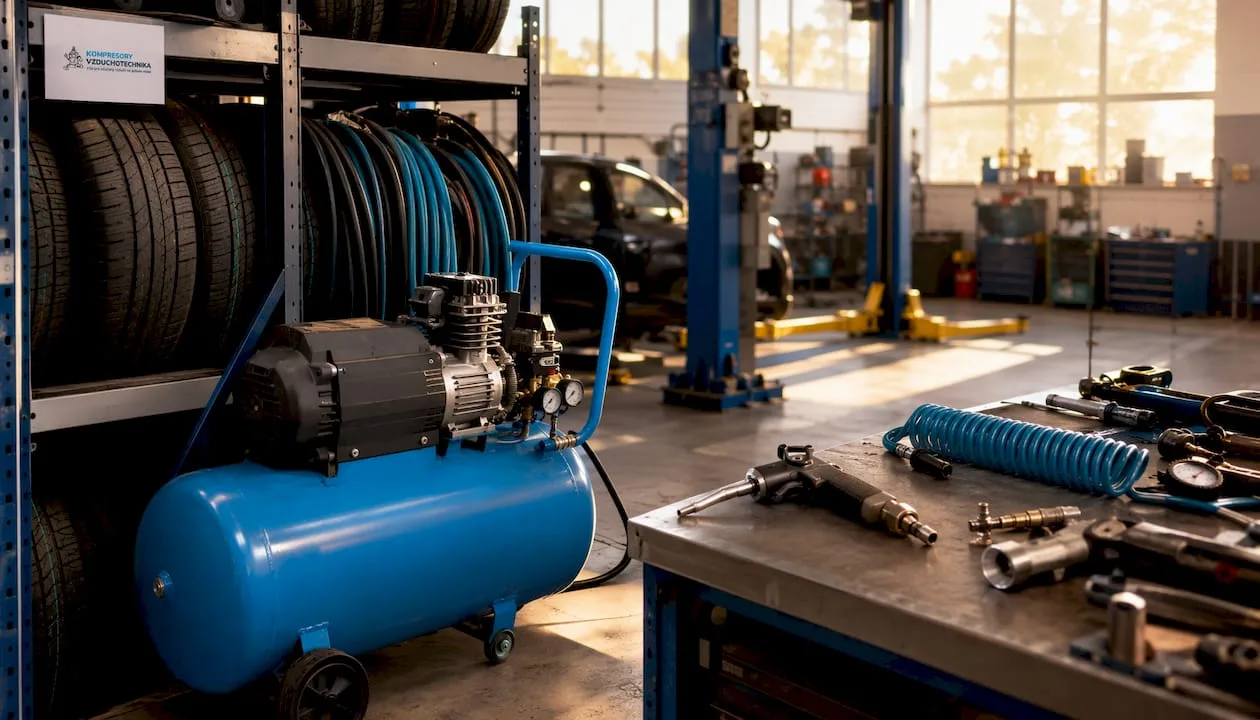
Screw compressors are designed for stable, long-term, or continuous operation. They offer a steady air flow, lower noise level, and a higher duty cycle. Under constant load, they also bring energy savings. A more detailed overview of the advantages of screw compressors for industry shows why this investment pays off even for smaller operations with a higher frequency of draw-offs.
Oil-lubricated or oil-free?
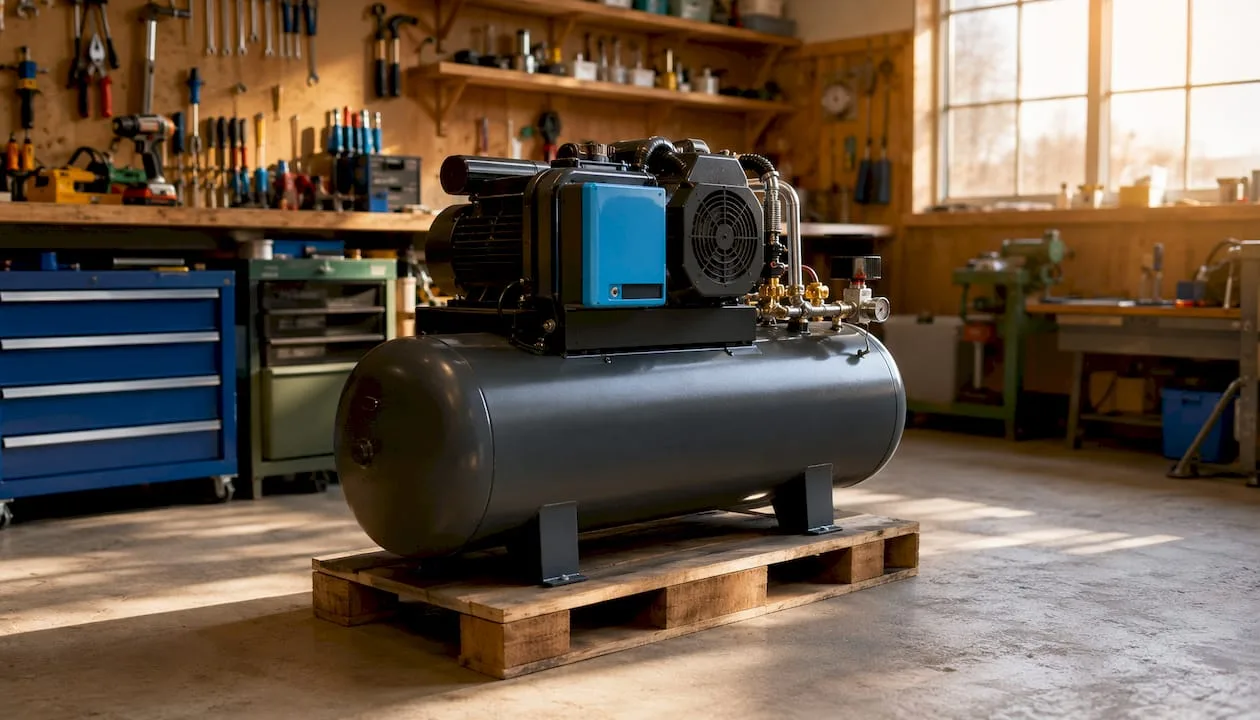
Oil-lubricated compressors have a longer service life and lower operating temperatures. Oil-free models deliver clean air without the risk of oil mist, which is a requirement for painting, airbrushing, the food industry, or healthcare. Oil-free piston compressors certified to ISO 8573-1 class 0 guarantee zero oil content in the air and are suitable for applications with strict cleanliness requirements.
Mobile vs. stationary
- 230 V mobile: suitable for outdoor use, construction sites, home workshops
- 400 V stationary: for workshops, car repair shops, production; requires a fixed electrical connection and inspection of the wiring
- Battery-powered: for working without an electricity supply; limited output and capacity
Professional tip: A screw compressor is worthwhile even for a smaller operation if the compressor cycles more than 10–15 times per hour. Frequent cycling of a piston compressor shortens its service life and increases energy consumption.
Which technical parameters in the datasheet are actually important?
A datasheet contains a number of figures, but not all of them carry the same weight. The key parameters for comparing models are as follows:
- Maximum working pressure (bar): most commonly 8–10 bar for hobby use, 10–13 bar for industrial use
- Flow rate (l/min or m³/h): always check the output flow rate at a specific pressure, not the intake capacity
- Power input (kW): affects operating costs and requirements for the electrical supply
- Air tank volume (l): a larger air tank means longer intervals between cycling and more stable pressure
- Duty cycle (%): what percentage of time the compressor can run without overheating
- Noise level (dB): critical for installation in a residential area or shared workshop
The output flow rate is in practice usually 30–50% lower than the intake flow rate stated by the manufacturer, so a reserve within this range must be taken into account. If your tool consumes a certain amount of air, you need a compressor with a corresponding intake flow rate that is 30–50% higher than the required output flow rate. Without this reserve, the compressor will switch on too frequently and will not be able to maintain the required pressure.
| Parameter | Typical value | What it means in practice |
|---|---|---|
| Intake | Typical theoretical manufacturer value | |
| Output flow rate at 7 bar | 30–50% lower than the intake flow rate | Actual flow rate for tools |
| Air tank volume | Sufficient for short-term demand peaks | |
| Duty cycle | Typical value for hobby machines | The compressor can run for part of the time within a given interval |
| Noise level | Around 80–90 dB and more | Suitable for a workshop, less suitable for a residential area |
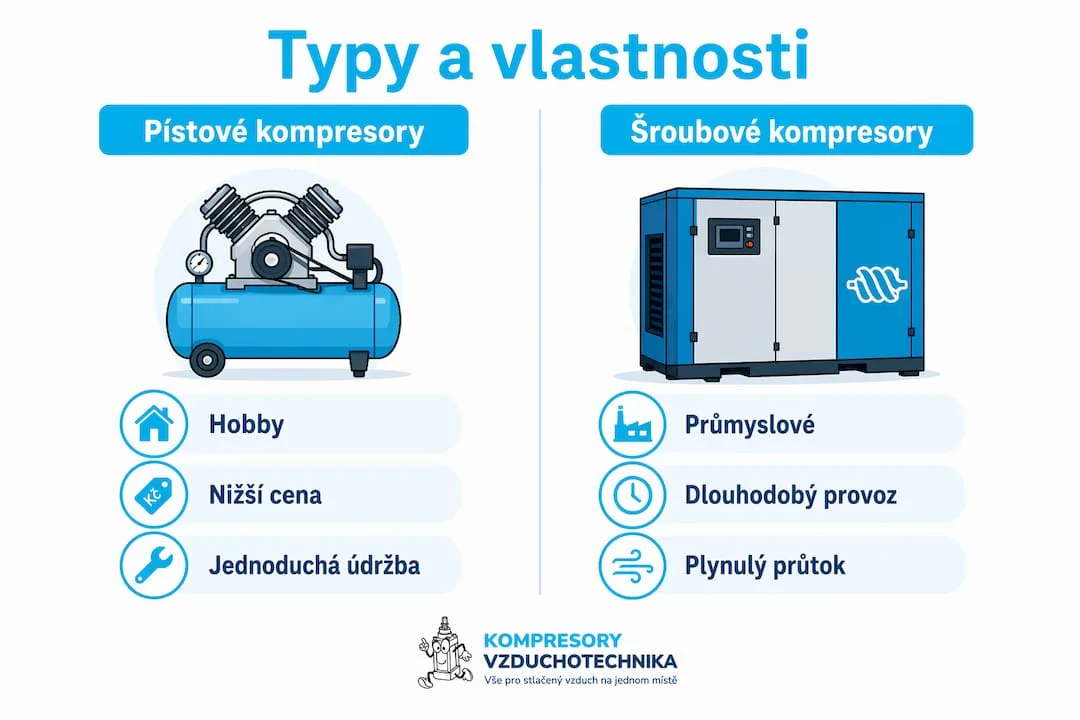
For hobby use, a lower air flow is sufficient. Painting and more demanding pneumatic tools require a higher flow. Professional operation starts from an even higher flow. For more detailed criteria for industrial applications, see the guide on choosing an industrial compressor.
What power and size of compressor do you need for your purpose?
| Application | Flow rate (l/min) | Pressure (bar) | Air tank (l) | Power supply |
|---|---|---|---|---|
| Inflating, blowing | 50–100 | 6–8 | 10–24 | 230 V |
| Hobby workshop, drill, grinder | 100–160 | 8 | 24–50 | 230 V |
| Painting, spraying | 160–260 | 6–8 | 50–100 | 230 V / 400 V |
| Car service, impact wrenches | 260 and above | 8–10 | 100–260 | 400 V |
| Small-scale production, continuous operation | 260 and above | 8–13 | 260 and above | 400 V |
| Industry | 500+ | 10–13 | 260 and above | 400 V |
For spraying and painting, it is recommended to use a larger air tank to ensure a stable air supply; for continuous operation, an even larger air tank is suitable. A smaller air tank leads to frequent re-pressurization, which can negatively affect the smoothness of work and put a strain on the compressor motor.
Quiet models with low noise levels are suitable for installation in residential areas or shared workshops, while standard piston compressors are significantly louder, which can limit work comfort without sound insulation.
Professional tip: When selecting output, allow for a reserve of 30–50% above the actual tool consumption. A compressor operating continuously at the limit of its output overheats, wears out faster, and has a shorter service life.
How much does an air compressor cost in the Czech Republic and where to buy one?
Price ranges vary depending on the category and output:
- Compact and battery-powered models: CZK 1,000–5,000
- Hobby piston compressors (230 V, 24–50 l): CZK 5,000–20,000
- Larger piston and twin-cylinder compressors: CZK 20,000–60,000
- Screw and industrial compressors: from CZK 100,000 upward
The price/performance ratio depends mainly on the actual output flow in l/min and the size of the air tank, not on the motor power in kW. Two models with the same power input can have significantly different output flow.
New vs. used: A new compressor comes with a warranty, availability of spare parts, and service support. With a used machine, there is a risk of unclear operating history, wear on the pistons or valves, and missing documentation. If you are still considering a used purchase, check:
- The number of operating hours and maintenance records
- Oil and seal condition (for oil-lubricated models)
- Functionality of the safety valve and pressure gauge
- Availability of spare parts for the given model in the Czech Republic
Kompresory-vzduchotechnika offers compressors in stock and on order with delivery throughout the Czech Republic.
What service and warranty should you require when buying a compressor?
Service conditions are just as important as technical parameters. When purchasing, require:
- Warranty length and scope of warranty service (minimum 24 months)
- Availability of spare parts for the given model in the Czech Republic
- Service response time (for industrial operations max. 24–48 hours)
- The option of a service contract with regular inspections
Regular maintenance extends the compressor's service life and prevents unplanned downtime. Basic service intervals:
- Daily: draining condensate from the air tank
- Every 500 hours: oil change (for oil-lubricated models), air filter inspection
- Every 1,000–2,000 hours: oil filter replacement, inspection of valves and seals
- Annually: safety valve inspection, air receiver inspection according to ČSN
Before putting the compressor into operation, arrange for an air receiver inspection, connection to 400 V by a qualified electrician, and installation of air filtration and an air dryer. Requirements for premises and inspections are described in the guide to basic requirements for a compressor room.
Professional tip: Structure your service contract to include preventive inspections twice a year and guarantee spare parts availability within 48 hours. This minimizes the risk of unplanned production downtime.
What accessories do you actually need for an air compressor?
A compressor alone, without accessories, is not enough. Basic equipment for a functional system:
- Hoses: rubber or PVC, diameter 6–10 mm depending on flow rate and distribution line length
- Quick couplers: standardized (Euro or Foster type) for quick tool connection
- Pressure reducer with pressure gauge: setting the working pressure for a specific tool
- Filter and condensate separator: protects tools from moisture and contaminants
- Air dryer: necessary for painting, airbrushing, and sensitive pneumatic systems
For selecting filtration, a simple rule applies according to ISO 8573-1: for common use (inflation, tools), class 4–5 is sufficient; for painting and spraying, require class 2–3; for the food or healthcare industry, class 0–1. Air treatment units for applications up to 10 bar are available directly in the Kompresory-vzduchotechnika e-shop.
Compressed air distribution through pipework (aluminium, stainless steel) is significantly more efficient than hoses for longer runs. Hoses have higher pressure losses and are more prone to damage. For permanent installations in a workshop or production facility, choose pipework distribution.
Checklist: what to verify before buying a compressor
Before signing the order, go through this procedure:
- Calculate the total air consumption of all tools that will run simultaneously, and add a 30–50% reserve.
- Check the output flow rate at working pressure (7 or 10 bar), not the intake capacity.
- Check the duty cycle (%) and compare it with the planned frequency of air draws.
- Find out the availability of spare parts for the given model in the Czech Republic and the service response time.
- Request a complete technical data sheet including noise level in dB and weight.
- Confirm the delivery date, installation, and pressure vessel inspection.
Questions for the seller:
- What is the actual output flow rate at 7 bar?
- What is the duty cycle at full load?
- Where is the nearest service center and what is the response time?
- Are spare parts in stock in the Czech Republic?
- Does the price include installation and inspection?
Warning signs: missing or incomplete technical data sheet, unspecified noise level, no service in the Czech Republic, unclear warranty terms, refusal of contractual service. The most common mistakes in selecting and operating a compressor are described in a practical guide to compressor usage mistakes.
Key takeaways
The right air compressor is selected based on the actual output flow rate at the operating pressure, not on the motor power input, and always with a 30–50% reserve above the actual tool consumption.
| Point | Details |
|---|---|
| Capacity reserve | Plan for an output flow rate 30–50% higher than the tool consumption. |
| Type by operation | Piston for intermittent operation, screw for continuous or industrial operation. |
| Air receiver and flow rate | For spraying, a min. 50 l air receiver; for continuous operation, 100 l or more. |
| Service and warranties | Require a warranty period of min. 24 months and availability of spare parts in the Czech Republic. |
| Kompresory-vzduchotechnika | Offers sales, installation, inspections and contract service of compressors throughout the Czech Republic. |
Why customers buy an unsuitable compressor
The most common mistake I see repeatedly is choosing a compressor based on motor input power instead of output flow rate. A customer buys a machine with a 2.2 kW motor and a 50 l air receiver, starts up an impact wrench and then waits a minute for the compressor to build up pressure again. The result is frustration, motor wear, and eventually the purchase of a second, correct machine.
The second mistake is underestimating noise level. An 85 dB piston compressor in a garage adjoining a living space is a problem that is solved either with sound insulation costing tens of thousands of crowns or by replacing it with a quiet model. Both can be avoided by choosing correctly from the start.
The third mistake is ignoring service availability. An industrial compressor without contract service and without a stock of spare parts in the Czech Republic can halt production for weeks in case of a breakdown. Energy savings and operating costs of screw solutions are discussed in detail in the guide to energy savings with a compressor. I recommend consulting before the purchase, not after.
Kompresory-vzduchotechnika: sales, installation and service in the Czech Republic
Kompresory-vzduchotechnika supplies air compressors for hobby use, workshops, auto service centers and industrial operations, with complete support for installation and service in the Czech Republic. The range includes the MARK COMPRESSORS line for workshops and medium-sized operations and SCR screw compressors for industrial and continuous applications.
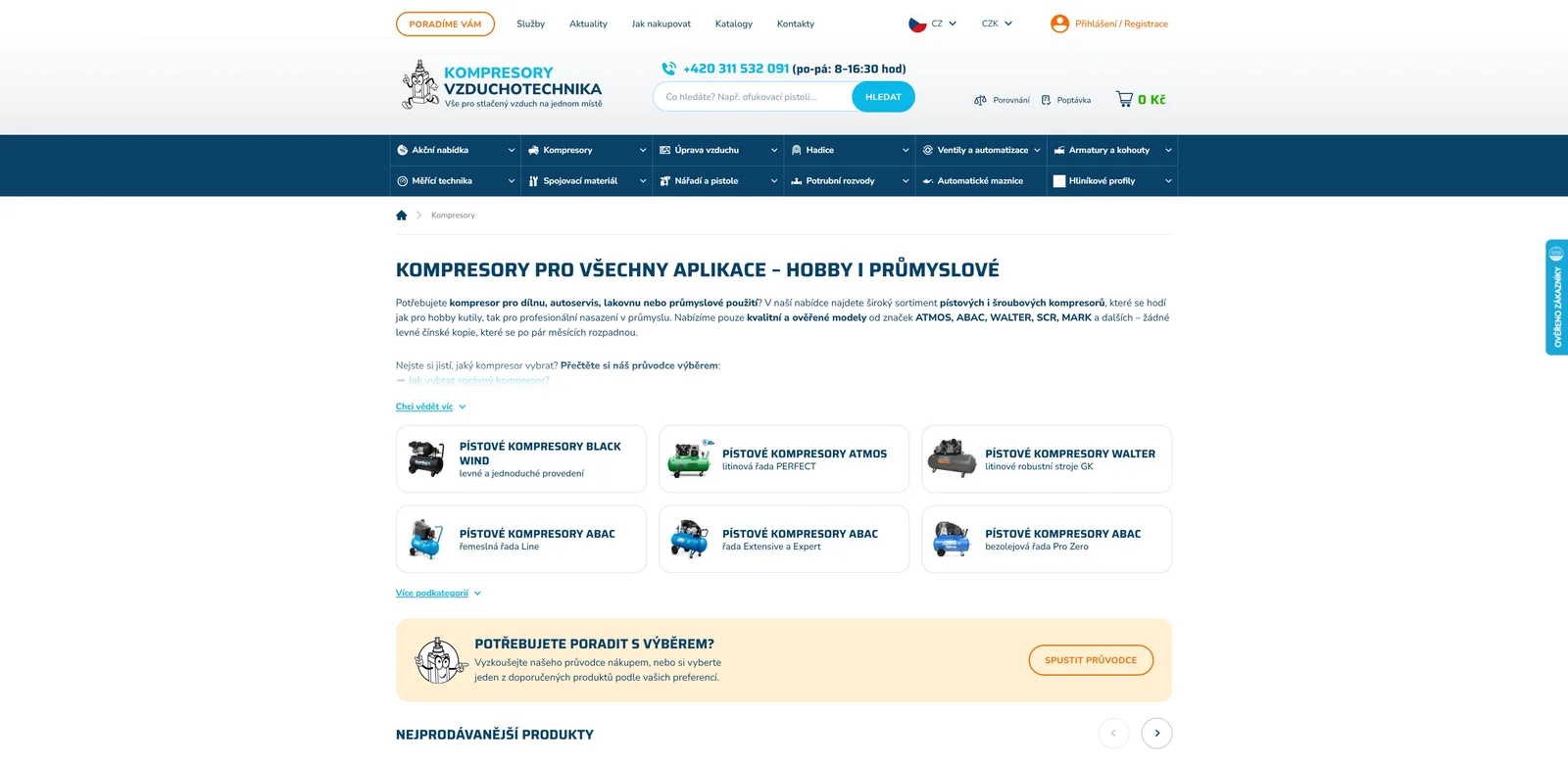
The delivery includes the option of onsite measurement of air consumption, compressor room design, installation, pressure vessel inspection and contract servicing with a guaranteed response time. Filters, dryers, piping and all accessories for the air compressor are also available. For a price quote or technical advice, contact Kompresory-vzduchotechnika directly via the e-shop or by phone.
Useful resources for choosing and operating a compressor
- Manufacturer's technical data sheet: always request complete documentation with output flow rate at a specific pressure, duty cycle and noise level
- Compressor room guide: requirements for premises, ventilation, inspections and connection to 400 V
- Kompresory-vzduchotechnika blog: technical articles on selection, diagnostics and operation of compressors for various applications
- Standard ČSN EN ISO 8573-1: compressed air purity classes for selecting filtration and dryers
When purchasing, always insist on receiving the complete technical data sheet, service documentation and warranty terms in writing.
Frequently asked questions
Which air compressor is suitable for a hobby workshop?
For a hobby workshop, a 230 V piston compressor with a sufficiently large air tank suitable for hobby and home use and a flow rate of 100–160 l/min is sufficient. An oil-lubricated model offers a longer service life, while an oil-free one is suitable for painting.
What is the difference between a compressor's intake capacity and output capacity?
Intake capacity is the manufacturer's theoretical value; output capacity at working pressure is 30–50% lower. When choosing a compressor, always check the output flow rate at 7 or 10 bar.
When is it worth choosing a screw compressor instead of a piston compressor?
A screw compressor is worth choosing for continuous or very frequent operation, when a piston compressor switches on more than 10–15 times per hour. A screw compressor offers lower noise levels, a higher duty cycle, and energy savings under constant load.
What air receiver volume do I need for spraying and painting?
For spraying and painting, an air receiver of at least 50 l is recommended. A smaller air receiver causes frequent repressurization, which interrupts work and can cause uneven paint application.
Where to buy an air compressor in the Czech Republic with service?
Kompresory-vzduchotechnika offers compressors for sale both in stock and on order, including installation, inspection, and contract service throughout the Czech Republic. Technical advice is available directly through the e-shop.
Recommended
- List of the best compressors 2026: a buying guide - Kompresory-Vzduchotechnika.cz
- Home use of compressors: options and how to choose the right one - Kompresory-Vzduchotechnika.cz
- Factors for selecting an industrial compressor: a 2026 guide - Kompresory-Vzduchotechnika.cz
- Basic requirements for a compressor room: guide 2026 - Kompresory-Vzduchotechnika.cz