

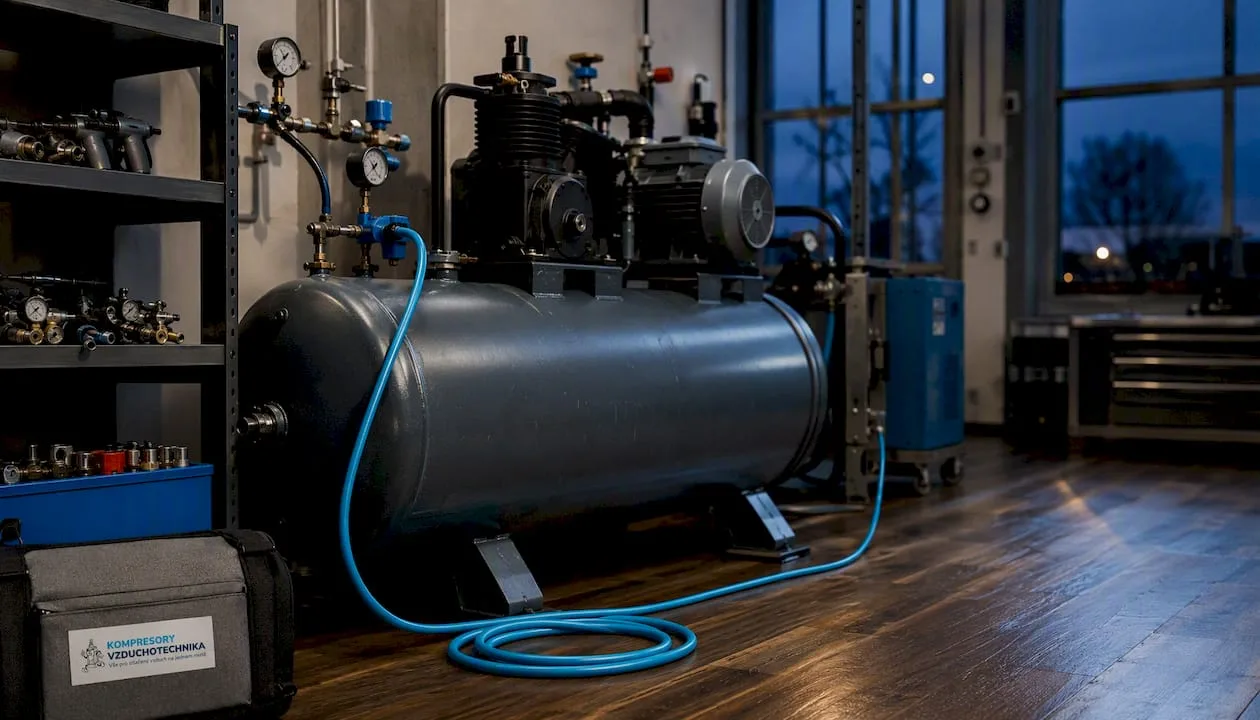
An air receiver is a buffering and accumulation element of the compressed air system that stabilizes the pressure in the distribution network, covers short-term consumption peaks, and reduces the number of compressor switching cycles. A properly sized air receiver protects the compressor from excessive wear, relieves the dryer, and improves the quality of the delivered air. The key parameters for the decision are the pressure range, the required flow rate, and the supply time in minutes. Before commissioning, check the sizing of the air receiver and its connection to the dryer.
- Main functions: pressure equalization, accumulation for peak consumption, reduction of switching cycles
- Key metrics: pressure range (bar), flow rate (l/s or m³/min), supply time (min)
- Recommendation: verify the sizing and the order of equipment in the piping (compressor → air receiver → dryer, or compressor → dryer → air receiver, depending on the type)
Contents
- How does the air receiver work within the compressor circuit?
- What are the main functions and benefits of an air receiver?
- How to size an air receiver?
- What types of air receivers are available?
- How to properly install and position the air receiver?
- How to maintain the air receiver and ensure its safe operation?
- How does the air receiver affect operating costs?
- Kompresory-vzduchotechnika will help you with the selection and servicing of the air receiver
- Key insights
- The air receiver that technicians underestimate
- Useful resources and further reading
- Frequently asked questions
How does the air receiver work within the compressor circuit?
Air enters the air receiver from the compressor's discharge piping under pressure. Inside the tank, the air settles, slows down and begins to cool. This way, the air receiver functions as a secondary heat exchanger: moisture contained in the air condenses on the tank walls and flows down to the bottom, where it is removed by the drain valve.

The output from the air receiver leads to the distribution system or directly to the dryer. The air receiver thus smooths out pressure pulses caused by the compressor's duty cycle and maintains a stable output pressure. The compressor's control system responds to the pressure in the air receiver via a pressure switch or regulator.
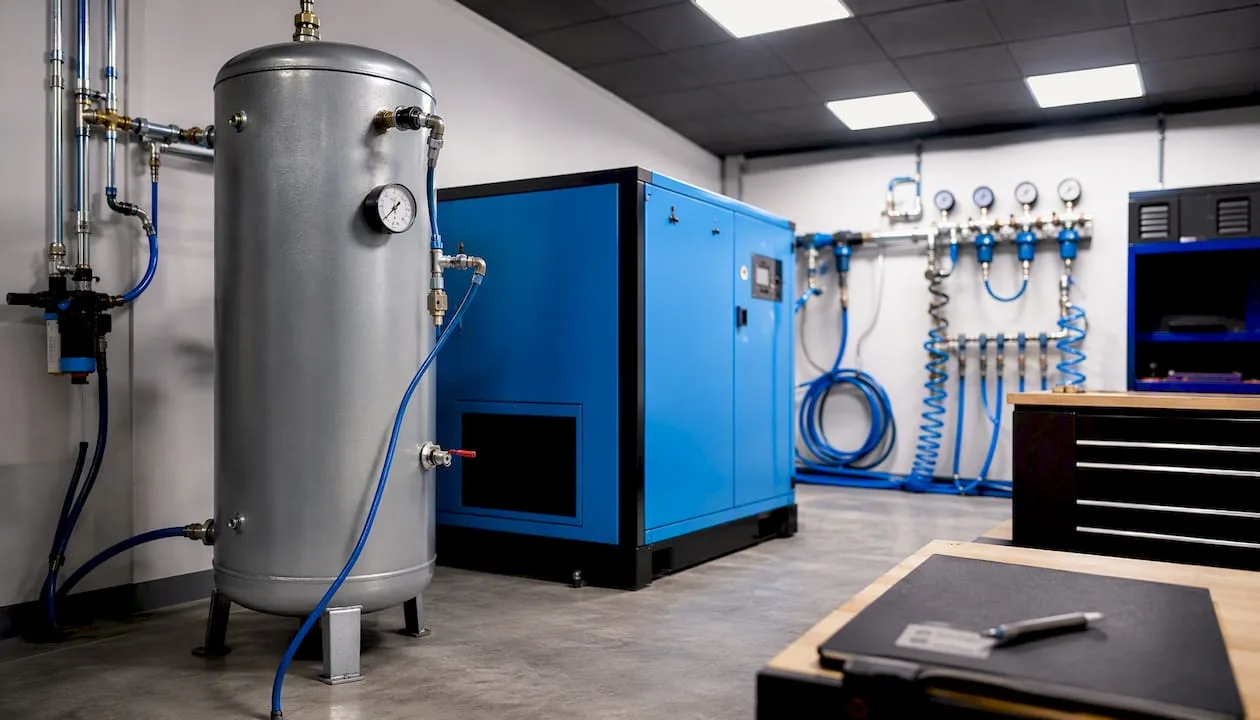
Main components of the air receiver and their functions:
- Inlet/outlet flange: connection to the compressor and distribution piping
- Drain valve (drain cock or automatic drain): removal of condensate from the bottom of the tank
- Pressure gauge: monitoring the current pressure in the tank
- Safety valve: protection against exceeding the maximum operating pressure
- Inspection opening (for larger tanks): access for internal inspection
The order of equipment in the piping depends on the type of air tank. A wet air tank is installed before the dryer and captures condensate from the compressor. A dry air tank is placed after the dryer and stores already treated air.
What are the main functions and benefits of an air tank?
The air tank fulfils four essential roles in a compressed air system, which complement each other.
Pressure equalisation and peak coverage. During a short-term increase in demand, the air tank supplies air from its own reserve without the compressor having to start immediately. The pressure in the distribution system remains stable, which is critical for pneumatic tools, spray guns and automated lines, where pressure fluctuations cause defective products or malfunctions.
Reducing the number of compressor starts. Each compressor start puts a load on the motor, starter and valves. The air tank extends the intervals between starts by covering demand from the accumulated reserve. The result is lower wear and a longer service life of the machine. Properly sizing the air tank together with eliminating air leaks can bring significant energy savings, as shown by the energy savings guide on the Kompresory-vzduchotechnika blog.
Cooling and moisture condensation. Air cools down in the air tank and moisture condenses before entering the dryer. The dryer thus processes air with a lower water content, works more efficiently, and its sorption or cooling capacity is less burdened.
Safety reserve. In the event of a compressor failure, the air tank provides a reserve of air for the controlled shutdown of machines or completion of a safety sequence.
The air tank is not a passive vessel. A properly sized air tank reduces compressor starts and operating costs, while also relieving the dryer and stabilising air quality throughout the distribution system.
How to size an air tank?
Sizing an air tank is based on four input parameters: required flow rate, operating pressure, permissible pressure drop and supply time.
Input parameters:
- Compressor flow rate: Q (l/s or m³/min)
- Maximum operating pressure: P₁ (bar absolute)
- Minimum permissible pressure in the distribution system: P₂ (bar absolute)
- Required supply time without a compressor: t (min)
Basic formula for air receiver volume:
V = (Q × t × P₀) / (P₁ P₂)
where P₀ = 1 bar (atmospheric pressure as the reference value), Q is the flow rate in l/min, t is the time in minutes, P₁ and P₂ are absolute pressures in bar. The formula is based on an isothermal simplification; in practice, add a 10–20% margin for temperature deviations and leaks.
Example calculation for typical operation:
The compressor delivers Q = 300 l/min. Operating pressure P₁ = 8 bar abs., minimum permissible pressure P₂ = 6 bar abs. The air receiver must cover the peak for a period of t = 1 min.
V = (300 × 1 × 1) / (8 6) = 300 / 2 = 150 litres
With a 15% margin, the recommended volume comes out to approximately 170 litres. For more detailed setting of switching cycles, we also recommend the guide to the compressor duty cycle.
Reference table: compressor flow rate vs. recommended tank volume
| Compressor flow rate (l/min) | Recommended tank volume (l) |
|---|---|
| up to 100 | 24 |
| 100–300 | 150–170 |
| 300 | 150–170 |
| over 1000 | 1,000 and more |
The values are indicative for an operating pressure of 7–10 bar and a supply time of 1 min. Specific applications may require different sizing.
What types of air tanks are available?
Tanks differ in orientation, function within the piping system, pressure classes, and material.
Vertical vs. horizontal design. Vertical air receivers take up less floor space and condensate naturally flows to the bottom toward the drain valve. Horizontal air receivers are suitable for spaces with low ceilings or for mobile applications, but require careful placement of the drain valve at the lowest point.
Wet and dry tanks. A wet tank is installed directly after the compressor, before the dryer. It captures condensate and heat from the compressor and reduces the moisture load on the dryer. A dry tank is located after the dryer and stores already treated air without the risk of recondensation.
Pressure classes and material:
- Standard air tanks: up to 11 bar, suitable for most workshop and industrial applications
- High-pressure air tanks: 15–40 bar, for special industrial or filling applications
- Material: structural steel with epoxy or zinc coating (standard), stainless steel for food, pharmaceutical, or environments with aggressive media
- Connections: standard threaded (BSP or NPT), flanged for larger tanks
When selecting an air tank for connection to a dryer, verify the compatibility of connection diameters and the location of the inlet and outlet ports.
How to correctly install and position the air tank?
The installation of the air tank directly affects its reliability and accessibility for servicing.
Installation checklist:
- Solid concrete or steel foundation with sufficient load-bearing capacity
- Anchoring of the air tank according to the manufacturer's instructions (vertical air tanks especially when over 1 m in height)
- Minimum distance of 0.5 m from walls and machines for access to fittings
- Drain valve at the lowest point of the tank, accessible without dismantling the piping
- Pressure gauge positioned at a height readable by the operator
- Safety valve on the discharge port, uncovered and unblocked
Connection to the distribution system and dryer. The piping between the compressor and the air tank should be as short as possible to minimize pressure losses. After the air tank (or after the dryer in the case of a dry air tank), install a filter to capture remaining impurities. Automatic timer-controlled drain valves or float drains ensure regular condensate drainage without the need for manual intervention.
Professional tip: In environments with high air humidity (paint shop, food processing facility), install flexible compensators on the air tank's inlet piping. This will reduce the transmission of vibrations from the compressor and also reduce the risk of corrosion damage to flanges caused by mechanical stress.
Requirements for the compressor room, ventilation, and safety distances are summarized in the compressor room guide on the Kompresory-vzduchotechnika website.
How to maintain the air tank and ensure its safe operation?
Regular maintenance extends the air tank's service life and is a condition for the validity of inspections according to Czech regulations.
Recommended inspection intervals:
- Daily or before each shift: visual inspection of the pressure gauge, condition of the safety valve, and tightness of connections
- Monthly: visual inspection of the tank's external surface (corrosion, mechanical damage, coating), function of the drain valve
- Annually: internal inspection of the tank (corrosion, deposits, condition of welds), safety valve test, pressure gauge inspection, entry in the operating log
- According to Czech regulations: pressure vessels are subject to inspections according to applicable technical standards and government regulations; the interval and scope of the inspection are determined by the inspection technician based on the vessel category
Safety notice: If you suspect corrosion of the tank walls, deformation, or air leakage from the receiver body, immediately take the receiver out of operation, reduce the pressure to zero, and call a inspection technician. Never weld or drill into the air receiver without expert assessment.
Draining condensate is the most commonly neglected part of maintenance. Condensate contains oil, rust and microorganisms; its accumulation accelerates corrosion of the tank bottom and degrades air quality. An automatic float-type or electronic condensate drain eliminates the need for manual draining and ensures regular removal even during continuous operation.
How does the air receiver affect operating costs?
The air receiver reduces costs through three mechanisms: fewer compressor switching cycles, longer running under load, and lower component wear.
Savings mechanisms:
- Every unnecessary compressor start consumes several times more energy than operation in steady state; the air receiver eliminates these starts
- Stable pressure in the distribution system reduces air consumption of pneumatic tools and prevents overpressurization
- Fewer switching cycles mean less wear on valves, bearings and the starter, resulting in lower spare parts costs
Simple ROI example. A compressor with a power input of 7.5 kW starts on average 20 times per hour without an air receiver. After installing a properly sized air receiver, the number of starts drops to 4–6 per hour. At an electricity price of CZK 5/kWh and 2,000 operating hours per year, the savings from optimized switching and reduced losses show up both in the electricity bill and in service costs. Eliminating air leaks combined with correctly sizing the air receiver can bring energy savings in the order of tens of percent, as documented by an internal analysis by Kompresory-vzduchotechnika.
When deciding between a larger air receiver and an additional compressor or controlled switching, the overview of compressed air automation and consumption optimization can help.
Kompresory-vzduchotechnika will help you choose and service your air receiver
Kompresory-vzduchotechnika offers air receivers ranging from small service tanks (24–100 l) up to stationary industrial air receivers over 1,000 l, including stainless steel versions for demanding environments. Every delivery includes technical consultation: we help with volume calculation, pressure class selection, and designing the sequence of equipment in the piping.
Services include turnkey system design, installation, pressure vessel inspections, and energy audits of compressor rooms. The entire range of pneumatics and air technology is available in the e-shop. For a free sizing consultation, contact the technical department of Kompresory-vzduchotechnika directly via the website.
Key findings
An air tank is an active element of the compressed air system, whose correct sizing and maintenance directly affect energy consumption, compressor service life, and the quality of the supplied air.
| Point | Details |
|---|---|
| Role of the air tank | Equalizes pressure, covers demand peaks, and reduces the number of compressor cycles. |
| Sizing | The air tank volume is calculated from the flow rate, pressure band, and required supply time; add a reserve of 10–20%. |
| Types of air tanks | A wet air tank is placed before the dryer, a dry air tank after the dryer; choose a vertical or horizontal design depending on the available space. |
| Maintenance | Visual inspection monthly, internal inspection annually, revision according to Czech regulations depending on the vessel category. |
| Kompresory-vzduchotechnika | Offers air receivers, sizing design, installation and revisions; consultation available via the e-shop. |
The air receiver that technicians underestimate
The air receiver tends to be an overlooked item in compressed air projects. Technicians focus on compressor output, the type of dryer and filtration, but treat the air receiver as an "extra tank." Yet it is precisely the air receiver that determines how many times per hour the compressor starts, and thus directly determines how quickly the motor and valves wear out.
The most common mistake I see in operations is an undersized air receiver on compressors with a frequency inverter. Technicians assume that the inverter will handle switching on its own. However, without a sufficiently sized air receiver, the inverter oscillates within a narrow pressure band and the compressor never reaches its optimal operating point. The result is higher consumption than would occur with a correctly sized air receiver combined with a fixed-speed unit.
Before making any decision about the air receiver size, measure the actual flow and pressure band in operation. Compressor catalogue values and the actual consumption of the application differ, sometimes significantly. A compressed air consumption audit is the fastest way to obtain a figure that makes the calculation meaningful.
Useful resources and further reading
For further study of this topic, we recommend the following Kompresory-vzduchotechnika pages:
- Optimizing compressed air consumption — practical procedures for reducing the energy demands of operation
- Compressor duty cycle — a technical guide for setting switching strategies
- Basic requirements for a compressor room — installation and safety requirements including ventilation
- Selecting an industrial compressor — criteria for comparing output and capacity
Note on inspections and legislation: Pressure vessels (including air tanks) are subject to technical standards and relevant government regulations in the Czech Republic. Verify specific requirements for inspections, categorization, and documentation with a certified inspection technician or the relevant inspection authority. Regularly update equipment technical sheets and keep records of all service interventions.
Frequently Asked Questions
What is the main role of an air tank in the system?
The air tank balances pressure in the distribution system, covers short-term consumption peaks, and reduces the number of compressor cycles, thereby extending its service life.
What size air tank do I need for a 300 l/min compressor?
A typical application requires an air tank with a volume of 150–170 litres for a compressor with a flow rate of 300 l/min, a pressure range of 6–8 bar, and a supply time of 1 min, including a reserve for temperature variations and leaks.
Where in the piping should the air tank be installed, before or after the dryer?
A wet air tank belongs before the dryer (it collects condensate from the compressor), a dry air tank belongs after the dryer (it stores treated air).
How often should an air tank be inspected?
A visual inspection of the exterior is performed monthly, an internal inspection annually. Inspections according to Czech regulations depend on the pressure vessel category and are determined by an inspection technician.
Will Kompresory-vzduchotechnika help with selecting an air tank?
Yes. Kompresory-vzduchotechnika offers technical consultation, sizing calculations, supply of air tanks, and service support; a consultation can be arranged directly through the e-shop.
Recommended
- List of tasks for compressed air: a guide for technicians - Kompresory-Vzduchotechnika.cz
- Compressed air storage options: a guide for technicians - Kompresory-Vzduchotechnika.cz
- A guide to industrial air distribution: operating efficiency - Kompresory-Vzduchotechnika.cz
- How to store air hoses correctly: a guide for tradespeople - Kompresory-Vzduchotechnika.cz