

TL;DR:
- Compressed air automation optimizes compressor operation according to actual demand and reduces energy consumption.
- Proper implementation includes data collection, control logic, and their integration with production and control systems, which enables a fast return on investment.
Compressed air automation is defined as controlling the operation of compressors and distribution networks based on actual demand, rather than on manual settings or continuous operation. This approach is referred to in industrial practice as Compressed Air System Management. The DENSO project, carried out in collaboration with Rockwell Automation, demonstrated that properly implemented automation of industrial processes reduces compressed air energy consumption by 26%, saving 350,000 USD annually. This result shows that the benefits of air automation are not theoretical but measurable and quickly achievable.
How compressed air automation works in industrial systems
Automation of compressed air systems rests on three technical layers: data collection, control logic, and integration with the production environment. Each layer performs a specific function, and real savings cannot be achieved without their interconnection.
Data collection using sensors
The basis is flow measurement, pressure, and air quality measurement in real time. Sensors are installed at the compressor outlet, at key points of the distribution piping, and at the inlets of individual consumers. Accurate consumption measurement at various points in the distribution system reveals leaks and excessive consumption that would otherwise remain invisible. Without this data, the system cannot be controlled efficiently.
Control logic and compressor regulation
The measured data is fed into a PLC (programmable logic controller), which, based on this data, starts or shuts down compressors, switches between performance modes, and synchronizes the cycling of multiple machines. The system responds to actual demand rather than a fixed schedule. Automatic mode switching and control based on demand peaks are among the key functions that distinguish true automation from mere monitoring. For example, when a production line stops, the system immediately reduces compressor output, eliminating unnecessary idle running.

Integration with building and production control
Modern systems connect to Building Management Systems (BMS) and production control systems (MES or SCADA). This integration allows the compressor to automatically adjust its output when the production plan changes or when switching to a different production program. Integration with production automation thus brings synchronization of the entire operation, not just the optimization of an isolated subsystem.
Monitoring versus actual control
Monitoring collects data and displays it to the operator. Actual automation processes this data and acts on its basis without human intervention. Monitoring alone is not sufficient to achieve significant savings. Only control logic that connects measurement with automatic switching and regulation delivers results comparable to the DENSO project.
Professional tip: When designing automation, start by mapping consumption at the level of individual distribution branches, not just at the compressor outlet. Only a detailed overview of where the air actually travels will allow the control logic to be set so that interventions are targeted and effective.
What are the main benefits of compressed air automation?
The benefits of air automation are manifested in four areas: energy savings, operational reliability, environmental impact, and maintenance costs.
- Energy savings. Systel states that compressed air monitoring brings savings of around 22% with a return on investment within 3 to 4 months. These figures correspond to operations where automation is deployed on previously fully manually controlled systems.
- Reduction of CO2 emissions. The DENSO project recorded a reduction in emissions of 3,110 tons of CO2 per year. For industrial operations meeting ESG goals or subject to emission regulations, this is a direct and measurable benefit.
- Extended equipment service life. A compressor that does not run unnecessarily idle wears out less. Automation reduces the total number of operating hours while maintaining the same output.
- Predictive maintenance. Advanced sensors and cloud platforms enable visualization of consumption, anomaly detection, and prediction of failures before they cause a production outage. This changes the approach to maintenance from reactive to proactive.
- Leak detection. Undetected leaks in the distribution system increase energy costs by tens to hundreds of thousands of crowns per year. Automated monitoring identifies them immediately, not only during a scheduled inspection.
Key conclusion: automation of industrial processes in the field of compressed air does not only bring energy savings, but changes the entire way operators approach system control and maintenance.
Manual control versus an automated compressed air system
Traditional manual compressor operation means that the machine runs according to a fixed schedule or even continuously, regardless of actual production demand. The result is high energy consumption, unnecessary wear, and an inability to respond to operational changes. An automated system, by contrast, synchronizes compressor output with actual consumption in real time.
| Parameter | Manual control | Automated system |
|---|---|---|
| Response to demand change | Manual operator intervention | Automatic, within seconds |
| Energy consumption | High, continuous operation | Reduced by 20 to 26 % |
| Leak detection | During scheduled maintenance | Continuous, in real time |
| Compressor service life | Shortened by unnecessary running | Extended by optimal loading |
| Maintenance costs | Reactive, unpredictable | Predictive, planned |
| Integration with production | None or minimal | Full integration via PLC or SCADA |
The difference in operating costs becomes apparent as early as the first six months after implementing automation. The first and greatest savings are usually achieved during this period, when the system identifies inefficient parts and operators carry out the first targeted interventions. Manual operation simply does not see these opportunities.
Professional tip: Before switching to automation, carry out a consumption audit lasting at least two weeks. Record demand peaks and lulls across different shifts. This data forms the basis for correctly setting up the control logic and selecting a suitable compressor with a frequency inverter.
Practical examples of savings thanks to compressed air automation
Specific figures from industrial practice are the strongest argument for investing in automation. Below are examples that document real-world results.
DENSO and Rockwell Automation project
DENSO, a Japanese manufacturer of automotive components, implemented a PLC control system for compressor management at its plant. The result was a 26% reduction in energy consumption and an annual saving of 350,000 USD. The system used synchronous cycling of compressors according to current demand instead of continuous operation. A reduction in emissions of 3,110 tons of CO2 per year was a secondary, but strategically important result for meeting the company's environmental commitments.
„Automation must go beyond data collection. It requires designing control logic with automatic switching of compressor modes and control according to demand peaks, including maintenance functions based on loss trends." Rockwell Automation, DENSO case study
Deployment of IIoT sensors according to Systel
Systel documents a project where annual cost savings reached approximately 13.2 lakhs INR, with monitoring costs of 2.8 to 4.5 lakhs INR. A return on investment within 3 to 4 months is a result that is exceptionally short in an industrial environment. IIoT sensors here provided continuous measurement of flow and pressure, while a cloud platform visualized the data and generated alerts in the event of anomalies.
Recommended implementation steps
- Audit of the existing system. Measure consumption at the compressor outlet and at key nodes in the network for a minimum of two weeks.
- Identification of losses. Comparing the inlet and outlet flow of individual branches reveals leaks and excessive consumption.
- Selection of the control system. Choose a PLC or industrial controller with the ability to integrate into the existing BMS or MES.
- Installation of sensors and measuring devices. Cover not only the compressor outlet, but also the distribution network all the way to the end consumers.
- Setting up the control logic. Define rules for starting, shutting down, and switching compressor modes according to the measured demand peaks.
- Continuous monitoring and optimization. After startup, monitor the system and adjust parameters based on operating data. The compressed air consumption optimization guide from Kompresory-vzduchotechnika offers practical methodologies for this step.
Key insights
Compressed air automation delivers proven energy savings in the range of 20 to 26%, with return on investment occurring within as little as four months of deployment.
| Point | Details |
|---|---|
| Energy savings | Automation reduces energy consumption by 20 to 26% compared to manual operation. |
| Fast payback | The investment in monitoring and automation pays back within 3 to 4 months of operation. |
| Leak detection | Continuous monitoring reveals losses in the distribution system that manual inspections overlook. |
| Integration with production | Connection to a PLC or SCADA system enables automatic response to changes in production. |
| Predictive maintenance | Trend analysis of consumption makes it possible to plan servicing before a failure occurs. |
Why monitoring without control logic is not enough
I work with industrial facilities of various sizes and repeatedly encounter the same pattern. The operator installs sensors, displays data on a dashboard, and claims to have automation. In reality, they just have an expensive thermometer. Data without control logic is passive. A system that sees that pressure has dropped but cannot react to it without operator intervention is not automated. It is just an informed manual operation.
The biggest mistake I see is focusing exclusively on compressor output. Operators measure what the compressor produces, but they don't measure what happens to that air afterward. A leak in a pipe just a few millimeters in diameter can cost hundreds of thousands of crowns a year, yet it doesn't show up dramatically at the compressor output. Only visibility of consumption in individual distribution branches allows interventions to be targeted where they actually deliver results.
I recommend approaching automation as a two-phase project. In the first phase, install measurement equipment and collect data for six to eight weeks. In the second phase, design the control logic based on this data. This approach prevents a situation where the control system is set up based on estimates and the results turn out to be disappointing. Diagnostics of the compressor and the entire system before implementation is an investment that pays off many times over. More on this approach is described in the guide to compressor diagnostics by Kompresory-vzduchotechnika.
— Zdeněk
Kompresory-vzduchotechnika: solutions for compressed air automation
Kompresory-vzduchotechnika offers products and technical support for the entire compressed air automation process, from compressor selection to integration into control systems.
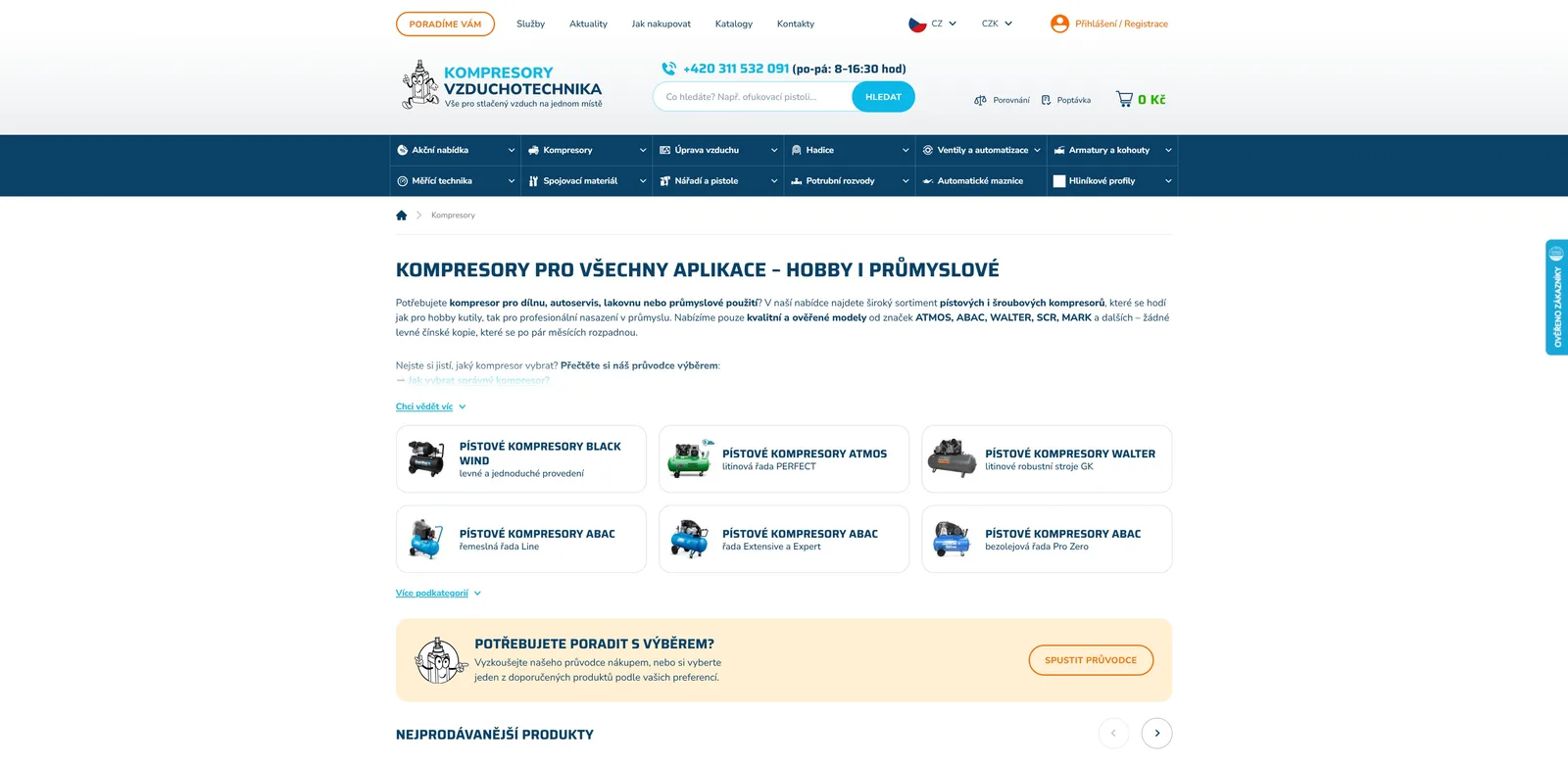
SCR screw compressors are designed for industrial facilities requiring a reliable and energy-efficient source of compressed air, with the option to connect to a frequency converter and external control systems. Kompresory-vzduchotechnika also supplies components for compressed air distribution systems, air treatment units, and monitoring accessories. The technical team provides consulting on automation design, sensor selection, and integration with PLC or BMS. For a detailed overview of the energy savings achievable with specific compressor models, we recommend the guide to energy savings with a compressor on the Kompresory-vzduchotechnika website.
FAQ
What is compressed air automation?
Compressed air automation is the control of compressor operation and distribution networks based on current demand using sensors, PLC, and control logic. The goal is to eliminate unnecessary compressor operation and reduce energy consumption.
How much energy savings can be expected?
The DENSO project achieved energy consumption savings of 26%, while Systel reports an average of around 22%. The specific result depends on the current state of the system, the extent of leaks, and the control method used before implementing automation.
How quickly will the investment in automation pay off?
Systel documents a return on investment of 3 to 4 months in facilities where the system was previously controlled manually. The largest savings typically occur during the first six months after launch.
What is the difference between monitoring and automation?
Monitoring collects and displays data but does not require automatic intervention. Automation processes this data and, based on it, controls compressor operation without the need for manual intervention by the operator.
Which compressors are suitable for automated operations?
Screw compressors with a frequency converter are best suited for automation, as they allow smooth output regulation according to current demand. Fixed-speed piston compressors are less suitable for full automation.
Recommended
- What is pneumatic automation: a guide for industry - Kompresory-Vzduchotechnika.cz
- The importance of multi-way valves in industrial systems - Kompresory-Vzduchotechnika.cz
- The importance of air drying in industry and construction - Kompresory-Vzduchotechnika.cz
- Air treatment: maximum efficiency for industry and construction - Kompresory-Vzduchotechnika.cz