
In brief:
- Compressed air is expensive energy, accounting for up to 80% of compressor operating costs.
- Proper planning and monitoring of consumption helps prevent unnecessary leaks and reduce costs.
Compressed air is defined as air compressed above atmospheric pressure and stored in an air tank or piping system for the purpose of energy transfer. It is one of the most expensive forms of energy in industry. Up to 80% of compressor operating costs consist of electrical energy consumption. Yet technicians in auto repair shops, production halls, and construction sites work with compressed air daily without a structured overview of its uses. A well-compiled list of tasks for compressed air changes this approach. It helps select the right equipment, set the pressure, and prevent unnecessary energy losses.
How compressed air works and its basic tasks
An air compressor draws in ambient air, compresses it, and delivers it under pressure to pneumatic equipment. This process describes the thermodynamic principle of converting mechanical energy into pneumatic energy. The result is transferable energy that can be distributed through piping to any location within the facility.
The basic tasks of compressed air in industrial systems include:
- Powering pneumatic tools (grinders, drills, impact wrenches)
- Blowing off and cleaning surfaces, components, and molds
- Cooling production molds with a fast stream of air
- Powering and controlling automation elements (cylinders, valves, actuators)
- Painting and applying coatings with spray guns
- Tyre inflation and leak testing
The thermodynamic principle enables the conversion of mechanical energy into pneumatic energy in the form of compressed air. This means that every kilowatt of electrical energy input into the compressor is transferred as pressure energy to tools and machines.
Professional tip: Before selecting a compressor, always determine the total air flow of all connected tools in litres per minute. Underestimating the flow causes a pressure drop and reduces the performance of the entire system.
1. Powering pneumatic tools
Powering pneumatic tools is the most widespread application of compressed air in industry and car repair shops. Air compressors enable the use of impact wrenches, grinders, drills, spray guns and other tools. Pneumatic tools offer higher power at lower weight than electric equivalents, which reduces operator fatigue during long-term work.
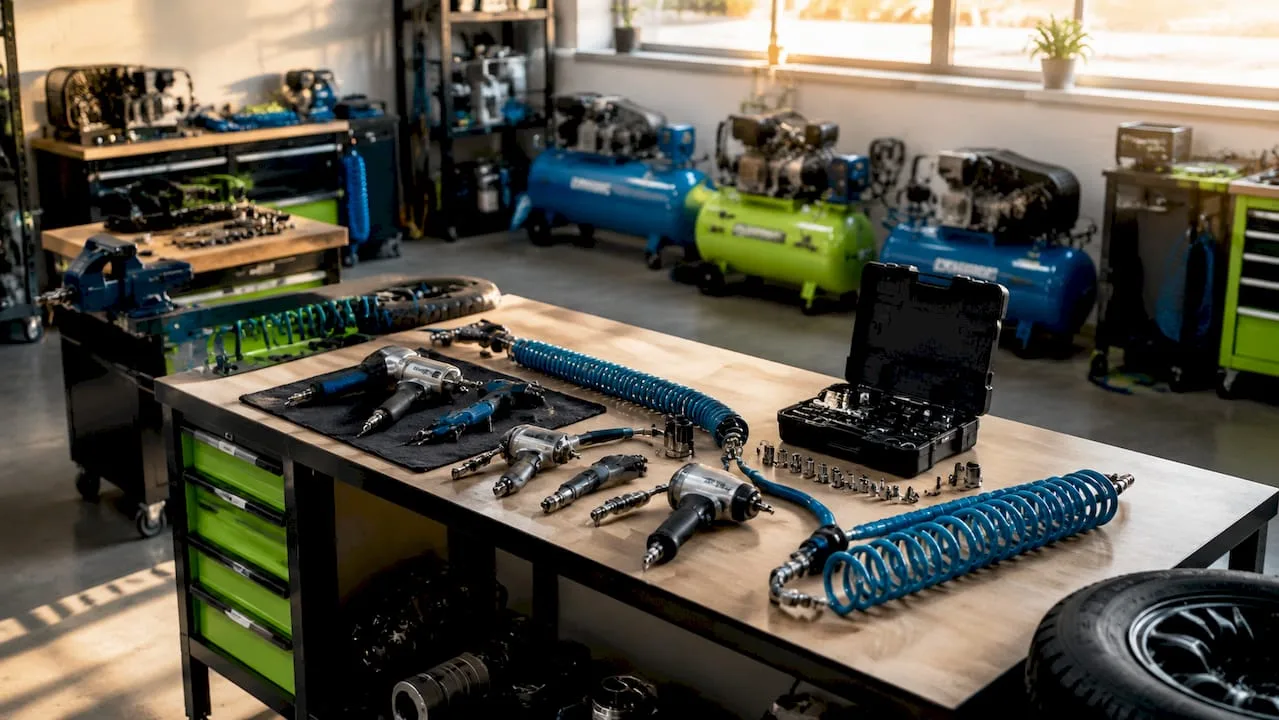
An impact wrench with a working pressure of 6.3 bar and a flow of 200 l/min can remove a passenger car's wheels in a fraction of the time compared to manual tools. Pneumatically powered grinders and files are used for finishing welds and surfaces in body shops.
2. Blowing off and cleaning working surfaces
Blowing off with compressed air removes chips, dust and dirt from workpieces, moulds and machine components. This task is fast, requires no chemical solvents and leaves no moisture on sensitive surfaces. Blow guns with adjustable flow enable precise cleaning even in hard-to-reach places.
Professional tip: When blowing off, always use blow guns with a safety nozzle in accordance with EN 13463. A direct air stream at a pressure higher than 0.5 bar can cause serious injury upon contact with the skin.
Blowing off is used in machining centres, plastic moulding plants and assembly lines. The correct choice of nozzle and working pressure extends tool life and reduces air consumption.
3. Rapid cooling of production moulds
Compressed air is used for rapid cooling of moulds in plastic moulding plants and pressure die-casting foundries. Air at ambient temperature or cooled by a vortex tube reduces the mould temperature between cycles. A shorter cooling cycle increases line productivity without investment in liquid cooling.
A vortex tube (Ranque-Hilsch tube) can produce a stream from ordinary compressed air at a temperature up to 50 °C below the inlet air temperature. This solution requires no cooling medium or electrical power, only a supply of compressed air.
4. Drive and control in industrial automation
Pneumatic cylinders, valves and actuators form the basis of automation systems in manufacturing. Compressed air drives both linear and rotary motion with fast response and simple control. Pneumatic systems are resistant to electromagnetic interference and operate reliably in dusty or humid environments.
Automation and air treatment are key to the reliability and efficiency of pneumatic systems. Properly set pressure and air purity extend the service life of pneumatic components and reduce the number of failures. The ISO 8573 industry standards define compressed air purity classes for various applications.
5. Painting and coating application
Spray guns powered by compressed air ensure even application of paints, lacquers and primers. The quality of the surface finish depends on pressure stability, air purity and the correct material viscosity. Pressure fluctuations of more than 0.2 bar cause uneven application and increase paint consumption.
Body shops and industrial paint shops use HVLP (High Volume Low Pressure) guns, which operate at a pressure of 0.7 bar at the nozzle. This system reduces paint waste and emissions of volatile organic compounds compared to conventional high-pressure guns.
6. Assembly and disassembly in an auto repair shop
Pneumatic tools in an auto repair shop shorten service task times and reduce the physical strain on mechanics. Impact wrenches, pneumatic lifts and air drills are standard equipment in every professional workshop. The correct working pressure for most service tools is in the range of 6–8 bar.
Specific tasks in an auto repair shop include:
- Wheel removal and installation with an impact wrench (torque 500–1,500 Nm)
- Tyre inflation to the pressure specified by the vehicle manufacturer
- Cleaning carburettors and injectors by blowing out
- Grinding and polishing bodywork with pneumatic eccentric sanders
- Leak testing of the cooling system and air conditioning with compressed air
Pneumatic tools do not require electrical power directly at the tool, which eliminates the risk of short circuit when working near fuel or electrolytes.
7. Construction pneumatic tools and technology
On construction sites, compressed air powers breakers, pneumatic hammers, nailers and spraying equipment. Portable compressors with an air tank volume of 50–200 litres supply multiple tools simultaneously. Pneumatic breakers with an impact energy of 40–80 J handle the demolition of concrete, asphalt surfaces and masonry.
Nailers and staplers powered by compressed air work at a rate of 2–3 nails per second. This is a performance that hand tools cannot achieve. Construction companies also choose pneumatic tools because they withstand dusty and damp conditions better than electric tools.
8. Filling and testing pressure vessels
Compressed air is used for filling vehicle tyres, industrial wheels and pressure vessels. Leak testing of welds, piping and pressure vessels is carried out by applying air to the test pressure and monitoring the pressure drop. This method is safer than hydraulic testing, because air does not create a hydraulic shock when it leaks.
Industry standards ČSN EN 13445 and ČSN EN 286 specify the procedures for pressure testing of pressure vessels. Proper execution of the test requires a calibrated pressure gauge and a precisely defined test pressure.
9. Transport and handling of materials
Pneumatic conveying of bulk materials moves dust, granulate or powder through piping without mechanical conveyors. Air drives the material by pressure or suction principle over distances of tens of metres. This task is used in the food industry, the chemical industry and plastics production.
Pneumatic ejectors and suction cups handle fragile or smooth objects without mechanical damage. Robotic workstations use vacuum suction cups powered by compressed air for precise part handling.
10. Optimization and monitoring of compressed air consumption
Checking and eliminating compressed air leaks brings the greatest immediate savings. Leaks reach 10–30% of the produced air volume, in extreme cases even 50–60%. Regular leak inspection and elimination brings savings of up to 42% of the energy consumed by the compressed air system.
Key steps for reducing losses and costs:
- Leak detection with an ultrasonic detector at regular intervals (quarterly recommended)
- Monitoring pressure regime by continuous measurement at multiple points in the distribution system
- Cleaning and replacing filters of condensate separators and air filters according to the service plan
- Setting the minimum working pressure separately for each application
- Checking condensate and its regular draining from the air tank and distribution lines
Professional tip: Every bar of unnecessary overpressure increases the compressor's energy consumption by approximately 7%. Always set the pressure to the lowest value at which the tool or machine works reliably.
Proper routing of distribution lines and compressed air quality directly affect the lifespan of pneumatic components. Moisture and impurities in the air cause valve corrosion, nozzle clogging, and premature seal wear.
| Optimization area | Impact on operation |
|---|---|
| Leak detection and repair | Savings of 10–42% in system energy |
| Reducing operating pressure by 1 bar | Energy consumption decrease of approx. 7% |
| Regular filter replacement | Extending the service life of tools and valves |
| Automatic compressor control | Eliminating idle running and unnecessary consumption |
Key findings
Efficient use of compressed air requires a structured overview of tasks, regular maintenance, and consumption monitoring, since uncontrolled losses and incorrectly set pressure directly increase operating costs.
| Point | Details |
|---|---|
| Compressed air is expensive energy | Up to 80% of costs are electricity, so every loss directly increases operating expenses. |
| Leaks are the largest source of losses | Detecting and fixing leaks brings savings of up to 42% of system energy. |
| Set the pressure to the minimum | Every unnecessary bar increases energy consumption by approximately 7%. |
| Air purity protects components | Moisture and contaminants shorten the service life of valves, seals, and nozzles. |
| Regular maintenance reduces costs | Quarterly leak inspections and filter servicing keep the system in optimal condition. |
Practical experience: what actually helps technicians
I have worked with pneumatic systems for many years and repeatedly see the same mistake. Technicians assemble the piping, connect the tools, and start up the system. However, no one writes down which tasks the system covers, what pressure each of them requires, and where the critical points of the piping are. The result is that the compressor runs at a higher pressure than necessary, leaks are not addressed, and costs rise.
A well-prepared list of compressed air tasks is not a bureaucratic formality. It is a working tool. When a technician knows that a nail gun requires 5.5 bar and an impact wrench requires 6.3 bar, they can set the regulator precisely and without compromise. The compressor then does not need to run unnecessarily at 8 bar for the whole system.
The second thing that is often underestimated in practice is compressor control automation. A frequency inverter or a pressure switch with a hysteresis of 0.5 bar can reduce energy consumption by tens of percent compared to a fixed-speed compressor. The investment pays back quickly, especially in two-shift or three-shift operation.
I recommend that every facility go through the entire task list once a year, measure the actual air consumption at each draw-off point, and compare it with the values from the time the system was commissioned. Deviations indicate leaks or changes in technology that deserve attention.
— Zdeněk
Products for compressed air distribution and treatment
Kompresory-vzduchotechnika offers a complete range of products for building and operating compressed air systems in industry, construction, and auto repair shops.
For reliable piping systems, push-in system pipes are available in diameters of 15–28 mm, suitable for quick installation without special tools. For clean and dry air at draw-off points, air treatment units with filters, condensate separators, and automatic lubricators up to 10 bar are available. The Kompresory-vzduchotechnika team provides technical advice on piping system design and the selection of suitable components for specific applications.
Frequently Asked Questions
What is a compressed air task list?
A compressed air task list is an overview of specific applications and work procedures in which compressed air is used in industry, auto repair shops, or construction. It serves as a practical tool for technicians when selecting equipment, setting pressure, and planning maintenance.
How does compressed air work in a pneumatic system?
The compressor draws in ambient air, compresses it, and stores it in the air receiver under pressure. The compressed air is then distributed through piping to tools and equipment, where the pressure energy is converted into mechanical motion or an air stream.
What are the most common compressed air leaks and how can they be detected?
Leaks most often occur at pipe joints, hose connections, and worn seals. Detection is performed using an ultrasonic detector or soap solution while the system is under pressure.
What compressed air pressure is suitable for pneumatic tools?
Most pneumatic tools operate at a pressure of 6–8 bar. The exact working pressure is specified by the tool manufacturer and is set using a regulator directly at the point of use.
How can compressed air costs in operation be reduced?
The greatest savings come from regular leak detection and repair, reducing the working pressure to the minimum required for the given application, and installing an inverter on the compressor to regulate output according to current demand.
Recommended
- The significance of the compression stage: a guide for technicians - Kompresory-Vzduchotechnika.cz
- What is pneumatic lubrication: a guide for technicians - Kompresory-Vzduchotechnika.cz
- Air flow testing methods: a guide for technicians - Kompresory-Vzduchotechnika.cz
- Checklist of accessories for compressors: a guide for technicians - Kompresory-Vzduchotechnika.cz