
In short:
- A properly designed compressed air storage system reduces compressor cycling and extends its service life. A wet air tank is installed before the dryer, a dry air tank after it, which affects the air quality in the system. UCAES is long-term underground energy storage with an efficiency of around 70 percent, suitable for large energy projects.
Compressed air storage is defined as a controlled, maintained reserve of compressed air in a pressure vessel or underground reservoir that balances the difference between compressor output and instantaneous demand. A properly designed storage system reduces the number of compressor starts, stabilizes operating pressure, and extends the service life of the entire equipment. Compressed air storage options range from simple air tanks through multi-purpose pressure vessels to industrial CAES (Compressed Air Energy Storage) systems. Choosing the right solution directly affects the energy efficiency of operation and operating costs.
1. What are the basic types of pressure vessels for storing compressed air?
The pressure vessel, in practice referred to as an air tank or air reservoir, forms the basis of every compressed air storage system. Air tanks are divided according to their position in the system into wet and dry, and this division fundamentally affects both air quality and dryer function.
Wet air tank
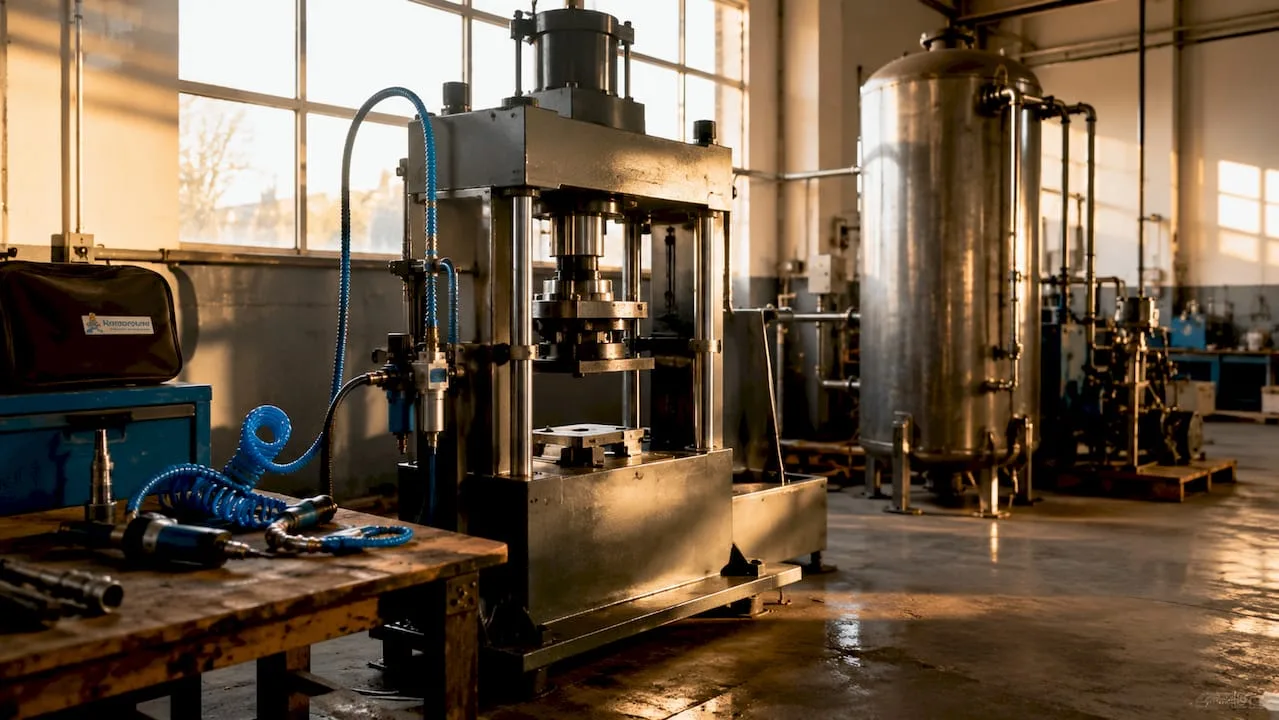
A wet air tank is installed before the air dryer, i.e. directly after the compressor. The air inside it contains moisture and condensate, which settle here and separate from the air stream. The wet air tank thus functions as a primary condensate separator and also reduces the air temperature before it enters the dryer. The choice of wet air tank fundamentally affects the dryer's operation and the quality of compressed air throughout the system.
Dry air tank
A dry air tank is placed after the air dryer. The air entering it has already been dried, so the tank serves purely a balancing function. It stabilizes the pressure in the distribution network and dampens pressure surges caused by sudden draw-offs. For applications requiring high air quality, such as in mechanical engineering or the food industry, a dry air tank is an essential part of the system.
Key parameters when selecting an air tank:
- Tank volume must correspond to the compressor output and peak consumption; an undersized air tank causes frequent cycling and motor overheating.
- Maximum working pressure must be compatible with the compressor's pressure. A higher pressure in the tank does not mean a greater flow rate, but rather a reduction in it.
- Material and surface treatment affect resistance to corrosion, especially with wet air receivers.
- Safety equipment includes a safety valve, pressure gauge, and condensate drain valve.
Professional tip: Automatic condensate drainage is more reliable than manual draining. With wet air receivers, condensate accumulates quickly, and regular draining prevents corrosion and damage to the tank.
2. Modern CAES systems and their industrial applications
CAES (Compressed Air Energy Storage) is a technology for long-term energy storage in the form of compressed air in underground reservoirs, such as salt caverns, depleted mines, or porous rock formations. The system works by using surplus electrical energy to drive compressors that compress and store the air. When needed, the air is released, heated, and drives a turbine or expansion machine that generates electricity.
CAES systems achieve an overall efficiency of around 70% and a lifespan exceeding 30 years. This performance is comparable to pumped-storage hydroelectric plants, which are currently the most widespread technology for grid-scale energy storage.
The three basic CAES concepts differ in how they handle the heat generated during compression:
- Diabatic CAES releases the heat generated during compression into the environment and, during expansion, heats the air using natural gas. It is the oldest and simplest concept, but it loses part of the energy.
- Adiabatic CAES captures the heat and stores it in a thermal energy storage (TES) system. During expansion, it returns the heat back into the air, eliminating the need for fossil fuels. Advanced CAES systems with TES achieve higher overall energy efficiency.
- Isothermal CAES keeps the air temperature constant throughout both compression and expansion. It is theoretically the most efficient approach, but its practical implementation is technically demanding.
CAES systems function as a balancing reservoir for renewable energy sources. They store surplus electricity from wind and solar power plants in the form of compressed air and release it when production is insufficient to cover demand. This rapid response capability makes them a key element of modern energy grids.
Typical components of an industrial CAES system include multi-stage compressors, coolers, an underground reservoir, a heat management system, and an expansion turbine. The main challenge remains heat loss during compression, which reduces the overall efficiency of the system unless the heat is actively captured and reused.
3. Key factors affecting air receiver sizing
Correct air receiver sizing is the most common mistake in compressed air system design. An undersized air receiver causes frequent compressor cycling, motor overheating, and premature equipment failure. Conversely, an oversized tank unnecessarily increases investment costs and takes up space.
Factors that determine the correct air receiver volume:
- Compressor output indicates the maximum air flow in liters per minute or m³/hour. The air receiver volume should correspond to at least four times this flow rate for standard applications.
- Peak demand is the maximum instantaneous air consumption during operation. Taking peak demand into account when sizing reduces operating costs and increases the efficiency of the entire system.
- Required operating pressure must match the pressure of the compressor and the connected equipment. A mismatch in pressure parameters leads to reduced flow and system instability.
- Length of the pipework affects pressure losses. Longer piping requires a larger storage volume to maintain stable pressure at the end points of consumption.
A correctly sized air receiver extends the service life of compressors by minimizing unwanted cycling and mechanical load. Every unnecessary compressor start shortens the service life of the motor, valves, and seals.
Additional equipment that increases system reliability:
- Air dryers (refrigerant or adsorption type) remove moisture and prevent corrosion in the distribution network.
- Filters capture oil, solid particles, and microorganisms according to the ISO 8573-1 purity class.
- Automatic condensate drains ensure regular draining without the need for operator attention.
Professional tip: When designing a system, always allow for a 20% margin above peak demand. This margin will cover future expansion of operations without the need to replace the air receiver. For more detail on this topic, see the guide to selecting an industrial compressor.
4. Comparison of compressed air storage systems by parameters
Choosing the right system depends on the operating scenario, available space, required air quality, and investment budget. The table below summarizes the key characteristics of each type.
| Parameter | Wet air tank | Dry air tank | CAES system |
|---|---|---|---|
| Position in the system | Before the dryer | After the dryer | Underground reservoir |
| Function | Condensate separator, cooling | Pressure equalization, storage | Long-term energy storage |
| Air quality | Lower (wet air) | High (dry air) | Depends on treatment |
| Typical volume | 50–5,000 l | 50–5,000 l | Thousands of m³ |
| Service life | 15–25 years | 15–25 years | Over 30 years |
| Investment costs | Low to medium | Low to medium | Very high |
| Typical use | Workshop, production | Production, food industry | Energy grid, industry |
| Energy efficiency | Depends on sizing | Depends on sizing | Around 70% |
A wet air receiver is the right choice for most standard industrial operations where an air dryer is part of the system. A dry air receiver is essential where air quality directly affects the product or process, for example in the pharmaceutical industry or in painting. CAES systems are economically justified only for large-capacity applications in the energy sector or heavy industry, where power outputs are in the order of megawatts.
For optimizing compressed air consumption in smaller operations, a properly sized air receiver combined with a dryer and filters is sufficient. In these cases, investment in CAES would not pay off.
5. Installation, maintenance and safety of pressure vessels
Proper installation of the air receiver determines the safety and efficiency of the entire system. The pressure vessel must meet the requirements of Directive PED 2014/68/EU and be marked with the CE mark. Regular inspection in accordance with ČSN 69 0012 is a legal obligation for vessels above the specified pressure and volume limit.
Principles of proper installation and operation:
- Install the air receiver on a flat, solid surface with sufficient access for inspections and maintenance.
- The safety valve must be set to the maximum working pressure of the vessel and must not be blocked.
- Size the inlet and outlet piping so that no pressure losses occur at the joints.
- Drain condensate regularly. For wet air receivers, daily inspection or installation of an automatic drain is recommended.
The use of air dryers and filters significantly increases the quality of the stored air and extends the service life of equipment. Moisture and impurities in the air accelerate internal corrosion of the air receiver and damage pneumatic tools and control elements.
Inspections include a visual check of the outer shell, inspection of the safety valve, ultrasonic wall thickness measurement, and testing of the safety equipment. Neglecting inspections increases the risk of an accident and can have legal consequences for the operator.
6. Energy efficiency and savings with proper storage
Proper compressed air storage directly reduces operating costs. A compressor operating in regular cycles consumes less energy than a machine that starts and stops unnecessarily. Proper air storage ensures regular compressor cycles and reduces unnecessary starting.
Pressure losses in the system are another source of energy waste. Each bar of pressure loss in the distribution network corresponds to approximately 7% higher compressor energy consumption. A properly sized air receiver combined with quality piping and seals minimizes pressure losses.
CAES systems help balance fluctuations in wind and solar energy by storing surplus electricity as compressed air with the possibility of rapid release. For industrial facilities connected to renewable sources, CAES represents a way to reduce dependence on the grid during periods of peak electricity prices.
Real-time monitoring of pressure and flow allows the identification of air leaks and inefficient consumption. Air leaks in industrial facilities account for a significant portion of total compressed air consumption. Regular system audits are therefore part of efficient operation. More on this topic is provided by the overview of air treatment for industry.
Key Takeaways
Correct sizing and selection of the air receiver type are a decisive factor for energy efficiency, compressor service life, and pressure stability throughout the compressed air system.
| Point | Details |
|---|---|
| Air receiver type by location | A wet air receiver is placed before the dryer, a dry air receiver after the dryer to ensure air quality. |
| Sizing according to peak demand | The tank volume must cover peak consumption with a reserve, otherwise the compressor will cycle. |
| CAES for large-capacity applications | CAES systems achieve an efficiency of around 70% and a service life of over 30 years, suitable for the energy sector. |
| Regular maintenance and inspections | Daily condensate drainage and regular inspections prevent corrosion and failures. |
| Supplementary equipment increases reliability | Dryers and filters extend the service life of the air receiver and connected equipment. |
Experience from practice: what really matters
I have worked with compressed air systems for many years, and the most common mistake I see is undersizing the air receiver. Technicians focus on compressor output and think about the tank only as an afterthought. The result is a compressor that starts every few minutes, overheats, and wears out prematurely.
The second thing that keeps surprising me is underestimating thermal management. In CAES systems, heat loss during compression is a key issue. Adiabatic concepts with TES storage are technically more complex, but significantly more energy-efficient. Anyone who designs a large-capacity system without addressing heat is wasting energy unnecessarily.
From a practical standpoint, I always recommend starting with an audit of actual air consumption in operation, not just a calculation on paper. Real peak demand tends to be higher than expected. A properly designed system pays for itself in energy savings within a few years.
— Zdeněk
Compressed air storage solutions from Kompresory-vzduchotechnika
Kompresory-vzduchotechnika offers a complete range of products for efficient compressed air systems, from compressors to accessories to piping components.
To ensure air quality, air treatment units up to 10 bar are available, which remove moisture, oil, and solid particles. Compressed air piping can be built using push-in system pipes in diameters of 15–28 mm, suitable for both industrial and workshop applications. The Kompresory-vzduchotechnika team provides technical advice on selecting the right solution for a specific operation, including air receiver sizing and piping network design.
Frequently asked questions
What is an air receiver and what is it used for?
An air receiver is a pressure vessel that stores compressed air and balances the difference between compressor output and instantaneous consumption. It stabilizes the pressure in the system and reduces the number of compressor starts.
What is the difference between a wet and a dry air receiver?
A wet air receiver is installed before the dryer and serves as a condensate separator. A dry air receiver is positioned after the dryer and provides a supply of dry air to the distribution network.
How to size an air receiver for industrial operation?
The volume of the air receiver should correspond to at least four times the compressor's per-minute output and take into account the peak demand of the operation. An undersized air receiver causes frequent cycling and shortens the equipment's service life.
What is CAES and who is it suitable for?
CAES (Compressed Air Energy Storage) is a system for long-term energy storage in compressed air in underground reservoirs. It is suitable for large-capacity industrial and energy applications, where it achieves an efficiency of around 70% and a service life of over 30 years.
How often should condensate be drained from the air receiver?
Condensate from a wet air receiver must be drained daily, or an automatic drain must be installed. Regular draining prevents corrosion and extends the service life of the tank.
Recommended
- List of tasks for compressed air: a guide for technicians - Kompresory-Vzduchotechnika.cz
- How to store air hoses correctly: a guide for tradespeople - Kompresory-Vzduchotechnika.cz
- Air pressure measurement options: a guide for technicians - Kompresory-Vzduchotechnika.cz
- Air flow testing methods: a guide for technicians - Kompresory-Vzduchotechnika.cz