

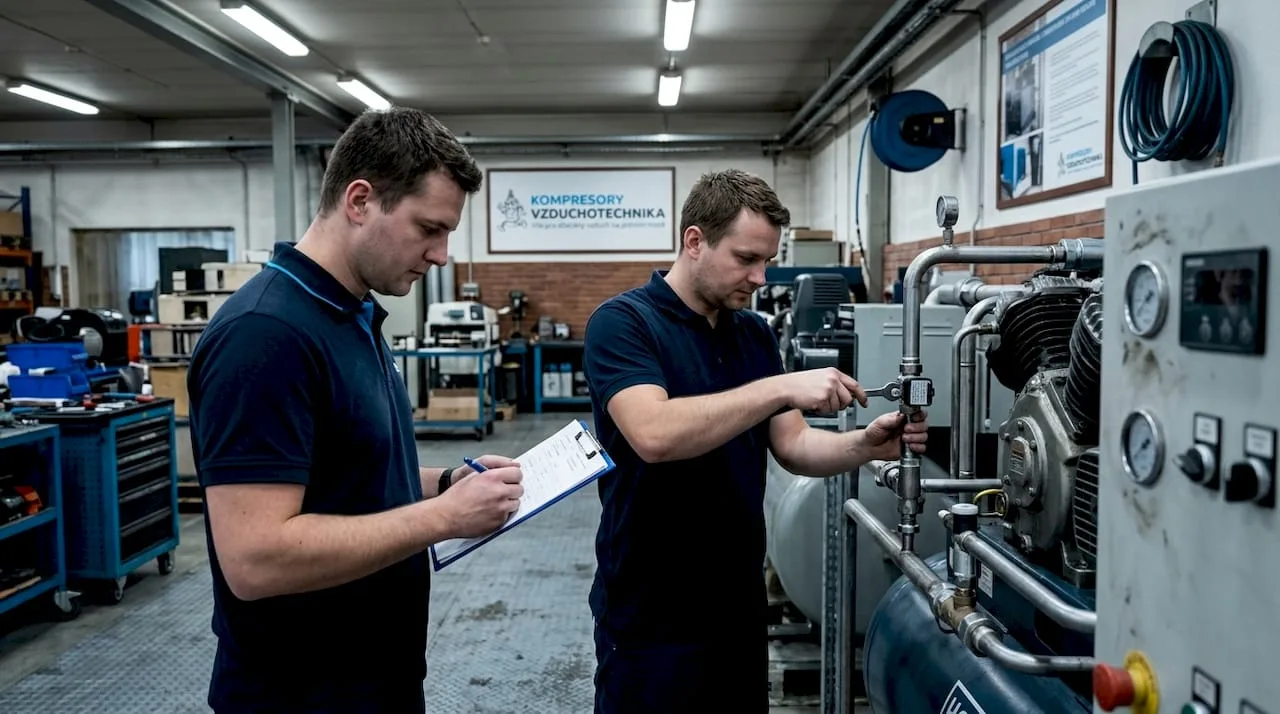
Industrial plants waste millions of crowns on the energy of compressed air every year without realising it. Accurate measurement of air consumption reveals hidden leaks, optimises the operation of compressors and reduces energy costs by tens of percent. This article will explain why systematic monitoring of air consumption is essential for a modern industrial plant, which methods and technologies to use and how to get maximum savings out of the measurement. You will learn to identify critical points of waste, choose the right measuring equipment and implement effective audit procedures.
Key findings
| Point | Details |
|---|---|
| Identification of air leaks | Systematic measurement reveals leaks and enables targeted repairs. |
| Reducing energy consumption | The consequence is a fall in the consumption of compressed air by up to tens of percent. |
| Modern measuring technologies | The use of thermal and mass flow meters ensures accurate measurement even with fluctuations of pressure. |
| Regular audits and data | Long-term analyses of data help identify peaks of consumption and support investment decision-making. |
Why measuring air consumption is essential in industry
Compressed air is among the most expensive forms of energy in an industrial plant. Producing one cubic metre of compressed air requires eight times the electrical energy compared with its volume equivalent. Yet many plants underestimate the importance of systematic measurement of consumption and thus lose enormous financial resources.
Leaks represent 20-35 % of the energy losses in a typical industrial system. A single leak with a diameter of 1 mm can cost tens of thousands of crowns a year in needlessly consumed electricity. Without accurate measurement these leaks remain undetected for months or years, while the compressors run at full power.
The measurement of air consumption provides objective data for identifying problem areas. Modern flow meters reveal not only leaks, but also incorrect dimensioning of the pipework, unsuitable pressure levels and inefficient operating modes of the compressors. These data enable targeted interventions exactly where they will bring the highest return on investment.
Key benefits of measuring air consumption:
- Identification of leaks in real time with precise localisation of the sections
- Optimisation of operating pressures according to the actual needs of production
- Detection of inefficient components requiring service
- Support for decision-making about investments in modernisation
- Documentation of savings for energy audits and certifications
Methods and technologies of measuring air consumption
The choice of the right measuring method depends on the requirements of the plant, the accuracy and the budget. Industrial practice offers several proven technologies.
Thermal flow meters use the principle of thermal conductivity. The sensor heats the stream of air and measures the loss of heat, which is directly proportional to the speed of flow. Mass flow meters measure the actual mass of the air passing through regardless of pressure and temperature. FTMg sensors combine the measurement of flow, pressure and temperature in one device, which simplifies the installation.
Acoustic cameras represent a breakthrough technology for detecting leaks in noisy environments. The device displays the ultrasonic emissions from leaks on the screen as a colour map, which enables fast localisation of problems even in complex distribution systems without the need to shut down the system.
| Measuring method | Accuracy | Main advantage | Limitation |
|---|---|---|---|
| Thermal flow meter | ±2-3 % | A wide measuring range | Sensitivity to contamination |
| Mass flow meter | ±1-2 % | Independence from pressure | Higher purchase costs |
| FTMg sensor | ±1,5 % | Combined measurement | A more complex installation |
| Acoustic camera | Qualitative | Fast detection of leaks | A high investment |
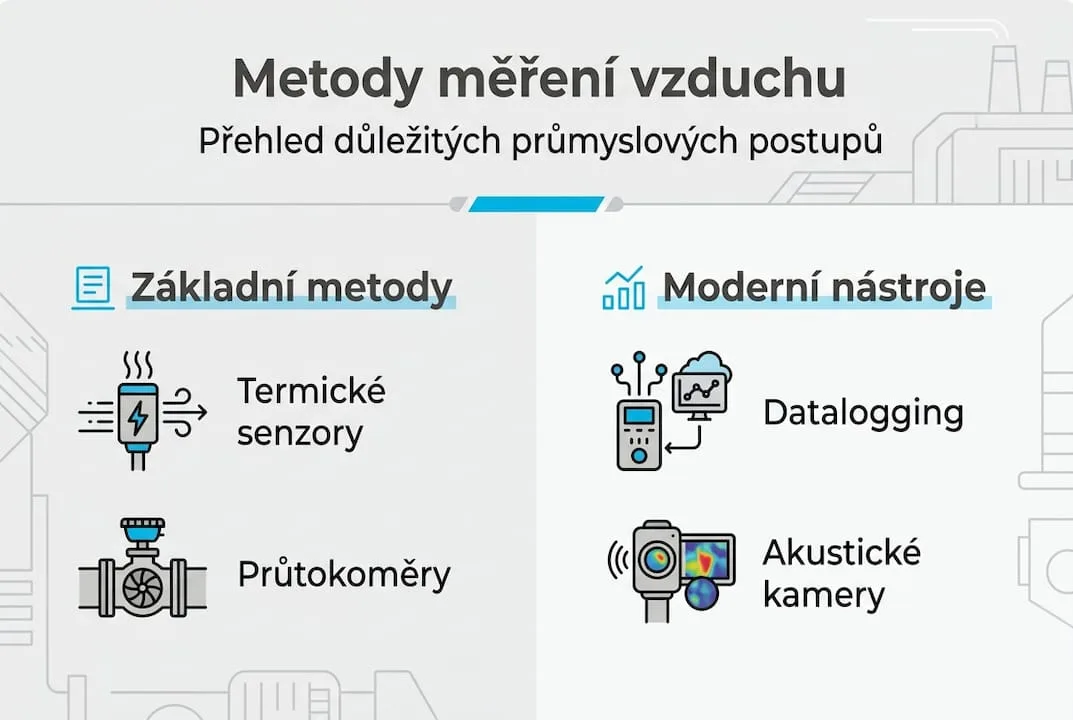
Comparison of measuring methods and typical problems in practice
Eighty percent of leaks arise in treatment units, threads and valves. This statistic reflects the critical points of the system where the greatest mechanical stress occurs. A regular check of these places using acoustic cameras reveals problems before they cause significant losses.
Bad dimensioning of the pipework is among the frequent design errors. Too narrow distribution causes pressure losses, while oversized pipework increases the volume of the system and lengthens the time of pressure build-up. Flow meters installed on various sections reveal places with an unsuitable cross-section.
| Type of problem | Typical manifestation | Detection method | Solution |
|---|---|---|---|
| Leaks in threads | A drop of pressure outside operation | Acoustic camera | Re-sealing or replacement |
| Worn valves | Excessive consumption at rest | Flow meter | Replacement of the inner parts |
| Clogged filters | Pressure losses | Differential pressure gauge | Replacement of the cartridges |
| Bad dimensioning | High speeds of flow | Velocity measurement | Reconstruction of the pipework |
Professional tip: When installing the measuring points observe the minimum distances from bends and valves according to the manufacturer’s specifications. Turbulent flow in these places distorts the results of the measurement by up to 15 %.
Practical benefits and applications of measurement in production
The implementation of systematic measurement brings results across sectors. Regular audits achieve savings of 15-30 % of the energy, while monitoring supports the implementation of ISO 50001. Continuous measurement provides the necessary data for auditors and simplifies the process of certification.
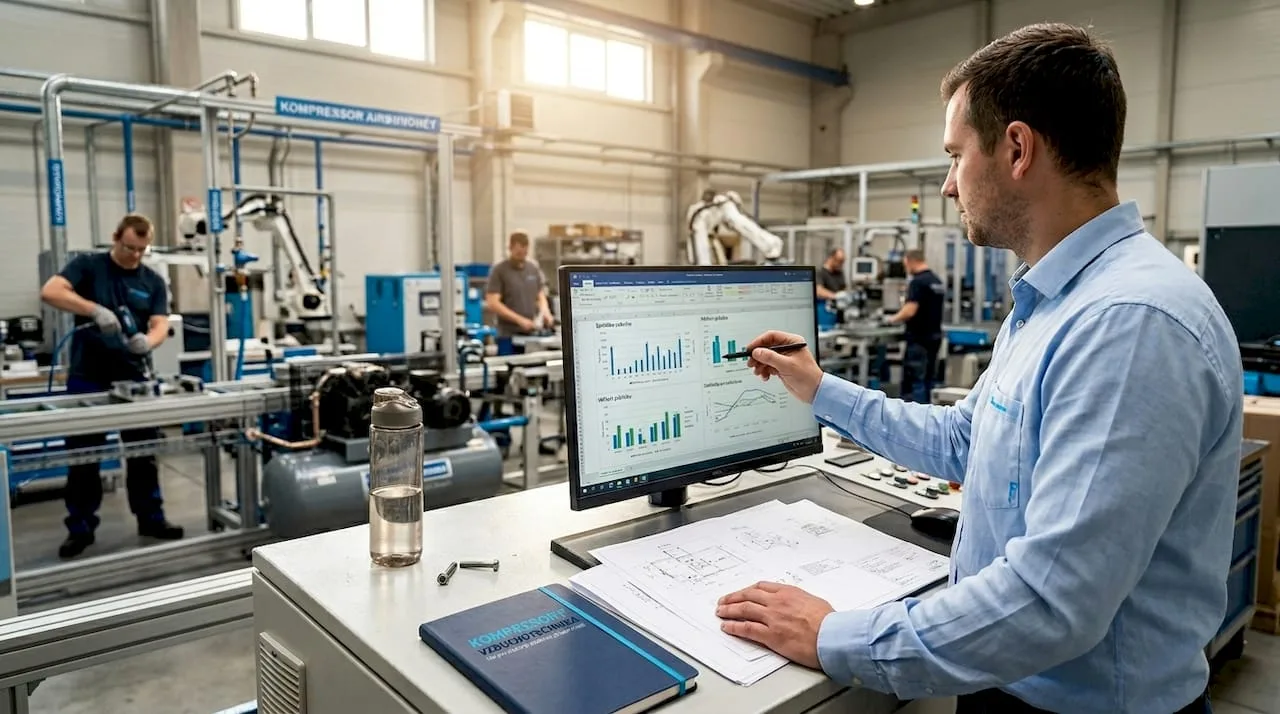
The procedure for implementing a measuring system:
- Mapping of the distribution and identification of the critical measuring points
- Installation of flow meters on the main lines and consumers
- Configuration of the datalogging and setting of the alarms
- Collection of data (min. 4 weeks) to capture all operating modes
- Analysis of the data and identification of saving measures
- Implementation of the changes and verification of the savings by repeated measurement
Equipment and accessories for measurement and optimisation
Professional measurement requires quality equipment and reliable components. We offer comprehensive solutions for industrial applications with an emphasis on accuracy.
Our SCR screw compressors with frequency converters automatically adapt the output to the current consumption and achieve savings of up to 35 %. Integrated flow meters provide data for optimising operation. We further offer professional gun sets with manometers for checking consumption in applications and air treatment units with measurement of differential pressure, which signal the need for service and minimise losses.
Frequently asked questions about measuring air consumption
How often should the measurement of air consumption be carried out?
Continuous monitoring of the main lines provides the best overview in real time. We recommend carrying out a comprehensive audit with portable flow meters at least once a year, ideally before a planned shutdown.
Which parameters are the most important for an audit?
Air flow, operating pressure and temperature form the basis. The measurement of the specific energy consumption per unit of air produced reveals the efficiency of the compressors. The differential pressure on the filters then indicates the need for maintenance.
How to distinguish real leaks from operating fluctuations?
Measuring consumption during a shutdown reveals the basic leaks. A healthy system should have a consumption outside operation of less than 10 % of the nominal output of the compressor. Higher values indicate leaks requiring localisation.
Which devices are the most accurate for continuous monitoring?
Mass flow meters and FTMg sensors achieve an accuracy of 1-2 % and provide stable results in the long term. The investment in quality measurement comes back within 12-24 months thanks to the identification of saving measures.
How does measurement help to fulfil the requirements of ISO 50001?
The standard requires demonstrable documentation of energy flows. Continuous measurement of air consumption provides the necessary data for energy audits and the verification of savings, thereby simplifying the process of certification.