

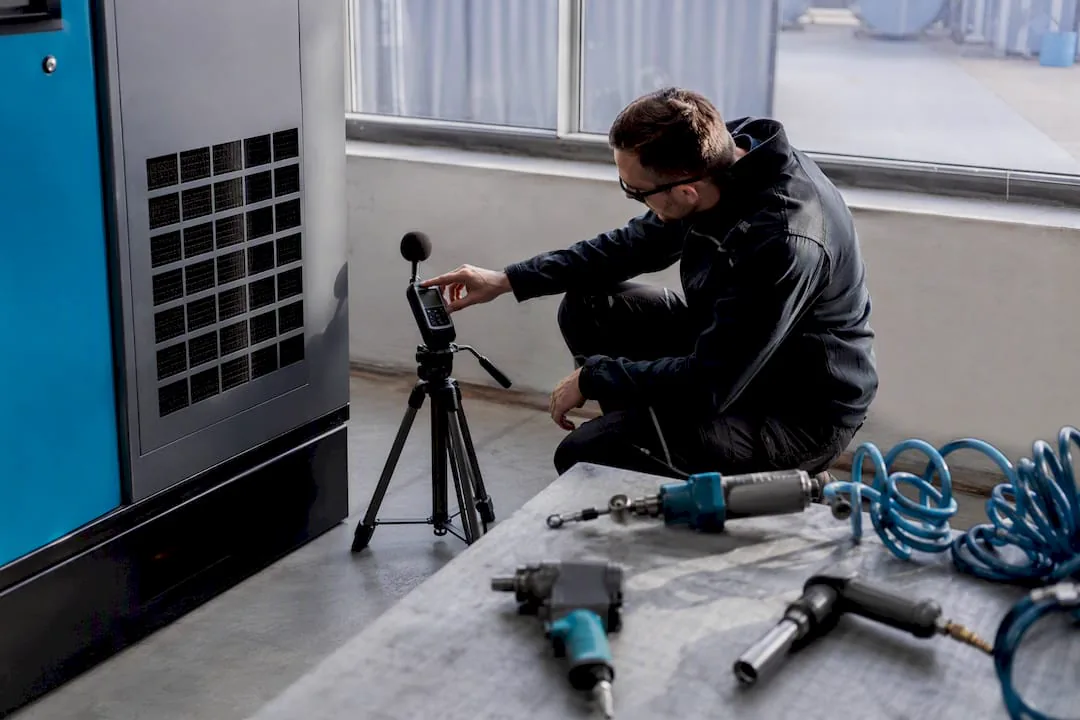
A screw compressor typically produces a sound power level (Lwa) in the range of 79 to 90 dB(A), while the sound pressure level (Lwp) at the workplace tends to be 59 to 70 dB(A). These two values are not the same, and confusing them is the most common mistake when comparing models. The first step is therefore to determine which quantity the manufacturer states on the label, and then carry out your own measurement directly on site, because the installation and the acoustics of the space can significantly shift the actual value. Standards for noise measurement and expert consultations on this topic are also offered by Kompresory-vzduchotechnika.
In brief:
- The manufacturer states different values for sound power (Lwa) and sound pressure (Lwp), which must be verified by your own measurement with regard to the installation site.
- Most compressors in operation reach a noise level of 59 to 70 dB(A) for pressure and 79 to 90 dB(A) for power, while the actual value in practical use tends to be 5 to 10 dB higher.
- The use of soundproof enclosures, anti-vibration pads, and proper pipe fastening can significantly reduce the spread of noise in the work area.
- When comparing catalog data, the measurement conditions and confirmation of the method used to determine the value must be requested, because without this, it is not possible to reliably track the actual noise level.
- Immediate measures for high noise levels include measurement, maintenance, and installation of noise-reduction elements, while investing in insulation without verifying the actual condition tends to be unnecessary.
Contents
- What do Lwa, Lwp, and dB(A) mean for a compressor
- What is the typical noise level of screw compressors in operation?
- How to compare compressor noise levels based on catalog data?
- How Kompresory-vzduchotechnika measures and addresses noise in practice
- When to address noise immediately and in what order to proceed
- Solutions for quieter compressor operation
- Useful resources for further reading
- Frequently asked questions
What Lwa, Lwp and dB(A) mean for a compressor
Sound power level (Lwa) describes the total amount of acoustic energy a machine radiates into its surroundings, regardless of distance. Sound pressure level (Lp, often written as Lwp), on the other hand, indicates how strongly the sound hits a specific point, typically one metre from the compressor housing. It is the difference between how much energy the source produces and what a person standing next to the machine actually hears.
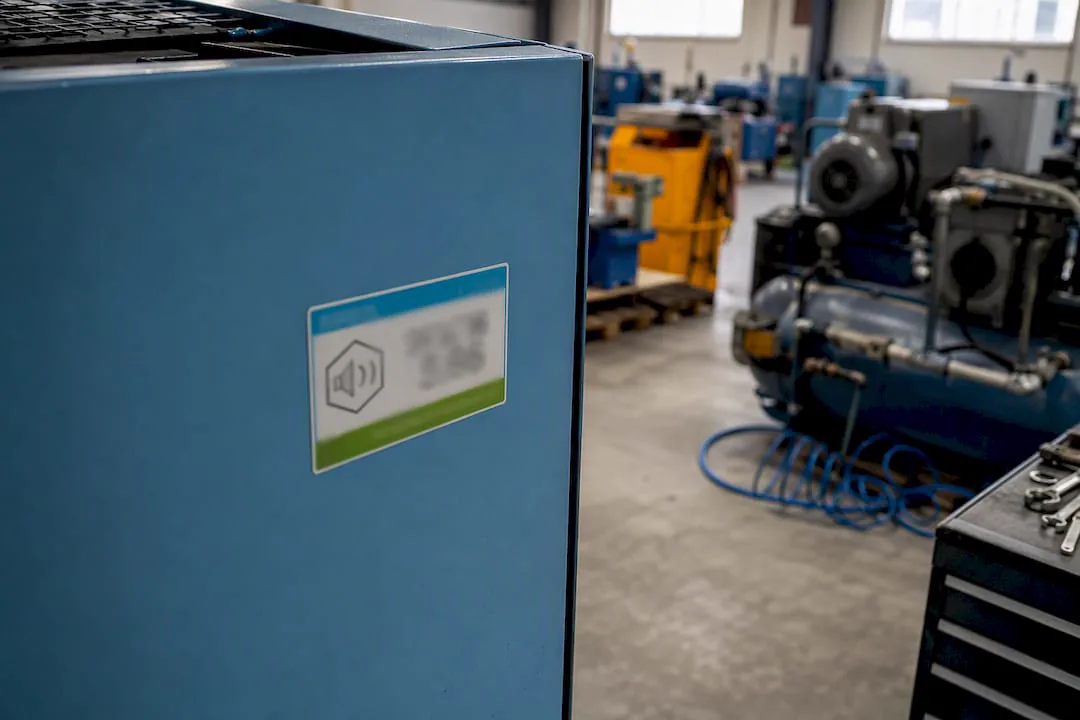
The unit dB(A) is used because the "A" weighting filter mimics the sensitivity of the human ear, which does not perceive all frequencies with the same intensity. Without this filter, the numbers would not correspond to the actual subjective perception of noise.
Comparability of the data depends on the measurement conditions:
- the distance of the microphone from the source (usually 1 metre),
- the specific measuring point (front, side or top of the housing),
- the acoustic reflectivity of the room where the measurement takes place.
Two compressors with the same figure in the catalogue can therefore behave differently in practice. A unit placed in a small workshop with smooth walls will sound louder than the same model in a larger hall with sound insulation, even though the datasheets of both state an identical value.
What is the typical noise level of screw compressors in operation?
Approximate ranges for larger enclosed screw units are around Lwp 59 to 70 dB(A) and Lwa 79 to 90 dB(A). The spread is fairly wide, as it is influenced by motor power, enclosure design, and rotational speed.
Practical measurements in operation often reveal values 5 to 10 dB higher than catalog data — the reason is usually the placement of the machine, proximity to walls, or hard floors, which reflect sound instead of dampening it.
Enclosed units with an insulated housing are among the quieter solutions and are suitable for spaces where people work near the machine. Open installations, common in industrial halls with a central compressor room, do not limit noise in any way and rely on distance or structural insulation of the room. Mobile versions intended for construction sites tend to be noisier, as the compact design and lack of a soundproof enclosure increase the transmission of vibrations to the surroundings. This has a direct impact on the working environment. A noise level exceeding commonly accepted limits already requires hearing protection during full-shift exposure, while lower levels usually do not disrupt normal communication in the hall.
How to compare compressor noise levels based on catalog data?
The statement "noise level 70 dB" without further context has no value for comparison. You don't know whether it refers to sound power or pressure, nor under what conditions the measurement was taken. Likewise, a reference value of around 85 dB often appears in practice, which must always be verified in the same way, as it alone says nothing about the type of quantity.
Before comparing two models, request specific documentation from the supplier:
- the type of quantity stated (Lwa, or Lp),
- the distance and point of measurement,
- the type of enclosure (closed, open, soundproof box),
- motor speed and cooling method (air-cooled, oil-cooled),
- measurement protocol according to the relevant standard.
Request a measurement report that includes the measurement conditions, including the room geometry. Without it, models from different manufacturers cannot be directly compared, because each may have been tested under different conditions. An estimate of the real level at the installation site can be made with a simple calculation taking wall reflectivity into account, but an on-site operational measurement in the hall is always more accurate.
| Parameter to verify | Why it is key |
|---|---|
| Type of quantity (Lwa/Lp) | Distinguishes the source power from the impact at a specific location |
| Measurement distance | Affects the measured pressure value |
| Type of enclosure | A closed enclosure dampens noise more significantly than an open design |
| Motor speed | Higher speed usually increases flow noise |
| Measurement standard | Ensures comparability between manufacturers |
The acoustics of the premises themselves play a role that no catalogue will ever take into account. A hall with concrete walls and a high ceiling reflects sound differently than a workshop with acoustic ceilings, even with an identical machine. You can find a detailed overview of the technical advantages of different designs in the comparison of screw compressors for industry.
How Kompresory-vzduchotechnika measures and addresses noise in practice
The internal methodology is based on repeated measurements at a defined point (usually one metre from the housing, at a height corresponding to the operator), with several repetitions due to fluctuations in motor load. The measured data are compared with the manufacturer's data sheet and with the actual behaviour in a specific operation.
Practical interventions that have proven most effective in the field:
- installation of anti-vibration pads under the compressor feet,
- flexible mounting of piping so that vibrations are not transmitted into the distribution system,
- acoustic enclosures and boxes for units located close to residential areas,
- inspection and replacement of filters as part of regular maintenance, which prevents an increase in noise caused by flow.
Anti-vibration pads and proper pipe fastening are among the quickest and cheapest steps to reduce noise transmitted into the building structure. For technicians dealing with specific service tasks, the guide to bleeding a compressor is useful, as well as the overview of compressor noise reduction methods, which describes the technical measures in more detail.
When to address noise immediately and in what order to proceed
If the noise level endangers the operator's hearing or exceeds the limits for the working environment, act immediately. This is not an aesthetic problem, but a matter of work safety. If it is only a matter of comfort in a hall with no people nearby, you can proceed systematically without rushing.
The recommended sequence is clear: first measure the actual noise level on site, then check maintenance (filters, lubrication, bearings), then add anti-vibration mounting, and only as the last step address an acoustic enclosure or room insulation. Skipping the measurement and going straight to investing in insulation tends to be the most common unnecessary expense we have repeatedly seen with clients.
— Zdeněk
Solutions for quieter compressor operation
Lower noise levels in a screw compressor often start with the quality of air treatment and distribution, not just the motor itself. Kompresory-vzduchotechnika offers specific categories that help reduce both operating noise and the energy demands of the system.
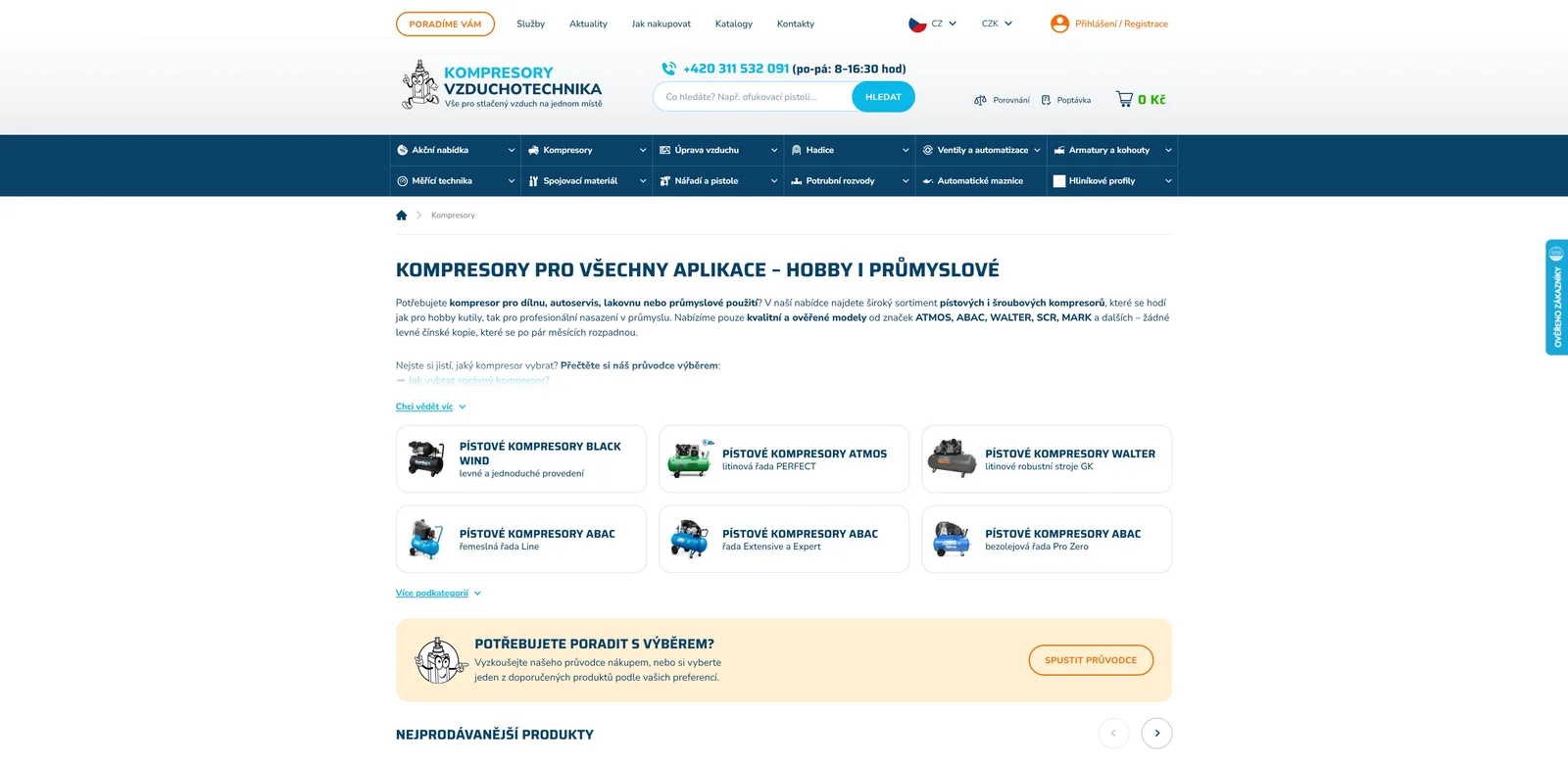
Compressed air treatment units up to 18 bar limit turbulent flow in the distribution system, which is often one of the sources of noise. Filtration according to ISO 8573 reduces the load on the compressor and thus its noise level during long-term operation. For operations where energy savings are a priority, we offer SCR regulation for screw compressors, which limits unnecessary operation at high speeds, and for the most demanding applications also scroll compressors as a quieter alternative.
If you need to order an on-site noise measurement or a consultation on selecting a suitable unit, contact Kompresory-vzduchotechnika and arrange a date directly at your facility.
Useful resources for further reading
Details on technical interventions can be found in the overview of compressor noise reduction methods. Diagnosing leaks, which amplify noise, is described in the guide to repairing an air leak, and the broader context of health protection is summarized in the article on noise reduction in operations.
Frequently asked questions
How to reduce compressor noise?
The fastest effect comes from anti-vibration pads under the feet, flexible piping mounts, and regular filter replacement. For permanently noisy units, an acoustic enclosure or placement in a separate, insulated space helps.
How loud is a noise level of 40 dB?
The level corresponding to a quiet conversation or a calm office is significantly lower. Screw compressors typically operate significantly higher, with sound pressure typically between 59 and 70 dB(A).
What is the operating principle of a screw compressor?
Two interlocking rotors compress air through a continuous rotary motion in an enclosed space, without the pulsating motion of a piston. This principle leads to a more uniform air flow and a different noise character.
What is the difference between a piston compressor and a screw compressor in terms of noise?
Piston compressors generate more pronounced impulse noise due to the intermittent motion of the piston, while screw compressors produce smoother but more continuous vibrations. The choice between them therefore also depends on whether operator comfort sensitivity or long-term noise exposure is more important.
Recommended
- List of advantages of screw compressors for industry - Kompresory-Vzduchotechnika.cz
- Screw and piston compressors with 63 kW power input - Kompresory-Vzduchotechnika.cz
- Piston and screw compressors in professional design with 4.0 kW power input
- Screw and piston compressors with 132 kW power input - Kompresory-Vzduchotechnika.cz