
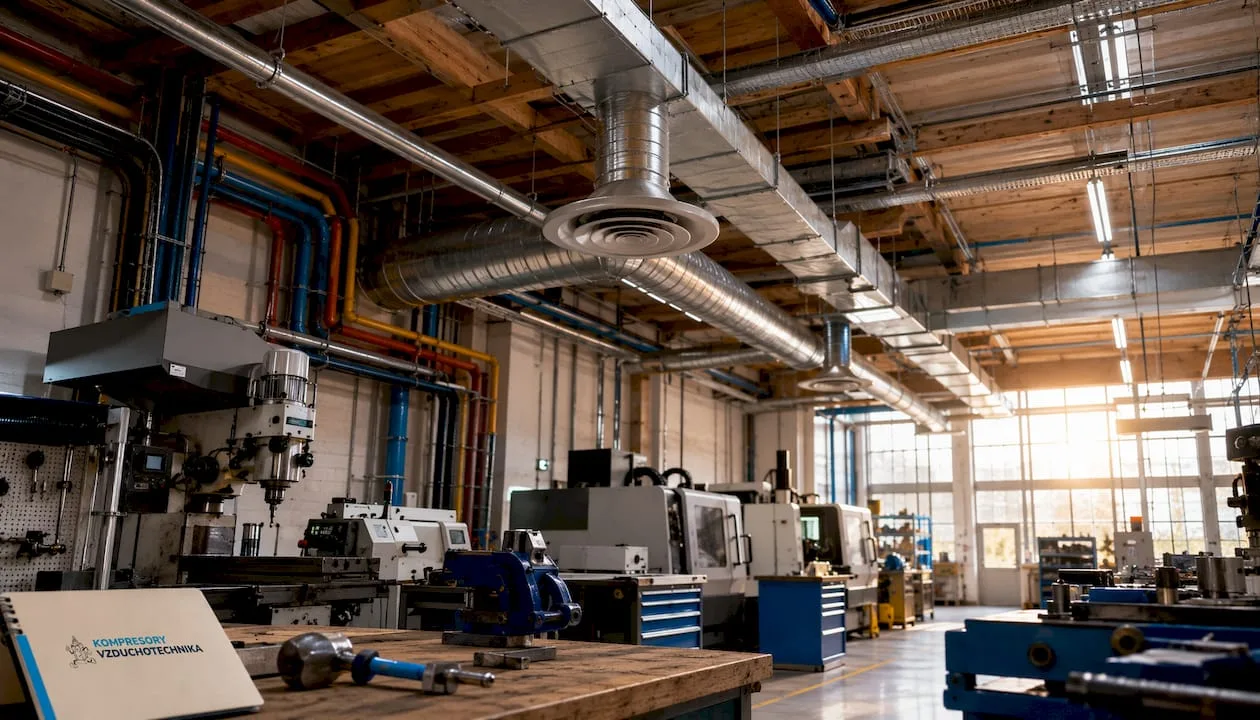
Ventilation technology is a necessity for modern industrial and manufacturing operations, not an optional extra. Controlled ventilation with heat recovery ensures a constant supply of fresh air, significantly reduces heating costs, and removes moisture, CO2, dust, and allergens from the working environment. The result is healthier air, lower employee sickness rates, and demonstrably higher work performance. Kompresory-vzduchotechnika offers technical consulting as well as specific product solutions in this area for industrial and commercial premises.
Main benefits of ventilation technology at a glance:
- Controlled ventilation ensures constant air exchange without relying on open windows
- Heat recovery returns up to 90% of energy from exhaust air back into the building
- Filtration removes dust, pollen, allergens, and harmful particles
- Mould prevention through active removal of excess moisture
- Noise insulation with closed windows in noisy industrial locations
- Integration with heat pumps and CO2 sensors for automated control
Contents
- How does heat recovery save energy and reduce heating costs?
- How does ventilation technology improve workers' health?
- Closed windows, clean air: how does ventilation technology increase comfort?
- Why is regular maintenance of ventilation systems essential?
- Why do modern buildings not function properly without ventilation systems?
- How do ventilation systems work together with heat pumps and sensors?
- What types of ventilation systems exist?
- What are the consequences of poor ventilation for health and performance?
- What standards and regulations govern ventilation systems in buildings?
- Compressors-Ventilation: technical solutions for air systems
- Key takeaways
- Frequently asked questions
How does heat recovery save energy and reduce heating costs?
Heat recovery is a principle in which the ventilation unit transfers heat from the exhaust air to the incoming fresh air via a heat exchanger. The efficiency of modern heat recovery units is high, with heating savings being significant compared to buildings without controlled ventilation.
Heat recovery can utilize up to 90% of the heat from the exhaust air, which significantly reduces heat losses and heating costs by up to 85%.
Systems are divided into central and decentralized types. Central units serve the entire building through air distribution ductwork, while decentralized units operate independently in each room without the need for ducting. Automatic two-zone control distinguishes between day and night operation, reducing both energy consumption and system noise. Sensor-based control also adjusts output to actual demand, so the system does not run needlessly at full power in empty spaces.
- Central systems: suitable for new industrial halls and larger commercial buildings
- Decentralized units: ideal for renovations or spaces where ductwork is not possible
- Two-zone control: separate control of production and administrative areas within one building
How does ventilation improve workers' health?
The quality of indoor air directly affects employees' health and performance. Ventilation systems actively remove excess moisture, CO2, dust, and allergens, reducing the risk of mold growth and contributing to a healthy indoor environment.
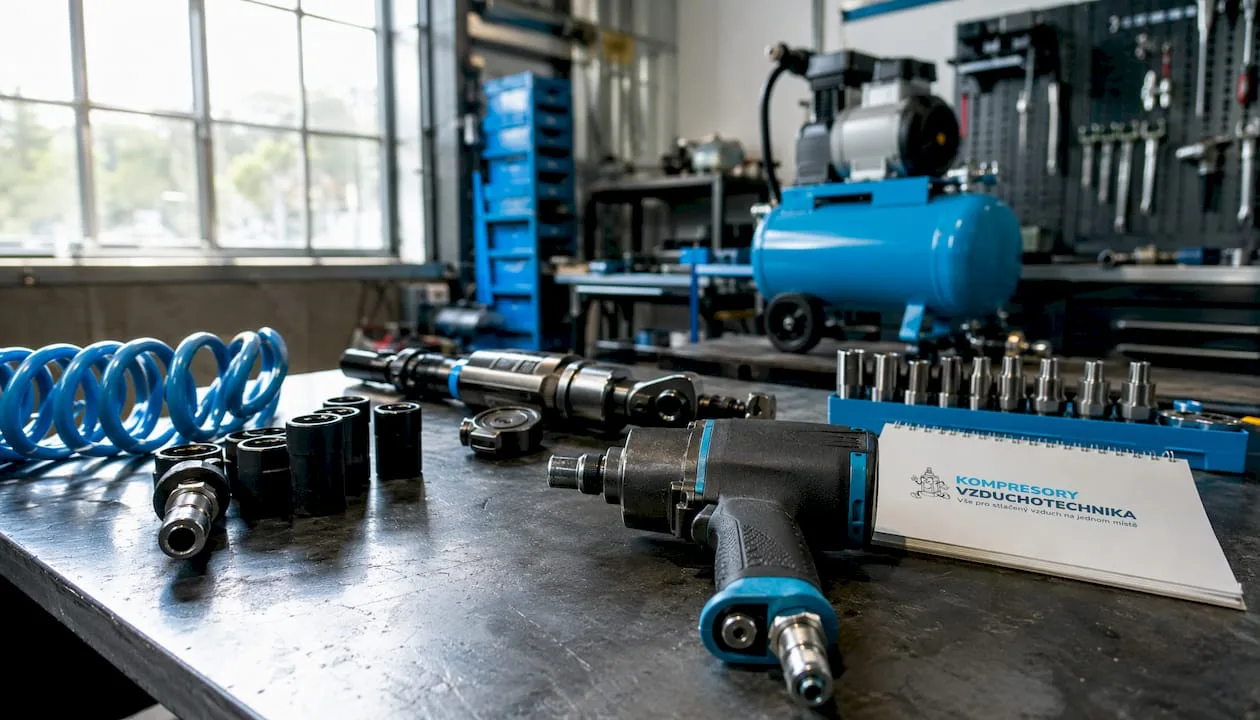
High CO2 concentration causes fatigue, headaches, and reduced concentration. In production halls where many people work in a small space, CO2 levels rise quickly without controlled ventilation. Air quality in production has a direct impact on productivity and the number of sick days.
Key insight: Properly designed ventilation reduces the occurrence of respiratory diseases and allergies among workers in enclosed facilities.
Mold prevention is especially important in insulated, airtight buildings, where natural air exchange is not sufficient to remove moisture from production, showers, or kitchens. Without controlled ventilation, moisture accumulates in building structures, causing permanent damage to the building as well as health problems.
Closed windows, clean air: how does ventilation increase comfort?
Closed windows in noisy locations minimize the penetration of noise, while ventilation systems ensure a continuous supply of fresh, filtered air. For production facilities in industrial zones or near busy roads, this is a practical solution that combines two otherwise conflicting needs.
Air filtration captures dust, pollen, and fine particles before they enter the work area. Industrial air filtration is especially important in facilities involving machining, welding, or painting, where the air contains harmful substances. This allows workers to breathe clean air without the constant need to open windows, which would disrupt thermal comfort or operational safety.
Why is regular maintenance of ventilation systems essential?
A ventilation system only works reliably if the operator maintains it regularly. Neglected maintenance leads to deteriorated air quality, higher energy consumption, and system noise.
Basic maintenance tasks:
- Filter replacement according to the manufacturer's recommendations, typically every 3–6 months
- Cleaning the heat exchanger to maintain heat recovery efficiency
- Disinfection of ductwork in case of mold or bacteria occurrence
- Checking the tightness of ducting and joints to prevent air leaks
- Inspection of control electronics and CO2 or humidity sensors
Professional tip: Create a service plan right when installing the system. Write down the filter replacement intervals directly in the building's operating log. A system without a maintenance plan loses efficiency and can become a source of contamination instead of a solution to it.
Tomáš Sysel from the Institute of Healthy Living points out that ventilation systems require regular care, especially filter replacement, otherwise they stop fulfilling their purpose. Heat recovery is not a cure-all. A poorly maintained system can spread pollutants instead of removing them.
Why don't modern buildings function properly without ventilation systems?
Due to energy standards, modern buildings are tighter than older construction. Natural air infiltration through gaps in windows and doors, which used to ensure basic air exchange, practically does not exist in new buildings. Without controlled ventilation, moisture, CO2, and pollutants accumulate with no way to escape.
Legislation and expert recommendations therefore require the installation of controlled ventilation in low-energy and passive buildings. For industrial facilities, hygienic standards apply, setting minimum amounts of supplied fresh air per person and per type of operation. These requirements are met by air handling systems automatically and measurably, whereas ventilation through windows depends on user behaviour and weather conditions.
How does air handling cooperate with heat pumps and sensors?
The integration of air handling systems with heat pumps and CO2 sensors enables automated ventilation control, optimisation of energy consumption and increased comfort for workers. A CO2 sensor measures the current concentration of carbon dioxide and regulates the fan output accordingly. The result is ventilation exactly where it is needed, without unnecessary overheating or overcooling.
Connection with heat pump systems reduces the ecological footprint of operation, because waste heat from ventilation is returned back into the heating circuit. Two-zone control separates the operation of the production hall from the administrative part, with each zone responding to its own sensors. Automation of compressed air in industry shows how similar control logic also works in pneumatic systems.
What types of air handling systems exist?
The choice of system depends on the type of building, the size of the operation and the installation options.
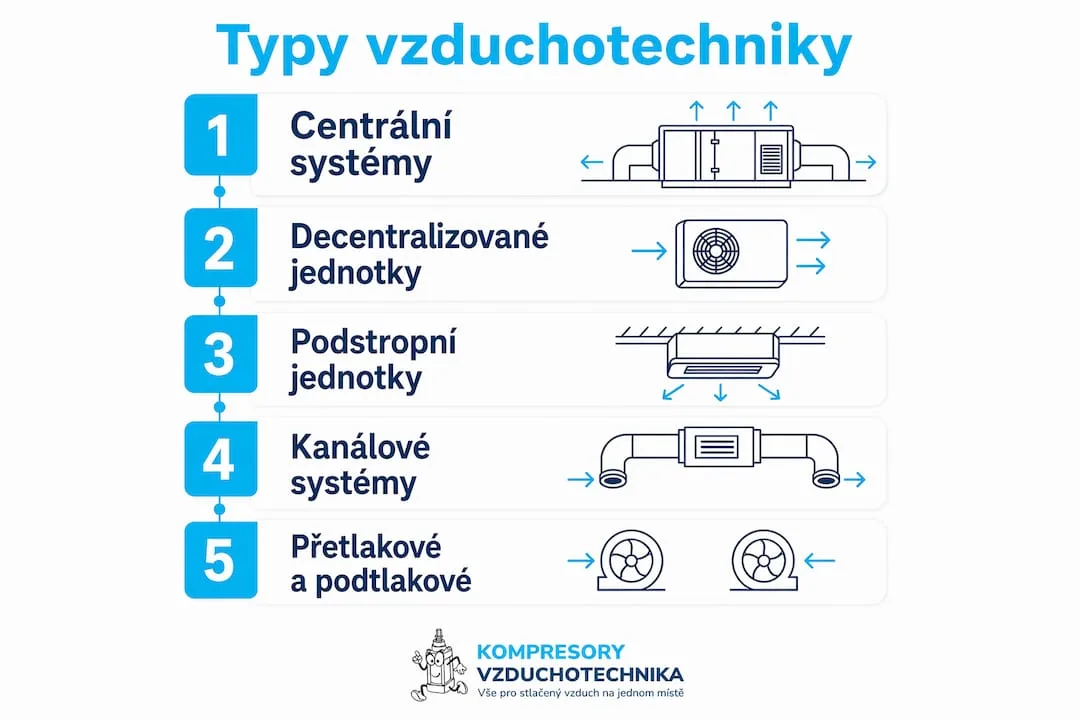
Central air handling systems serve the entire building with a single unit connected to a network of ductwork. They are suitable for new industrial halls, production plants and larger commercial buildings, where the ductwork can be integrated into the building structure.
Decentralised units operate without ductwork and are installed directly into the perimeter wall or window. Decentralised air handling systems allow installation even in spaces without ductwork options, making them suitable for renovations or apartments. For industrial operations, they are suitable where a central solution is not technically or economically feasible.
Ceiling-mounted and duct units combine ventilation with air conditioning or heating and are common in commercial spaces, server rooms and clean operations.
Pressurised and depressurised systems are used in special operations, for example in paint shops or the food industry, where it is necessary to control the direction of air flow and prevent contamination.
What are the consequences of poor ventilation for health and performance?
Insufficient ventilation causes measurable problems. High CO2 concentration reduces the cognitive performance of workers, increases the number of errors and slows down decision-making. Humid air promotes the growth of mould and bacteria on surfaces as well as in building structures.
Workers in poorly ventilated spaces suffer more often from headaches, fatigue, and respiratory problems. Long-term exposure to dust or chemical fumes without adequate ventilation leads to occupational diseases. Besides health impacts, employee turnover and sick leave costs also increase. Investment in ventilation technology therefore pays off not only in energy savings but also in the reduction of these indirect costs.
What standards and regulations govern ventilation technology in buildings?
Czech legislation and European standards set specific requirements for ventilation depending on the type of building and operation. Government Regulation No. 361/2007 Coll. determines the minimum amount of supply air at the workplace. The standard ČSN EN 16798 addresses the energy performance of buildings and requirements for the indoor environment, including ventilation.
For industrial operations, hygienic limits apply for concentrations of pollutants, dust, and temperature of the working environment. These limits are monitored by the Regional Public Health Authority, and failure to comply can lead to fines or closure of the operation. Properly designed and operated ventilation technology meets these requirements automatically and provides the operator with measurable evidence of indoor environment quality.
Kompresory-vzduchotechnika: technical solutions for air systems
Kompresory-vzduchotechnika supplies components and systems for industrial air distribution, from air treatment units through SCR screw compressors to air receivers and accessories. For operations dealing with both ventilation technology and compressed air for pneumatic tools, it is a single supplier with a complete offering.
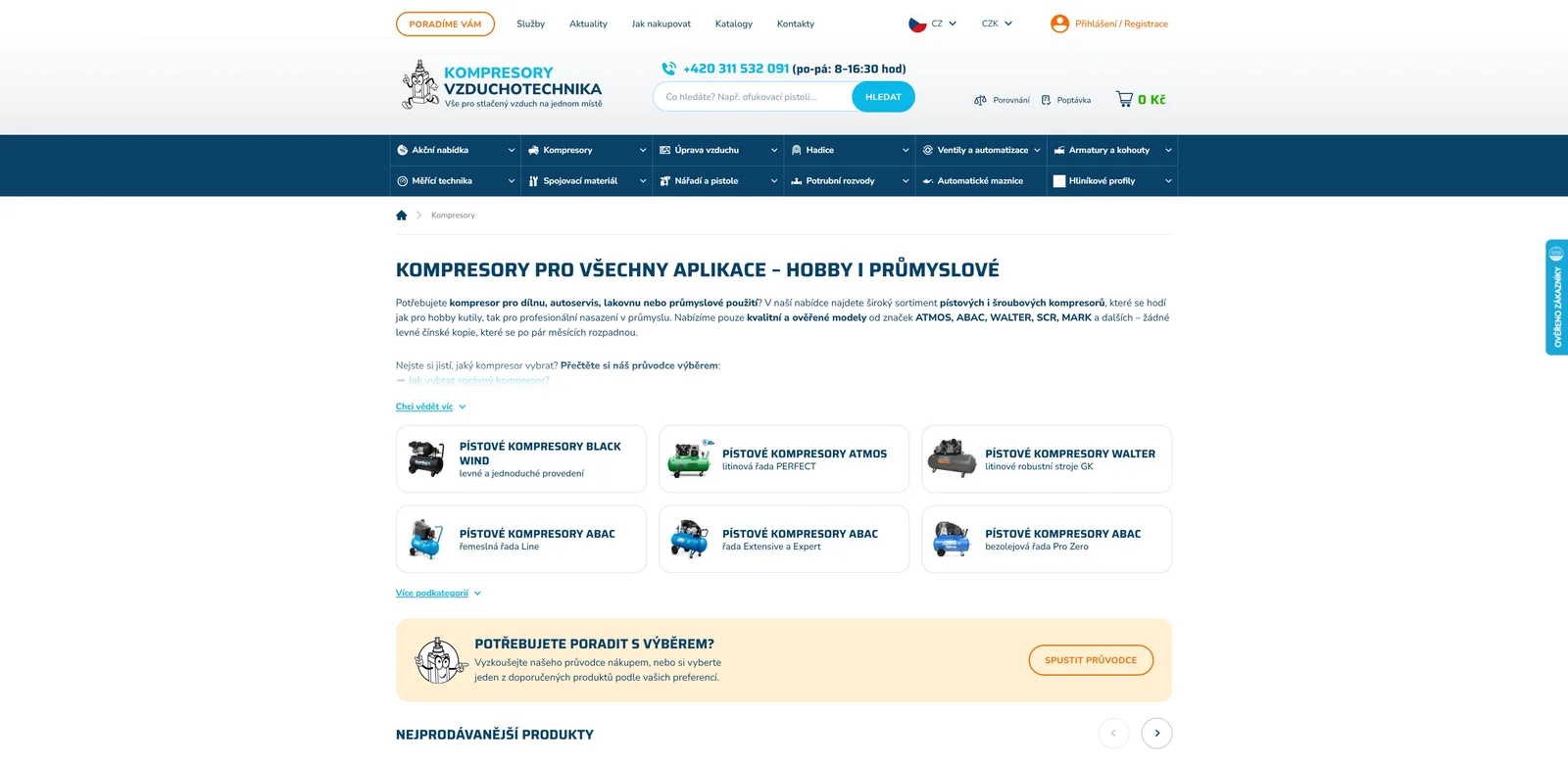
The technical team at Kompresory-vzduchotechnika will advise on the correct selection of compressors, filters, and distribution components for a specific type of operation. Whether it is a new installation or the modernization of an existing system, the offering includes products for small workshops as well as large industrial plants. Browse the current range at kompresory-vzduchotechnika.cz and find out which components match your operational requirements.
Key findings
Ventilation technology with heat recovery is, for industrial and commercial operations, the most effective way to simultaneously ensure air quality, energy savings, and compliance with legislative requirements.
| Point | Details |
|---|---|
| Energy savings | Recuperation recovers up to 90% of heat from exhaust air. |
| Worker health | Controlled ventilation removes CO2, moisture and dust, reducing sick leave and increasing performance. |
| Regular maintenance | Replacing filters every 3–6 months is a condition for maintaining the system's efficiency. |
| Legislative compliance | Standards ČSN EN 16798 and Government Regulation No. 361/2007 Sb. set binding ventilation limits. |
| Compressors-ventilation systems | Supplies compressors, air treatment units and accessories for industrial air systems. |
Frequently asked questions
Why use ventilation systems instead of opening windows?
Ventilation systems ensure a controlled, filtered air supply independent of weather or user behaviour. At the same time, recuperation recovers heat that would otherwise escape through open windows.
How effective is heat recovery?
Modern heat recovery units achieve efficiencies of up to 90% and allow heating cost savings of up to 85% compared to buildings without controlled ventilation.
How often do filters in ventilation systems need to be replaced?
Filters are generally replaced every 3–6 months depending on operating intensity and manufacturer recommendations. Neglected replacement reduces system efficiency and worsens air quality.
Is ventilation mandatory in industrial buildings?
Yes, Government Regulation No. 361/2007 Coll. and hygiene standards set minimum requirements for workplace ventilation. Failure to comply can lead to sanctions from the Regional Public Health Authority.
Can ventilation be connected to a heat pump?
Yes, integrating ventilation with a heat pump and CO2 sensors enables automated ventilation control and reduces the overall energy consumption of operation.
Recommended
- The importance of compressed air automation in industry - Kompresory-Vzduchotechnika.cz
- How air quality affects performance in industry - Kompresory-Vzduchotechnika.cz
- How to install air handling equipment correctly: a practical procedure - Kompresory-Vzduchotechnika.cz
- List of tasks for compressed air: a guide for technicians - Kompresory-Vzduchotechnika.cz