
Anti-vibration mounts for compressors: rubber-metal buffers
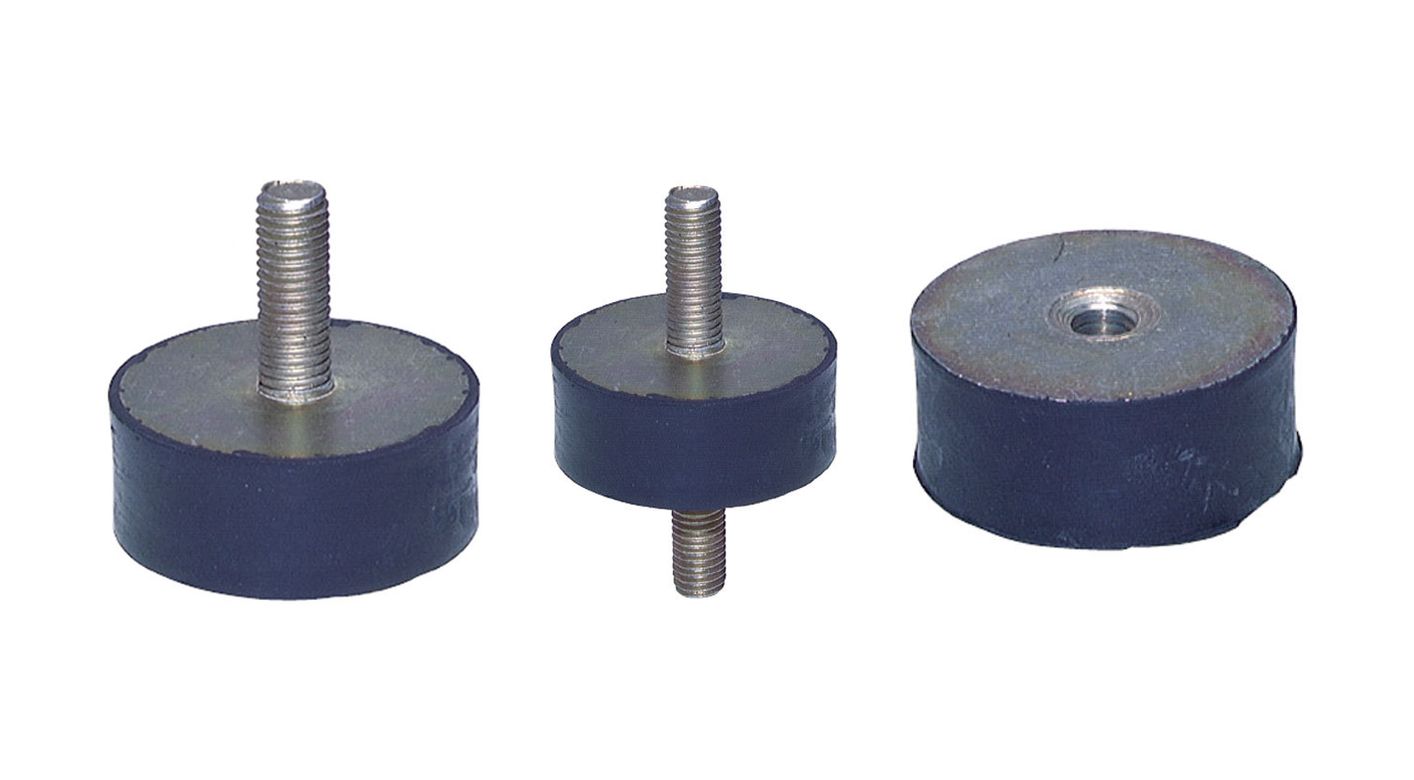
A compressor bolted straight into concrete passes every stroke of the piston into the floor. The workshop rattles, bolted joints work loose, and over time the shaking fatigues the welds on the feet of the air receiver. An anti-vibration mount is a rubber cylinder between two steel plates that goes between the machine and the floor — and it breaks that path. We carry them in three diameters and four thread designs, so they fit the feet your machine actually has.
What an anti-vibration mount is
An anti-vibration mount — also called a rubber-metal buffer, a machine foot, or a silent block — is a cylinder of natural rubber at 55° Shore hardness with galvanised steel plates pressed into both ends, each carrying a thread. The rubber between the plates works as a spring: it absorbs the knocks and the shaking that would otherwise go straight into the floor. The maker lists two purposes for them — sound damping and vibration isolation.
One thing to watch: the same word, silent block, is also used for the bushings in a car’s suspension. That is an entirely different part and you will not find it here. Ours are machine mounts — they belong under a compressor, a pump, or any other machine that stands on feet.
Two questions that settle the choice
Before you start picking a size, look at the feet of your machine. The answers to these two questions narrow twenty-four items down to a handful.
1. Male or female thread?
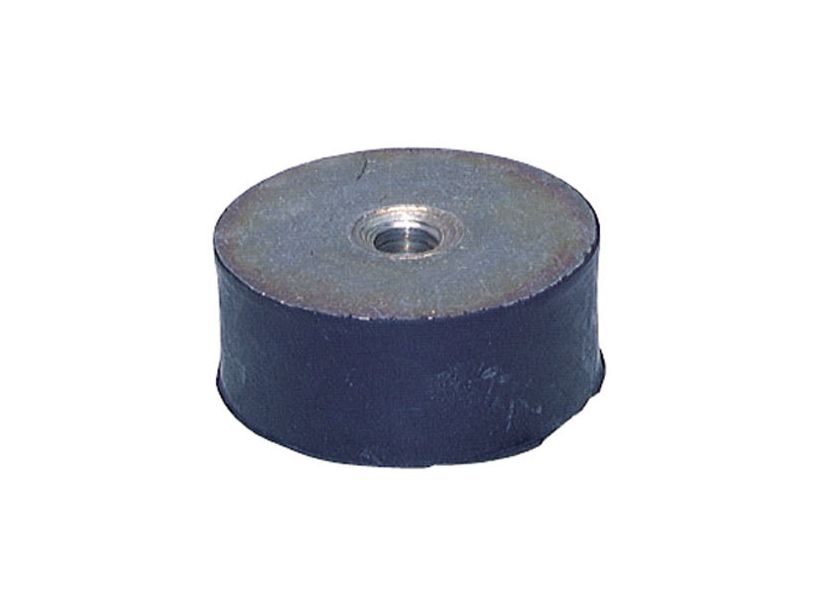
What decides it is what sits on the machine’s foot. If the foot has only a plain hole, you need a mount with a male thread — the stud goes through the hole and is secured with a nut. If instead a bolt or a threaded stud sticks out of the foot, you need a female thread, that is a block with a tapped hole that screws onto it.
2. One-sided or two-sided?
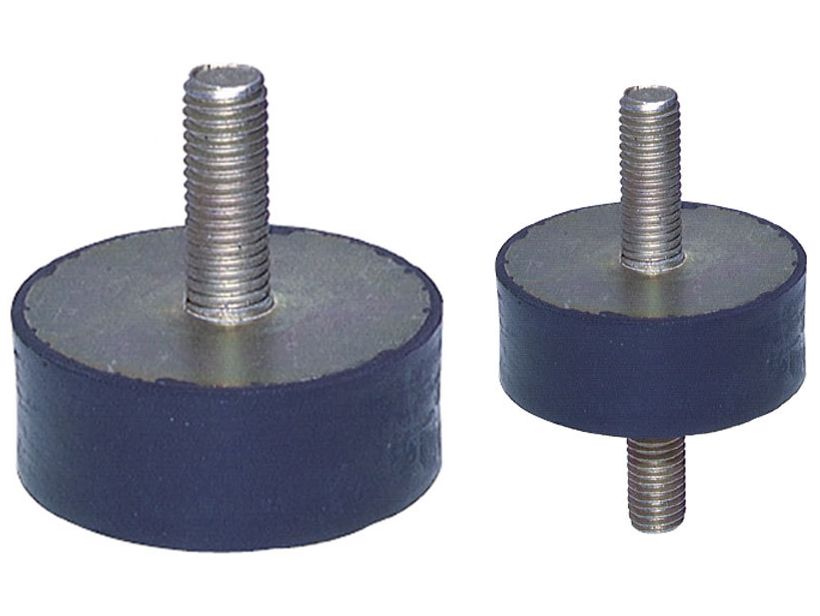
A one-sided mount has a thread at one end only. The other end is plain and the machine simply stands on it — an ordinary foot. A two-sided mount has threads at both ends: one fastens to the machine, the other can be bolted to the floor, to a frame or to a bracket. Take it where the machine must not shift anywhere.
How to tell them apart
In the photographs the difference shows at a glance — and it is exactly the difference you have to get right.
Overview by thread and size
One row is one size. The two columns side by side give that same size in the two-sided and the one-sided design, so you do not have to hunt through two lists.
Mounts with a male thread
| Anti-vibration mounts with a male metric thread — diameter, height and stud length | |||||
|---|---|---|---|---|---|
| Two-sided | One-sided | Diameter | Height | Thread | Stud length |
| GPA4020 | GPD4020 | 40 mm | 20 mm | M8 | 23 mm |
| GPA4030 | GPD4030 | 40 mm | 30 mm | M8 | 23 mm |
| GPA5020 | GPD5020 | 50 mm | 20 mm | M10 | 28 mm |
| GPA5030 | GPD5030 | 50 mm | 30 mm | M10 | 28 mm |
| GPA7525 | GPD7525 | 75 mm | 25 mm | M12 | 37 mm |
| GPA7550 | GPD7550 | 75 mm | 50 mm | M12 | 37 mm |
Mounts with a female thread
| Anti-vibration mounts with a female metric thread — diameter, height and thread depth | |||||
|---|---|---|---|---|---|
| Two-sided | One-sided | Diameter | Height | Thread | Thread depth |
| — | GPE4020 | 40 mm | 20 mm | M8 | 7 mm |
| GPC4025 | — | 40 mm | 25 mm | M8 | 7 mm |
| GPC4030 | GPE4030 | 40 mm | 30 mm | M8 | 7 mm |
| — | GPE5020 | 50 mm | 20 mm | M10 | 8 mm |
| GPC5025 | — | 50 mm | 25 mm | M10 | 8 mm |
| GPC5030 | GPE5030 | 50 mm | 30 mm | M10 | 8 mm |
| GPC7525 | GPE7525 | 75 mm | 25 mm | M12 | 10 mm |
| GPC7550 | GPE7550 | 75 mm | 50 mm | M12 | 10 mm |
An empty cell means the maker does not make that size in that design. The female range starts five millimetres taller: where the male series has 40 × 20, the two-sided female has 40 × 25.
For the male design the figure given is the length of the stud projecting from the mount. For the female design it is the depth of the tapped hole — which is why those numbers are so much smaller, and it is not a mistake. Dimensions follow the maker’s catalogue.
#showmore#
Choosing the size
Diameter by machine and by foot
The mount must have a bearing face at least as large as the machine’s foot, otherwise the rubber is loaded only at its edge and soon squashes. We carry three diameters: 40 mm for smaller workshop compressors and lighter air equipment, 50 mm for ordinary stationary machines, and 75 mm for heavy piston units, where there is plenty to absorb. If you are torn between two, take the larger — more rubber damps better and the machine stands steadier.
Height: how much room you gain under the machine
The height of the block is also how far the machine rises. At 40 and 50 mm you choose between 20, 25 and 30 mm, at seventy-five between 25 and 50 mm. A taller block holds more rubber, so it damps more — but it also allows the machine more sideways movement, which matters for anything connected to it by rigid pipework.
How many
As many as the machine has feet — on a compressor with a receiver that is usually four. Always the whole set: if one corner stays hard-mounted, the vibration concentrates there and the result is worse than having no mounts at all.
Fitting
Once seated, the machine must stand level, with the weight spread evenly over all the mounts. Tighten the bolted joints, but do not compress the rubber solid — it is meant to work, not to be wedged fast. If the machine is connected by rigid pipework, reckon with it now being allowed to move a little; a flexible hose on the first section saves a great deal of trouble.
Rubber does not get on with oil and solvents. If the compressor on its mounts stands where oil drips, wipe it up — natural rubber softens in oil.
Where else they are used
Whether a mount fits is decided not by the kind of machine but by the thread and the bearing face of the foot. That is why these items are used beyond compressors — under generator sets, pumps, fans and outdoor air-conditioning units, anywhere a machine shakes and stands on feet.
The same applies as with a compressor: measure the spacing and the thread on the feet and pick a diameter that covers the foot. If you are not sure, photograph the machine’s foot and send it to us — we will advise which size will sit there.
What goes with them
Mounts are one piece of the puzzle around the receiver. Here is the rest.
- Air receivers — the mounts go on their feet
- Receiver fittings — safety valve, pressure gauge and cocks for the receiver
- Drain valves — releasing condensate from the bottom of the vessel
- Compressor noise — how it is measured and what else can be done about it
- Ways to cut noise — mounts are only one of the routes

Ventilek says
A compressor bolted hard straight into concrete is a road to ruin.
I know it looks like a trifle. But over time that shaking will reliably work your pipes loose, or the welds on the receiver feet — and a cracked weld on a pressure vessel is not repaired, the vessel is scrapped. A set of mounts is the cheapest insurance you can give your machine. And two things, so it does some good: fit them under every foot at once, not just under two, and on heavy machines take 50 or 75 mm, so there is a proper face underneath.
Frequent questions about anti-vibration mounts
- How do I tell whether I need a female or a male thread?
- Look at the foot of the machine. A plain hole in the foot means a mount with a male thread — the stud goes through the hole and is secured with a nut. A protruding bolt or threaded stud means a female thread, that is a block with a tapped hole. If you are not sure, photograph the foot and send it to us.
- How many mounts do I need?
- As many as the machine has feet — on a compressor with a receiver that is usually four. Always the whole set at once. If one corner stayed hard-bolted, the vibration would concentrate there and the result would be worse than having no mounts at all.
- Which diameter should I pick?
- One that covers the foot of the machine. We carry 40, 50 and 75 mm: forty for smaller workshop compressors, fifty for ordinary stationary machines and seventy-five for heavy piston units. Between two sizes, choose the larger.
- Can a mount be used under something other than a compressor?
- Yes. What decides is the thread and the size of the foot, not the kind of machine — they are used under generator sets, pumps, fans and outdoor air-conditioning units. The method is the same: measure the thread on the foot and pick a diameter that covers it.
- What are the mounts made of?
- Natural rubber at 55° Shore hardness with galvanised steel plates pressed in, carrying the thread. Rubber is sensitive to oil and solvents, so wipe up any drips.
- Why do the female designs come in different heights from the male ones?
- Because that is how the maker builds them. The female range starts five millimetres taller: where the male design has 40 × 20 mm, the two-sided female has 40 × 25 mm. Keep that in mind so you are not looking for a size that does not exist in that design.
Dimensions follow the maker’s catalogue. For the male design the figure is the length of the projecting stud, for the female one the depth of the tapped hole.


Product sorting
List of products

GPD5030 silent blocks for compressors with pressure vessel. Designed primarily for mounting on pressure vessel attachments, they prevent vibration transmission and contribute to...

Silentblocks GPE4030 for compressors with pressure vessel. Designed primarily for mounting on pressure vessel extensions. They prevent vibration transmission and contribute to...

GPD7550 silent blocks for compressors with pressure vessel. Designed primarily for mounting on pressure vessel attachments, they prevent vibration transmission and contribute to...

GPD5020 silent blocks for compressors with pressure vessel. Designed primarily for mounting on pressure vessel attachments, they prevent vibration transmission and contribute to...

Silentblocks GPE4025 for compressors with pressure vessel. Designed primarily for mounting on pressure vessel extensions. They prevent vibration transmission and contribute to...

GPD4020 silent blocks for compressors with pressure vessel. Designed primarily for mounting on pressure vessel attachments, they prevent vibration transmission and contribute to...

GPD7525 silent blocks for compressors with pressure vessel. Designed primarily for mounting on pressure vessel attachments, they prevent vibration transmission and contribute to...

Silentblocks GPE5030 for compressors with pressure vessel. Designed primarily for mounting on pressure vessel extensions. They prevent vibration transmission and contribute to...

Silentblocks GPA7525 for compressors with pressure vessel. Designed primarily for mounting on pressure vessel extensions. They prevent the transmission of vibrations and...

Silentblocks GPC7550 for compressors with pressure vessel. Designed primarily for mounting on pressure vessel extensions. They prevent the transmission of vibrations and...

Silentblocks GPA7525 for compressors with pressure vessel. Designed primarily for mounting on pressure vessel extensions. They prevent the transmission of vibrations and...

Silentblocks GPC7525 for compressors with pressure vessel. Designed primarily for mounting on pressure vessel extensions. They prevent the transmission of vibrations and...

Silentblocks GPE7525 for compressors with pressure vessel. Designed primarily for mounting on pressure vessel extensions. They prevent vibration transmission and contribute to...

Silentblocks GPE7550 for compressors with pressure vessel. Designed primarily for mounting on pressure vessel extensions. They prevent vibration transmission and contribute to...

Silentblocks GPC4025 for compressors with pressure vessel. Designed primarily for mounting on pressure vessel extensions. They prevent the transmission of vibrations and...

Silentblocks GPA4020 for compressors with pressure vessel. Designed primarily for mounting on pressure vessel extensions. They prevent the transmission of vibrations and...

GPD4030 silent blocks for compressors with pressure vessel. Designed primarily for mounting on pressure vessel attachments, they prevent vibration transmission and contribute to...

Silentblocks GPC5030 for compressors with pressure vessel. Designed primarily for mounting on pressure vessel extensions. They prevent the transmission of vibrations and...

Silentblocks GPC5025 for compressors with pressure vessel. Designed primarily for mounting on pressure vessel extensions. They prevent the transmission of vibrations and...

Silentblocks GPA4020 for compressors with pressure vessel. Designed primarily for mounting on pressure vessel extensions. They prevent the transmission of vibrations and...

Silentblocks GPA5020 for compressors with pressure vessel. Designed primarily for mounting on pressure vessel extensions. They prevent the transmission of vibrations and...

Silentblocks GPE5020 for compressors with pressure vessel. Designed primarily for mounting on pressure vessel extensions. They prevent vibration transmission and contribute to...

Silentblocks GPC4030 for compressors with pressure vessel. Designed primarily for mounting on pressure vessel extensions. They prevent the transmission of vibrations and...

Silentblocks GPA4030 for compressors with pressure vessel. Designed primarily for mounting on pressure vessel extensions. They prevent the transmission of vibrations and...