

In brief:
- Quality air has optimal concentrations of pollutants and physical parameters. For correct assessment, both outdoor and indoor environments are measured, including PM particles, CO2, humidity and temperature. Continuous monitoring of these parameters is key to protecting health and performance.
Quality air is air with optimal concentrations of pollutants and physical parameters that ensure a healthy and comfortable environment for people. The technical term for this area is air quality (in Czech kvalita ovzduší), whereby in practice both outdoor and indoor environments are assessed. Key parameters include dust particles PM10 and PM2.5, carbon dioxide (CO2), relative humidity and temperature. Czech legislation, specifically Act No. 201/2012 Coll. on air protection, sets binding limits for pollutants and forms the basis for assessment using the Air Quality Index (IKO). Proper understanding of these parameters is the first step towards protecting health and performance.
What is the definition of quality air and which parameters determine it?
Quality air meets precisely defined values of pollutant concentrations and physical quantities. It is not enough to monitor a single indicator. Only the combination of all parameters gives a complete picture of the condition of the environment.
Dust particles PM10 and PM2.5
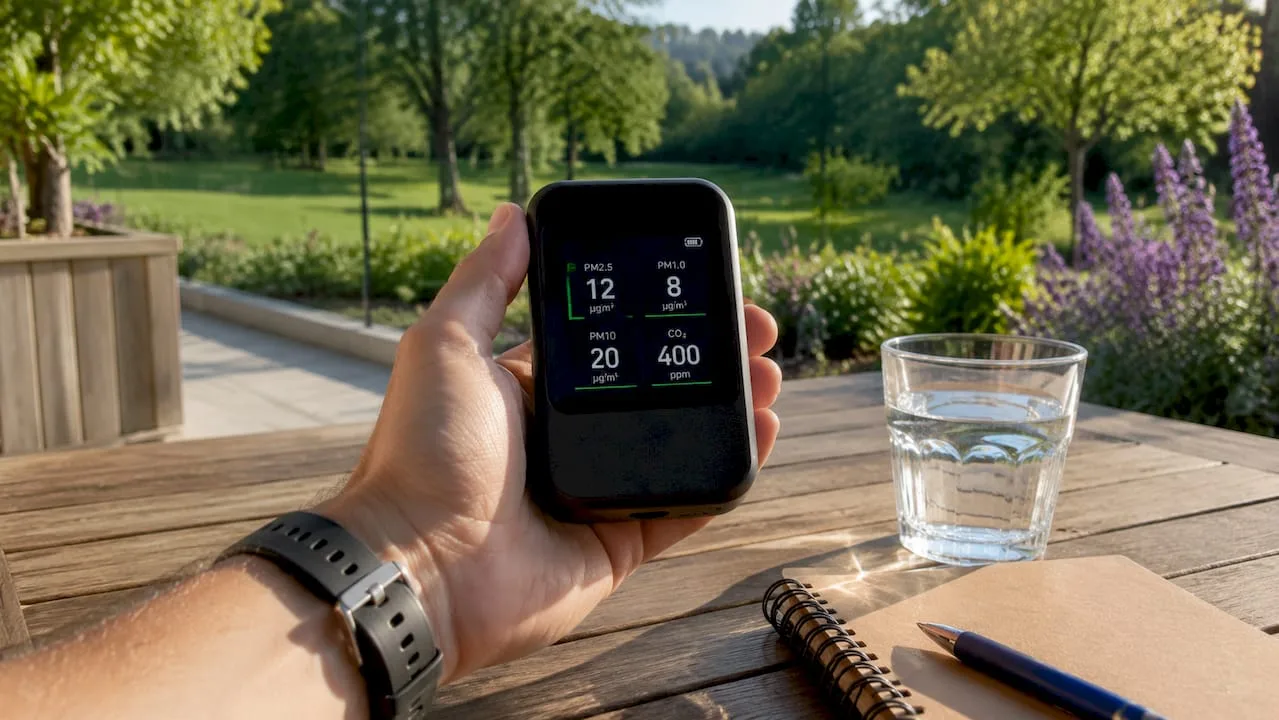
PM10 are particles with a diameter of up to 10 micrometers, while PM2.5 are up to 2.5 micrometers. Smaller particles penetrate deeper into the respiratory tract and cause more serious health problems. The European Union sets the annual limit value for PM2.5 at 25 µg/m³ and for PM10 at 40 µg/m³. Exceeding these limits increases the risk of cardiac and pulmonary diseases.
Carbon dioxide as an indicator of ventilation
CO2 is the best indicator of indoor ventilation quality. Values above 1,000 ppm signal insufficient air exchange and lead to fatigue and reduced ability to concentrate. The optimal CO2 level in residential and working spaces lies below 1,000 ppm. Monitoring CO2 is therefore a basic tool for anyone who wants to maintain a healthy indoor environment.
Relative humidity and temperature
The optimal indoor humidity is 40–60%. When humidity drops below 30%, mucous membranes dry out and susceptibility to respiratory infections increases. Conversely, humidity above 60% promotes the growth of mold and dust mites. Air temperature is closely related to the feeling of thermal comfort and also affects the perception of humidity.
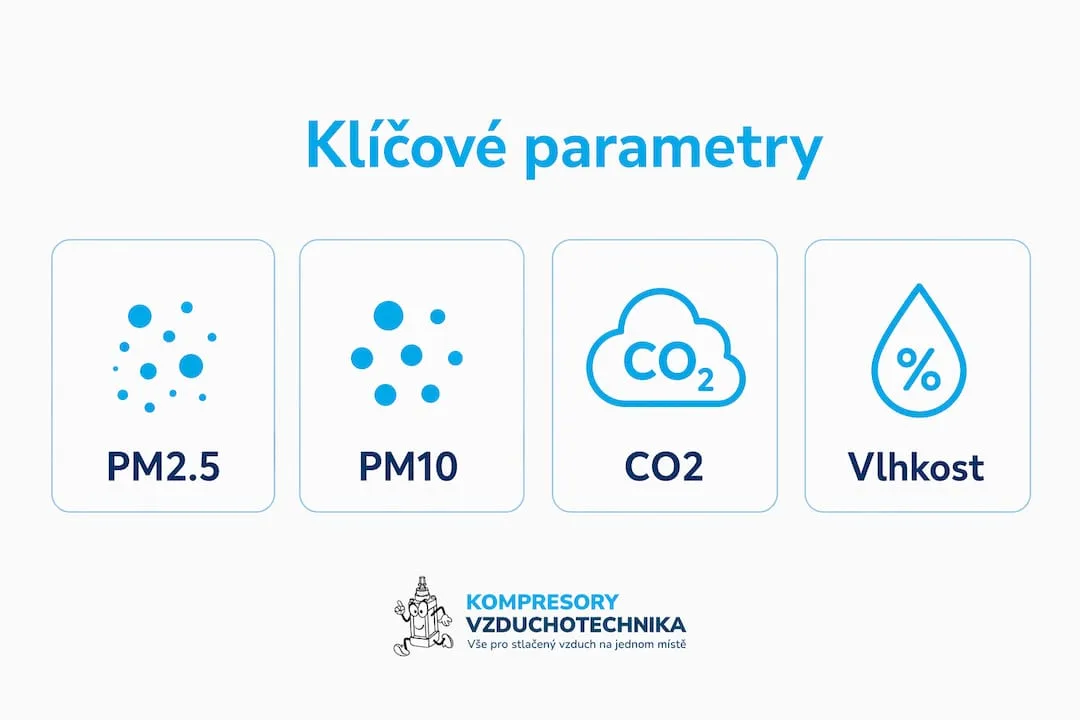
Monitoring all parameters together is essential. Air with a low concentration of PM2.5 but excessive humidity still represents a health risk.
Professional tip: Get a combined sensor that measures CO2, humidity, and temperature at once. Such devices are available from manufacturers such as Aranet or CO2Meter and provide a comprehensive overview of air condition in a single device.
What air quality standards and measurement methods apply in the Czech Republic?
The Czech Republic follows Act No. 201/2012 Coll. on Air Protection, which defines pollutants and sets their limit values. The act implements European directives and imposes obligations on both industrial facilities and state administration bodies.
Air Quality Index and its methodology
The new IKO methodology in the Czech Republic uses three-hour moving averages of PM10, NO2, and SO2 concentrations. This change brings a more accurate and realistic assessment of the current situation compared to the older daily averages. The IKO ranges on a scale from 1 to 7, with a lower number indicating better air quality. The results are publicly available through the Air Quality Information System.
Methods for measuring indoor air
Several technologies exist for measuring the indoor environment:
- CO2 sensors based on NDIR technology (non-dispersive infrared spectroscopy) are the most accurate method for measuring carbon dioxide indoors.
- Relative humidity sensors work on a capacitive or resistive principle and are part of most combined meters.
- Laser particle counters detect PM2.5 and PM10 in real time and are suitable for both industrial and home use.
- Electrochemical sensors measure concentrations of gases such as CO, NO2, or VOC (volatile organic compounds).
| Parameter | Measurement method | Recommended device |
|---|---|---|
| CO2 | NDIR sensor | Aranet4, CO2Meter |
| Humidity | Capacitive sensor | Combined meters |
| PM2.5 / PM10 | Laser particle counter | Industrial detectors |
| NO2, CO | Electrochemical sensor | Multi-purpose analyzers |
Professional tip: For industrial applications, choose measuring instruments certified according to EN 14211 or EN 14907. These standards guarantee measurement accuracy and comparability of results with reference methods used by state stations.
The state monitoring network in the Czech Republic is operated by the Czech Hydrometeorological Institute (ČHMÚ), which manages dozens of measuring stations throughout the country. Private companies and industrial enterprises acquire their own measuring systems for internal control. The choice of suitable equipment depends on the required accuracy, environment, and budget.
How to improve air quality indoors and outdoors?
Indoor air tends to be two to five times more polluted than outdoor air. The cause lies in emissions from cooking, cleaning, furniture, and building materials. Without regular ventilation and filtration, pollutants accumulate in enclosed spaces and worsen the health condition of occupants.
Ventilation as the basis
Short, intensive cross-ventilation for 3–5 minutes is more effective than long-term micro-ventilation. Cross-ventilation quickly exchanges the air throughout the entire room while also saving heating costs, since the walls do not have time to cool down. Ventilation is the cheapest and most accessible method of improving air quality in the household.
Air filtration and cleaning technologies
Air purifiers with HEPA filters reduce illness rates by capturing dust particles, allergens, and bacteria. The World Health Organization (WHO) links indoor air pollution to millions of premature deaths per year. Besides HEPA filters, there are activated carbon filters for capturing volatile organic compounds and UV lamps for destroying microorganisms.
Reducing sources of pollution
The main sources of indoor pollution include:
- Smoking indoors, which produces PM2.5 and hundreds of toxic substances.
- Chemical cleaning agents with a high VOC content, which are released into the air during use.
- Dust mites and mold in carpets, upholstery, and damp areas, which produce allergens.
- Printers and copiers in offices, which emit ozone and fine toner particles.
- New furniture and flooring made of chipboard or laminates, which release formaldehyde.
Professional tip: When choosing an air purifier, pay attention to the CADR (Clean Air Delivery Rate) value. This value indicates the volume of cleaned air per hour and allows you to compare the performance of different devices regardless of the manufacturer's marketing descriptions.
Humidity control and outdoor air
Proper air humidity strengthens immunity and reduces the risk of respiratory illness. Humidifiers are suitable in winter, when heating reduces humidity below 30%. Dehumidifiers, on the other hand, help during the summer months or in basement areas. Outdoor air quality depends on traffic, industry, and meteorological conditions, with temperature inversions and calm wind having the greatest impact.
Comparison of methods for ensuring healthy air
Choosing the right method depends on the specific environment, requirements, and available budget. Different air filtration technologies vary in efficiency, operating costs, and maintenance requirements.
| Method | Advantages | Disadvantages | Suitable environment |
|---|---|---|---|
| Window ventilation | Zero cost, simple | Dependent on outdoor air, heat losses | Households, offices |
| Controlled ventilation with heat recovery | Energy savings, constant air exchange | High acquisition costs, installation required | New buildings, industry |
| HEPA filtration | High efficiency for particles | Does not remove gases, filter replacement required | Allergy sufferers, hospitals, laboratories |
| Activated carbon filter | Captures VOCs and odours | Low efficiency on particles | Offices, production halls |
| Combined system | Comprehensive protection | Higher cost and complexity | Industry, healthcare |
Window ventilation is sufficient for ordinary households with low outdoor air pollution. Industrial facilities and healthcare establishments require a combination of controlled ventilation and multi-stage filtration. EU and Czech legislation sets strict limits for SO2, NO2, PM10 and CO, with regions exceeding these limits required to develop plans to achieve the limit values. The choice of technology therefore always starts with an analysis of the specific environment and the applicable standards.
Key findings
Air quality is a system of interrelated parameters that requires continuous monitoring and a combination of ventilation, filtration and limitation of pollution sources.
| Point | Details |
|---|---|
| Definition of good-quality air | Air meeting the limit values for PM2.5, PM10, CO2 and humidity for a healthy environment. |
| Key parameters | CO2 below 1,000 ppm, humidity 40–60%, PM2.5 below 25 µg/m³ are the basic metrics. |
| Legislative framework | Act No. 201/2012 Coll. and IKO form the binding basis for assessing air quality in the Czech Republic. |
| Most efficient ventilation | Short intensive drafts of 3–5 minutes are more effective than continuous micro-ventilation. |
| Technology selection | Combining ventilation and HEPA filtration provides the best protection in both industrial and residential environments. |
Air quality in practice: what actually works
I have been working with air quality issues in industrial and residential environments for a long time, and one thing still surprises me. Most people only address air quality once health problems or unpleasant odours appear. Yet prevention costs a fraction of the expense of dealing with the consequences.
The most common mistake I see is relying on a single method. Some people buy an air purifier and stop ventilating. Others ventilate regularly but ignore humidity, which drops to 20% in winter. Both situations lead to a deterioration in the quality of the environment, just for different reasons.
The second thing that is often underestimated in practice is measuring air cleanliness. Without data, you don't know whether your measures are working. A CO2 sensor costing a few hundred crowns will immediately show you whether ventilation is sufficient. This is information you cannot otherwise obtain.
I recommend starting with measurement, and only then investing in technology. You will find out what is actually missing, and you won't buy unnecessary devices. Air quality is not a one-off project. It is ongoing care, just like the maintenance of any technical system.
— Zdeněk
Air quality solutions from Kompresory-vzduchotechnika
Kompresory-vzduchotechnika offers technical solutions for industrial and operational air treatment, from filters and pressure regulators to complete compressed air treatment systems. The product range includes components for industrial filtration and accessories for precise air quality control in demanding operations.
For industrial applications, systems are available that meet the ISO 8573 standard, which defines compressed air purity classes. Kompresory-vzduchotechnika's technical support will help you select the right solution according to the specific environment and requirements. The entire range of pneumatic components is available online, with the option of expert consultation.
Frequently asked questions
What does quality air mean according to Czech legislation?
Quality air meets the limit values for pollutants set by Act No. 201/2012 Coll. on air protection. Evaluation is carried out using the Air Quality Index (IKO), which is based on moving averages of PM10, NO2 and SO2 concentrations.
What is the optimal CO2 concentration indoors?
The CO2 concentration should be below 1,000 ppm. Higher values indicate insufficient ventilation and cause fatigue and reduced ability to concentrate.
How to measure air quality at home?
The most accessible method is a combined sensor measuring CO2, humidity and temperature. Laser particle counters, which are also available for home use, are used to detect PM2.5 dust particles.
What humidity level is healthy?
Relative humidity of 40–60% is optimal for a healthy indoor environment. Humidity below 30% dries out mucous membranes, while humidity above 60% promotes the growth of mold and mites.
Why is indoor air often more polluted than outdoor air?
Indoor air tends to be two to five times more polluted than outdoor air due to emissions from cooking, cleaning products, furniture and building materials. Without regular ventilation and filtration, pollutants accumulate in enclosed spaces.
Recommended
- Why air purity is measured: methods and health - Kompresory-Vzduchotechnika.cz
- Why monitor air humidity: a guide to a healthy home - Kompresory-Vzduchotechnika.cz
- Compressed air treatment units up to 18 bar
- Air pressure measurement options: a guide for technicians - Kompresory-Vzduchotechnika.cz