

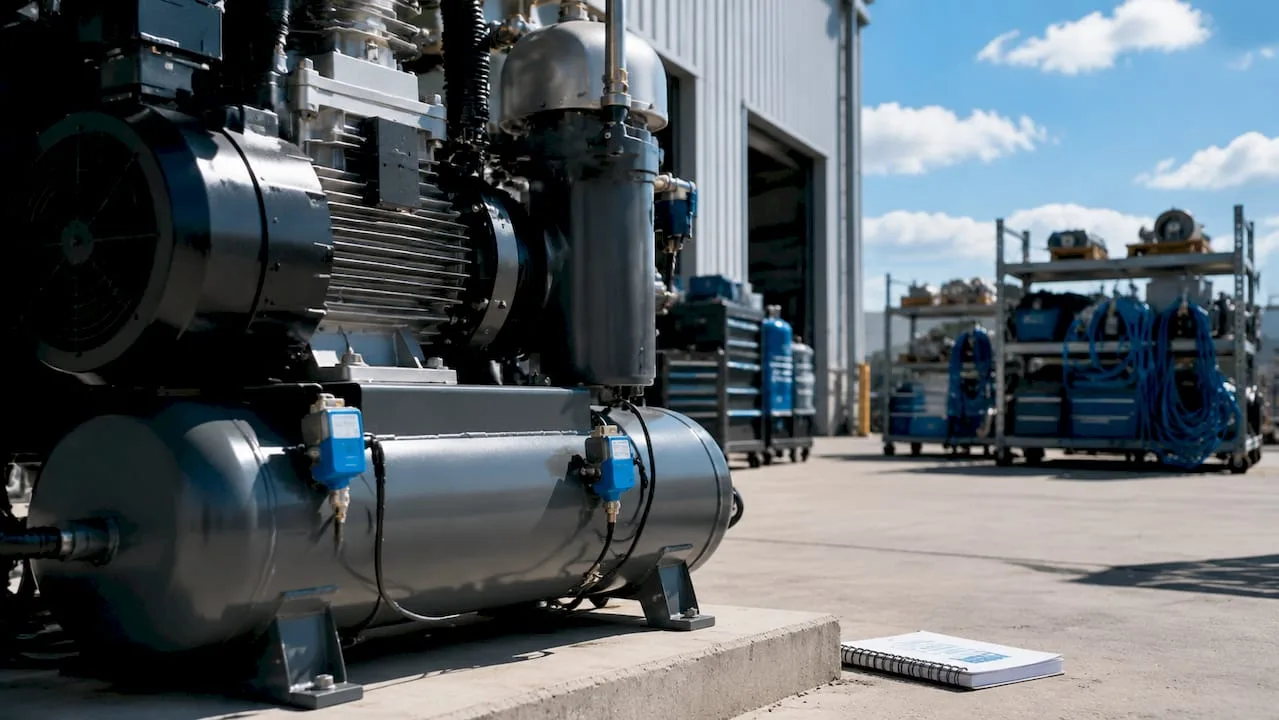
In brief:
- Regular monitoring of compressor vibrations enables early detection of technical faults and reduces repair costs. Vibration diagnostics identifies changes in the vibration profile that signal an impending component failure before it occurs. Modern sensors and automatic monitoring increase the reliability and efficiency of machine maintenance.
Compressor vibration monitoring is a fundamental diagnostic method for early detection of technical problems and ensuring efficient operation. In industrial practice, this method is referred to as vibration diagnostics. It is a non-disassembly method according to industrial standards, which allows faults to be localized without stopping production. Vibrations do not merely signal noise or shaking. Every change in the compressor's vibration profile reflects a specific technical condition of a component, bearing, or shaft. Technicians who regularly monitor vibrations move from reactive repair to planned maintenance, thereby reducing repair costs and unplanned downtime.
Why monitor compressor vibrations and what they tell us
Compressor vibrations are a direct reflection of its technical condition. Every component, from bearings through the shaft to the piston assembly, creates a characteristic vibration pattern during operation. If this pattern changes, it signals a specific problem even before a failure or breakdown occurs.
Every compressor component has a unique vibration signature, and monitoring it enables a transition to preventive maintenance that saves time and costs. In practice, this means the technician does not have to wait for visible signs of failure. A change in amplitude or frequency of vibration at a specific point on the machine precisely indicates which component is starting to fail.
Vibrations are divided into two basic types:
- Free vibration arises after a single impulse, for example at startup or impact. It dies out on its own without an external source of energy.
- Forced vibration is continuous and is caused by a repeating force, such as rotor imbalance, a worn bearing, or a loose joint.
Forced vibration is key for diagnostics. Its frequency corresponds to the machine's speed or multiples of the speed, so frequency analysis directly reveals the source of the problem. Rotor imbalance manifests at the fundamental rotational frequency, while a damaged bearing manifests at higher harmonic components. Compressors most often fail due to operation outside specifications, and vibrations signal this wear earlier than other methods.
Operating conditions and the surrounding environment have a direct impact on vibrations. Improper placement of the compressor on the floor, missing damping pads, or proximity to other machines can amplify vibrations and mask the actual condition of the equipment. Therefore, vibration data must always be evaluated in the context of the entire operating environment.

How to measure compressor vibrations: methods and technologies
Compressor vibration measurement is carried out in practice using accelerometers. These are sensors that detect vibration acceleration and convert it into an electrical signal. The result is a time waveform or frequency spectrum, from which a technician can read the condition of individual components.
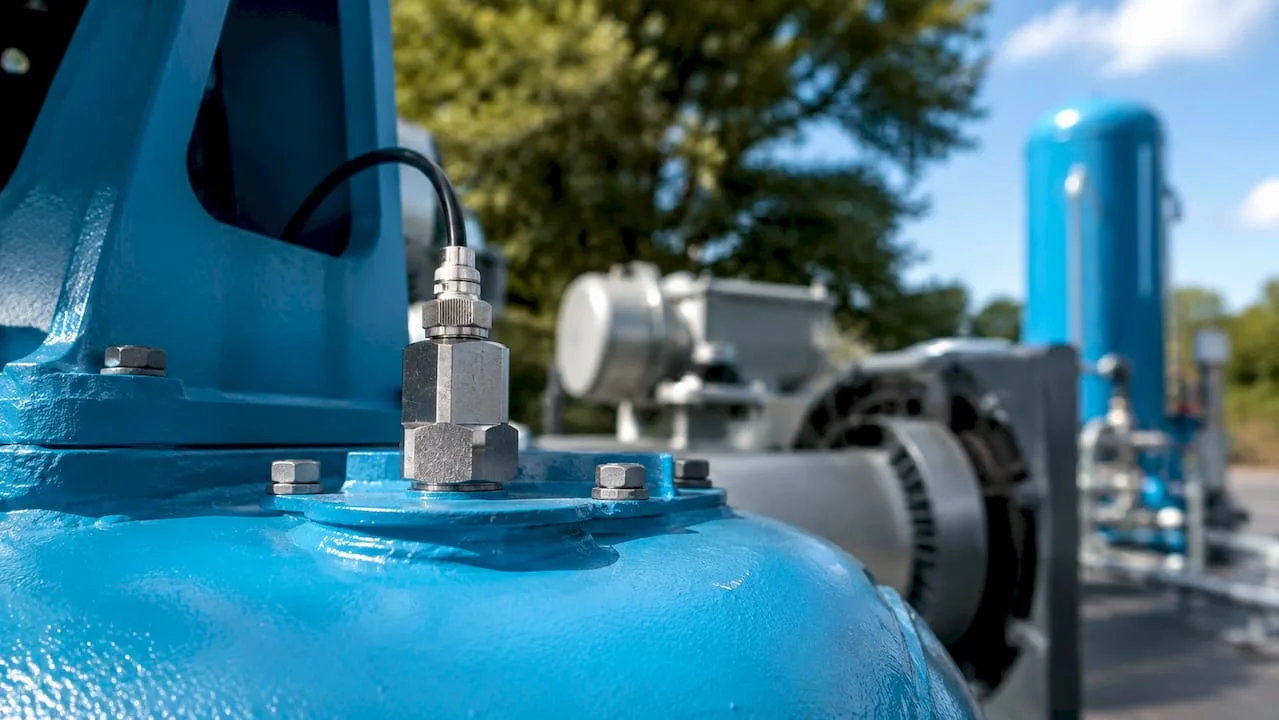
Modern sensors enable real-time vibration measurement and remote monitoring, so that faults can be predicted before the machine has to be shut down. Remote monitoring is especially valuable for compressors in continuous operation or in hard-to-reach locations.
During measurement, we monitor two basic parameters:
- Vibration amplitude indicates the intensity of vibration. An increasing amplitude signals a deteriorating condition of the component.
- Vibration frequency determines which component is causing the problem. Frequency analysis (FFT, i.e. Fast Fourier Transform) decomposes the complex vibration signal into individual components.
In addition to accelerometers, vibration velocity sensors and non-contact shaft position sensors (eddy current probes) are also used. The choice of sensor depends on the type of compressor, the frequency range, and the required measurement accuracy.
Professional tip: Always place sensors as close as possible to the bearings. The longer the vibration transmission path, the more the signal becomes distorted, and the lower the diagnostic value of the data.
Real-time data collection is enabled by continuous monitoring systems. These systems record vibration values at regular intervals and automatically alert the operator when the set limits are exceeded. The advantage is that the technician sees the trend of vibration development over time, not just the instantaneous condition. The trend is more valuable for diagnostics than a single measurement.
Interpreting the measured values requires a reference baseline. When the compressor is commissioned, an initial vibration profile, the so-called vibration signature, is measured. All subsequent measurements are compared with this reference condition. A deviation by a predetermined value triggers an alarm or a planned inspection.
How vibration monitoring helps prevent failures
The shift from reactive to preventive maintenance is the main benefit of vibration diagnostics. The reactive approach means repairing the compressor only after a failure occurs. The preventive approach means intervening at the moment when vibrations indicate an approaching problem, and planning the repair without an unplanned shutdown.
The practical procedure for implementing preventive maintenance based on vibrations looks as follows:
- Measure the baseline vibration profile of a new or freshly repaired compressor. This profile serves as the reference point for all future measurements.
- Set alarm limits. Industry standards, such as ISO 10816, define permissible vibration values for different types of machines and power classes.
- Measure regularly and record trends. A single measurement has limited value. Only a series of measurements over time reveals whether the condition of the machine is deteriorating.
- Link vibration data with other parameters. Bearing temperature, oil pressure, and energy consumption complement the vibration picture with an overall view of the compressor's condition.
- Plan repairs based on data, not on a time schedule. A compressor with stable vibrations does not require premature bearing replacement. Conversely, a machine with increasing amplitude needs intervention sooner than the schedule prescribes.
Investment in systems that increase compressor efficiency pays back in 3 to 6 months under two-shift operation of up to 6,000 motor hours per year. Vibration diagnostics, as part of a preventive maintenance system, contributes to this return by reducing the costs of unplanned repairs and extending component lifespan.
Early detection of problems has a direct economic impact. Replacing a bearing at a scheduled time costs a fraction of the cost compared to a failure that damages the compressor shaft or housing. An unplanned shutdown also halts production, which further multiplies the costs. Compressors with an inverter reduce the number of start-stop cycles, thereby increasing operational stability and reducing the need for maintenance. Vibration diagnostics and the correct choice of compressor technology thus complement each other.
Proper compressor diagnostics includes vibration analysis as one of the key tools for maintaining efficient operation.
Common mistakes in vibration monitoring and how to avoid them
The most common mistake in vibration diagnostics is focusing only on symptoms instead of causes. Misinterpretation of vibrations leads to unnecessary replacement of functional components and unnecessary costs. A technician who sees increased vibrations on a bearing must first determine whether the cause is bearing wear or rotor imbalance transferring the load onto that particular bearing.
Other common mistakes include:
- Confusing vibration with noise. Noise is an acoustic manifestation of vibration, but its intensity does not correspond to the severity of the mechanical problem. A quiet compressor may have critical vibrations at frequencies outside the audible range.
- Measuring under unsuitable conditions. Vibrations from surrounding machinery, shocks from production, or unstable power supply distort the measured data. Measurements should be carried out under calm conditions without external interference to ensure the data is as accurate as possible.
- Monitoring only one parameter. Vibration amplitude without frequency analysis will not reveal which component is problematic. Conversely, a frequency spectrum without amplitude trend monitoring will not reveal whether the condition is worsening.
- Ignoring environmental and structural influences. Vibration diagnostics reveals not only the internal condition of the machine but also external influences on the structure and floor that affect the compressor's lifespan. Improper mounting or missing damping elements cause vibrations even in an otherwise flawlessly serviced machine.
- Absence of a reference measurement. Without a baseline vibration profile, it is not possible to assess whether the measured values are normal or alarming.
Professional tip: Always compare vibration data with bearing temperature and oil pressure. The combination of these three parameters gives a more reliable picture of the compressor's condition than any single parameter alone.
An overall view of the machine's condition is a prerequisite for correct diagnostics. Vibrations are one of the diagnostic tools, not the only one. Technicians who are familiar with the most common operating mistakes and actively prevent them achieve significantly lower failure rates for their compressors.
Key findings
Regular monitoring of compressor vibrations using the vibration diagnostics method is the most reliable way to prevent unplanned failures, reduce repair costs, and extend the service life of the equipment.
| Point | Details |
|---|---|
| Vibration signatures of components | Each component has a unique vibration profile, a change in which signals a specific fault. |
| Non-intrusive diagnostics | Vibration diagnostics reveals faults without stopping production, in accordance with industry standards. |
| Reference measurement as a baseline | The initial vibration profile at startup is essential for the correct evaluation of all subsequent measurements. |
| Data correlation for accuracy | Combine vibration data with bearing temperature and oil pressure for a reliable diagnosis. |
| Economic return | Preventive maintenance based on vibration reduces repair costs and shortens downtime. |
Vibration diagnostics in practice: what I've learned over the years with compressors
Zdeněk shares his perspective here.
Over the years of working with industrial compressors, I've found that the biggest mistake isn't a faulty sensor or bad software. The biggest mistake is stopping measurements the moment the compressor is "running fine". That's precisely when the reference baseline is built, without which all later measurements are just numbers without context.
Vibration diagnostics has saved production for me on several occasions. I specifically remember a case where frequency analysis showed a growing amplitude at a frequency corresponding to the bearing's outer race. The compressor operated normally, and the noise was the same as always. Without vibration measurement, we would have replaced the bearing only after a failure, likely with damage to the shaft.
I recommend that every company implement vibration monitoring as part of a standard operational protocol, not as a tool for crisis situations. Continuous monitoring systems with automatic alarms are now available even for medium-sized enterprises, and their acquisition costs are a fraction of the price of a single unplanned breakdown.
Modern technologies, such as wireless accelerometers and cloud platforms for data collection, significantly reduce the demands on personnel. A technician does not need to be physically present at every measurement. Data arrives automatically and the trend is evaluated continuously. This is exactly the shift from reactive to predictive maintenance that has been discussed in the industry for years, but which is only now becoming accessible to ordinary facilities.
— Zdeněk
Technical background for proper compressor operation
Vibration diagnostics is only one part of overall compressor care. Equally important is the correct compressed air distribution and quality air treatment before entering the pneumatic system.
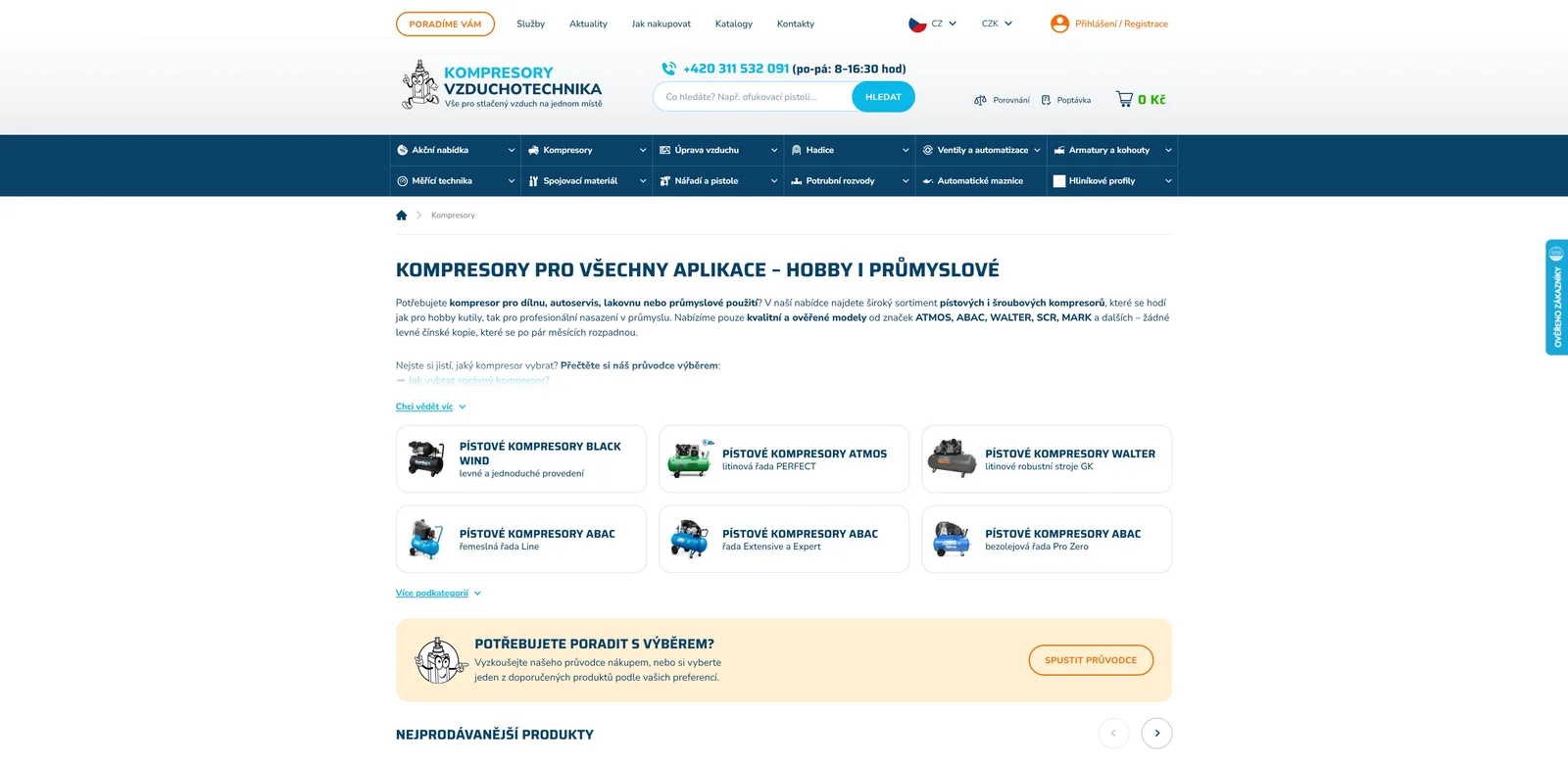
Kompresory-vzduchotechnika offers a complete range for compressed air treatment, including filters, regulators, and automatic lubricators for proper operation of pneumatic systems. For more demanding applications, metal treatment units up to 18 bar are available. The Kompresory-vzduchotechnika team provides technical advice on equipment selection and on solving specific operational problems. A correctly designed and maintained compressed air system reduces vibrations transmitted to the piping and extends the service life of the entire installation.
Frequently Asked Questions
What is compressor vibration diagnostics?
Vibration diagnostics is a non-disassembly method of measuring and analyzing compressor vibrations during operation. It allows the localization of component failures, such as bearings or the rotor, without stopping production.
How often should compressor vibrations be measured?
The measurement frequency depends on the operating intensity and the criticality of the equipment. For compressors in continuous operation, continuous monitoring is recommended; for less utilized machines, monthly or quarterly measurements with trend comparison are recommended.
What sensors are used for vibration measurement?
The most common sensors are accelerometers, which measure vibration acceleration. For precise bearing diagnostics, they are supplemented with temperature sensors and, in some applications, non-contact shaft position probes.
How do you know when compressor vibrations are alarming?
Vibrations are alarming when their amplitude exceeds the reference value from the baseline measurement or the limits defined by ISO 10816. The trend is decisive: an increasing amplitude over time is always a warning sign.
Can vibration diagnostics reveal problems beyond the compressor itself?
Yes. Vibration diagnostics also reveals environmental influences, such as improper compressor positioning or missing damping pads, which cause vibrations even in an otherwise properly serviced machine.
Recommended
- Compressor bleeding procedure: a guide for technicians - Kompresory-Vzduchotechnika.cz
- Definition of the compressor duty cycle: a guide for technicians - Kompresory-Vzduchotechnika.cz
- The significance of the compression stage: a guide for technicians - Kompresory-Vzduchotechnika.cz
- Checklist of accessories for compressors: a guide for technicians - Kompresory-Vzduchotechnika.cz