
In short:
- Industrial ventilation ensures controlled air exchange in production halls and protects workers' health. The system includes fans, filters, ducting, and control elements, with proper sizing being key to efficiency. The correct selection of the fan, filter maintenance, or proper ducting design is often underestimated, which reduces system performance.
Industrial ventilation is defined as controlled air exchange in production and industrial spaces, aiming to supply fresh air and remove air contaminated with dust, chemical substances, or heat. The technical term for this field is industrial air handling. The system consists of fans, filtration units, duct distribution, and control elements. Properly designed industrial ventilation protects workers' health, meets occupational health and safety requirements, and maintains stable conditions for production processes. Without functional ventilation, contaminants accumulate in the halls, temperature rises, and productivity decreases.
What is industrial ventilation and how does it work as a system?
Industrial air handling is a set of technologies ensuring controlled air exchange in demanding production conditions. It provides fresh air supply, removal of contaminated air, and stable conditions even under high dust levels, the presence of chemical substances, or thermal load.
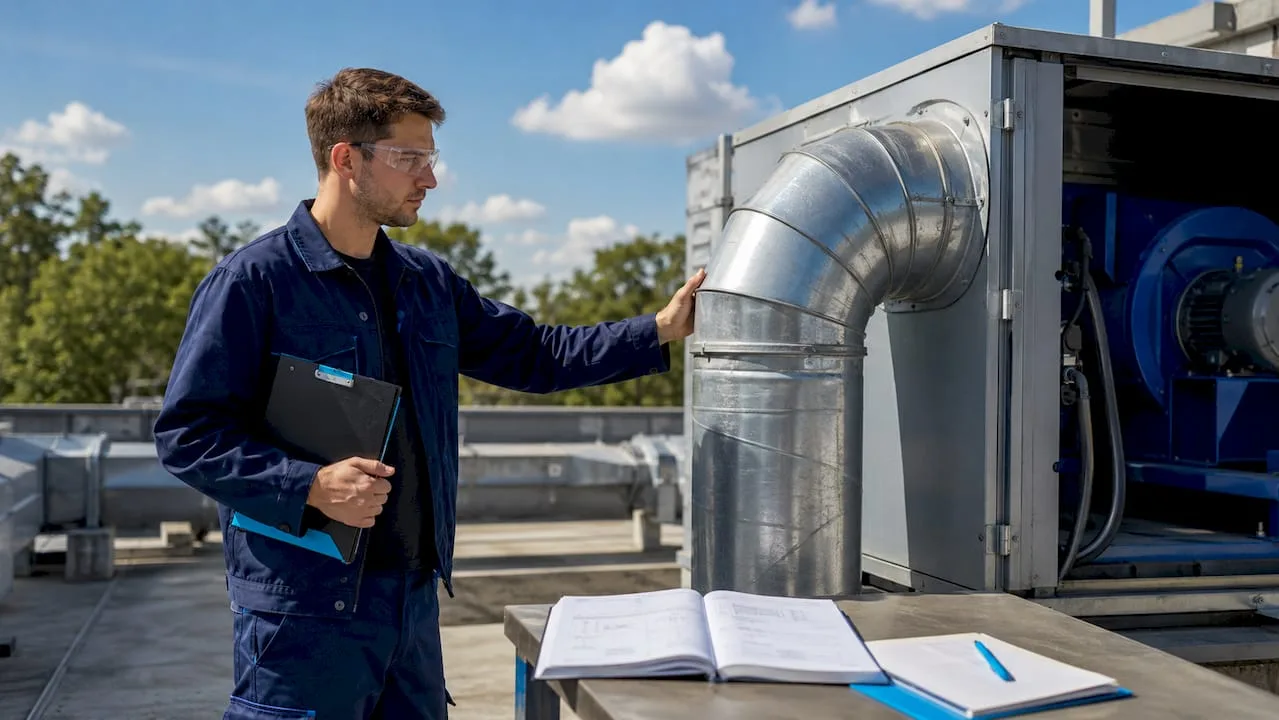
The basic principle is straightforward. The fan creates negative pressure, which draws air from the source of contamination through the duct distribution into the filtration units and out of the hall. This controlled air movement is the key principle of industrial ventilation. Without properly designed airflow, air does not follow the path from the source of contamination to the exhaust, and contaminants spread throughout the space.
The system consists of several interconnected parts. Each part performs a specific function, and the failure of one reduces the performance of the entire system:
- Fans ensure the movement of air and overcome the resistance of ducting and filters.
- Duct distribution carries air from the extraction points to filtration and exhaust.
- Filtration units capture solid particles, aerosols, or gaseous substances.
- Control elements (dampers, valves) allow control of flow in different branches of the system.
- Supplementary separators such as cyclones serve as pre-filtration before fine filters.
Professional tip: Place extraction points as close as possible to the source of contamination. The shorter the distance between the source of dust or fumes and the inlet of the extraction ducting, the lower the airflow needed to capture the contaminants, and the smaller the fan you will need.
The efficiency of industrial ventilation depends on a comprehensive assessment of the entire system, not just individual components. A powerful fan combined with improperly sized ducting or a clogged filter will not deliver the expected results.
What is the difference between an axial and a radial fan?
Choosing the right fan is one of the most important decisions when designing industrial ventilation. Axial and radial fans differ in construction, performance, and suitable application.
An axial fan moves air parallel to the axis of rotation. It handles large airflows at low system resistance. Typical applications include ventilating large production halls, warehouses, or supplying fresh air to spaces without long ducting runs. A radial fan (centrifugal) moves air by centrifugal force perpendicular to the axis of rotation. It generates higher pressure and overcomes the resistance of long ducting runs and filtration units.
| Parameter | Axial fan | Radial fan |
|---|---|---|
| Airflow | High | Medium to high |
| Static pressure | Low | High |
| Typical use | Hall ventilation, air supply | Extraction with filtration, long ductwork |
| Noise level | Lower | Higher |
| Energy consumption | Lower at low resistance | Higher, but efficient under resistance |
Fan static pressure is a key parameter that affects the actual air flow in an installed system with ductwork and filters. Manufacturers state the flow rate in m³/h at zero resistance. In a real system with piping, dampers and filters, the actual flow rate is always lower.
Fan selection must take into account not only the flow rate but, above all, the static pressure of the system and the resistance of the filtering elements. Underestimating this parameter leads to undersizing of the entire system.
Professional tip: Before selecting a fan, always calculate the total resistance of the system. Add up the losses in the ductwork, dampers, grilles and filters. Only then select a fan whose operating point lies on its performance curve at the required flow rate.
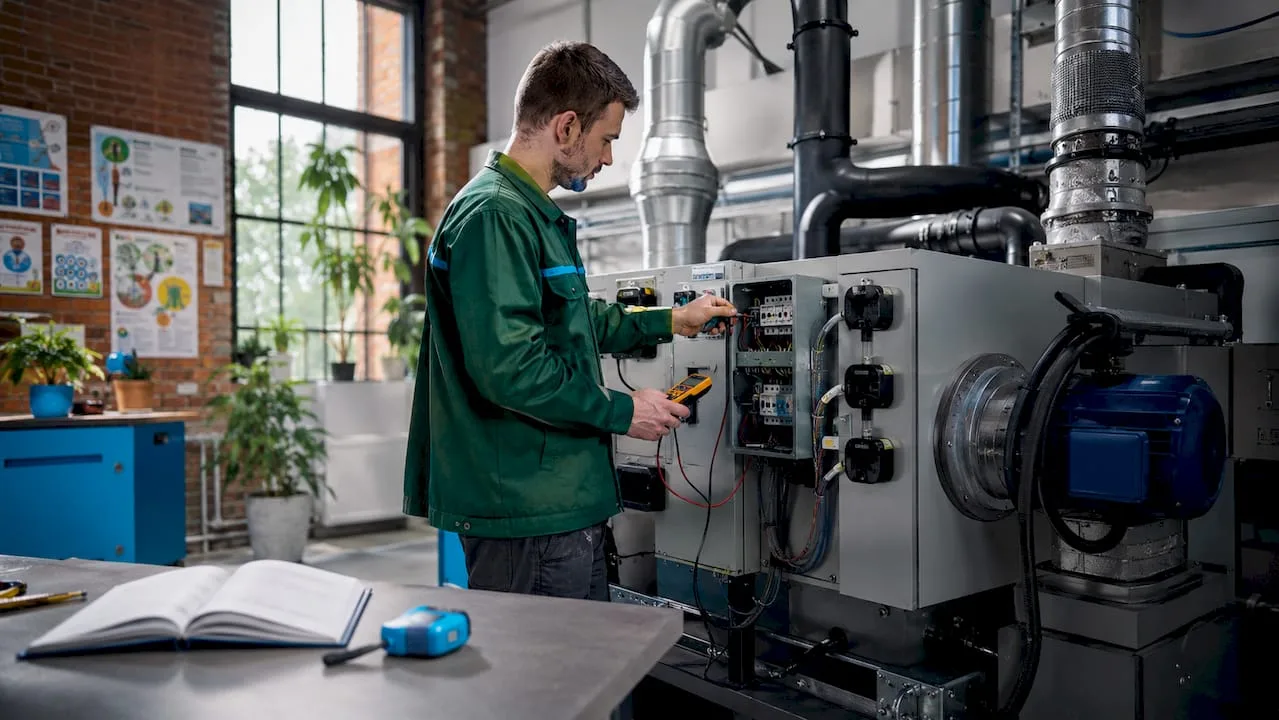
Industrial fans for specific applications, such as switchboard cooling, use a specific power supply and output expressed as air flow in m³/h. Each application requires a different type and sizing of equipment.
What types of filters are used in industrial ventilation?
Filtration is an integral part of every industrial ventilation system. Industrial fluid power uses cyclones, fabric filters, electrostatic precipitators, and adsorption filters in demanding operations. The choice of filtration depends on the type and composition of the contaminants.
Proper filtration of industrial air directly affects employee health and the safety of production facilities. Insufficient filtration causes occupational diseases and shortens machine service life.
Overview of the main types of filters and their use:
- Cyclones capture heavier solid particles by centrifugal force without consuming filter media. They serve as the first stage of pre-filtration before fine filters.
- Fabric (textile) filters capture fine dust with high efficiency. They are used in the woodworking industry, metal grinding, or in the food industry.
- Cartridge filters offer a large filtration area in a compact design. Suitable for continuous operation with automatic cleaning using compressed air.
- Electrostatic precipitators capture aerosols, oil mists, and fine particles using an electrostatic charge. Typical use is in machining centers and paint shops.
- Adsorption filters (with activated carbon or zeolite) remove gaseous substances, solvent vapors, and odors. Essential wherever fabric filters are not sufficient.
| Filter type | Captures | Typical operation |
|---|---|---|
| Cyclone | Coarse solid particles | Woodworking industry, agriculture |
| Fabric filter | Fine dust | Grinding, wood, food industry |
| Cartridge filter | Fine dust, continuous operation | Welding, metals, ceramics |
| Electrostatic precipitator | Aerosols, oil mists | Machining, painting |
| Adsorption filter | Gaseous substances, vapors | Chemical industry, paint shops |
Multi-stage separation using cyclones and specialized filters significantly increases the reliability and service life of industrial ventilation systems. The cyclone captures heavier particles and reduces the load on fine filters, thereby extending the intervals between filter cartridge replacements.
A detailed overview of types of air filtration systems for manufacturing will help in selecting the right combination for a specific operation.
How to design industrial ventilation for a production hall?
The design of industrial ventilation begins with calculating the required air volume. This calculation depends on the type of work, the number of workers, the type of contamination, and the heat load of the space. Without a correct calculation, the result is either an undersized system that fails to perform its function, or an oversized system with unnecessarily high operating costs.
Procedure for designing a ventilation system for a production hall:
- Identify the sources of contamination. Map all locations where dust, vapors, heat, or noise are generated. Each source requires its own extraction point or at least needs to be accounted for in the total airflow.
- Calculate the required airflow. The air exchange at the workplace must correspond to the type of work. For work without dust and chemicals, the standard of 25 m³/h per employee applies. For higher heat loads or odor, this amount is increased by 10 m³/h per person.
- Design the duct routes. Ductwork systems carry the air from the extraction points to filtration and exhaust. Unsuitable bends and dampers add hydraulic losses and reduce the efficiency of the entire system. Design the routes to be as direct as possible with a minimum of elbows.
- Select filtration according to the type of contamination. The filter type must correspond to the substances being captured. For dust, a textile or cartridge filter is sufficient, for aerosols an electrostatic precipitator is necessary, and for vapours an adsorption filter.
- Size the fan according to the total system resistance. Add up the losses in the ductwork, filters, and other components. Select a fan with an operating point corresponding to the required flow rate at this resistance.
- Take temperature and humidity into account. High temperature or humidity changes the air density and thus the actual fan performance. These parameters affect both the choice of fan and the material of the ductwork and filters.
Professional tip: When designing ductwork, allow for an air velocity in the ducts ranging from 5–10 m/s for main branches and 3–6 m/s for sub-branches. Higher velocities increase noise and hydraulic losses, while lower velocities cause dust to settle in the ductwork.
Properly sized air ductwork systems are the foundation of efficient air distribution in large industrial facilities. The duct diameter directly determines the flow velocity and thus the hydraulic losses of the entire system.
Workers' thermal comfort is part of occupational health and safety and affects productivity. An overheated or poorly ventilated hall increases error rates and sickness absence. Ventilation must ensure not only the removal of contaminants but also the maintenance of acceptable temperature and humidity at the workplace.
Key findings
Industrial ventilation functions as a system of interconnected components, where the performance of the whole depends on the correct sizing of each part, from the fan through the ductwork to the filtration.
| Point | Details |
|---|---|
| System definition | Industrial ventilation is a controlled air exchange ensuring the supply of fresh air and the removal of contaminated air in production premises. |
| Fan selection | Axial fans are used for large spaces with low resistance, radial fans for systems with filtration and long ductwork. |
| Multi-stage filtration | A cyclone as pre-filtration extends the service life of fine filters and reduces their maintenance requirements. |
| Airflow sizing | The standard specifies a minimum of 25 m³/h per employee for dust-free work, with an additional 10 m³/h per person added for thermal load. |
| Duct systems | Unsuitable bends and dampers increase hydraulic losses and reduce the actual airflow in the system. |
Practical experience: what is most often underestimated in industrial ventilation
The biggest mistake I see in practice is fan undersizing. The designer or operator selects a fan based on the airflow stated in the catalogue at zero resistance. However, a real system with ductwork, filters and dampers always has resistance. The result is a fan that delivers only a third of the promised airflow, and the hall remains full of dust or fumes.
The second most common mistake is neglected maintenance. Filter cartridges gradually become clogged and reduce airflow. Regular inspection of filter condition and timely replacement are essential for maintaining ventilation performance and equipment service life. I have seen facilities where the filter was not replaced for two years. The fan was running at full capacity, but hardly any air was passing through the clogged filter.
The third problem is the approach of "I'll buy one big fan and solve everything". Industrial ventilation works as a system. One powerful fan without properly designed extraction points, ductwork and filtration will not help. Contaminants must be captured directly at the source, not after they have already dispersed throughout the entire hall.
I recommend that every production hall operator carry out a ventilation system inspection once a year. Check the condition of the filters, measure the actual air flow at the extraction points and compare it with the design values. A deviation greater than 20% indicates a problem that needs to be addressed before it affects workers' health or production quality.
— Zdeněk
Industrial ventilation from Kompresory-vzduchotechnika
Kompresory-vzduchotechnika offers technical consulting and supplies of components for industrial ventilation systems. The product range includes fans, filtration units, ducting accessories and control elements for production facilities of various sizes.
The expert team at Kompresory-vzduchotechnika will help you select the right equipment according to the specific parameters of your operation, the type of contamination and the required air flow. Technical support includes consultation during system design as well as service after installation. The entire range of pneumatics, ventilation equipment and accessories can be found in the industrial pneumatics and hydraulics section on the Kompresory-vzduchotechnika website.
Frequently Asked Questions
What is industrial ventilation and what is it for?
Industrial ventilation is a system for controlled air exchange in production spaces. It ensures the supply of fresh air, the removal of contaminated air, and maintains safe working conditions for employees.
What is the difference between an axial and a radial fan?
An axial fan moves a large volume of air at low system resistance and is suitable for ventilating halls. A radial fan generates higher pressure and overcomes the resistance of filters and long ducting runs.
How often should filters in industrial ventilation be changed?
The replacement interval depends on the intensity of operation and the type of contamination. The condition of the filters needs to be checked regularly, as clogged filters reduce air flow and put a strain on the fan.
How much air does one worker need in a production hall?
The standard specifies a minimum of 25 m³/h per employee when working without dust and chemicals. At higher heat loads or odour levels, this amount increases by 10 m³/h per person.
What is an industrial fan and how does it differ from a domestic one?
An industrial fan is designed for continuous operation, high airflow rates, and overcoming the resistance of ducting and filters. A domestic fan operates at low resistance and short-term operation, without requirements for filtration or dust resistance.
Recommended
- The importance of multi-way valves in industrial systems - Kompresory-Vzduchotechnika.cz
- How air valves work: their key role and efficient solutions - Kompresory-Vzduchotechnika.cz
- Why use safety valves in industry and construction - Kompresory-Vzduchotechnika.cz
- Safety valves: Function, selection and the right capacity - Kompresory-Vzduchotechnika.cz