
In brief:
- Automation in pneumatics controls actuators and valves using programmable systems without human intervention. It uses thermodynamics, fluid mechanics, and digital control to operate production lines efficiently. Modern trends include IoT sensors, digital twins, and software-controlled valves that reduce changeover time.
Automation in pneumatics is defined as the control of pneumatic actuators, valves, and components through programmable control systems without direct human intervention. This technology combines the thermodynamic principles of compressed air with modern control electronics, such as PLC and SCADA systems, thereby changing the way industrial production lines operate. The result is higher repeatability of movements, lower energy consumption, and reduced downtime. For technicians and engineers working in industrial automation, understanding the role of automation in pneumatics represents the foundation for designing reliable and efficient production processes.
How does automation in pneumatics work?
Pneumatic automation is based on three scientific foundations: thermodynamics, fluid mechanics, and control theory. Compressed air is generated by converting the mechanical energy of a compressor into the pressure energy of a gas. This energy is then transmitted through piping to consumers, such as pneumatic cylinders or rotary actuators, where it is converted back into mechanical motion.
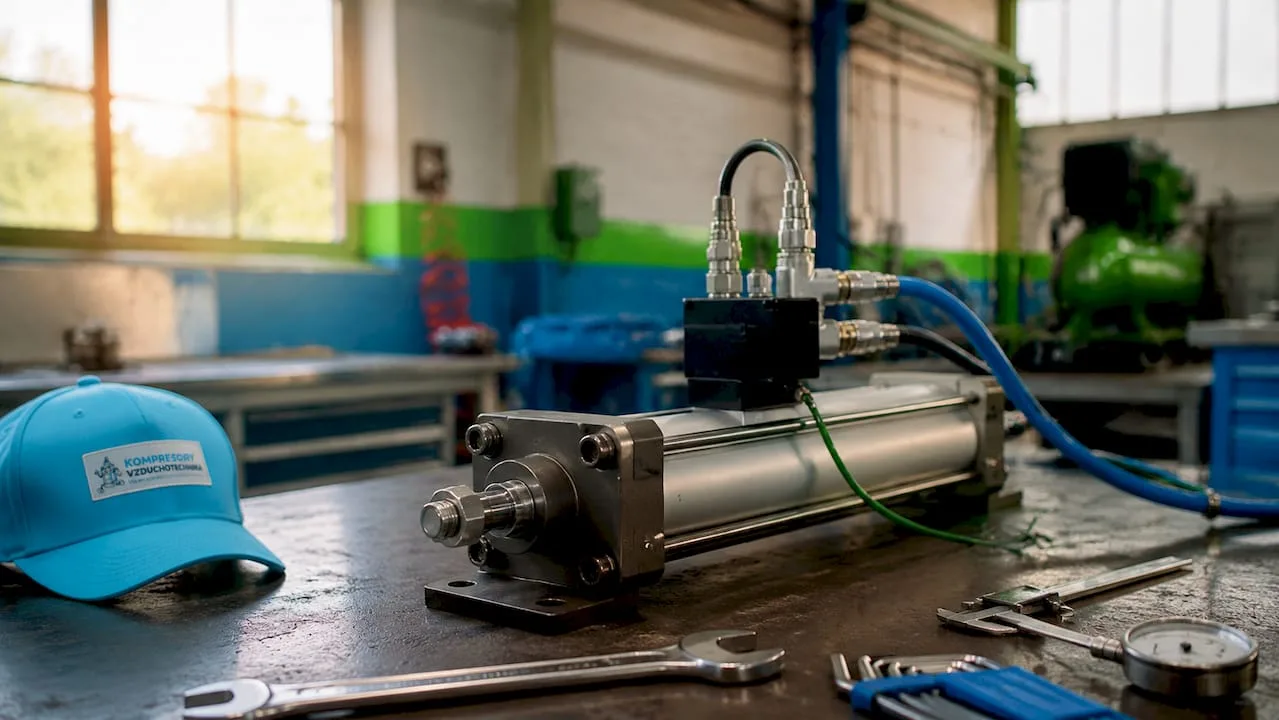
Fluid mechanics determines how air flows through piping, how it behaves when passing through throttle valves, and what pressure acts on the cylinder piston rod. Correct design of pipe cross-section dimensions and valve selection directly affect the speed and force of the movement. Incorrect design leads to pressure losses and unpredictable actuator behavior.
Control theory then connects the physical layer with digital logic. The PLC receives signals from sensors, evaluates conditions, and issues commands to solenoid valves. Safety analysis and pressure optimization are necessary steps when designing reliable pneumatic systems. Without correctly set safety limits, there is a risk of overpressure or uncontrolled movement.
Industry standards such as ISO 4414 set requirements for the safe operation of pneumatic systems, including maximum working pressures and venting requirements. Compliance with these standards is not optional. It is a condition for operation in regulated industrial environments.
Professional tip: Before designing a pneumatic circuit, always calculate the actual air consumption of all actuators in the worst-case scenario of simultaneous movement. An undersized compressor causes a pressure drop and instability of the entire line.
- Thermodynamics: conversion of compressor energy into compressed air
- Fluid mechanics: flow, pressure losses, and flow rates in piping
- Control theory: PLC logic, sensor feedback, valve control
- Safety standards: ISO 4414, EN 983 and venting requirements
- Pressure optimization: setting pressure regulators for minimum energy consumption
What are the main types of automated pneumatic systems?
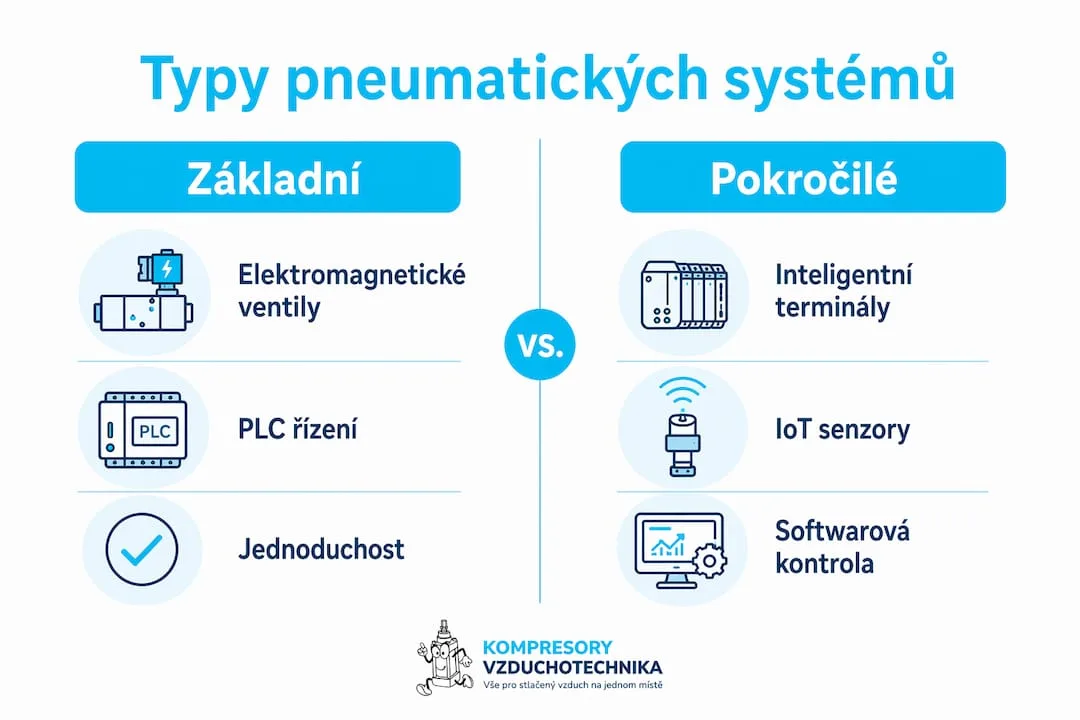
Pneumatics as an industrial technology offers reliability, simplicity and low costs when automating repetitive tasks. The types of systems differ according to the complexity of the control logic and the degree of integration with digital platforms.
Basic pneumatic actuators with solenoid valves
The most widespread type consists of pneumatic cylinders controlled by solenoid valves. The PLC energizes the valve coil, air enters the cylinder and the piston performs the movement. This approach covers most simple handling and pressing applications.
Intelligent valve terminals
A more advanced category is represented by valve terminals with integrated electronics. The Festo Motion Terminal replaces more than 50 physical components with a single intelligent valve, with changes to system functions handled by software via apps. A single control terminal can control up to eight movements with up to 65% lower energy consumption compared to conventional electric actuators. This saving directly translates into the operating costs of the manufacturing plant.
Systems with IoT sensors
The third category consists of pneumatic systems equipped with IoT sensors for measuring pressure, flow, temperature and position. The integration of IoT sensors with PLC and SCADA enables the programming of advanced control logic and real-time synchronization of production processes. This layer of data opens the way to predictive maintenance and remote monitoring.
| System type | Control logic | Suitable applications |
|---|---|---|
| Solenoid valves with PLC | Sequential logic | Handling, pressing, packaging |
| Valve terminals | Software applications | Flexible manufacturing cells |
| IoT sensor systems | Real-time data analysis | Predictive maintenance, energy monitoring |
| SCADA integration | Centralized control | Complex production lines |
How are digitalization and IoT changing pneumatics in automation?
Digitalization is transforming pneumatics from a passive component into an actively controlled element with predictive maintenance based on actual condition rather than a fixed schedule. This shift has a direct impact on operating costs and production line availability.
Predictive maintenance works by continuously measuring pressure, flow, and vibration using sensors. The control software compares the measured values with reference models and identifies deviations before they cause a failure. The result is planned component replacement instead of unplanned downtime.
Software systems can analyze data from existing CAN and ABS buses and predict the condition of components without the need to install additional sensors. This capability reduces the investment costs of digitalizing existing systems.
Digitalization and the unification of data environments significantly improve collaboration across teams and speed up project implementation. Platforms such as 3DEXPERIENCE demonstrate that connecting design, production, and service data into a single environment shortens the time from design to production and reduces the number of errors caused by outdated documentation.
The role of digitalization in pneumatics is also evident in energy savings. Smart pressure regulators reduce the working pressure to the level actually needed for each phase of the production cycle. Unnecessarily high pressure increases compressor consumption and accelerates seal wear.
- Continuous pressure and flow measurement detects air leaks in real time
- Remote monitoring via SCADA reduces the need for physical inspections
- Data analysis identifies wear patterns before a component fails
- Software updates to valve terminals change function without hardware replacement
- Energy reports show actual compressed air consumption per production operation
How to integrate pneumatics into automated production lines?
Successful integration of pneumatics into an automated production line requires a systematic approach from design to commissioning. Improvisation at this stage causes problems that are difficult to remove after production has begun.
- Requirements analysis: Define forces, speeds, strokes, and cycling frequencies for each actuator. These parameters determine cylinder diameters, valve flow rates, and compressor capacity.
- Design of compressed air distribution: Design piping distribution with minimal pressure losses. Pipes for compressed air distribution of the push-in system enable quick assembly and easy network expansion without special tools.
- Air treatment: Every pneumatic circuit needs filtration, pressure regulation, and lubrication. Centralized lubrication systems automatically supply lubricant to critical points, thereby increasing reliability and reducing manual maintenance requirements.
- Control system selection: Choose a PLC with a sufficient number of inputs and outputs for all sensors and valves. Ensure compatibility with the plant's superior SCADA system.
- Testing and tuning: Verify the function of each movement individually, then in combination. Set the throttle valves for the required speeds and check the safety functions.
Professional tip: When designing, place air treatment units as close to the consumers as possible. Long sections of piping without filtration and regulation cause pressure instability and shorten the service life of seals in the cylinders.
Energy consumption optimization is achieved by setting the lowest pressure at which the system reliably operates. Each bar of unnecessary overpressure increases compressor consumption by approximately 7 %. This figure quickly shows up on the annual electricity bill in a larger plant.
What are the current trends in the automation of pneumatic systems?
Modern pneumatic automation is moving toward software-defined systems, where the hardware remains standardized and the functions are changed by the program. This approach reduces the time needed to reconfigure a production line from hours to minutes.
Digital twins of pneumatic systems allow the behavior of a line to be simulated before physical installation. The engineer verifies movement sequences, identifies collisions, and optimizes cycle timing in a virtual environment. Only after validation does physical assembly proceed.
- Software-controlled smart valves: A single physical platform replaces dozens of specialized components, and functions are switched via an application
- Digital twins: A virtual model of the system enables testing of changes without stopping production
- Modular systems: Standardized blocks are quickly reconfigured for new production tasks
- Energy management: Automatic pressure reduction during production breaks saves on compressor costs
| Trend | Benefit | Deployment status |
|---|---|---|
| Software-defined valves | Flexibility without hardware replacement | Available in industry |
| Digital twins | Testing without downtime | Expanding deployment |
| Predictive maintenance | Elimination of unplanned downtime | Standard in new installations |
| Modular pneumatic blocks | Fast line changeover | Available for new projects |
Automation possibilities in pneumatic systems are further expanding through integration with the industrial internet of things. Every valve, sensor, and compressor becomes a data source for higher-level analytical platforms. The result is a production environment that monitors itself and alerts the operator to deviations before they cause downtime.
Key findings
Automation of pneumatic systems delivers measurable results when technical design, control logic, and digital monitoring form one interconnected whole.
| Point | Details |
|---|---|
| Scientific foundations | Thermodynamics, fluid mechanics and control theory form the basis of every pneumatic system. |
| Types of systems | From solenoid valves to intelligent terminals with energy savings of up to 65%. |
| Digitalisation and IoT | Predictive maintenance is replacing fixed schedules and reducing unplanned downtime. |
| Practical integration | Proper air treatment and centralised lubrication increase the reliability of the entire line. |
| Future trends | Software-defined valves and digital twins shorten the changeover time of the production line. |
Practical experience: what really determines success
When deploying pneumatic automation in industrial operations, I have repeatedly encountered the same problem. The technical team pays great attention to selecting cylinders and valves, but underestimates the quality of compressed air and the correctness of its treatment. The result is premature seal failures, unstable movements and unnecessary downtime.
The second recurring problem is underestimating the data layer. The system gets installed, started up, and then forgotten about until the first failure. Yet the role of IoT in pneumatic systems lies precisely in the fact that continuous data reveals a problem weeks before failure occurs. The investment in sensors pays off the first time it catches a downtime event.
My recommendation is to start simply. Deploy pressure and flow measurement at key points in the circuit. Monitor trends for one month. Only then decide on further digitalization steps. This approach makes sense both for new installations and for modernizing existing systems.
Connecting pneumatics with digital platforms is not a one-off project. It is an ongoing process that delivers results progressively. Every added sensor and every piece of analyzed data increases the ability to predict and control the production process. The benefits of pneumatic technology automation only fully manifest when the physical and digital layers of the system work together as a whole.
— Zdeněk
Pneumatic components for industrial automation from Kompresory-vzduchotechnika
Kompresory-vzduchotechnika offers a complete range of pneumatic components for industrial automation, from basic valves and cylinders to air preparation units and accessories for compressed air distribution. Each product is selected with regard to reliability in industrial conditions and compatibility with common control systems.
Technical support is available for industrial customers in selecting components and designing pneumatic circuits. The range of pneumatic and hydraulic components includes everything needed for building and modernizing automated production lines. The expert team at Kompresory-vzduchotechnika can advise on selecting the correct air preparation unit as well as on sizing the entire pneumatic system according to specific production requirements.
Frequently Asked Questions
What is the role of automation in pneumatics?
Automation in pneumatics refers to the control of pneumatic actuators and valves using PLC, SCADA, or intelligent valve terminals without direct human intervention. The goal is to increase repeatability, reduce energy consumption, and shorten downtime.
What types of automated pneumatic systems exist?
Basic types include PLC-controlled solenoid valves, intelligent valve terminals with software control, and systems with IoT sensors for predictive maintenance. Each type corresponds to a different level of complexity and production flexibility requirements.
How do IoT sensors contribute to pneumatic automation?
IoT sensors measure pressure, flow, and temperature in real time and transmit data to control systems. This data enables predictive maintenance, energy monitoring, and remote control of the pneumatic system.
How to integrate pneumatics into an existing production line?
Integration begins with an analysis of force and speed requirements, followed by the design of air distribution and selection of the control system. Proper air treatment and compatibility of pneumatic components with the plant's existing PLC or SCADA system are key.
What are the advantages of automating pneumatic technology compared to electric drives?
Pneumatic drives are simpler, more resistant in dusty and humid environments, and have lower acquisition costs. Furthermore, intelligent valve terminals achieve up to 65% lower energy consumption compared to conventional electric drives at comparable performance.
Recommended
- What is pneumatic automation: a guide for industry - Kompresory-Vzduchotechnika.cz
- How pneumatics works: a complete guide for industry 2026
- The importance of compressed air automation in industry - Kompresory-Vzduchotechnika.cz
- Stepless pressure control: precise regulation in pneumatics - Kompresory-Vzduchotechnika.cz