


For reliable CNC machining, you need dry, clean, and correctly sized compressed air. Without a dryer and multi-stage filtration, moisture and oil particles will sooner or later get into pneumatic components, sensors, and the cutting zone. The standard for assessing air quality is ISO 8573, which defines purity classes according to the content of solid particles, water, and oil. A key parameter is the dew point, whose continuous monitoring (for example with a SUTO S217 sensor) reveals a problem before it shows up on the workpiece.
Before changing anything, check these four things:
- Pressure – matches the current machine specification setting and is stable even under load.
- Flow – the compressor covers the peak consumption of all appliances running simultaneously.
- Dew point – the air is sufficiently dry for the given ISO 8573 class.
- Leaks – the distribution system shows no audible or measurable pressure losses.
Key findings
Reliable operation of a CNC machine depends on a combination of dry and clean air, a correctly sized compressor, and regular measurement of consumption and leaks.
| Point | Details |
|---|---|
| Air quality takes priority | A dryer and multi-stage filtration according to ISO 8573 prevent damage to sensors and tools. |
| Monitor the dew point continuously | A sensor such as the SUTO S217 with an alarm detects the problem before a defective part is produced. |
| Measure before purchasing a compressor | Actual consumption and leaks determine the required output better than an estimate based on machines. |
| VSD only within the efficient range | Continuous speed control pays off at loads ranging from 50 to 80% of output. |
| Address leaks as the first step | Fixing leaks and measuring consumption brings energy savings of up to around 35%. |
| Comprehensive solutions from Kompresory-vzduchotechnika | The e-shop offers dryers, filtration, compressors, and hoses, along with design, installation, and energy audit services. |
Contents
- What role does compressed air play in CNC machining
- What air treatment is essential for CNC
- How to correctly size a compressor for CNC machines
- How to size the air distribution system and select accessories
- How to deal with leaks, condensate, and oil contamination
- How to increase the energy efficiency of compressed air
- Installation and operation checklist according to Kompresory-vzduchotechnika
- What I would address first when modernizing an air system
- Where to order air treatment and service for CNC operations
- Frequently Asked Questions
What function does compressed air serve in CNC machining
Compressed air in CNC machining performs three basic functions: it removes chips from the cutting zone, blows off the tool during tool changes, and cleans clamping surfaces before the workpiece is secured. Each of these has a direct impact on the result.
Insufficient chip removal means that fragments return into the cut, scratch the surface, and shorten tool life. In precision operations (engraving, micro-machining), the stability of the air stream matters just as much as its force, not just its strength.
- Chip blow-off improves surface quality and reduces tool wear.
- Blow-off during tool change protects the taper and the holder from contaminants that would cause inaccurate clamping.
- Cleaning the clamping surfaces before the workpiece prevents zeroing errors and uneven clamping.
Air cannot replace liquid cooling in operations with high thermal load, deep drilling, or machining of hard-to-machine materials, where the heat needs to be dissipated by a medium with higher thermal capacity. However, where chip removal and surface cooling are sufficient, air is the cheaper and faster choice.
Moisture and residual oil in the piping have a worse impact on CNC machines than expected: they clog nozzles, damage electropneumatic valves, and distort the signal from optical and inductive sensors. CNC machine manufacturers therefore often specify a requirement for the quality of the supplied air in their technical documentation, and if the supplier fails to meet this specification, problems such as claims and unplanned downtime can occur.
What air treatment is essential for CNC
Air treatment has three layers: drying, filtration, and continuous quality monitoring. Omitting one of them usually means the problem appears later and at a higher cost.
Condensation dryers reduce the dew point to values suitable for common pneumatic actuators and blow-off. Adsorption dryers go deeper and are necessary where the process requires a very low dew point, typically in precision machining, painting lines following CNC production, or machines with sensitive optics.
Filtration should have a multi-level structure:
- a condensate separator right after the compressor,
- a coarse filter capturing solid particles and oil droplets,
- a final filter for submicron particles before entering the machine.
A statistic that is often overlooked: combining a dryer with multi-stage filtration according to the ISO 8573 filtration program significantly reduces the risk of contamination of sensitive CNC components – a separator, coarse and fine filter together with a dryer form the minimum standard, not an above-standard solution.
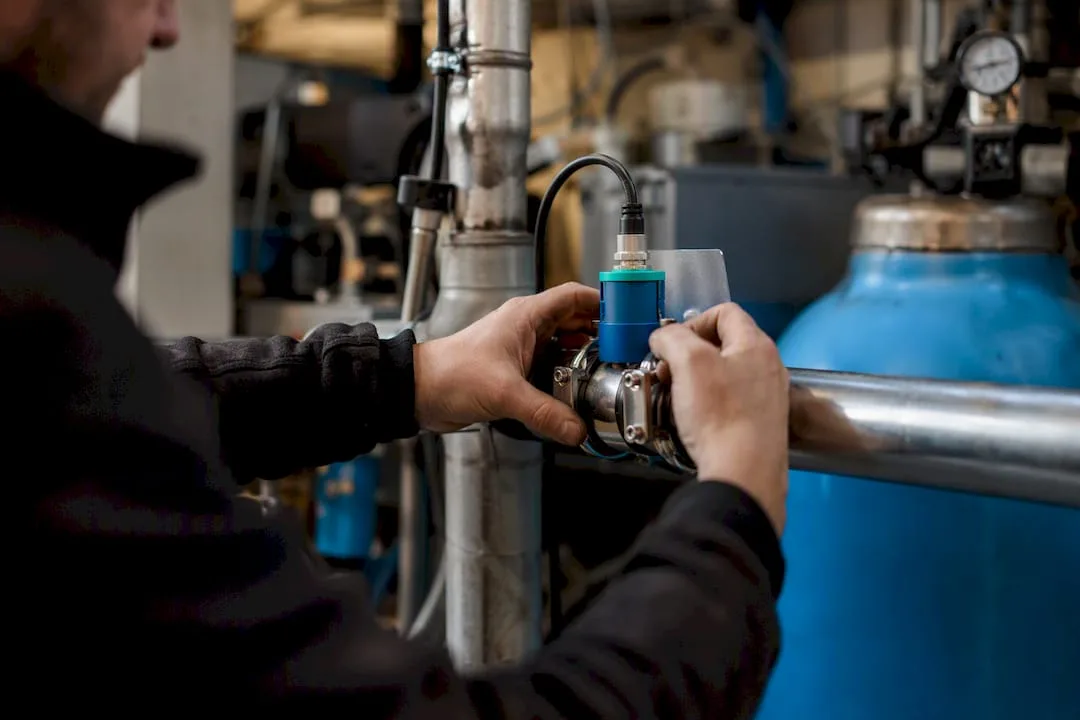
Continuous dew point monitoring complements the treatment with real-time control. Sensors such as SUTO S217 allow you to set a two-level alarm that warns of an approaching problem and, in extreme cases, automatically cuts off the air supply before moist air damages the tool or workpiece. For operations with high quality requirements, this is a simple safeguard against scrap rate.
How to properly size a compressor for CNC machines
The basis is to measure, not estimate. Before you buy a new compressor for CNC machines, determine the actual air consumption, peak flow, and the level of leaks in the current distribution system. Without this step, it's easy to end up with a new compressor that is either undersized during peaks or permanently oversized and inefficient.
- Measure the actual consumption over a typical working cycle, including peaks when multiple machines are running simultaneously.
- Estimate future growth in consumption if you plan to expand production – underestimating this step is one of the most common mistakes in sizing.
- Consider the technology: a screw compressor with continuous speed control (VSD) is suitable for continuous operation with variable load, while an oil-free solution is suitable where traces of oil would compromise process quality.
- Set a power reserve – usually 15 to 25% above the measured peak, never double it "just to be safe."
A VSD compressor makes sense where the load fluctuates and the unit will most often operate in the mid-range of its output. Outside this range, the inverter's efficiency is lost, and the investment in VSD won't pay off as quickly as expected.
Professional tip: Don't plan the compressor based on the nameplate output of the machines in the shop. Measured consumption tends to be lower, because the machines don't run at full air draw simultaneously throughout the entire shift.
How to size the air distribution system and choose accessories
Pressure losses in the distribution system most often occur due to undersized hoses and the number of connections, not the length of the piping itself. Technicians' forums confirm that the choice of hose cross-section and the number of quick couplings have a real and often underestimated effect on pressure loss.
- For common CNC applications, hoses with a dimension of 8/6 mm have proven effective, while 10/8 mm is suitable for longer runs or higher flow.
- Hoses with textile or metal braiding can withstand higher temperatures and resist abrasion better than smooth profiles.
- Place push-in fittings as close to the consumer as possible and choose types with low pressure drop.
- Every joint is a potential leak point – minimize their number on the main line.
How to deal with leaks, condensate, and oil contamination
In practice, an air leak is usually detected by ear before any instrument picks it up, but for accurate assessment, measuring the pressure drop in a section of the distribution system that is shut off during downtime helps.
- Check for leaks using an ultrasonic detector or a simple overnight pressure drop test.
- Ensure condensate drainage through automatic drain valves, never by manually opening a valve once in a while.
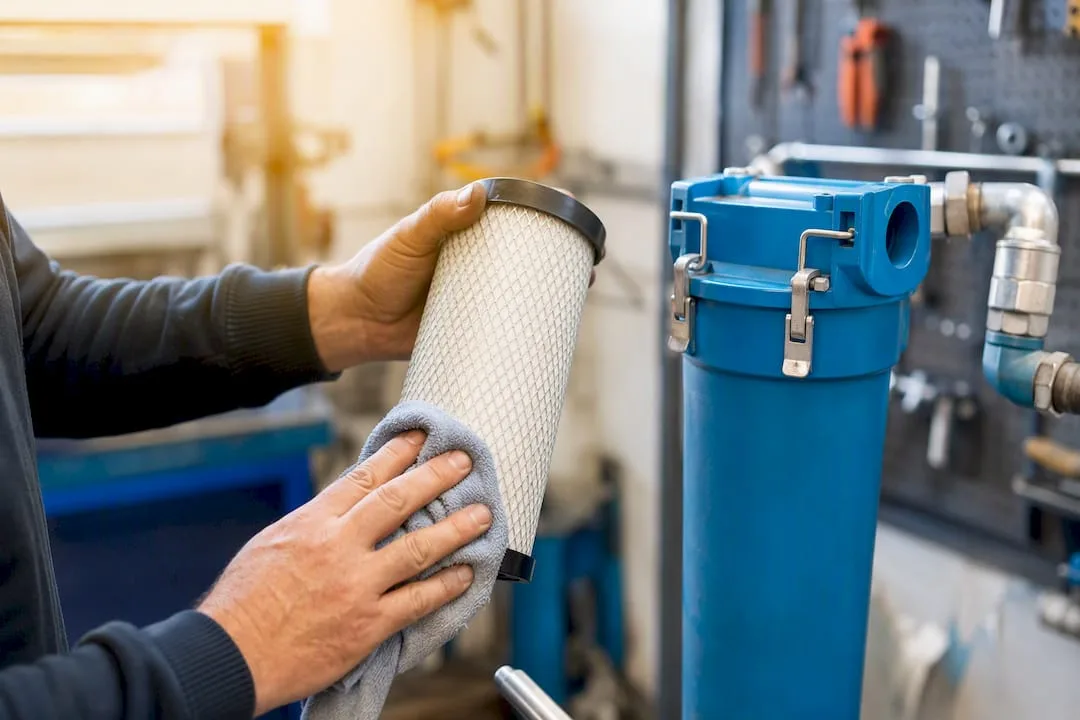
- Replace filters according to the interval recommended by the manufacturer, not only once visible clogging appears.
- Check the solenoid valves – a delayed response or leakage indicates worn seals.
Professional tip: Do you keep a daily record of the pressure drop in the system? Even a small but persistent drop with no obvious cause is often the first sign of a developing leak.
When it's time to replace components rather than just service them: if a filter loses permeability faster than before after cleaning, or if a dryer fails to reach its declared dew point even after servicing, it is more economical to replace the component than to keep funding operation through repairs.
How to increase the energy efficiency of compressed air
Compressed air is often described in operation as a "hissing energy guzzler" – and rightly so, if nobody pays attention to how much air is lost through leaks or incorrectly set pressure. A basic energy audit takes one working cycle and measures three variables: total consumption in kWh per m³ of air, the share of leaks in total output, and pressure stability over time.
- Measure consumption with a flow meter at the compressor station, not by estimating from the nameplate output.
- Fix leaks as the first step – it tends to be the cheapest and fastest measure with an immediate effect.
- Consider a VSD compressor where the load fluctuates and the unit will run within an efficient range.
- Optimize the operating pressure to the actual needs of the machines, not to a "safety margin" of an extra bar.
That is a difference that is noticeably reflected in the annual electricity bill, especially in multi-shift operation.
Installation and operation checklist according to Kompresory-vzduchotechnika
The technicians at Kompresory-vzduchotechnika recommend the following minimum air treatment setup for a CNC line:
- dryer (refrigerant or adsorption, depending on the required dew point),
- multi-stage filtration with a condensate separator, coarse and final filter,
- automatic drain,
- Dew point sensor with alarm for continuous quality monitoring.
Procedure when planning or upgrading a system:
- Check the current air quality against the filtration programme according to ISO 8573.
- Review the list of tasks for technicians and plan maintenance intervals.
- Order a turnkey design, installation or energy audit directly from Kompresory-vzduchotechnika.
What I would address first when upgrading an air system
If I had to rank priorities, I would put air quality first, not compressor output. A faulty dew point will ruin precision faster than a missing bar of pressure. Only after drying and filtration are resolved does it make sense to calculate output and consider VSD. Measurement is always cheaper than guesswork, and regular dew point monitoring pays off more in the long run than a one-off investment in a larger compressor.
Where to order air treatment and service for CNC operation
Kompresory-vzduchotechnika offers direct access to the technologies discussed above, without the need to source a dryer, filtration and dew point sensor separately from three different suppliers. The catalogue includes compressed air treatment units up to 18 bar as well as a complete filtration programme according to ISO 8573, so you can select the dryer, filters and condensate separator according to the same purity class all at once.
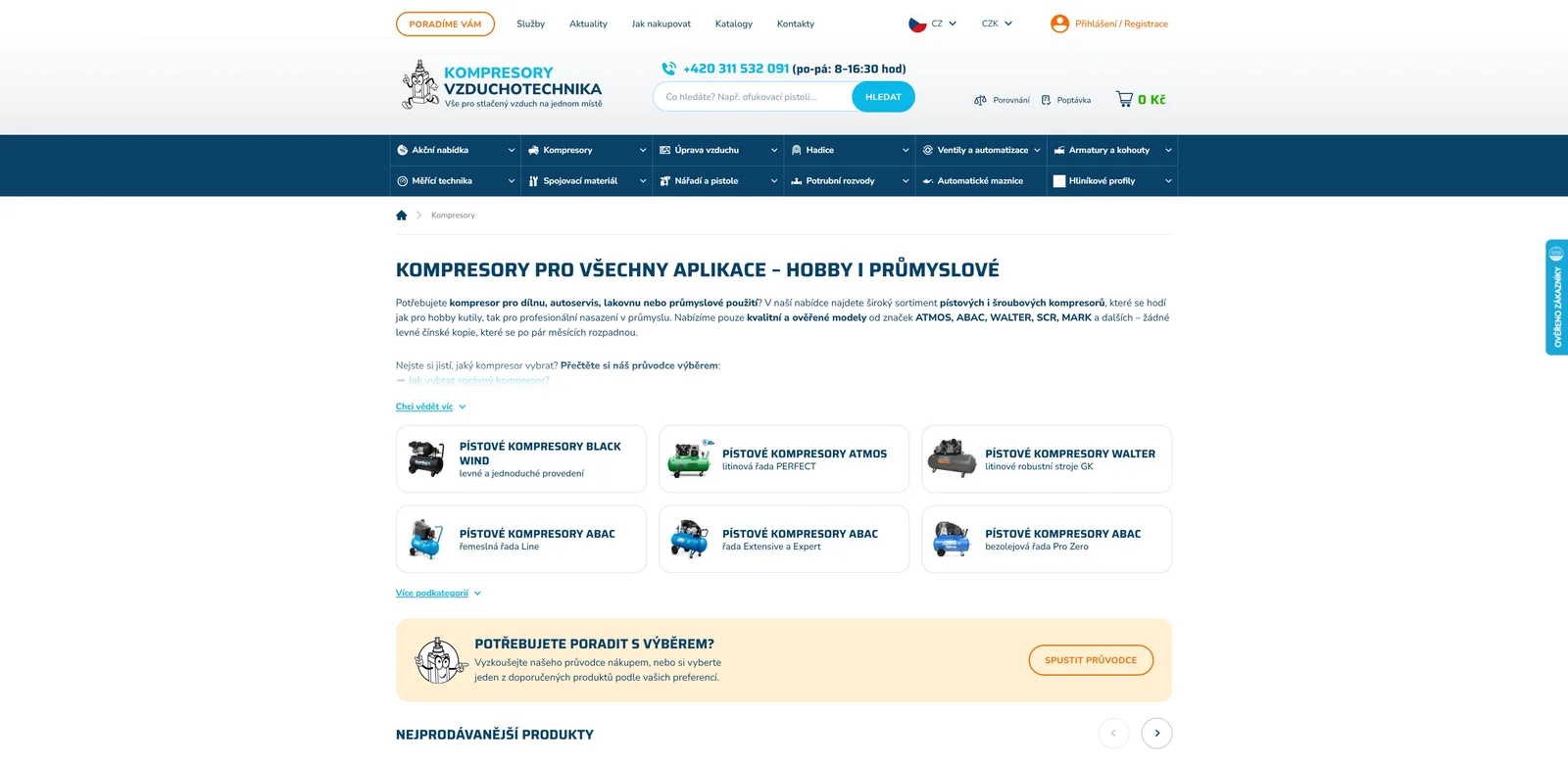
For distributing air to CNC machines, the range also includes compressed air hoses in dimensions common for machine shop operation, including braided versions for higher thermal and mechanical load. If you are deciding on or replacing a compressor, the entire catalogue of piston and screw compressors also includes VSD and oil-free variants suitable for sensitive processes.
Kompresory-vzduchotechnika also provides expert consulting, turnkey solution design, installation and energy audits focused on measuring consumption and leaks. If you are unsure about the current state of your distribution system, request a non-binding consumption measurement proposal or a consultation on selecting a dryer and filtration directly from the Kompresory-vzduchotechnika team.
Frequently asked questions
What dew point is suitable for CNC machining?
The specific value depends on the purity class according to ISO 8573 and on the machine manufacturer's requirements, so it is verified by continuous measurement, not a one-time check.
Is a refrigeration dryer sufficient for CNC, or is an adsorption dryer necessary?
A refrigeration dryer will cover standard blow-off and pneumatic actuators, while an adsorption dryer is used where the process requires a significantly lower dew point, for example in precision machining or sensitive optics.
What size compressor do I need for a CNC line?
When is a compressor with variable speed drive (VSD) worthwhile?
How often should leaks in the compressed air distribution system be checked?
Regular checks using an ultrasonic detector or a pressure drop test outside of operating hours should be part of routine maintenance, ideally as part of a program offered by Kompresory-vzduchotechnika.
Recommended
- Compressed air storage options: a guide for technicians - Kompresory-Vzduchotechnika.cz
- List of tasks for compressed air: a guide for technicians - Kompresory-Vzduchotechnika.cz
- The importance of compressed air automation in industry - Kompresory-Vzduchotechnika.cz
- Compressed air treatment units up to 18 bar