

In brief:
- Pneumatic Systems Trends 2026 are linked to the integration of intelligent control, magnetic levitation and the ISO 8573-1 standard. The implementation of these technologies increases efficiency, reduces energy consumption and improves the reliability of production lines. A proper foundation in the form of air quality control and energy-efficient compressors is key to successful modernization.
Trends in pneumatic systems 2026 are defined by three forces: the integration of intelligent control with the IO-Link protocol, magnetic levitation in rodless cylinders, and stricter requirements of the ISO 8573-1 standard for compressed air quality. 35% of new pneumatic products already include built-in condition monitoring. These figures show that intelligent features are ceasing to be an optional extra and becoming an industry standard. Production facilities that ignore these pneumatic innovations in 2026 face a growing disadvantage in both cost and reliability.
How are intelligent control and IoT transforming pneumatic systems?
Pneumatic systems have long been perceived as "black boxes" with no data output. The transition to intelligent nodes with IO-Link fundamentally changes this architecture. Every valve, pressure sensor or flow meter becomes a source of data available to the higher-level control system in real time.
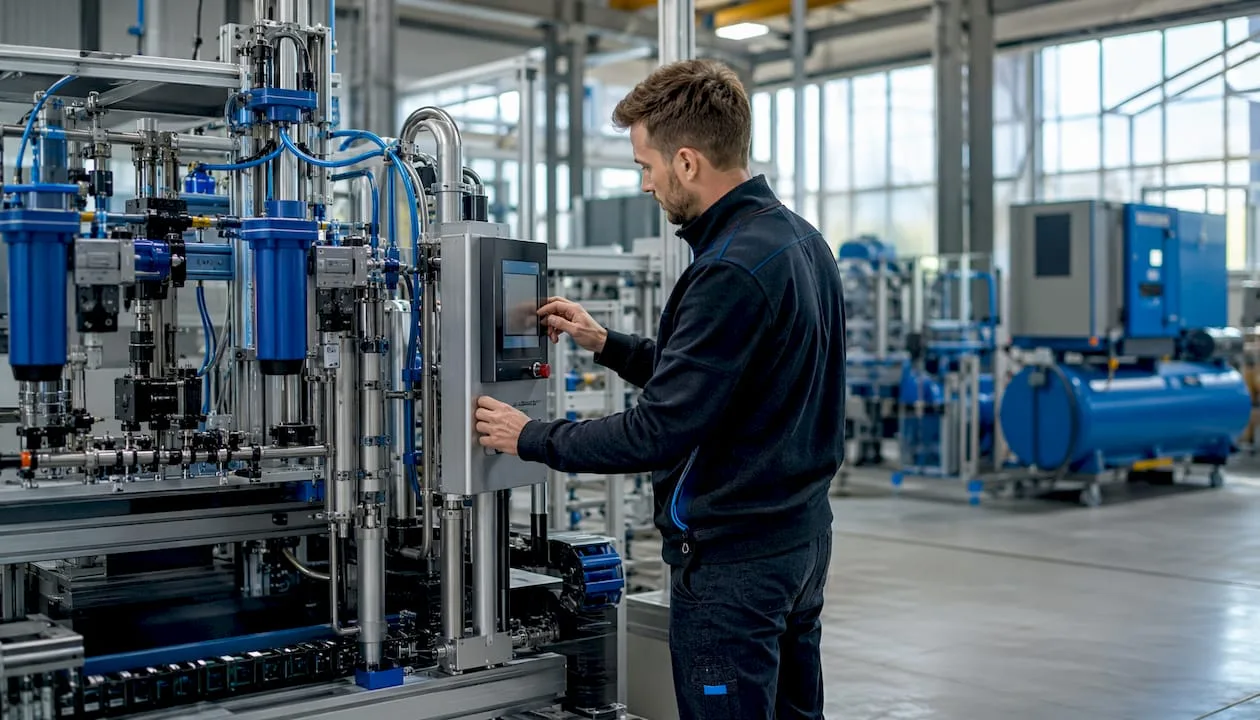
IO-Link is a standardized communication protocol according to the IEC 61131-9 standard. It operates over a standard three-wire cable and does not require a special bus. As a result, its deployment into existing infrastructure is significantly cheaper than switching to industrial Ethernet.
Edge computing complements IO-Link by processing data directly at the source, rather than in a central cloud. Latency drops to milliseconds, enabling an immediate response to pressure or flow deviations. Predictive maintenance thus ceases to be a theory and becomes operational practice.

Intelligent pneumatic systems reduce unplanned downtime by up to 45% and increase overall equipment effectiveness (OEE) by 12%. These figures correspond to experience from production lines, where sensor data detects an air leak or seal wear before it causes a failure.
Specific benefits of intelligent control include:
- Continuous pressure monitoring at every node with automatic alerts when a deviation exceeds the set limit
- Automatic flow correction according to the current demand of the production line without operator intervention
- Digital consumption records for accurate energy billing per individual machine or workstation
- Remote diagnostics via standard industrial interface without the need for a technician's physical presence
Professional tip: When deploying IO-Link, start with pressure monitoring at the most heavily loaded node. Data from one month of operation will show where the biggest losses are and justify the investment in further expansion.
Integration of piezo technology and software goes even further. A single programmable terminal replaces up to 50 individual components, significantly simplifying and reducing the cost of setting up the entire system. This level of consolidation reduces the number of potential failure points and shortens the time needed to reconfigure the line when the production program changes. More on the role of automation in practice is described in the fluid power automation guide.
How does magnetic levitation change rodless cylinders?
Magnetic levitation in rodless cylinders eliminates mechanical contact between the moving member and the cylinder body. The result is zero friction, no seal wear, and significantly higher positioning accuracy. Accuracy reaches ±1 µm, a parameter previously reserved only for electric linear actuators.
The energy aspect is equally convincing. Magnetically levitated cylinders achieve 40% higher energy efficiency compared to conventional pneumatic cylinders. This saving comes from the elimination of friction losses and from the recovery of kinetic energy via supercapacitors integrated into the actuator.
Service life exceeds 100 million cycles, which is 5 to 10 times more than conventional designs. This service life fundamentally changes the economics of component replacement and reduces planned maintenance costs.
| Parameter | Conventional cylinder | Magnetically levitated cylinder |
|---|---|---|
| Positioning accuracy | ±50–100 µm | ±1 µm |
| Energy efficiency | basic level | +40 % |
| Service life (cycles) | 10–20 million | over 100 million |
| Friction | mechanical | zero |
| Energy recovery | no | yes (supercapacitor) |
Implementation of magnetically levitated cylinders requires expertise in both motion control and supercapacitor integration. This is not a simple replacement of a mechanical cylinder. The system integrator must design a control loop capable of handling levitation dynamics while also ensuring safe stopping in the event of a power failure.
Professional tip: Before deploying magnetic levitation, verify the compatibility of the control system with the required dynamics. A standard PLC with a 10 ms cycle time may not be sufficient for applications requiring ±1 µm accuracy at high speeds.
Special designs for demanding environments, for example operation with hydrogen, achieve reliability of 99.999% and a service life 300–400% longer than standard designs. These parameters show where the future of pneumatic systems in energy-intensive industries is heading.
Why is compressed air quality critical in 2026?
ISO 8573-1 defines purity classes for compressed air based on solid particle content, moisture, and oil content. Quality class ISO 8573-1:2010 [1:2:1] is becoming the standard for production facilities with high reliability requirements. Failure to meet these classes causes premature valve wear, nozzle clogging, and product contamination.
The correct selection and installation of FRL units (filter, regulator, lubricator) directly determines whether the system will meet this standard. An incorrect component sequence or undersized components increases pressure losses above 10%, which directly translates into higher compressor energy consumption. Optimal sizing is based on actual flow rates in l/min, not on the nominal values shown on the equipment nameplate.
Correct procedure for selecting and installing FRL units:
- Measure the actual flow rate at the given point in l/min at maximum line load, not just an estimated value.
- Select a filter with a flow coefficient at least 20% higher than the measured value, so that the pressure drop does not exceed 0.1 bar at full flow.
- Install the components in the correct order: filter first, followed by the regulator, with the lubricator last before the consumer.
- Set the regulator to the lowest pressure at which the consumer operates reliably. Every extra bar unnecessarily loads the compressor.
- Monitor the pressure differential across the filter. Exceeding 0.5 bar indicates that the filter element is clogged and needs to be replaced.
The correct order of FRL units significantly affects the service life of the entire system. Many operating technicians underestimate this order and install the automatic lubricator before the regulator, causing oil contamination of the control valve and shortening its service life. Filtration of compressed air according to international standards is described in detail by the ISO 8573 filtration program.
How do modern compressors reduce energy costs?
Screw compressors with permanent magnet motors and variable speed drive (VSD) save 15–20% energy compared to compressors with fixed-speed motors. This saving comes from dynamic adaptation of compressor output according to current demand for compressed air. The compressor does not run at full output when the line only needs 60% of capacity.
Permanent magnet motors have higher efficiency across the entire speed range, not just at a single operating point. This feature is key for operations with variable demand, where a traditional fixed-speed motor works outside the optimal point for most of its operating time.
Benefits of modern compressors with VSD and permanent magnets include:
- Reduction of heat losses in the motor compartment, which reduces demands on plant room air conditioning
- Quieter operation under partial load due to lower speeds of the screw block
- Longer service life of the screw block due to lower peak temperatures under variable load
- Direct integration with intelligent pneumatic systems via IO-Link or industrial Ethernet for central consumption control
Integration of the compressor with an intelligent pneumatic system closes the control loop from the consumer to the source. The control system knows the current demand of each node and passes this information to the compressor, which adjusts output before the pressure in the network drops below the set limit. The result is a more stable network pressure and a lower energy peak at startup. Technical parameters of screw compressors for continuous operation are available directly in the Kompresory-vzduchotechnika catalog.
Key insights
Trends in industrial pneumatics for 2026 require the simultaneous implementation of intelligent control, proper filtration according to ISO 8573-1, and energy-efficient compressors with VSD, so that operations achieve measurable savings as well as higher reliability.
| Point | Details |
|---|---|
| Intelligent control with IO-Link | Reduces unplanned downtime by 45% and increases OEE by 12% thanks to real-time data. |
| Magnetic levitation | Accuracy of ±1 µm and a lifespan of over 100 million cycles are changing the maintenance economics of rodless cylinders. |
| ISO 8573-1 standard | The correct air purity class and the correct order of FRL units prevent pressure losses exceeding 10%. |
| Compressors with VSD | Permanent magnet motors with variable speed save 15–20% energy compared to fixed-speed motors. |
| Condition monitoring | 35% of new pneumatic products feature built-in monitoring, which reduces energy consumption by 25–35%. |
Practical experience: what really works and what doesn't
I have been working with pneumatic systems long enough to see how promising technologies turn into operational reality. Magnetic levitation and IO-Link are genuine shifts, not marketing terms. But deployment without preparation brings problems that manufacturers don't mention in their brochures.
The biggest mistake I see repeatedly is underestimating the quality of compressed air. An operation invests in smart valves with IO-Link and then files a complaint six months later, because nobody changed the filters or checked the humidity class. The ISO 8573-1 standard is not a bureaucratic formality. It is protection for the investment in the entire system.
The second thing that surprises me: compressors with VSD are deployed, but the control system does not communicate with them. The compressor runs autonomously and the smart pneumatic system runs autonomously too. The energy savings, which could be 30%, remain at 10%, because the data connection is missing. Integration is not optional, it is a condition for achieving the declared parameters.
Digital twins of pneumatic systems are another topic where expectations are ahead of reality. The model must be specified with the accuracy required for its use: ±2% for control, ±5% for energy optimization, and ±10% for predictive maintenance. An operation that wants a "digital twin" but does not specify the accuracy will get a tool that does not fulfill any of these purposes well.
The recommendation for 2026 is simple: start from the basics. Measure actual air consumption, check quality according to ISO 8573-1, and only then add the smart layer. The technology works. But only on a solid foundation.
— Zdeněk
Pneumatic components and consultation from Kompresory-vzduchotechnika
Kompresory-vzduchotechnika offers a complete range for modernizing pneumatic distribution systems as well as compressed air treatment. For new distribution systems, push-in system pipes are available in diameters of 15–28 mm, suitable for industrial installations requiring low pressure drops and easy assembly. For air quality treatment according to the ISO 8573-1 standard, Kompresory-vzduchotechnika offers air treatment units up to 10 bar with various filtration levels.
The expert team at Kompresory-vzduchotechnika provides technical consultation when selecting components as well as when designing the entire system. The consultation includes an assessment of the current state of the distribution system, recommendations for filtration class, and sizing of FRL units according to actual flow rates. Contact and technical support are available directly on the Kompresory-vzduchotechnika.cz website.
Frequently asked questions
What are the trends in pneumatic systems 2026?
Key trends include smart control with IO-Link, magnetic levitation in rodless cylinders, stricter requirements of the ISO 8573-1 standard, and compressors with VSD drives. Together, these technologies reduce energy consumption and increase the reliability of production lines.
How does IO-Link reduce pneumatic operating costs?
IO-Link enables continuous real-time monitoring of every node and predictive maintenance. Smart systems with IO-Link reduce unplanned downtime by up to 45% and increase overall equipment effectiveness by 12%.
What is the service life of magnetically levitated cylinders?
Magnetically levitated rodless cylinders achieve a service life of over 100 million cycles, which is 5 to 10 times more than conventional designs. Eliminating friction removes the main cause of wear in standard pneumatic cylinders.
Why is the ISO 8573-1 standard important for selecting FRL units?
ISO 8573-1 defines compressed air purity classes that a system must meet for reliable operation. Properly sized and sequenced FRL units prevent pressure losses exceeding 10% and protect valves and consumers from contamination.
How much energy does a compressor with VSD save compared to a standard one?
Screw compressors with permanent magnet motors and VSD drive save 15–20% energy compared to compressors with fixed-speed motors. The savings are highest in operations with variable compressed air demand.
Recommended
- Pneumatic tools in 2025: trends and innovations - Kompresory-Vzduchotechnika.cz
- How pneumatics works: a complete guide for industry 2026
- Overview of pneumatic valve applications in industry 2026 - Kompresory-Vzduchotechnika.cz
- Why use pneumatics: efficiency, speed and safety - Kompresory-Vzduchotechnika.cz