

Omega Air vacuum filters for vacuum pumps
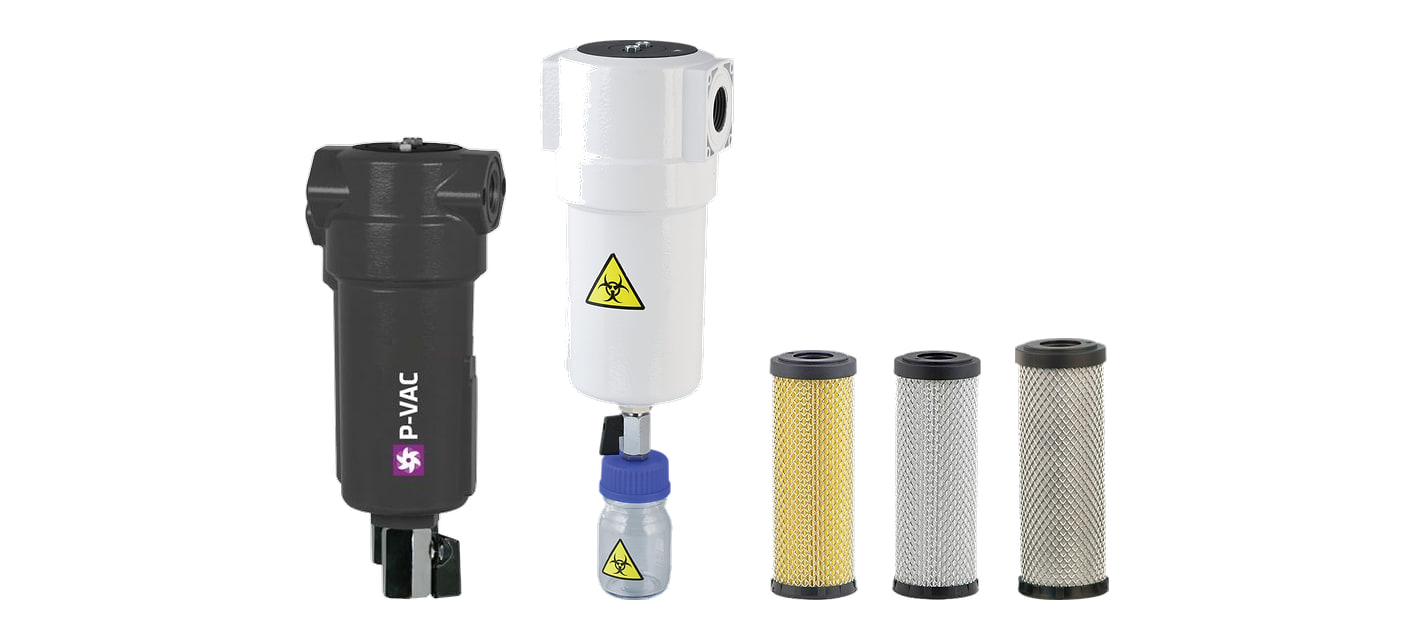
Vacuum filters from the Slovenian manufacturer Omega Air are mounted on the suction side of a vacuum pump. They trap solid particles and liquid before these reach the pump and damage it.
The P-VAC range protects vacuum pumps in industry, while the M-VAC range is designed for medical vacuum systems and also traps bacteria. Both work at an absolute pressure of 20 to 2,000 mbar and a temperature of +1.5 to +65 °C. They are part of the range of industrial compressed air filters.
Choose a range
Choose the range by application and the stage by how fine the contaminants are that must be kept away from the pump.
M-VAC medical filters
For medical vacuum systems: traps bacteria and collects liquids in a transparent bowl.
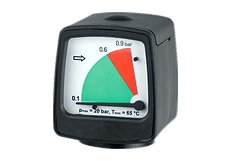
VPG 40 differential pressure gauges
Shows the pressure drop across the element, i.e. when to replace it.
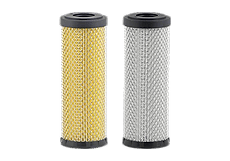
Ranges at a glance
| Vacuum filters at a glance | ||||||
|---|---|---|---|---|---|---|
| Range | Element | Working pressure | Connection | Flow | Sizes | Housing colour |
| P-VACP | 3 µm pre-filter | 20 to 2,000 mbar abs. | G 1/8" to 3" | 1.25 to 345 Nm³/h | 17 | dark grey RAL 7021 |
| P-VACM | 0.1 µm fine pre-filter | 20 to 2,000 mbar abs. | G 1/8" to 3" | 1.25 to 345 Nm³/h | 17 | dark grey RAL 7021 |
| M-VAC | 0.1 µm medical element | 20 to 2,000 mbar abs. | G 1/8" to 3", DN80 to DN150 flanges | 1.25 to 787 Nm³/h | 21 | white RAL 9003 |
Working pressure, connections and flows according to the manufacturer’s technical data sheets. The flow applies at atmospheric pressure.
Filtration stages
#showmore#
How to set up filtration before the vacuum pump
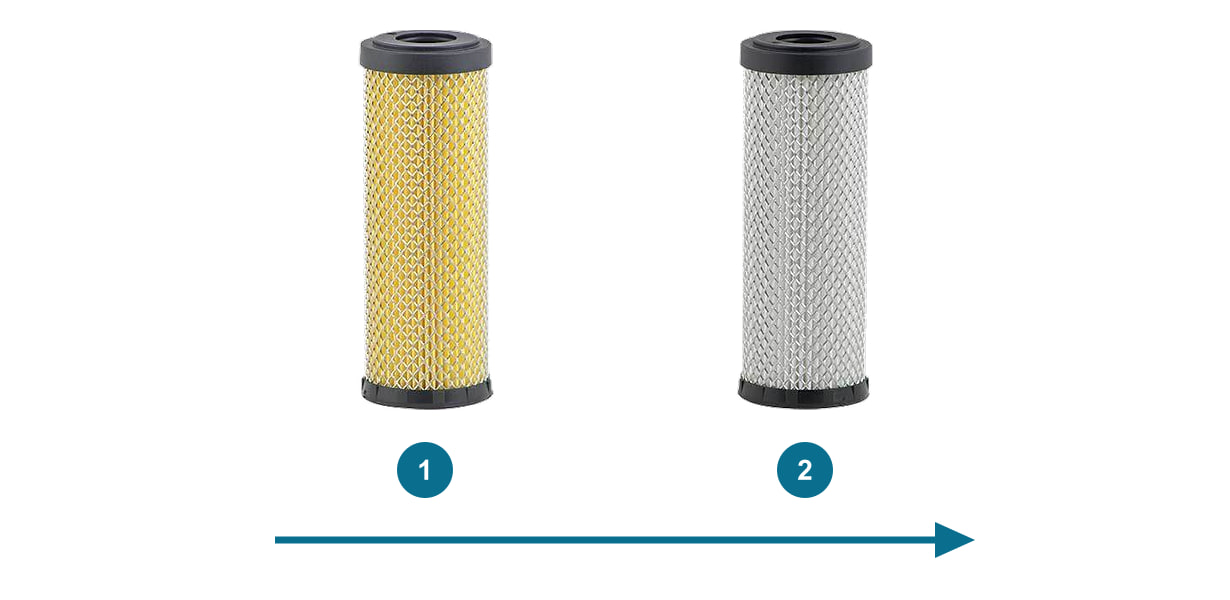
Where liquid or coarser contaminants are drawn in, the P-VACP pre-filter with a 3 µm element goes first. It is followed by the P-VACM fine pre-filter with a 0.1 µm element, which also traps very fine dust.
The pre-filter protects the fine element after it so that it does not clog quickly. In each size, both elements use the same housing and have the same dimensions.
Flow under vacuum
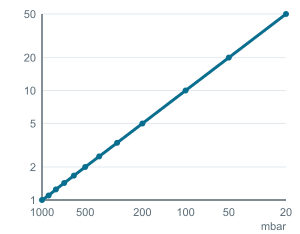
The flows in the tables apply at atmospheric pressure. The deeper the vacuum, the less air the filter passes: the actual flow is the nominal flow multiplied by the factor C1, which equals the absolute pressure in bar.
When selecting, multiply the system flow by the factor C2 for the vacuum level in the pipeline and choose a filter with at least that nominal flow. Example: a flow of 20 m³/h at an absolute pressure of 500 mbar × 2 = 40 Nm³/h, i.e. size 0306 with a flow of 41.9 Nm³/h.
| Flow correction by the vacuum level in the pipeline | |||
|---|---|---|---|
| Absolute pressure | Vacuum relative to atmosphere | Actual filter flow (× C1) | System flow for selection (× C2) |
| 1,000 mbar | 0 mbar | 1 | 1 |
| 900 mbar | 100 mbar | 0.9 | 1.1 |
| 800 mbar | 200 mbar | 0.8 | 1.25 |
| 700 mbar | 300 mbar | 0.7 | 1.43 |
| 600 mbar | 400 mbar | 0.6 | 1.67 |
| 500 mbar | 500 mbar | 0.5 | 2 |
| 400 mbar | 600 mbar | 0.4 | 2.5 |
| 300 mbar | 700 mbar | 0.3 | 3.33 |
| 200 mbar | 800 mbar | 0.2 | 5 |
| 100 mbar | 900 mbar | 0.1 | 10 |
| 50 mbar | 950 mbar | 0.05 | 20 |
| 20 mbar | 980 mbar | 0.02 | 50 |
Element replacement
A VPG 40 differential pressure gauge on the filter head shows when to replace the element: it measures the pressure drop across the element. The VPG40C version also has an electrical contact for remote signalling.
P-VAC filters are supplied with an element, without a drain. M-VAC filters collect the liquid in a transparent bowl.
More Omega Air filters
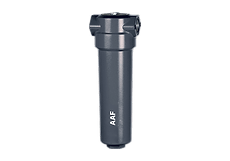
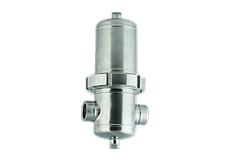
Stainless steel process filters
Stainless steel 1.4404 housings for the food and chemical industries.
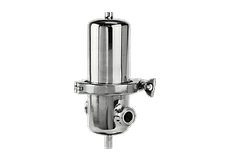
Stainless steel sterile filters
Stainless steel housings and sterile elements for pharmaceuticals and biotechnology.
Ventilek’s tip
Choose the filter by the flow at the actual vacuum level. At 500 mbar absolute pressure, the filter passes half of its nominal flow. An undersized filter throttles the vacuum pump intake and the element clogs faster.
- What is the difference between P-VAC and M-VAC?
- P-VAC protects vacuum pumps in industry and has two stages: a 3 µm pre-filter and a 0.1 µm fine pre-filter. M-VAC is designed for medical vacuum systems: the 0.1 µm element also traps bacteria, and the liquid collects in a transparent bowl.
- How do I choose the filter size?
- By the flow at the vacuum level in your pipeline. Multiply the system flow by the factor C2 from the table and choose a filter with at least that nominal flow.
- When should the element be replaced?
- When the VPG 40 differential pressure gauge shows that the element is clogged.
- What pressure can the filters withstand?
- An absolute pressure of 20 to 2,000 mbar and a temperature of +1.5 to +65 °C.
- Where are M-VAC filters used?
- The manufacturer designs them for operating theatres, maternity hospitals, dental practices, pathology laboratories, pharmaceuticals and autopsy rooms.


Product sorting
List of products

The 3 µm element traps liquid and larger solid particles from the air drawn in by the vacuum pump. Flow of 7.5 Nm³/h (125 l/min) at atmospheric pressure, 20 to 2,000 mbar abs.,...

Spare 0.1 µm medical element for M-VAC vacuum filters.

Kit for the N1 bowl of M-VAC medical vacuum filters.

Kit for the N2 bowl of M-VAC medical vacuum filters.

Kit for the N3 bowl of M-VAC medical vacuum filters.

The transparent bowl collects the liquid from the M-VAC filter; it can be removed and sterilised.

The transparent bowl collects the liquid from the M-VAC filter; it can be removed and sterilised.

The transparent bowl collects the liquid from the M-VAC filter; it can be removed and sterilised.

Shows the pressure drop across the vacuum filter element, i.e. when to replace it.

Shows the pressure drop across the vacuum filter element, i.e. when to replace it. Electrical contact for remote signalling.

Traps bacteria and other solid and liquid contaminants from the air drawn in by the vacuum pump, and collects the liquid in a transparent bowl. Flow of 1.25 Nm³/h (21 l/min) at...

Traps bacteria and other solid and liquid contaminants from the air drawn in by the vacuum pump, and collects the liquid in a transparent bowl. Flow of 2.25 Nm³/h (38 l/min) at...

Traps bacteria and other solid and liquid contaminants from the air drawn in by the vacuum pump, and collects the liquid in a transparent bowl. Flow of 3.13 Nm³/h (52 l/min) at...

Traps bacteria and other solid and liquid contaminants from the air drawn in by the vacuum pump, and collects the liquid in a transparent bowl. Flow of 3.75 Nm³/h (63 l/min) at...

Traps bacteria and other solid and liquid contaminants from the air drawn in by the vacuum pump, and collects the liquid in a transparent bowl. Flow of 4.37 Nm³/h (73 l/min) at...

Traps bacteria and other solid and liquid contaminants from the air drawn in by the vacuum pump, and collects the liquid in a transparent bowl. Flow of 7.5 Nm³/h (125 l/min) at...

Traps bacteria and other solid and liquid contaminants from the air drawn in by the vacuum pump, and collects the liquid in a transparent bowl. Flow of 9.8 Nm³/h (163 l/min) at...

Traps bacteria and other solid and liquid contaminants from the air drawn in by the vacuum pump, and collects the liquid in a transparent bowl. Flow of 15 Nm³/h (250 l/min) at...

Traps bacteria and other solid and liquid contaminants from the air drawn in by the vacuum pump, and collects the liquid in a transparent bowl. Flow of 24.8 Nm³/h (413 l/min) at...

Traps bacteria and other solid and liquid contaminants from the air drawn in by the vacuum pump, and collects the liquid in a transparent bowl. Flow of 41.9 Nm³/h (698 l/min) at...

Traps bacteria and other solid and liquid contaminants from the air drawn in by the vacuum pump, and collects the liquid in a transparent bowl. Flow of 63.8 Nm³/h (1,063 l/min)...

Traps bacteria and other solid and liquid contaminants from the air drawn in by the vacuum pump, and collects the liquid in a transparent bowl. Flow of 97.5 Nm³/h (1,625 l/min)...

Traps bacteria and other solid and liquid contaminants from the air drawn in by the vacuum pump, and collects the liquid in a transparent bowl. Flow of 125 Nm³/h (2,083 l/min)...

Traps bacteria and other solid and liquid contaminants from the air drawn in by the vacuum pump, and collects the liquid in a transparent bowl. Flow of 187.5 Nm³/h (3,125 l/min)...

Traps bacteria and other solid and liquid contaminants from the air drawn in by the vacuum pump, and collects the liquid in a transparent bowl. Flow of 210 Nm³/h (3,500 l/min)...

Traps bacteria and other solid and liquid contaminants from the air drawn in by the vacuum pump, and collects the liquid in a transparent bowl. Flow of 270 Nm³/h (4,500 l/min)...

Traps bacteria and other solid and liquid contaminants from the air drawn in by the vacuum pump, and collects the liquid in a transparent bowl. Flow of 345 Nm³/h (5,750 l/min)...

Traps bacteria and other solid and liquid contaminants from the air drawn in by the vacuum pump, and collects the liquid in a transparent bowl. Flow of 275 Nm³/h (4,583 l/min)...

Traps bacteria and other solid and liquid contaminants from the air drawn in by the vacuum pump, and collects the liquid in a transparent bowl. Flow of 394 Nm³/h (6,567 l/min)...

Traps bacteria and other solid and liquid contaminants from the air drawn in by the vacuum pump, and collects the liquid in a transparent bowl. Flow of 587 Nm³/h (9,783 l/min)...

Traps bacteria and other solid and liquid contaminants from the air drawn in by the vacuum pump, and collects the liquid in a transparent bowl. Flow of 787 Nm³/h (13,117 l/min)...

Spare 0.1 µm medical element for M-VAC vacuum filters.

Spare 0.1 µm medical element for M-VAC vacuum filters.

Spare 0.1 µm medical element for M-VAC vacuum filters.

Spare 0.1 µm medical element for M-VAC vacuum filters.

Spare 0.1 µm medical element for M-VAC vacuum filters.

Spare 0.1 µm medical element for M-VAC vacuum filters.

Spare 0.1 µm medical element for M-VAC vacuum filters.

Spare 0.1 µm medical element for M-VAC vacuum filters.

Spare 0.1 µm medical element for M-VAC vacuum filters.