

How automatic air control works and why it matters
Automatic air control is a technology that independently regulates the flow, pressure, temperature and quality of air in an enclosed space without the need for manual intervention. The system continuously collects data from sensors, evaluates it according to pre-set control logic and automatically adjusts the operating parameters of ventilation or air-conditioning units. The result is a stable microclimate, lower energy consumption and the elimination of errors caused by the human factor.
Key functions and areas of application of automatic air control:
- Air flow regulation in residential heat recovery units as well as industrial ventilation systems
- Maintaining pressure balance between supply and exhaust air, thereby minimizing heat losses
- Air quality control by measuring CO2, humidity and temperature with automatic switching of operating modes
- Integration with building control systems for coordinating ventilation, heating and fire protection
- Industrial applications ranging from production halls to compressor stations
Expert Libor Štorec from the TZB-info website emphasizes that a correctly set automatic system regulates flows quickly and precisely, which saves technicians time during commissioning. The company Brink Climate Systems has demonstrated that automatic constant flow control maintains pressure balance and maximizes the efficiency of the heat exchanger. Kompresory-vzduchotechnika offers components and expert advice for these systems.
What sensors and data drive automatic air control?
The whole system is based on precise measurement. Without reliable sensors, the control logic has nothing to work with, and the results are then inaccurate or misleading.
The most commonly used types of sensors:
- Temperature sensors monitor the temperature of both supply and exhaust air and respond to fluctuations in real time
- Humidity sensors prevent condensation and mould growth by triggering a dehumidification or ventilation cycle
- CO2 sensors measure carbon dioxide concentration and signal the need for more intensive ventilation
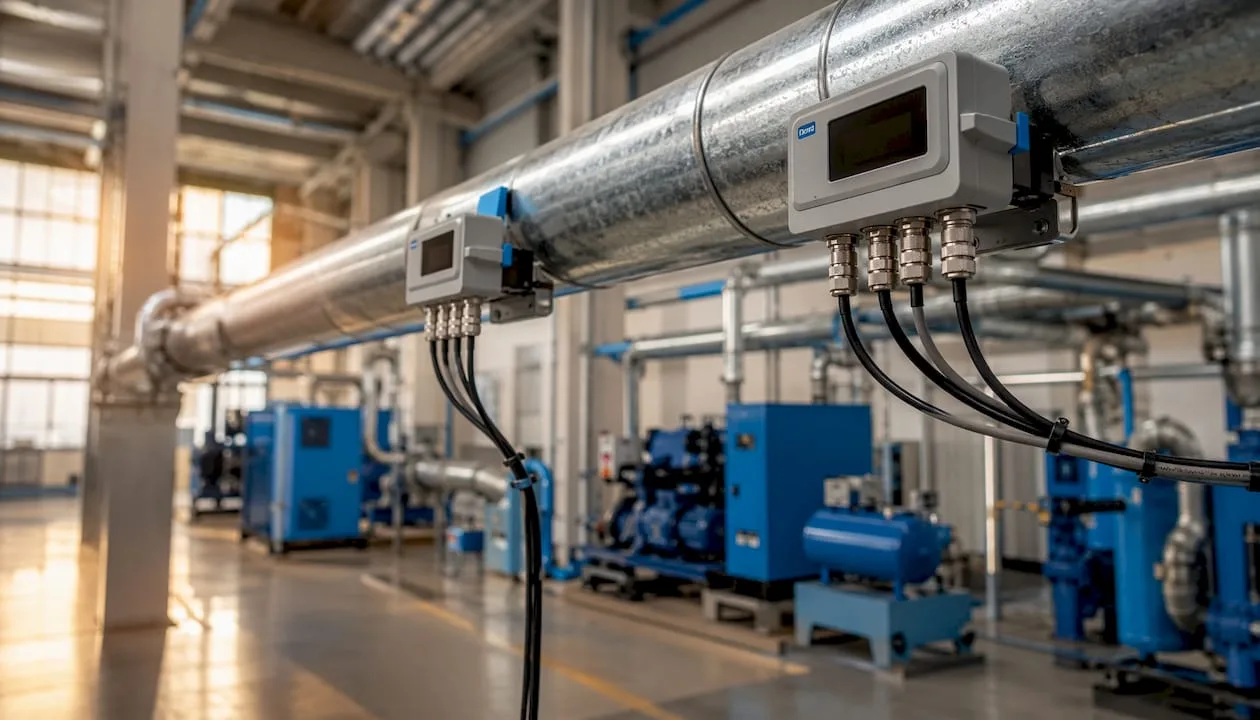
- Pressure sensors monitor differential pressure in the ductwork and detect clogged filters or blocked ducts
- Built-in anemometers measure precise volumetric air flow and allow the system to maintain set values
Data transmission takes place either via analogue signals (0–10 V, 4–20 mA) or digital buses such as Modbus or KNX. The control centre processes the data in real time and activates the corresponding ventilation or shutdown modules. Sensor accuracy directly affects how quickly and reliably the system responds to changes in the space.
Professional tip: Place CO2 sensors at a height of 1.5 m above the floor, as far as possible from the air supply opening. Measurement near the supply opening underestimates the actual concentration in the occupied zone, causing the system to ventilate less than necessary.
The heat recovery system also prioritizes data from the constant flow sensor over user settings. If the filters are clogged or the ducts are blocked, the system automatically reduces the flow or signals a fault, even if the user has set a higher output.
How does control logic automate ventilation systems?
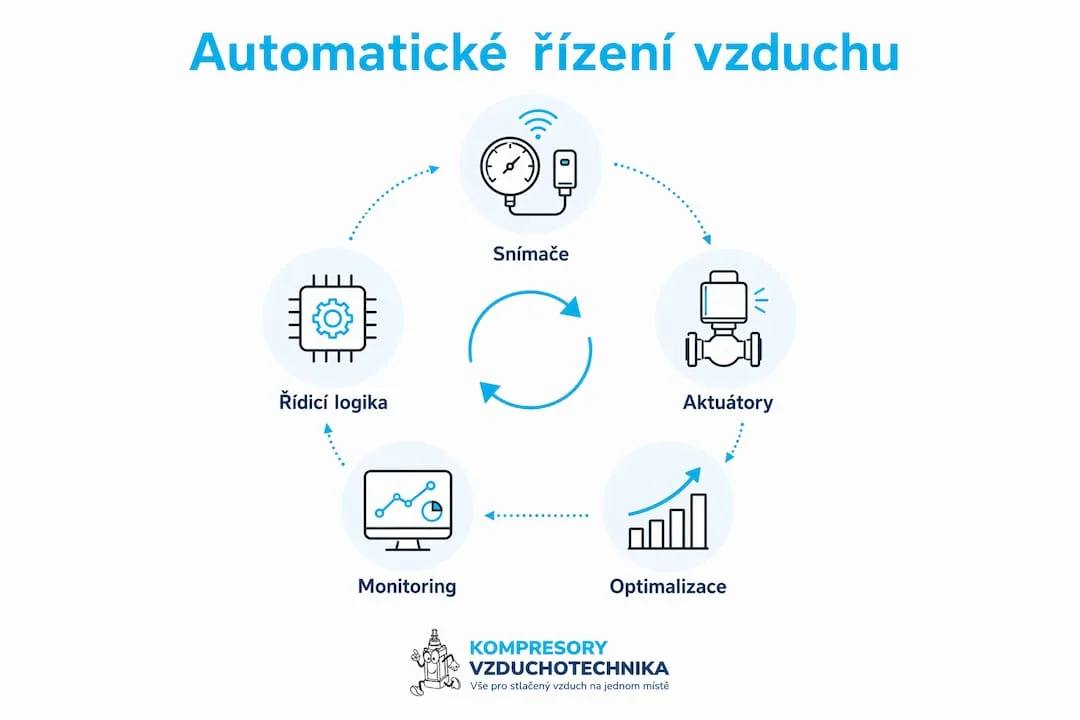
Sensors supply the data, but the control algorithm decides what happens with it. Modern ventilation systems use programmable logic controllers (PLCs) or built-in microcontrollers, which compare the measured values with the set setpoints and issue commands to inverters, dampers or fans.
| Control type | Principle | Typical application |
|---|---|---|
| Constant flow control | Maintains the set air flow regardless of duct resistance | Residential heat recovery units |
| Pressure control | Maintains constant pressure in the duct network | Industrial compressor stations |
| Trim control | Changes the setpoint according to room occupancy | Office buildings, production halls |
| Temperature control | Controls heating or cooling of the supply air | AHU air handling units |
| Humidity control | Activates the humidifier or dehumidifier | Hospitals, sensitive goods warehouses |
Trim control is particularly effective in industrial systems. The system dynamically adjusts the setpoint parameter according to the current occupancy of the space, so it ventilates at a minimum in an empty production hall and switches to maximum output during full operation. The result is demonstrable energy savings without compromising air quality.
System security includes emergency shutdown when temperature limits are exceeded, fire detection, or power failure. The control system then switches to a safe state and blocks restart without technician authorization.
Professional tip: When programming the PLC, set the controller hysteresis to at least 5% of the measured variable's range. Too narrow a hysteresis causes rapid switching of actuators, so-called hunting, which shortens their service life.
What advantages does automatic air control bring in practice?
Automatic air control brings measurable advantages over manual control, both in households and in industrial operations.
Precise flow measurement with a built-in anemometer maintains the set airflow while minimizing electricity consumption. Balanced ventilation, where supply and exhaust air are equalized, prevents condensation on cold surfaces and the formation of mold. Comparative measurements of CO2 and heat losses confirm that apartments with controlled ventilation achieve better air quality and lower energy consumption than spaces ventilated only through windows.
Main benefits of automatic air control:
- Energy savings thanks to optimizing fan speed and airflow according to current need
- Prevention of condensation and mold through balanced ventilation with precise humidity control
- Elimination of the human factor: the system ventilates correctly even when the user forgets to ventilate
- Healthier indoor environment by keeping CO2 concentration below critical levels
- Lower operating costs in irregularly used spaces thanks to demand-controlled regulation
Systems with automatic control provide comfortable microclimate and ecological benefits in modern homes. Automatic ventilation differs from air conditioning: its primary goal is continuous air exchange and humidity control, not cooling the space.
Where is automatic air control actually used?
Automatic air control finds application in a wide range of environments, from family homes to large industrial halls. The specific deployment varies according to the requirements for flow rate, pressure, and air quality.
- Residential heat recovery units (e.g. Brink systems) automatically maintain pressure balance and maximize the efficiency of the heat exchanger, thereby reducing heat losses during ventilation
- Production halls and warehouses use demand-controlled regulation, which adapts ventilation intensity to space occupancy and reduces operating demands in unoccupied zones
- Compressor stations regulate pressure in the pipe network and protect connected tools from pressure surges; pressure regulation in pneumatics is a key element of reliable operation
- Office buildings and schools combine CO2 sensors with a building management system (BMS) to ventilate according to actual occupancy
- Hospitals and clean rooms require precise regulation of overpressure or underpressure to prevent contamination between departments
- Automobiles control not only temperature but also air distribution according to the season, preventing window fogging and increasing driving safety
| Environment | Control type | Main benefit |
|---|---|---|
| Residential heat recovery ventilation | Constant flow | Pressure balance, minimal heat losses |
| Production hall | Trim control | Energy savings at low occupancy |
| Compressor station | Pressure control | Tool protection, stable performance |
| Hospital | Overpressure/vacuum control | Contamination prevention |
| Office | CO2 control | Air quality, worker comfort |
Integration with smart homes takes place via KNX, Modbus protocols or manufacturers' proprietary gateways. The system then coordinates ventilation with heating, shading and fire protection as a single unit. A more detailed look at industrial ventilation shows how these principles are applied in production operations.
How to correctly set up and maintain an automatic air control system?
Correct system setup determines whether it will operate reliably for years, or cause problems from the first month of operation. Sensor calibration, setpoint configuration and regular maintenance are the three pillars of long-term stability.
Recommended procedure for commissioning the system:
- Measure the actual flow rates at all outlets and compare them with the design values before starting up the automation
- Calibrate the sensors against a reference instrument, not just according to the factory calibration
- Set the setpoints for flow rate, temperature and humidity according to the actual use of the space, not according to general recommendations
- Verify the function of the emergency shutdown by simulating a fault condition before handover to operation
- Document the settings in the operating log so that a service technician later knows what to deviate from
Typical setup errors include a controller hysteresis that is too narrow, poor sensor placement, or neglecting calibration after a filter change. Regular filter checks, sensor calibration, and evaluation of operating data extend the system's lifespan and prevent failures before they occur.
Professional tip: After every filter change, check whether the system has correctly re-regulated the flow rates. A new filter has lower resistance than a clogged one, so the flow rates change and the automation must set new operating points.
The role of a professional technician is irreplaceable during initial setup. Automation eliminates errors caused by the human factor during operation, but the setup itself requires expert knowledge of sensor calibration, correct wiring of control elements, and an understanding of the piping network's hydraulics.
What standards and legislation apply to automatic air control in the Czech Republic?
Automatic air control in the Czech Republic is subject to several technical standards and legal regulations that set minimum requirements for air exchange, energy performance, and system safety.
The basic normative framework is formed by ČSN EN 16798 (energy performance of buildings, ventilation of non-residential buildings) and ČSN EN 15251 (input parameters of the indoor environment for the design and assessment of the energy performance of buildings). These standards define the minimum air flow rates per person and per area, and the categories of indoor environment quality, from which the settings of control systems are derived.
Industrial ventilation is governed by Government Regulation No. 361/2007 Coll., which sets out the conditions for health protection at work, including requirements for workplace microclimate. The minimum air exchange rate, permissible CO2 concentrations, and temperature ranges are binding here, not merely recommended.
The energy performance of buildings is governed by Act No. 406/2000 Coll. on Energy Management and implementing Decree No. 264/2020 Coll. Automatic air control is one of the tools by which designers achieve the required building energy performance classes (ENB). Recovery units with automatic flow control contribute to reducing the specific heating demand, which is a monitored parameter in building certification.
The installation of ventilation systems must also comply with ČSN 73 0872 (fire safety of buildings, ventilation equipment) and be coordinated with the building's fire safety design. Automatic dampers and control systems must respond according to a predefined scenario in the event of a fire alarm.
Key takeaways
Automatic air control combines precise measurement, control algorithms, and actuators into a system that ensures optimal air quality, pressure balance, and energy efficiency without manual intervention.
| Point | Details |
|---|---|
| Sensors as the foundation of the system | Temperature, humidity, CO2, pressure and flow are input data for every decision made by the control logic. |
| Pressure balance prevents mold | Balancing supply and exhaust airflow eliminates condensation and the formation of mold on perimeter structures. |
| Trailing control saves energy | Dynamic setpoint adjustment based on room occupancy reduces operational demands in unoccupied zones. |
| Standards are binding | ČSN EN 16798, Government Regulation No. 361/2007 Coll. and Act No. 406/2000 Coll. set the minimum requirements for both design and operation. |
| Calibration determines reliability | Regular sensor calibration and filter inspection are prerequisites for the accurate operation of the automation system. |
Frequently Asked Questions
What exactly does automatic air control mean?
Automatic air control is a system that uses sensors and control algorithms to independently regulate the airflow, pressure, temperature, and humidity in a space without manual user intervention.
How is airflow measured in automatic systems?
Airflow is measured by a built-in anemometer or differential pressure sensor located in the ducting. The measured value is compared with the setpoint, and the fan's inverter automatically adjusts the airflow.
How much air per person do Czech standards require?
ČSN EN 16798 and Government Regulation No. 361/2007 Sb. set minimum airflow rates per person and per room area depending on the category of the space and its use; specific values vary according to the type of building and occupancy.
What does air humidity express and why does the system monitor it?
Relative humidity indicates what percentage of the maximum possible amount of water vapor the air contains at a given temperature. The automatic system monitors it because excessively high humidity promotes mold growth, while low humidity causes the mucous membranes to dry out.
How does air-to-air air conditioning work together with automatic control?
Air-to-air air conditioning transfers heat between the outdoor and indoor air; automatic control coordinates its operation with ventilation to minimize heat losses and maintain the required temperature and humidity in the space.
Recommended
- The importance of compressed air automation in industry - Kompresory-Vzduchotechnika.cz
- List of tasks for compressed air: a guide for technicians - Kompresory-Vzduchotechnika.cz
- Pneumatic systems explained: a guide for technicians - Kompresory-Vzduchotechnika.cz
- The Role of Automation in Pneumatics in Manufacturing Processes - Kompresory-Vzduchotechnika.cz