
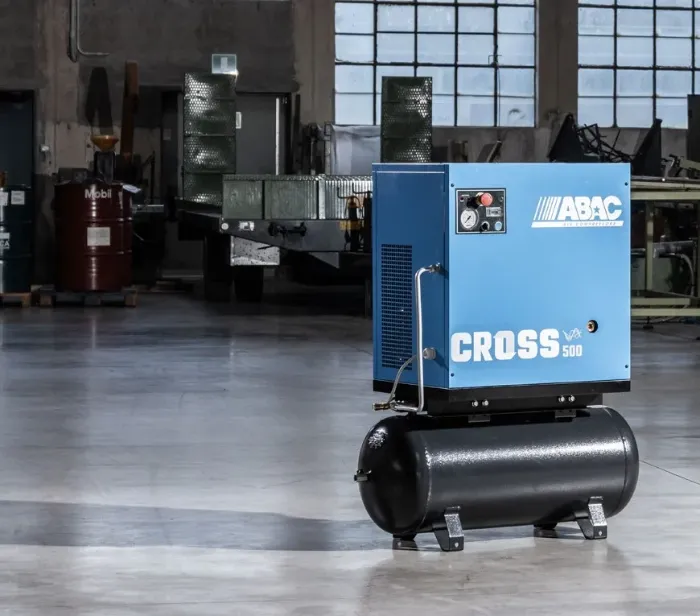
ABAC CROSS – small screw compressors – compact, efficient, quiet
A rotary screw compressor pays off the moment a piston machine stops keeping up — whether on noise or on output. TheABAC CROSSrange is built for exactly that step up: rotary screw performance in a size that fits a workshop.
Every model has avariable speed drive. Speed follows actual demand, so the motor never idles — ABAC quotes up to a quarter less energy than piston compressors. Unlike them, CROSS also handlescontinuous duty.
 First service after 2,000 hours
How CROSS differs from a piston compressor
Smooth running, no pulsation
Two rotors compress the air continuously. The pulsation and vibration a piston machine sends into the piping simply disappear.
Runs all day
A piston compressor needs cool-down breaks. CROSS is built for continuous duty.
Soft start
The drive spins the motor up gradually. Lower inrush current spares both your fuses and the machine.
Dry air straight away
Versions with the letter D have a built-in refrigerant dryer with a +5 °C dew point.
It goes in the workshop, not in a compressor room
At 60 dB(A) the four-kilowatt version is as loud as a household appliance. No separate room, no long pipe run — usually the most expensive part of the whole installation in a small shop.
How much noise is still bearable and how it is measured is covered inCompressor noise and what to watch out for.
Who CROSS is for
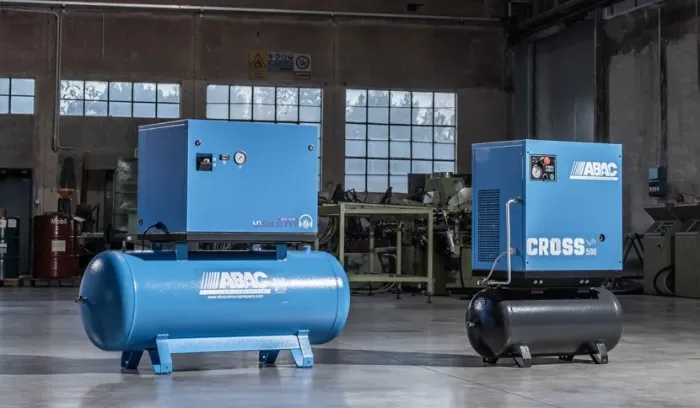
The maker aims it at small and mid-sized shops that need air every day but have neither the room nor the budget for a large screw compressor.
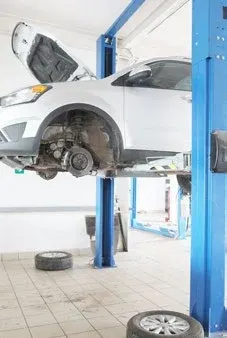
Impact wrenches, lifts, tyre service.
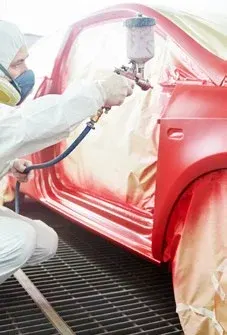
They need dry air — go for the version with a dryer.

Nail guns, sanders, extraction.
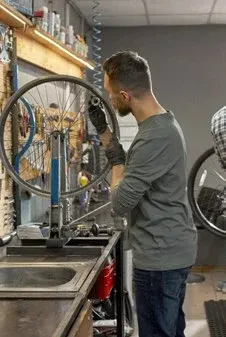
Inflation, cleaning, assembly tools.

Plasma cutting, grinders, blow-off.

Screwdrivers, jigs, continuous running.
Which model to choose
ABAC CROSS range specifications | |||||
|---|---|---|---|---|---|
| Model | Air delivery | Motor power | Noise level | Air receiver | Dryer |
| CRS-4/10 | 498 l/min | 4 kW | 60 dB(A) | — | — |
| CRS-4/10-100 | 498 l/min | 4 kW | 60 dB(A) | 100 l | — |
| CRS-4/10-200 | 498 l/min | 4 kW | 60 dB(A) | 200 l | — |
| CRS-4/10D-200 | 498 l/min | 4 kW | 60 dB(A) | 200 l | yes |
| CRS-7,5/10 | 848 l/min | 7.5 kW | 63 dB(A) | — | — |
| CRS-7,5/10-200 | 848 l/min | 7.5 kW | 63 dB(A) | 200 l | — |
| CRS-7,5/10-200D | 848 l/min | 7.5 kW | 63 dB(A) | 200 l | yes |
Air delivery measured per ISO 1217 ed. 4 (2009), annex E, at a reference pressure of 9.5 bar; noise per ISO 2151 (2004). Maximum working pressure is 10 bar on every model.
#showmore#
How much space it takes
The most common question before buying a screw compressor is not output but whether it fits. Dimensions include the receiver and the dryer — nothing is bought separately.
Dimensions and weights by version | |||
|---|---|---|---|
| Version | Length × width | Height | Weight |
| Without receiver | 690 × 480 mm | 787 mm | 99 kg |
| 100 l receiver | 1008 × 526 mm | 1209 mm | 123 kg |
| 200 l receiver | 1436 × 526 mm | 1316 mm | 153 kg |
| 200 l receiver + dryer | 1436 × 612 mm | 1316 mm | 180 kg |
Fixed speed instead of a drive is enough where demand stays the same — those machines are in the ABAC SPINN Mini series. If the workshop has no three-phase supply, the ABAC SPINN.D series runs on standard 230 V. And above 7.5 kW the machines continue up to 15 kW in the ABAC SPINN Maxi series.
Ventilek's tips
A drive does not save on its own. It saves once demand starts to fluctuate. When the same job runs in the workshop from morning to night, the machine behaves almost as if it had no drive at all. Those savings of up to 25 % add up where the tools and the pace change through the day.
Frequently asked questions
- How does a rotary screw compressor work?
- Two intermeshing rotors compress the air continuously, with no piston and no pulsation. We cover it in detail inRunning rotary screw compressors efficiently.
- Is a small screw compressor worth it instead of a piston one?
- Running time decides. Once the compressor runs more than a few hours a day, the energy saving and the longer service interval pay it back. You can work it out usingCompressor energy consumption.
- How often does a screw compressor need servicing?
- On the CROSS range the first service comes only after 2,000 operating hours or one year. What it involves is described inHow and why to service compressors properly.
- Do I need a dryer with it?
- If you spray paint or run air tools, yes. Versions with the letter D have one built in. Why it matters is explained inWhy and how to dry compressed air.
- What power supply do I need?
- Every CROSS model is three-phase, 400 V. Thanks to the soft start it loads your fuses less than a piston machine of the same rating.
Bestsellers


Product sorting
List of products

Compressor, a 200 l receiver and a refrigerant dryer in one unit. Dry air with a +5 °C dew point right at the outlet, with nothing extra in the line. Output 498 l/min, noise 60...

The most complete package in the range — 848 l/min, a 200 l receiver and a built-in refrigerant dryer with a +5 °C dew point. Dry air for the spray booth and for plasma from a...

A standalone screw unit for an existing receiver. It delivers 498 l/min at 10 bar and, thanks to the variable speed drive, runs only as fast as you actually draw. Noise 60...

Compressor and a hundred-litre receiver in one unit — the smallest package in the CROSS range. 498 l/min at 10 bar; the variable speed drive holds pressure steady, so a smaller...

The most popular package in the range: a rotary screw compressor with a two-hundred-litre receiver. 498 l/min at 10 bar feeds two or three air tools at once. The variable speed...

The stronger of the two CROSS versions, without a receiver. It delivers 848 l/min at 10 bar, seventy percent more than the four-kilowatt model — for several tools at once or...

A seven-and-a-half kilowatt rotary screw compressor with a two-hundred-litre receiver. 848 l/min at 10 bar feeds four or five air tools at once. It handles continuous duty with...