
Screw compressors ABAC
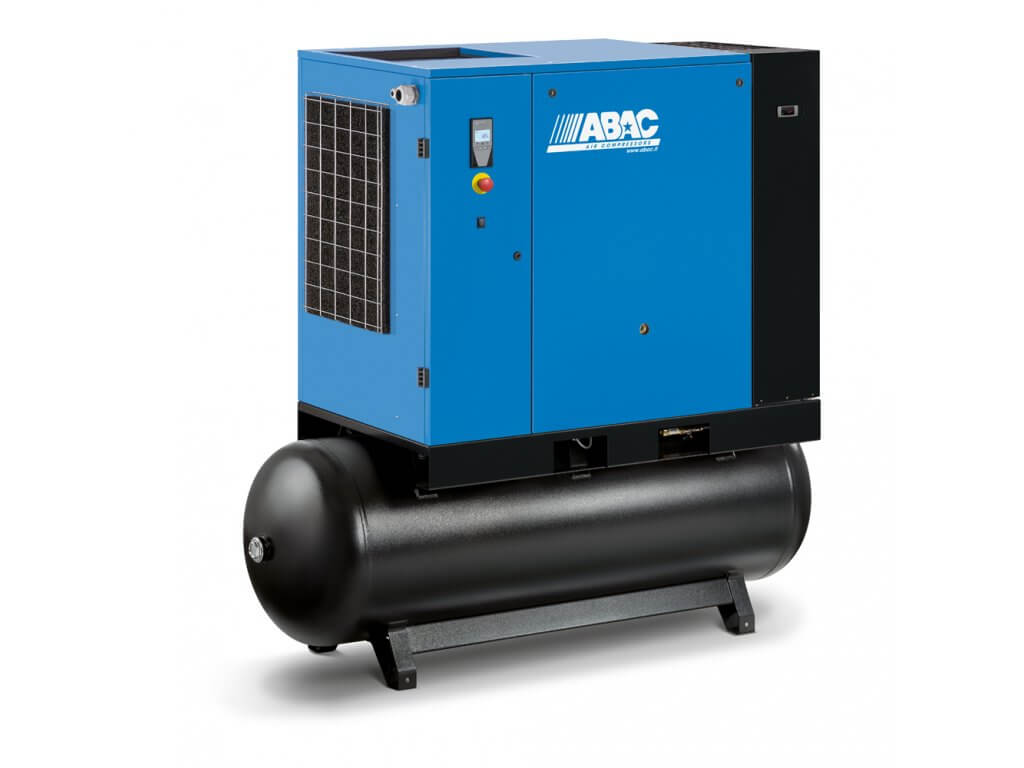 Six ranges, 30 models
We carry ABAC screw compressors in six ranges — from a two-kilowatt machine on ordinary 230 V up to a twenty-two-kilowatt station for a whole hall. 30 models in all, delivering 272 to 3,090 litres per minute.
The ranges differ in more than output. What decides between them is whether your demand fluctuates, whether you already have a receiver and drying, and what electrical supply the workshop has. This page is here to point you to the right one; the detail sits with each range.
Four questions that decide it
How much air do you need?
Up to 780 l/min the demand is covered by CROSS, SPINN.D, Mini and SPV. Up to 1,680 l/min by Maxi. Above 2,200 l/min only by Large.
Does demand fluctuate through the day?
If it does — an impact wrench one minute, nothing the next — the SPV with its variable speed drive pays off. If the same work runs all day, a fixed-speed machine saves almost as much and costs less to buy.
Do you already have a receiver and drying?
If you do, take a standalone machine — CROSS, Maxi without a receiver or Large without a receiver. If you do not, take a finished set: Mini, SPV, Maxi DX or Large D-500.
What supply do you have?
Everything but one model needs 400 V three-phase. The single exception in the whole line-up is the SPD-2,2/10CW-90 from the SPINN.D range, which runs on 230 V.
Ranges for a workshop and a smaller site
ABAC CROSS
When you are moving up from a piston compressor and want to put the set together yourself. Of all the ranges it offers the most variants of the same machine — on its own, on a 100 or 200 litre receiver, with a dryer or without. The drive is direct, so there are no V-belts to tension.
7 models · 4 a 7.5 kW · 495 a 848 l/min · 59–63 dB(A)
ABAC SPINN.D
When the workshop has no three-phase supply. The SPD-2,2/10CW-90 runs on ordinary 230 V and is the only such machine in the whole ABAC line-up. It also stands on wheels, so it can be moved about. The second model takes 400 V and a 200 litre receiver.
2 models · 2.2 kW · 272 l/min · 59 dB(A)
ABAC SPINN Mini
When you want a finished set and demand is roughly steady. A 200 litre receiver and a refrigerant dryer come with every model, not as an extra. Nothing is assembled from parts and the air reaches the pipework dry from day one.
4 models · 2.2–5.5 kW · 294–780 l/min · 61–66 dB(A)
ABAC SPINN SPV
When consumption changes through the day. It is the only range with a variable speed drive. At low demand the machine slows down instead of idling and burning electricity. These are also the quietest machines we carry — from 57 dB(A).
4 models · 2.2–5.5 kW · 131–757 l/min (regulace) · 57–61 dB(A)
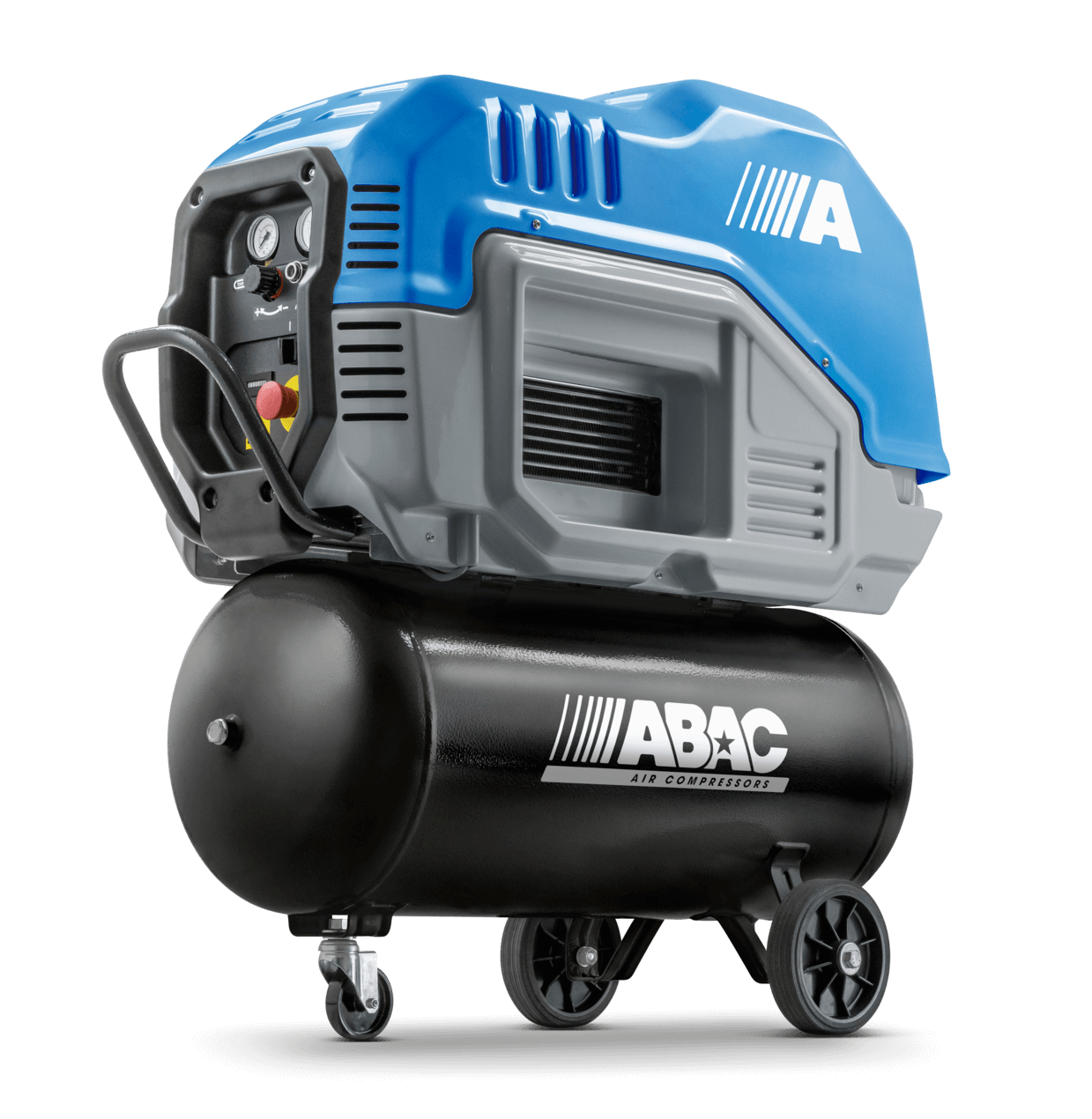
The only one that needs no three-phase supply
In the whole ABAC line-up there is exactly one screw compressor running on ordinary 230 V — the SPD-2,2/10CW-90 from the ABAC SPINN.D range. It delivers 272 litres per minute at 10 bar and stands on wheels, so you can move it to wherever the work is.
Every other machine, including the second model of that same range, needs 400 V three-phase. So if you have no such supply, the decision is simple — and if you do, the whole choice opens up.
Ranges for a compressor room and a hall
ABAC SPINN Maxi
When you are planning a compressor room rather than a workshop. Three standalone units with the smallest footprint we carry — 850 × 720 mm — for sites where the receiver already stands. Plus four finished sets on a 270 or 500 litre receiver with a dryer.
7 models · 5.5–15 kW · 696–1,680 l/min · 64–71 dB(A)
ABAC SPINN Large
When compressed air is the backbone medium of the whole site. The largest block we carry — the S67 with vertical three-stage oil separation. Three standalone machines and three complete stations on a 500 litre receiver with a dryer.
6 models · 15–22 kW · 2,215–3,090 l/min · 67–70 dB(A)
#showmore#
How the ranges differ in size
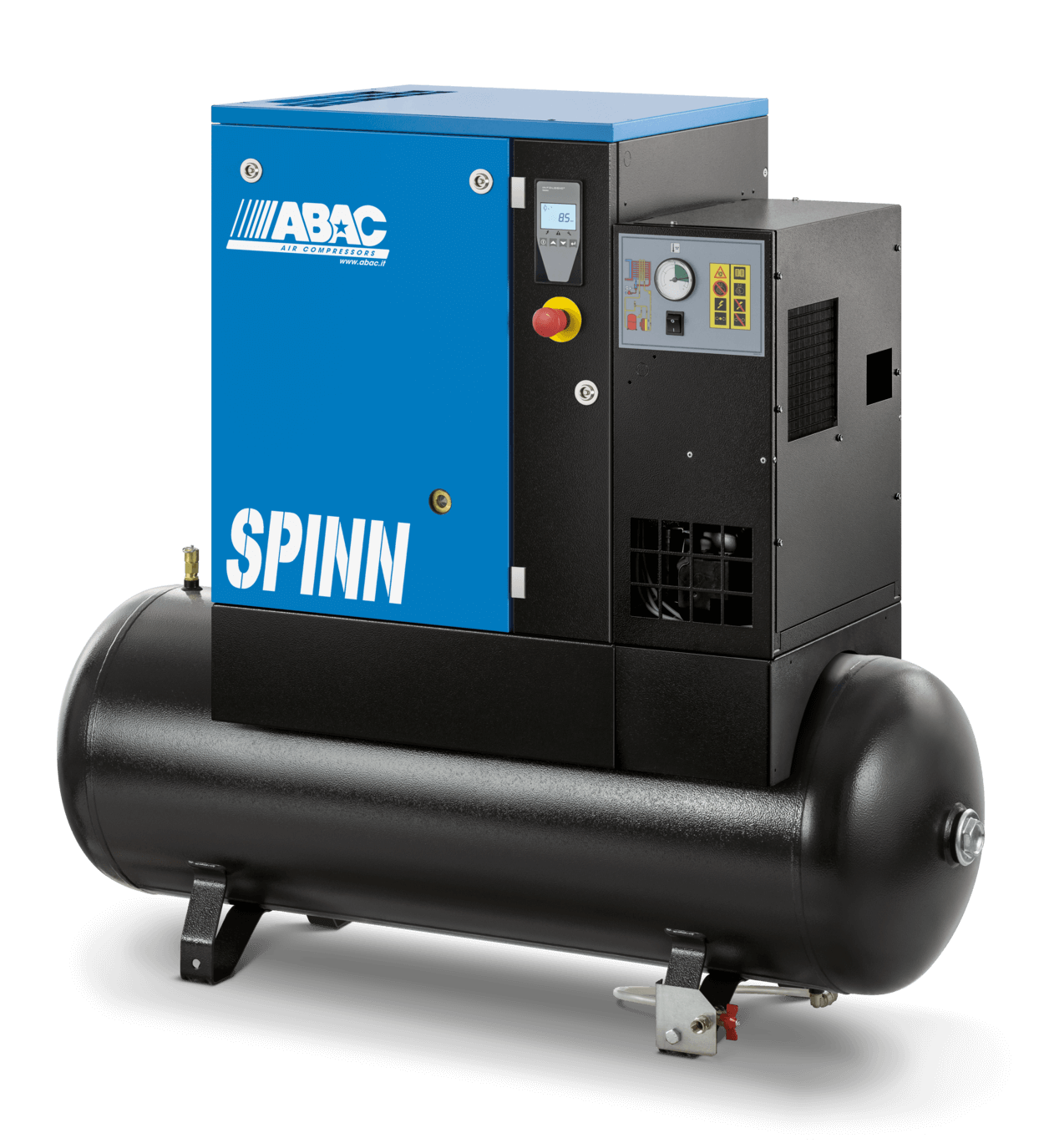
From the left: SPINN.D 2.2 kW on a 90-litre receiver · SPINN Mini 5.5 kW with a 200 l receiver and a dryer · SPINN Large 22 kW on 500 litres. Between the two extremes there is an elevenfold difference in delivery.
The six ranges side by side
| ABAC screw compressors — the six ranges side by side | |||||||
|---|---|---|---|---|---|---|---|
| Range | Models | Motor power | Free air delivery | Noise | Receiver | Dryer | Drive |
| ABAC CROSS | 7 | 4 a 7.5 kW | 495 a 848 l/min | 59–63 dB(A) | none, 100 or 200 l | optional | direct |
| ABAC SPINN.D | 2 | 2.2 kW | 272 l/min | 59 dB(A) | 90 or 200 l | no | direct |
| ABAC SPINN Mini | 4 | 2.2–5.5 kW | 294–780 l/min | 61–66 dB(A) | 200 l | yes | V-belts |
| ABAC SPINN SPV | 4 | 2.2–5.5 kW | 131–757 l/min (regulace) | 57–61 dB(A) | 200 l | yes | V-belts |
| ABAC SPINN Maxi | 7 | 5.5–15 kW | 696–1,680 l/min | 64–71 dB(A) | none, 270 or 500 l | on DX versions | V-belts |
| ABAC SPINN Large | 6 | 15–22 kW | 2,215–3,090 l/min | 67–70 dB(A) | none or 500 l | on D versions | V-belts |
Every range works at 10 bar. Delivery to ISO 1217 annex C, noise to ISO 2151:2004.
What all the ranges share
A screw instead of a piston
Two intermeshing rotors compress the air continuously rather than in strokes. That is why the machine can run without stopping and why it is quieter. The manufacturer states 30 % higher energy efficiency and noise roughly 20 dB(A) lower than piston compressors.
Oil that comes back
In the rotor chamber the oil lubricates, cools and seals the clearances. Before the air leaves for the pipework the oil is removed in multi-stage separation and circulates on — it is not consumed as in a piston machine.
The Infologic2 unit
Control, operating signals and tracking of service intervals. On the smaller ranges in steps of 2,000 – 4,000 – 6,000 running hours, on Large up to 8,000.
10 bar pressure
The whole line-up works at ten bar. What separates the ranges is the amount of air, not the pressure.
Five-year warranty as a gift
ABAC offers an extension of the basic two-year warranty to five years for a surcharge of 5 % of the machine price (code ABA-5R). With us that surcharge comes as a gift with the product. Pressure vessels carry ten years against corrosion.
Ventilek says
A screw compressor is not worth it for everyone. If the machine runs a few hours a week, a piston compressor is enough and costs considerably less. A screw pays for itself where it runs daily and for long stretches — and that is exactly where a piston machine runs out of capacity and wears on everyone with its noise. Do the sums before you decide.
Frequently asked questions
- When is it worth moving from a piston compressor to a screw?
- When the piston machine runs almost continuously and never gets to rest, or when its noise disturbs the neighbourhood. A screw compressor is built for continuous duty: the manufacturer states 30 % higher energy efficiency and roughly 20 dB(A) less noise. At a few hours a week, though, the price difference will not come back and a piston compressor is the sounder choice.
- What do the letters and numbers in the model codes mean?
- The first three characters give the range — CRS is CROSS, SPD SPINN.D, SPM Mini, SPV SPV, SPN Maxi and SPL Large. The number after the dash is the motor power in kilowatts, the number after the slash the pressure in bar. The letter D marks the version with a refrigerant dryer, and the final number is the receiver volume in litres. So SPL-22/10D-500 is a Large, 22 kW, 10 bar, with a dryer, on a 500 litre receiver.
- Do I need a dryer with a screw compressor?
- Compressed air always carries water and it condenses in the pipework. Without drying the pipes corrode, air tools suffer and in paint work the water leaves defects. The Mini and SPV ranges include a dryer with every model; on CROSS, Maxi and Large you choose between versions with and without. Why and how to dry compressed air covers it in detail.
- How large a receiver for a standalone machine?
- A receiver evens out peaks so the compressor does not start on every short draw. It will not cover a permanently higher demand, though — that has to be carried by the machine. Pressure vessels and air receivers shows how to work out the volume; we also carry air receivers on their own.
- What is the difference between direct drive and V-belts?
- Direct drive couples the motor to the block rigidly — nothing to tension, nothing to replace; the CROSS and SPINN.D ranges use it. V-belts are used on Mini, SPV, Maxi and Large; they are parts that get re-tensioned and eventually replaced, so allow for them in the service plan.
- What about the warranty?
- The basic warranty is two years. ABAC offers an extension to five years for a surcharge of 5 % of the machine price (code ABA-5R) — with us that surcharge comes as a gift with the product. Pressure vessels carry ten years against corrosion.
-
 Small cross compressors; compact, efficient, quiet
-
Compressors SPINN-D; small screw 2,2 kW
-
SPINN Mini compressors; small screw compressors 2,2 - 5,5 kW
-
SPINN SPV compressors; with frequency converter 2,2 - 5,5 kW
-
SPINN Maxi compressors; small screw compressors 5,5 - 15 kW
-
SPINN Large compressors; comfort screw compressors 15 - 22 kW
.jpg)

Bestsellers


Product sorting
List of products

The first model in the range that can handle tools drawing air continuously — grinders, sandblasting guns, longer blasting jobs. The four-kilowatt motor delivers 516 l/min at 10...

The smallest complete set in the range: compressor, 270-litre receiver and refrigerant dryer in one frame. 696 l/min at 10 bar, 64 dB(A) — the quietest machine in the range. Dry...

The choice for a workshop that has outgrown the entry model. The three-kilowatt motor delivers 366 l/min at 10 bar — a quarter more air than the SPM-2,2, yet the noise stays at...

The best-equipped set in the range. A fifteen-kilowatt compressor, a 500-litre receiver and a refrigerant dryer in one frame. 1,680 l/min at 10 bar, 71 dB(A), weight 300 kg.

Compressor, a 200 l receiver and a refrigerant dryer in one unit. Dry air with a +5 °C dew point right at the outlet, with nothing extra in the line. Output 498 l/min, noise 60...

A standalone 18.5 kW screw compressor delivering 2,590 l/min at 10 bar. It adds 375 litres per minute over the 15 kW and gives up 500 against the 22 kW — sitting exactly between...

The smallest in the SPINN Mini range and the cheapest way to leave a piston compressor behind in your workshop. The 2.2 kW motor delivers 294 l/min at 10 bar, that is 17.7 m³/h...

The most powerful machine in the SPINN Mini range: 780 l/min at 10 bar, which is 2.65 times the output of the entry model. It handles a spray gun and several workstations at...

The middle one of the three standalone units. It delivers 1,416 l/min at 10 bar, 420 l/min more than the 7.5 kW — and from the same 850 × 720 mm canopy. Noise 69 dB(A).

An eleven-kilowatt set with a 500-litre receiver and a refrigerant dryer. 1,416 l/min at 10 bar, 69 dB(A). Dry air for pipework serving several people at once.

The strongest standalone unit in the range. 1,680 l/min at 10 bar from a fifteen-kilowatt motor, noise 71 dB(A). The canopy stays 850 × 720 mm as on the weaker models.

Compressor, 500-litre receiver and refrigerant dryer in one unit. 996 l/min at 10 bar, 7.5 kW, 65 dB(A). Dry air and a reserve for peak demand without assembling a set.

The 4 kW regulates from 270 to 503 l/min at 58 dB(A). It feeds two or three pneumatic tools at once and drops back when demand falls instead of idling. 200 l receiver with dryer.

The strongest in the range. It regulates from 337 to 757 l/min, the widest range of all four models. It feeds several workstations at once. 200 l receiver, refrigerant dryer, 61...

The most complete package in the range — 848 l/min, a 200 l receiver and a built-in refrigerant dryer with a +5 °C dew point. Dry air for the spray booth and for plasma from a...

A standalone screw unit for an existing receiver. It delivers 498 l/min at 10 bar and, thanks to the variable speed drive, runs only as fast as you actually draw. Noise 60...

Compressor and a hundred-litre receiver in one unit — the smallest package in the CROSS range. 498 l/min at 10 bar; the variable speed drive holds pressure steady, so a smaller...

The most popular package in the range: a rotary screw compressor with a two-hundred-litre receiver. 498 l/min at 10 bar feeds two or three air tools at once. The variable speed...

The stronger of the two CROSS versions, without a receiver. It delivers 848 l/min at 10 bar, seventy percent more than the four-kilowatt model — for several tools at once or...

The same machine on a two-hundred-litre vessel: 272 l/min at 10 bar, noise 59 dB(A). The bigger air reserve covers a full day of demand without the compressor cutting in...

A rotary screw compressor you plug into an ordinary socket — it runs on 230 V, so no three-phase supply is needed. It delivers 272 l/min at 10 bar and measures only 59 dB(A)....

A standalone 15 kW screw compressor delivering 2,215 l/min at 10 bar. Of the three it makes the most air per kilowatt. The quietest (67 dB) and the lightest (313 kg), though its...

A complete compressed-air station: a 15 kW compressor delivering 2,215 l/min, a 500-litre receiver and a refrigerant dryer on one frame. Connect power and pipework — nothing is...

A complete compressed-air station: an 18.5 kW compressor delivering 2,590 l/min, a 500-litre receiver and a refrigerant dryer on one frame. The middle of the three complete...

A standalone 22 kW screw compressor delivering 3,090 l/min at 10 bar. The strongest machine in the range, on a 1,130 × 780 mm footprint — the same as the 15 kW.

The largest complete compressed-air station in the range: a 22 kW compressor delivering 3,090 l/min, a 500-litre receiver and a refrigerant dryer on one frame. The most powerful...

A standalone screw unit without a receiver. It delivers 996 l/min at 10 bar from a footprint of 850 × 720 mm, so it fits even where the receiver already stands. V-belt drive,...

The smallest in the range with a variable speed drive. It regulates steplessly from 131 to 293 l/min, so it makes only as much air as you are drawing. 200 l receiver,...

The 3 kW regulates from 139 to 360 l/min and still stays at 57 dB(A) like the smallest model. 67 l/min more at the top for the same noise. 200 l receiver and refrigerant dryer.

A seven-and-a-half kilowatt rotary screw compressor with a two-hundred-litre receiver. 848 l/min at 10 bar feeds four or five air tools at once. It handles continuous duty with...