
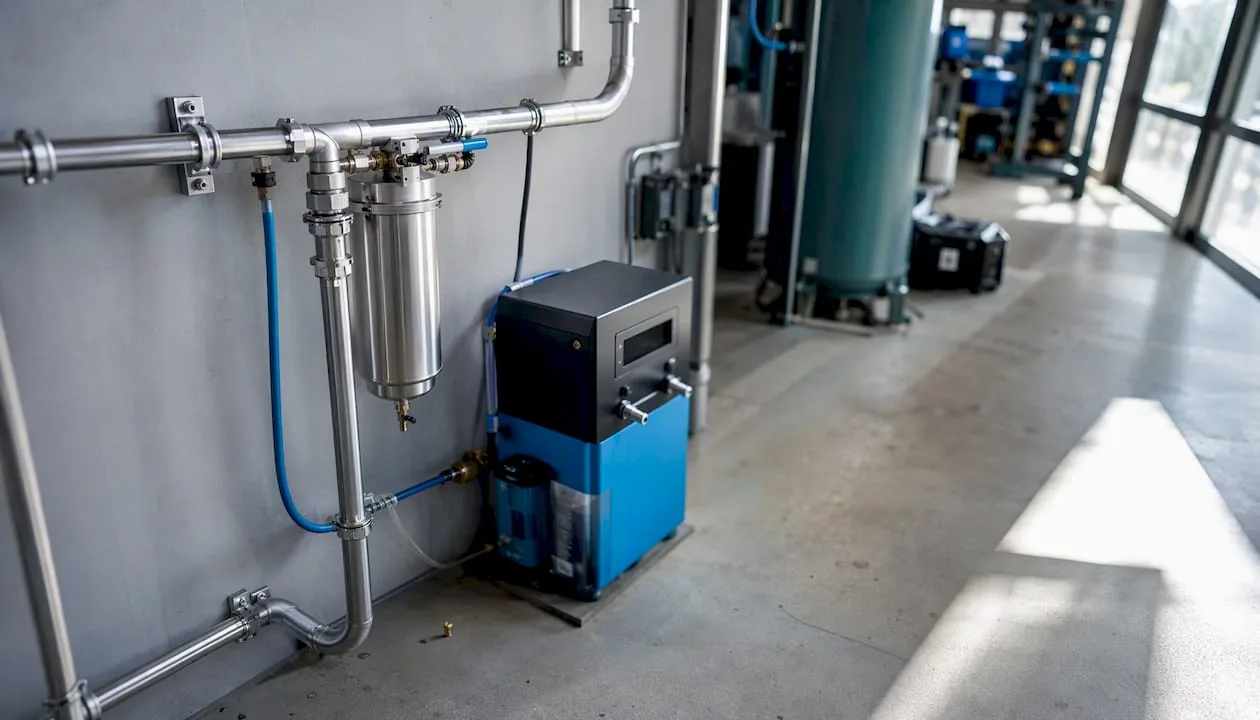
Condensate from oil-lubricated compressors must not be discharged into the public sewerage system without treatment. This obligation is imposed by Act No. 254/2001 Coll. (Water Act) in conjunction with the sewerage regulations of the public sewerage operator and technical standards ČSN EN 12056-1 and ČSN 75 6760. The condensate contains trace amounts of mineral oil, which qualify it as contaminated wastewater, and therefore direct discharge is prohibited.
What you must ensure:
- Install an oil–water separator or another approved method of condensate treatment before discharging it into the sewerage system.
- Neutralize condensate with a pH below 6.5 (typically condensate from condensing boilers or certain types of compressors) before discharging it into sewers sensitive to acidic water.
- Keep records of the amount of condensate, measurement results, and service interventions on the separator.
- Ensure the removal of separated oil by an authorized hazardous waste processor.
The first step is to verify the sewerage regulations of your public sewerage operator and include the remedy in the nearest operational audit.
 9:22
Video: Compressed air treatment step by step. The video starts right at the chapter Oil-water separator (5:37). Ventilek shows what is in compressed air, in which order filters, a dryer and a regulator go after the compressor, and what to do with condensate. The air treatment calculator puts the whole set together for you. The video is in Czech with English subtitles.
1:04 How clean your air needs to be 1:43 The right order after the compressor 2:18 Condensate and condensate drains 3:14 Air dryers 4:56 Filters 5:37 Oil-water separator 6:14 Regulator and treatment unit 7:01 Example: paint shop
Key findings
The compressor operator must ensure condensate treatment by means of a separator or neutralization, keep records, and hand over the separated oil to an authorized hazardous waste processor.
| Point | Details |
|---|---|
| Prohibition of direct discharge | Untreated condensate from oil-lubricated compressors must not be discharged into the sewer system; this obligation is imposed by Water Act No. 254/2001 Coll. |
| pH limit and neutralization | Condensate with a pH lower than 6.5 requires neutralization before discharge into sewers without acid-resistant protection. |
| Separator as the main solution | Physical separation (adsorption, filtration) achieves a residual oil content below the operational target of ~15 mg/l and is the preferred method. |
| Records and hazardous waste | The oil fraction is hazardous waste; keep records of handover to the processor for at least 5 years. |
| Kompresory-vzduchotechnika | Offers audit, supply of separators, installation, and service contracts to ensure compliance with Czech legislation. |
Contents
- What Czech laws and standards apply to compressor condensate?
- What specific limits must treated condensate meet?
- What technical solutions are available for condensate treatment?
- What are the installation and operational requirements for condensate piping?
- How to proceed step by step when ensuring compliance with regulations?
- How to monitor condensate quality and handle separated oil?
- When will the investment in a separator pay off?
- Editorial perspective: where operators most often make mistakes
- Kompresory-vzduchotechnika will help you with the whole process
- Frequently Asked Questions
What Czech laws and standards apply to condensate from a compressor?
The legal framework consists of three layers: the law, implementing regulations, and technical standards.
Act No. 254/2001 Coll. (the Water Act) establishes the basic rules for the discharge of wastewater. On its basis, the water authority issues discharge permits and may impose conditions or sanctions. Condensate from oil-lubricated compressors contains mineral oils, and therefore falls into the category of contaminated wastewater, the discharge of which without prior treatment is prohibited by law.
Act No. 274/2001 Coll. on Water Supply and Sewerage Systems introduces the institute of the sewerage regulations. Every operator of a public sewerage system issues its own sewerage regulations, which specifically define the permissible pollution limits, permitted substances, and technical conditions for connection. The sewerage regulations are binding for you as a producer of wastewater. Without studying them, you do not know what specific limits apply to your connection.
ČSN 75 6760 governs internal drainage systems and the technical requirements for condensate discharge, including the requirement for neutralization when pH is below 6.5. ČSN EN 12056-1 then sets out the principles of gravity drainage inside buildings. Both standards are mandatory when designing and installing condensate piping.
Key fact: Condensate from oil-lubricated compressors is technically classified as waste containing mineral oils. Without a separator or other treatment, this constitutes a direct violation of the Water Act, not merely a technical shortcoming.
Government Regulation No. 401/2015 Coll. supplements the Water Act and sets emission standards for the discharge of wastewater. For industrial operations, the limits for non-polar extractable substances (NEL) are particularly relevant, and treated condensate must fall below these limits.
What specific limits must treated condensate meet?
Three parameters determine whether you may discharge condensate directly into the sewer system after treatment.
| Parameter | Typical value for untreated condensate | Requirement for discharge |
|---|---|---|
| Oil content (NEL) | Trace amounts up to units of mg/l | Usually ≤ 15 mg/l (according to the sewerage regulations) |
| pH | Condensing boilers, some compressors | ≥ 6.5 for sewers without acid-resistant protection |
| Temperature | Depending on operation | According to sewerage regulations (usually ≤ 40 °C) |
The value of 15 mg/l for residual oil content is an operational reference target stated by separator manufacturers, which corresponds to common sewerage regulation requirements. Your specific limit may be stricter, so always check the sewerage regulations.
Condensate from condensing boilers and some types of compressors usually has an acidic pH lower than 6.5. The standard ČSN 75 6760 states that if the pH is lower than 6.5, neutralization must be carried out unless the sewers are made of acid-resistant material. Concrete and stoneware sewers are damaged by acidic condensate, while plastic ones (PVC, PP) are more resistant, but here too the sewerage regulations are decisive.
The minimum dimension of the condensate piping depends on the flow rate and the length of the route. DN 32 or DN 40 is commonly used for condensate drainage from compressors; the specific value is determined by the project or by ČSN EN 12056-1 based on flow rate calculation.
What technical solutions are available for condensate treatment?
Four main technologies cover most operational situations.
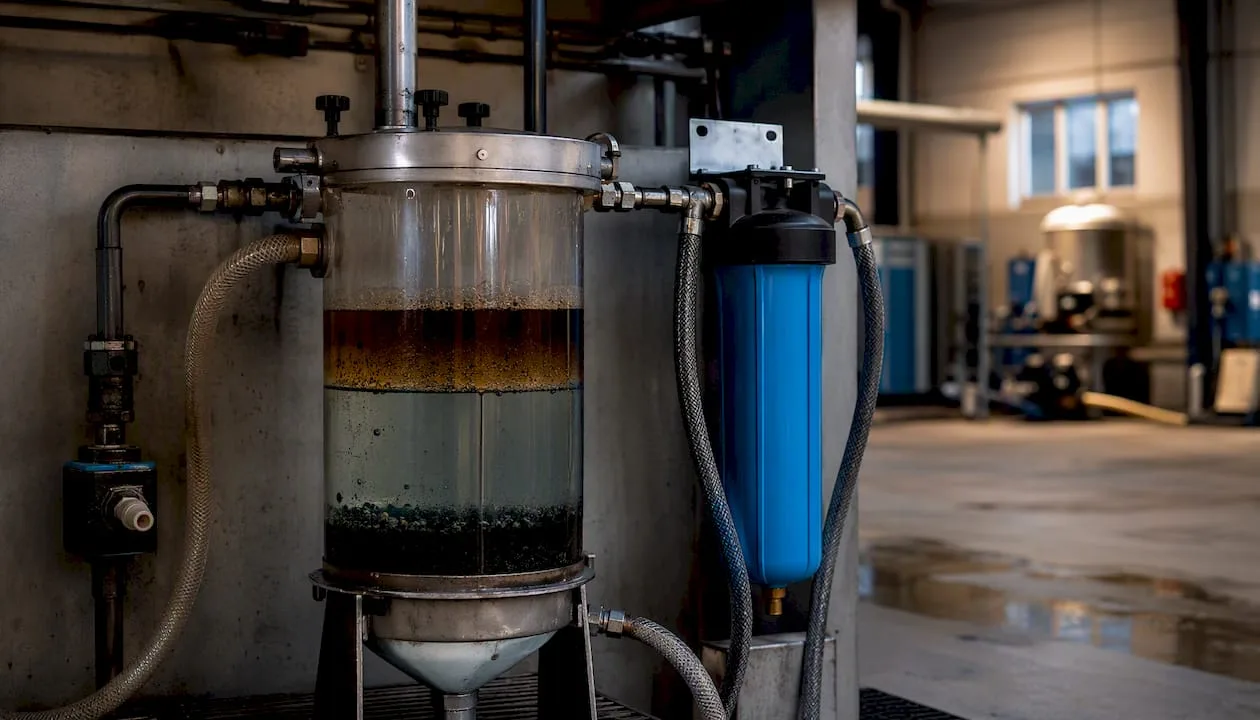
Oil–water separators are the most widespread solution for oil-lubricated compressors. They work on the principle of physical separation: the condensate first passes through a sedimentation chamber, where coarse oil droplets are separated, and then through a filtration layer made of adsorption media (activated carbon or special polypropylene fibers). The result is water with an oil content below the operational limit and a concentrated oil fraction, which is drained into a collection container. Physical separation is the preferred method because it does not introduce chemical substances into the process and provides stable results.
Neutralization boxes address the problem of acidic pH. The condensate flows through a layer of neutralization granulate (usually calcium or magnesium carbonate), which raises the pH to an acceptable value. They are used independently with condensing boilers or in combination with a separator where the condensate is both acidic and oily.
Combined systems integrate a separator and neutralization into a single device. For facilities with multiple condensate sources (compressor, condensing boiler, compressed air dryer), this is the most practical choice.
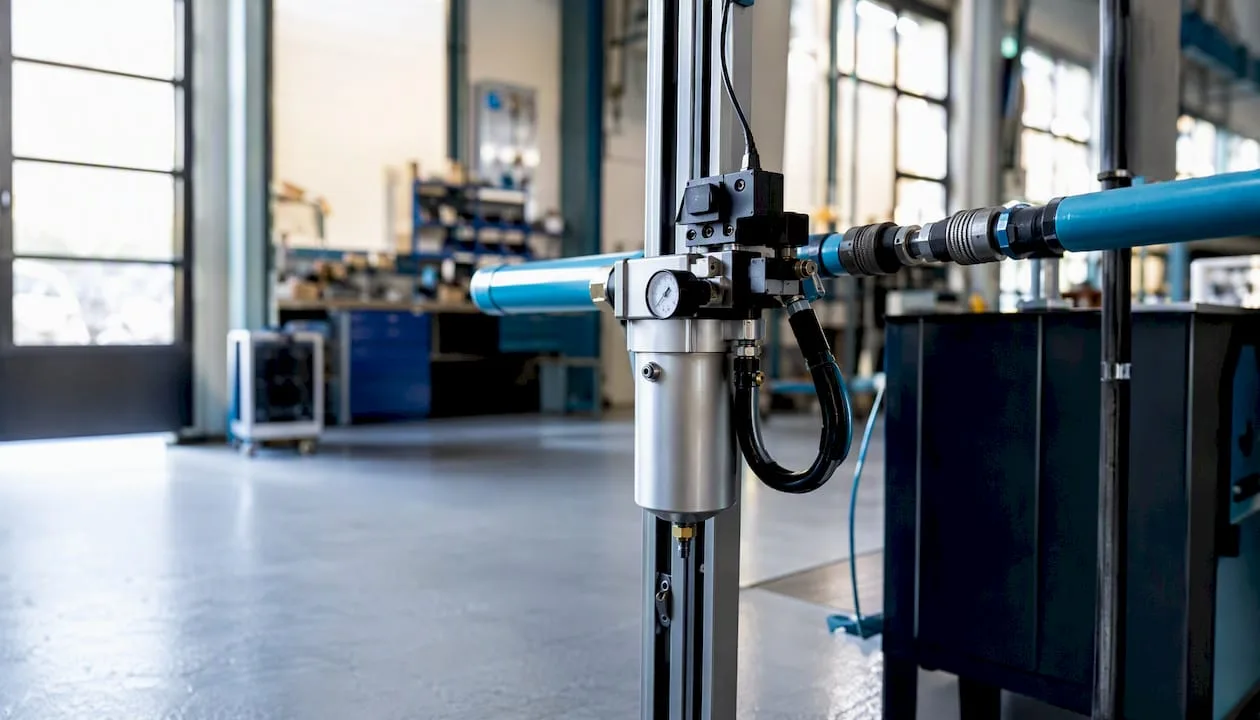
Automatic condensate drains are not a treatment technology but a key operational component. They ensure regular and controlled discharge of condensate from the pressure vessel, air tank or separator into the separator. Without a functioning drain, condensate overflows or accumulates, leading to leaks outside the system. Drains require regular checks of flow capacity and cleanliness of the float or electronic mechanism.
Professional tip: When selecting a separator, always base your choice on the maximum hourly condensate volume, not the average. A compressor operating in summer with high air humidity produces significantly more condensate than in winter. An undersized separator cannot filter the entire flow and allows oil to pass into the sewage system.
What are the installation and operational requirements for condensate piping?
Proper installation is a prerequisite for the functionality of the entire system. Piping errors cause leaks, odors, or backflow of sewer gases.
-
Pipe sizing: For condensate discharge from compressors, a minimum of DN 32 is used, and DN 40 or more for larger facilities. The piping must be sized for the maximum condensate flow with a safety margin.
-
Pipe slope: A minimum slope of 1% (1 cm per 1 m of length) ensures gravity drainage without condensate accumulation. For longer runs or insufficient slope, a pumping station must be used.
-
Water trap seal (siphon): Every connection to the sewage system must be fitted with a siphon with a water seal. With intermittent condensate discharge, there is a risk of the siphon drying out and sewer gases entering the facility. The solution is regular refilling with water or installing a siphon with anti-drying protection (glycerine filling or mechanical flap).
-
Funnel (open rim): Connection of the condensate piping to the sewage system is made via a funnel, not by direct connection. The funnel allows visual inspection of the flow and prevents backflow.
-
Pipe material: For acidic condensate (pH < 6.5), piping made of PP or HDPE is used. Steel or cast iron piping is corroded by acidic condensate.
-
Cleaning fittings: A cleaning fitting must be installed on every longer section of piping and before every change of direction, for access in case of blockage or inspection.
-
Regular separator maintenance: The separator's filter medium is replaced according to the manufacturer's instructions, usually once a year or upon reaching maximum capacity. The oil collection container is emptied as needed, but at least once a quarter. Every service intervention is recorded in the operating log.
How to proceed step by step when ensuring compliance with regulations?
A systematic approach minimises the risk of omissions and unnecessary costs.
-
Audit of condensate sources: Map all equipment producing condensate (compressors, dryers, condensing boilers). For each source, determine the estimated hourly volume of condensate and the current method of its discharge.
-
Sampling and measurement: Have a laboratory analysis of the condensate carried out: oil content (NEL), pH and temperature. Compare the results with the limits set out in the sewerage regulations of your public sewerage operator.
-
Studying the sewerage regulations: Request the sewerage regulations from the public sewerage operator or find them on their website. Focus on the limits for NEL, pH, temperature, and the conditions for connecting industrial wastewater.
-
Technology selection: Based on the measurements and limits, decide whether an oil–water separator is sufficient, or whether neutralisation is also necessary. For small operations with a low volume of condensate, consider disposing of the entire condensate as hazardous waste without installing a separator.
-
Installation and commissioning: Ensure installation in accordance with ČSN EN 12056-1 and ČSN 75 6760. After commissioning, carry out a control measurement of the outlet water and document the results.
-
Communication with the sewerage operator: If your operation exceeds the limits or it is a new connection, consult the conditions with the sewerage operator in advance. In some cases, notification or approval by the water management authority is required.
-
Setting up regular monitoring and record-keeping: Determine the measurement intervals, the responsible person, and the method of record archiving.
How to monitor condensate quality and handle the separated oil?
Ongoing monitoring and proper record-keeping are just as important as the treatment technology itself.
What and how often to measure:
- Oil content (NEL) in the output water from the separator: at least once a year, immediately in case of a change in operation or after replacement of the filtration medium.
- pH of the output water: at every replacement of the neutralization granulate and once a year as a check.
- Condensate volume: monitor continuously via an automatic drain or flow meter.
Records and documentation:
- Separator operating log: date of service intervention, condition of the filtration medium, volume of oil removed, name of the responsible person.
- Records of oil fraction handover: date, quantity, name of the authorized processor, number of the hazardous waste handover document.
- Results of laboratory analyses: archive for at least 5 years in case of inspection.
Handling of separated oil:
The oil fraction from the separator's collection tank is hazardous waste (waste catalogue number 13 05 07 or 13 05 08 according to the waste catalogue). You must store it in labeled, leak-resistant containers, hand it over exclusively to an authorized processor, and keep records in accordance with Act No. 541/2020 Coll., on Waste.
Sanctions and emergency procedure:
Discharging untreated condensate may result in a fine from the water authority or the sewerage operator. In the event of an incident (condensate leak outside the system), immediately stop the source, contain the leaked liquid, inform the sewerage operator and the water authority, and document the entire event including the measures taken.
When will the investment in a separator pay off?
The decision between in-house treatment and external disposal of condensate is primarily economic.
Most of the volume of condensate from a compressor is water. Hauling away the entire volume as hazardous waste is therefore costly and unnecessary. A separator splits off the oil fraction, which makes up only a small part of the total volume, and the clean water can be discharged into the sewer system. This radically reduces the volume of hazardous waste requiring disposal.
The figures in the table are indicative and depend on your waste processor's price list, the type of oil, and local conditions. The key variables are the annual condensate volume and the price of external disposal per litre. The higher the volume and the disposal price, the faster the separator pays for itself.
For very small operations with a condensate volume below 200 l per year, hauling away the entire volume as hazardous waste may be more economical than purchasing and operating a separator. For medium and larger operations, decentralized on-site treatment is almost always the cheaper option.
Professional tip: Before purchasing a separator, request the current price per litre of condensate from your waste processor. This single value determines the payback period more than the price of the equipment itself.
Editorial view: where operators most often go wrong
The biggest legal risk doesn't stem from ignorance of the law, but from inaction. Operators who know about the obligation but postpone remediation until "next year" are in the same position during an inspection as those who never heard of it.
The second typical mistake is the absence of records. A separator installed without an operating log, without a record of filter media replacement, and without documentation of the handover of the oil fraction provides no protection during an inspection. The authority doesn't see a functioning system; it sees equipment with no documentable history.
The third problem is underestimating seasonal variability. In summer, when air humidity is high, a compressor produces significantly more condensate than in winter. A separator sized for average flow may overflow in summer and release oil. Proper sizing based on peak flow is a technical, not a legislative, issue, but neglecting it has a direct legal impact.
Operators who have an oil-lubricated compressor for a workshop or industrial operation should take the type and amount of oil into account when choosing a separator. The composition of the condensate depends on the type of compressor and the oil used, as described in detail in the guide to choosing compressor oil.
Simple measures that minimize risk: a regular annual audit of the separator's condition and records, a contractual arrangement for collection of the oil fraction with an authorized processor, and basic training for operating staff on what must not go into the sewer system. Technical support and consultation on the selection and installation of separators is provided by Kompresory-vzduchotechnika through its service department.
Kompresory-vzduchotechnika will help you with the entire process
Meeting legal requirements for compressor condensate requires proper equipment, professional installation, and ongoing service. Kompresory-vzduchotechnika offers a complete turnkey solution: assessment of operation and condensate volume, supply and installation of oil-water separators and neutralization boxes, configuration of automatic drains, and service contracts including regular measurement of outlet water quality.
The order proceeds in three steps: an operational audit and condensate measurement, design of a specific solution with payback calculation, and installation and commissioning including handover of operational documentation. For the installation of condensate piping, pipes for compressed air distribution are also available in various dimensions and materials suitable for acidic condensate. Contact Kompresory-vzduchotechnika for a free consultation and find out which solution fits your operation and sewer regulations.
Frequently Asked Questions
Is it permitted to discharge compressor condensate directly into the sewer?
No. Condensate from oil-lubricated compressors contains mineral oils and must not be discharged into the public sewer system without treatment. It requires prior treatment using an oil-water separator.
What is the permitted limit for oil content in discharged condensate?
The specific limit is set by the sewer regulations of the public sewer operator. Separator manufacturers state a target operational value of ~15 mg/l (NEL); your sewer regulations may be stricter.
What happens if I don't treat the compressor condensate?
There is a risk of a fine from the water authority or the sewer operator for violating Water Act No. 254/2001 Coll. and the sewer regulations. In the event of an accident, it must be reported immediately and the measures taken must be documented.
How should the oil separated in the separator be handled?
The oil fraction is hazardous waste. Store it in labeled containers and hand it over exclusively to an authorized processor. Keep records of the handover for at least 5 years.
Do I need a permit from the water authority to discharge treated condensate?
It depends on the volume and conditions of the sewer system. Consult any new connection or exceeding of limits with the sewer system operator and the locally competent water authority in advance.
Recommended
- Basic requirements for a compressor room: guide 2026 - Kompresory-Vzduchotechnika.cz
- Why compressor cooling is essential for operation - Kompresory-Vzduchotechnika.cz
- A list of safety rules for working with a compressor in automotive 2026 - Kompresory-Vzduchotechnika.cz
- What to check when buying a compressor: a checklist for workshop and company - Kompresory-Vzduchotechnika.cz