

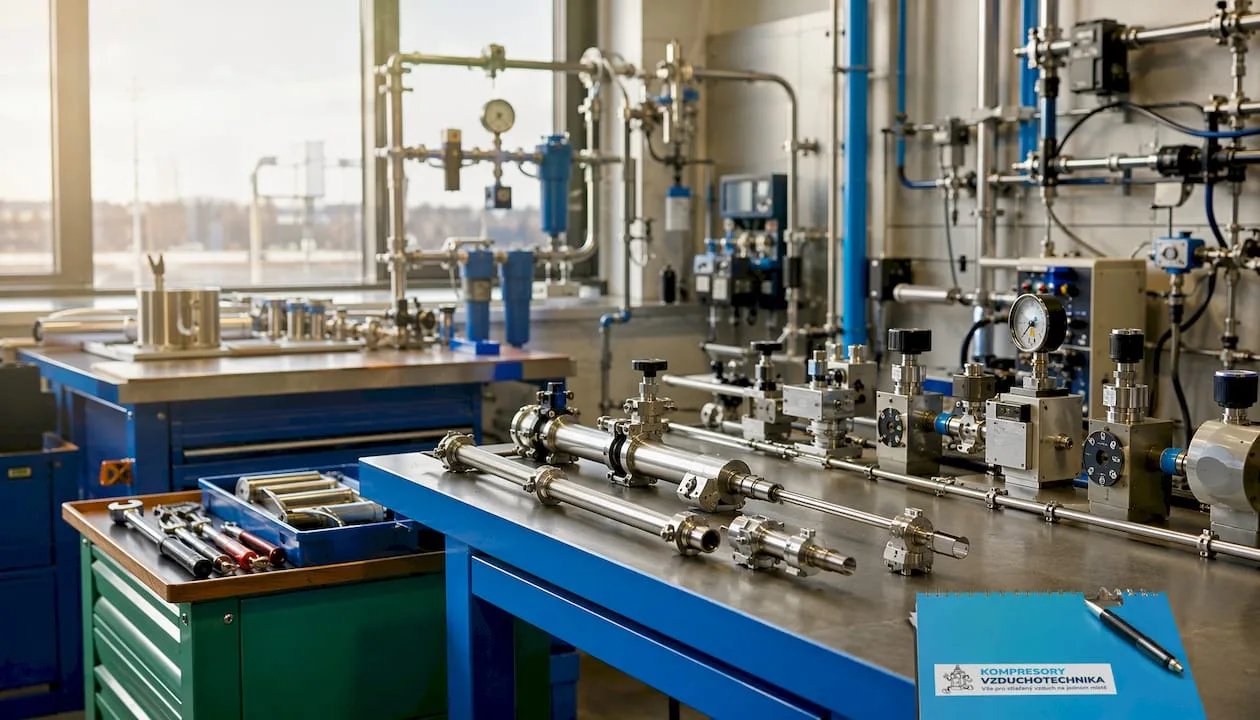
An air flow meter is a measuring instrument that determines the amount or mass of air passing through a pipe or air handling system. In industrial practice, it is a basic tool for monitoring compressed air consumption, detecting leaks, and meeting energy management requirements under ISO 50001. Without accurate flow measurement, it is not possible to reliably control compressor room operation or demonstrate energy savings.
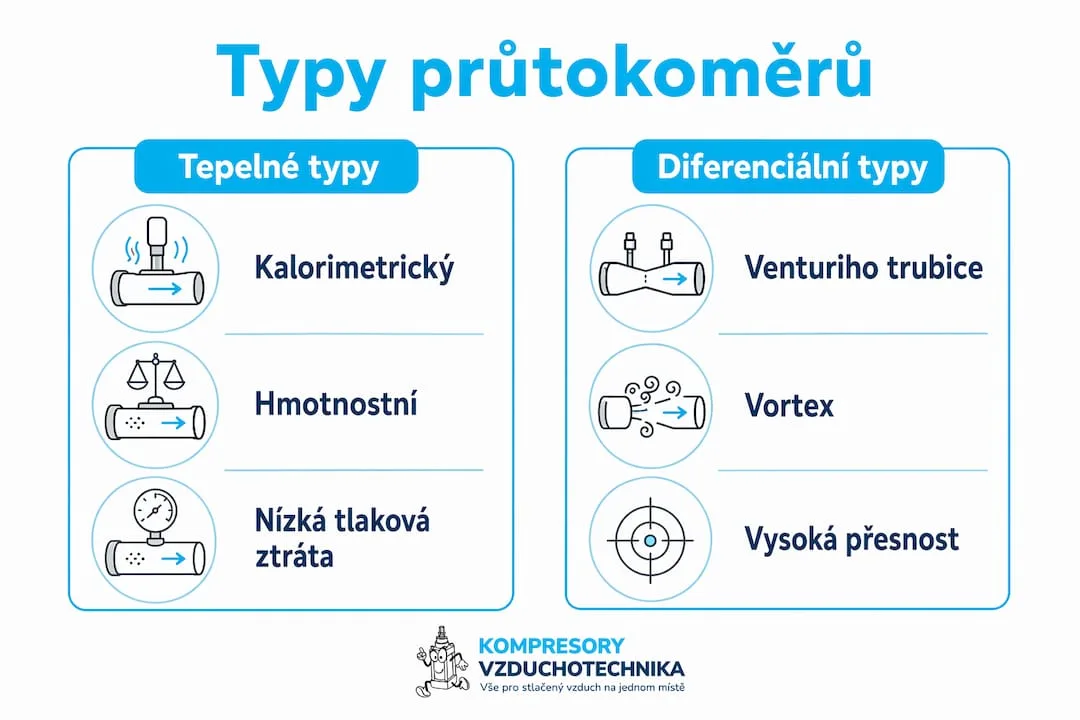
Air flow meters are divided into several main categories:
- Thermal mass (calorimetric) flow meters
- Differential pressure flow meters
- Vortex flow meters
- Turbine flow meters
- Ultrasonic flow meters
- Electromagnetic (inductive) flow meters
- Coriolis flow meters
What physical principles underlie air flow measurement?
Each type of flow meter uses a different physical phenomenon. Understanding these principles makes it easier to select the right device for a specific application.
Heat transfer is the basis of calorimetric flow meters. The device heats one sensor and monitors how the flowing air carries heat away from the heated sensor to the reference sensor. The faster the air flows, the greater the heat transfer. This method directly measures mass flow, so the result does not depend on the temperature or pressure of the air.
Bernoulli's equation is the basis for differential pressure flowmeters. A pressure difference arises before and after the restriction element (orifice, nozzle, or Venturi tube), the magnitude of which corresponds to the flow velocity. This method is widespread and reliable in industry, but requires precise installation and regular inspection.
Vortex frequency drives vortex flowmeters. Vortices form behind a triangular bluff body placed in the pipe, and their frequency is directly proportional to the flow velocity. The accuracy of vortex flowmeters is typically within a low single-digit percentage range, and their service life is good even under demanding conditions.
Key technical parameters of every flowmeter are measurement accuracy, pressure drop, measuring range, and response to flow changes. A lower pressure drop of the flowmeter reduces the energy consumption of the whole system and extends the service life of the compressor.
What types of air flowmeters are available?
| Flowmeter type | Principle | Advantages | Limitations |
|---|---|---|---|
| Thermal mass | Heat transfer | Low pressure drop, measures mass flow | Sensitive to moisture and contaminants |
| Differential pressure | Bernoulli's equation | Robust, industrially proven | Higher pressure loss, precise installation required |
| Vortex | Vortex frequency | Low unit percentage accuracy, good service life | Not suitable for very low flow rates |
| Turbine | Mechanical rotation | Simple design | Higher pressure loss, wear of moving parts |
| Ultrasonic | Acoustic transmission | Non-contact, no pressure loss | Higher purchase price |
| Electromagnetic | Electromagnetic induction | Suitable for conductive media | Not suitable for pure air |
| Coriolis | Coriolis force | Very high accuracy | High price, large dimensions |
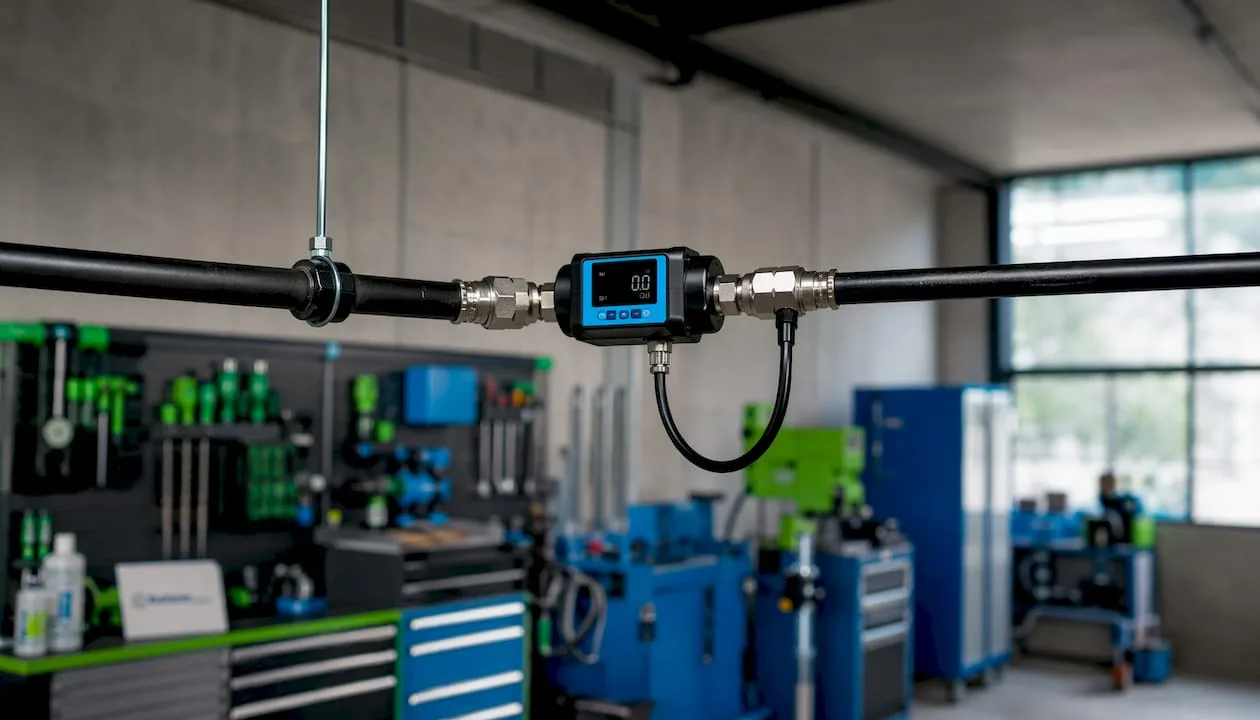
Testo 6454 is a compact thermal mass flow meter designed for measuring compressed air directly in the pipeline. It measures flow, pressure, and temperature in a single device and enables data transfer to higher-level systems. It is suitable for industrial facilities where continuous consumption monitoring is required.
CS Instruments GmbH offers compact flow meters for compressed air with a digital display and outputs for remote monitoring. Devices in this series are designed for direct installation in pipelines and meet the requirements for energy audits.
Professional tip: Before purchasing, verify whether the flow meter measures volumetric or mass flow. For energy audits and consumption calculations, mass flow is more accurate because it does not depend on operating pressure or temperature.
How to choose the right air flow meter for industry?
The choice of flow meter depends on several specific application parameters. It does not pay to underestimate any of them.
- Operating pressure and temperature: The device must be rated for the maximum operating pressure of the system. Thermal flow meters operate reliably at pressures common in industrial compressor stations.
- Air cleanliness and humidity: Thermal sensors are sensitive to condensate and oil aerosols. If the air is not sufficiently dry and clean, a differential or vortex flow meter is more suitable. Ignoring humidity and contaminants is one of the most common mistakes when selecting a flow meter.
- Measuring range: The flow meter must cover the entire expected flow range, including peak values. A range that is too small causes sensor overload, while a range that is too large reduces accuracy at low flow rates.
- Pressure drop: Older turbine models have higher pressure drops than modern thermal or vortex sensors. A lower pressure drop means lower energy costs and less load on the compressor.
- Calibration and certification: To meet the requirements of ISO 50001 and energy audits, verifiable calibration of the device is required. Flow meters should have a valid calibration certificate from an accredited laboratory.
- Integration into control systems: Modern flow meters offer digital outputs (4–20 mA, Modbus, M-Bus) for connection to remote monitoring systems and industrial automation.
Investing in a higher-quality flow meter with a lower pressure drop and more accurate measurement pays off through energy savings and more reliable operation. The detailed criteria for selecting an industrial compressor apply similarly to the choice of measuring instruments in the system.
Professional tip: Check the sensor's compatibility with the pipe diameter and the required length of straight pipe section before and after the flow meter. Failure to observe installation distances is the most common cause of inaccurate measurement.
How do air flow meters work in practice?
Air flow meters are used in a wide range of industrial applications. The most common areas include:
- Real-time monitoring of compressed air consumption makes it possible to track how much air each operating node actually consumes. This data forms the basis for energy audits and savings planning.
- Leak detection is one of the most valuable functions of a flow meter. By comparing the flow at the inlet and outlet of the system, leaks that would otherwise remain hidden can be quickly identified. The deployment of flow meters in compressed air systems directly contributes to reducing operating costs. More about eliminating air leaks can be found in a separate guide.
- Energy management according to ISO 50001 requires measurable consumption data. A flow meter with a data output allows automatic logging and reporting without manual readings.
- Production and quality: In processes where product quality depends on precise air dosing (painting, blow molding, pneumatic conveying), a flow meter ensures process repeatability.
Proper installation is a prerequisite for accurate measurement. The flow meter must be positioned on a straight section of pipe, sufficiently far from elbows, valves, and other elements causing turbulence. Regular calibration of the devices is essential to maintain accuracy over time. Without it, measured values may gradually drift and affect operational decisions. The recommended calibration interval depends on the manufacturer and operating conditions, and is usually around one year.
Common mistakes include mounting the flow meter too close behind a pipe elbow, neglecting air conditioning before the sensor, or using the device outside its measuring range. All these situations lead to systematic measurement errors, which only become apparent when compared against billed energy consumption.
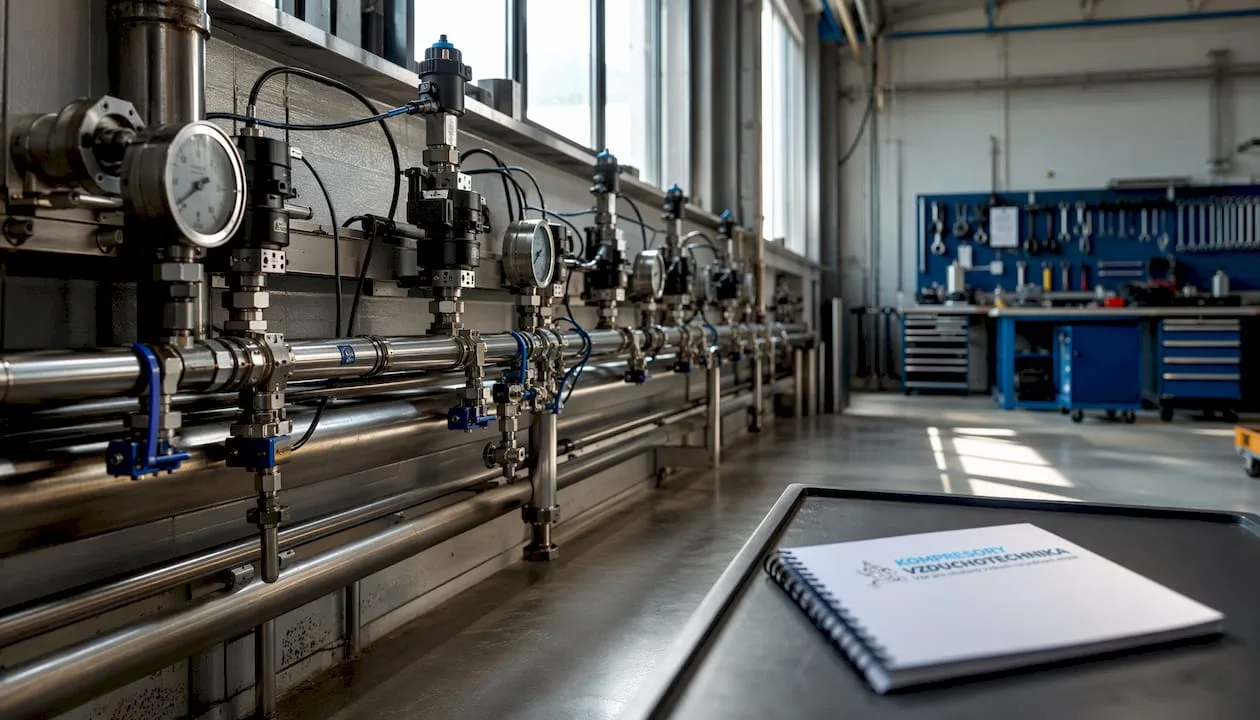
Kompresory-vzduchotechnika offers air treatment units suitable for preparing compressed air before measuring sensors. Properly treated air extends the flow meter's service life and ensures accurate results.
Key takeaways
An air flow meter is an essential tool for any industrial compressed air system where energy consumption, process quality, or audit compliance requirements matter.
| Point | Details |
|---|---|
| Measurement type | Thermal flow meters measure mass flow independently of pressure and temperature. |
| Pressure drop | A lower pressure drop of the flow meter reduces energy costs and the load on the compressor. |
| Technology selection | Humidity and contaminants in the air determine the suitable sensor type. |
| Accuracy of vortex devices | Vortex flow meters achieve an accuracy of 0.5–2% with good service life. |
| Calibration | Regular calibration is a prerequisite for reliable data for energy management. |
Frequently asked questions
What is an air flow meter and what is it used for?
An air flow meter is a measuring device that determines the quantity or mass of air passing through a pipeline. It is used for monitoring compressed air consumption, detecting leaks, and meeting energy audit requirements.
How does a thermal air flow meter work?
A thermal flow meter heats one sensor and measures how much heat the flowing air carries away to a reference sensor. The intensity of heat transfer corresponds to the mass flow rate of air, with the result being independent of operating pressure or temperature.
How is air flow measured by a differential flow meter?
A differential flow meter measures the pressure difference before and after a restriction element. According to Bernoulli's equation, there is a direct relationship between the pressure difference and the flow velocity, from which the flow rate is calculated.
How does an inductive flow meter work and is it suitable for air?
An inductive flow meter uses electromagnetic induction and requires an electrically conductive medium. It is not suitable for clean air; its typical applications are liquids, such as water or cooling media.
How to choose an air flow meter for an industrial system?
The choice depends on operating pressure, temperature, air cleanliness, required measuring range, and the method of data integration. Thermal flow meters are suitable for dry and clean air, while differential or vortex devices better tolerate moisture and impurities.
Recommended
- Air flow testing methods: a guide for technicians - Kompresory-Vzduchotechnika.cz
- Why monitor air humidity: a guide to a healthy home - Kompresory-Vzduchotechnika.cz
- Air pressure measurement options: a guide for technicians - Kompresory-Vzduchotechnika.cz
- How a cyclone separator works: a practical guide - Kompresory-Vzduchotechnika.cz