
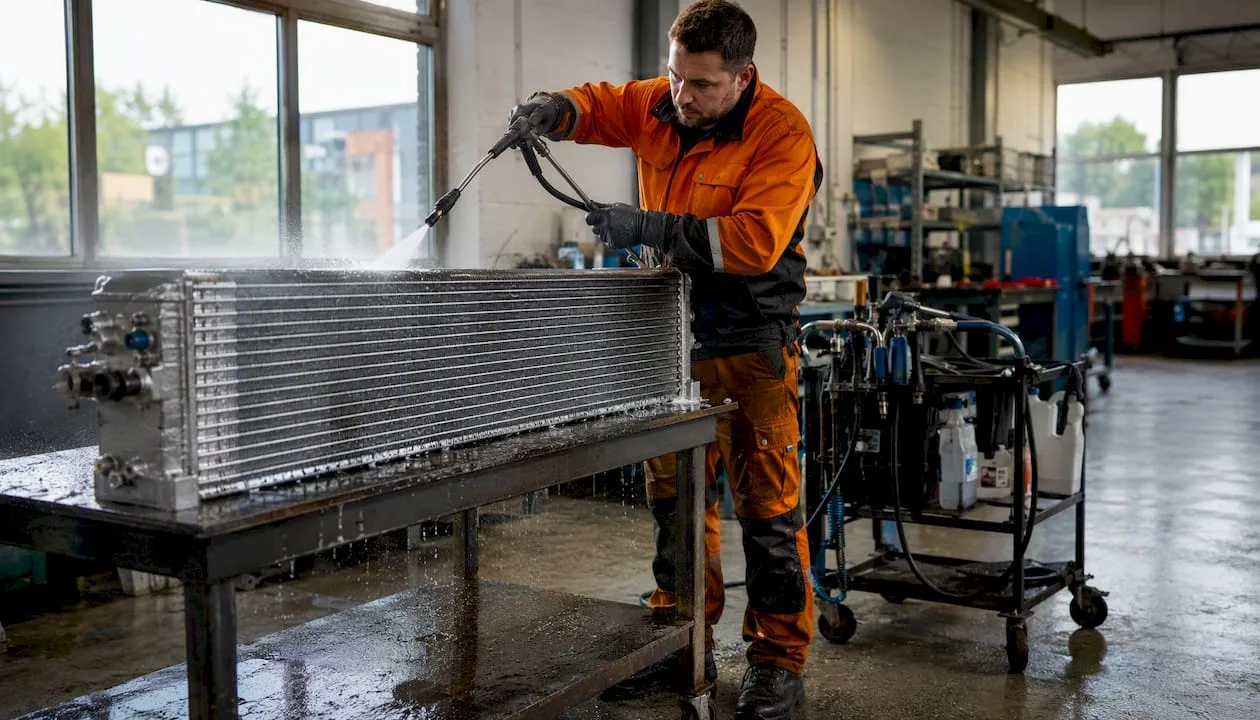
For industrial compressors, the most reliable approach is a combination of CIP (chemical circulation) for internal surfaces and mechanical flushing for finned air coolers. The choice of method depends on three variables: type of heat exchanger, type of deposits, and available downtime duration.
Immediate steps upon identifying a problem:
- Measure the baseline ∆T (temperature difference between inlet and outlet) and pressure drop.
- Isolate the circuit, close the service valves, and depressurize the system.
- Visually inspect the fins or plates for mechanical damage.
- Select the cleaning chemistry based on the heat exchanger material (aluminium, copper, stainless steel).
- Decide whether to clean on site (CIP) or disassemble for off-site processing.
Disassembly is necessary in case of heavy fouling, visible seal damage, or corrosion. On-site cleaning is sufficient for regularly maintained heat exchangers with mild deposits.
For a 300 kW machine operating 5,000 hours per year, this represents an estimated saving of 45,000 kWh/year after reducing ∆T by 1 °C.*
Key takeaways
Regular cleaning of the compressor heat exchanger reduces power consumption, extends machine service life, and prevents unplanned downtime, with the decrease in ∆T after the intervention being the key measure of effect.
| Point | Details |
|---|---|
| Choosing the method by type | Finned coolers: pressure flushing + chemicals; plate coolers: CIP; tube coolers: CIP + brushes. |
| Key performance metric | A 1 °C reduction in ∆T corresponds to approximately a 3% decrease in compressor power input. |
| Minimum frequency | Finned coolers: once a year; plate coolers in an open circuit with hard water: every 6 months. |
| Chemical safety | Always neutralize after acid cleaning; aluminium cannot tolerate strongly alkaline products. |
| Kompresory-vzduchotechnika | Ensures CIP, mechanical cleaning, before/after measurements, and a service protocol for operations in the Czech Republic. |
Contents
- What type of heat exchanger do you have and which cleaning method suits it?
- How to proceed when cleaning a heat exchanger step by step?
- When does automatic heat exchanger cleaning pay off?
- What safety rules apply when working with cleaning chemicals?
- How to set up a preventive maintenance plan for heat exchangers?
- How to measure the cleaning effect and calculate energy savings?
- What does heat exchanger service from Kompresory-vzduchotechnika include?
- How to verify the quality of the service performed?
- What cleaning products are available in the Czech Republic?
- Compressor heat exchanger service from Kompresory-vzduchotechnika
- Recommended resources for further reading
- Frequently asked questions
What type of heat exchanger do you have, and which cleaning method is appropriate for it?
Compressors use three basic types of heat exchangers. Each has a different design, material, and sensitivity to cleaning methods.
Finned air coolers are the most common in reciprocating and screw compressors. Aluminum fins with copper or aluminum tubes are prone to mechanical damage from improper water pressure. The outer surface is cleaned by applying a cleaning solution followed by rinsing with pressurized water or air perpendicular to the fins. The inner side of the tubes can be flushed using the CIP method.

Plate heat exchangers (Alfa Laval and similar designs) have a large transfer area in a small volume. Scale or oil residue deposits are removed by CIP circulation of an acidic solution. Disassembling the plates for mechanical brush cleaning is appropriate for heavy fouling or damaged gaskets.
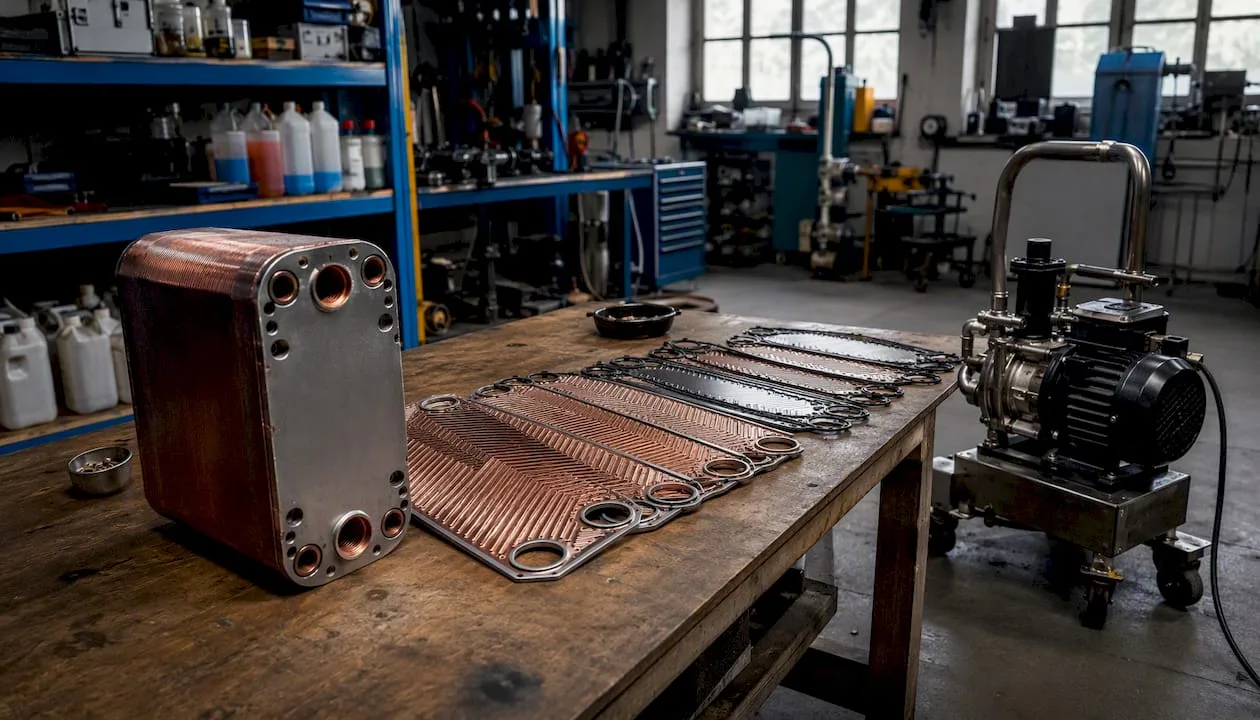
Tube heat exchangers are robust and withstand mechanical cleaning with rod brushes as well as CIP. They are used in larger machines and industrial cooling circuits.
| Heat exchanger type | Typical fouling | Recommended method | Main risks |
|---|---|---|---|
| Air-cooled finned | Dust, oil, biological deposits | Outer: pressure flushing + chemicals; inner: CIP | Fin damage from pressure, aluminium corrosion from strong acid |
| Plate (stainless steel/titanium) | Scale, biofilm, oil | CIP with acidic solution; disassembly in case of heavy fouling | Seal damage from unsuitable chemicals or temperature |
| Tubular (steel/copper) | Scale, corrosion, sediments | CIP + mechanical brushes | Copper corrosion from alkaline solutions |
Professional tip: Never use strongly alkaline agents (pH above 11) on aluminium finned coolers. Aluminium corrodes faster in an alkaline environment than in an acidic one.
How to proceed with cleaning the heat exchanger step by step?
The procedure applies to both on-site CIP and disassembly cleaning. The steps are arranged to minimise the risk of damage and shorten downtime.
Preparation and measurement of initial parameters
- Record the current ∆T, pressure drop across the heat exchanger, and medium flow rate.
- Depressurize the system, close the service valves, and ensure electrical disconnection.
- Check the condition of the compressor filters — a clogged filter increases fouling of the heat exchanger.
- Prepare PPE: acid-resistant gloves, safety glasses, apron.
On-site CIP (chemical circulation)
- Connect the flushing pump to the heat exchanger inlet and outlet.
- Select the cleaning solution according to the material and type of deposits (see the chemistry section below).
- Start the circulation and monitor the pH of the solution and its coloration every 15–20 minutes.
- Once a stable pH and a clear solution are achieved, stop the circulation.
- Flush with clean water until the pH of the wastewater reaches 6.5–8.5.
- Apply a neutralizer (alkaline agent) at the recommended concentration and flush again.
Disassembly and mechanical cleaning
- Safely disconnect the connections, mark the position of the plates or tubes.
- Check the gaskets — replace cracked or deformed gaskets before assembly.
- Mechanically clean the surfaces using brushes or a high-pressure water jet.
- Check tightness after assembly with a pressure test.
Inspection after cleaning
- Measure ∆T, pressure drop, and flow rate under the same operating conditions as before cleaning.
- Record the results in the service report, including photo documentation.
Service checklist for the visit: measuring instruments (thermometer, pressure gauge, flow meter), flushing pump, supplies of chemicals and neutralizer, replacement gaskets for the given heat exchanger type, pH strips or a digital pH meter.
When is automatic heat exchanger cleaning worthwhile?
Automatic systems maintain heat transfer continuously without the need for planned shutdowns. Trane offers systems for large HVAC and industrial installations with adjustable dosing and periodic flushing, which keep the heat exchanger operational continuously.
Automation is worthwhile in the following situations:
- Installations with output above 200 kW, where each hour of downtime means a measurable loss of production.
- Operations with a high level of medium contamination (hard water, biological deposits).
- Production lines where interruption of cooling jeopardizes product quality or process safety.
- Operations with limited service personnel capacity for regular manual cleaning.
Main operating requirements of automatic systems: constant supply of water and chemicals, automatic pH control, backup power source for the control unit, and regular inspection of dosing pumps.
Professional tip: Before investing in an automatic system, calculate the annual cost of manual cleaning (labor + chemicals + downtime) and compare it with the acquisition price and operating costs of the automatic system. For medium-sized installations, the payback period is typically in the range of 2–4 years.
What safety rules apply when working with cleaning chemicals?
The choice of chemicals depends on the heat exchanger material. Acidic agents (citric, phosphoric, or sulfuric acid in industrial concentrations) remove scale and metal oxides. Alkaline agents break down oil and biological deposits. Combining both types in a single cycle without thorough intermediate rinsing causes exothermic reactions and damages seals.
Neutralization principle: After applying the acidic solution, the residual acid must first be diluted with clean water, and only then should the neutralizer (alkaline agent) be applied. Directly mixing concentrated acid with the neutralizer can cause a violent reaction and damage to the heat exchanger and the operator. Dispose of the waste solution into the sewage system only after reaching a pH of 6.5–8.5 and in accordance with local regulations.
Rules for selecting chemicals according to material:
- Aluminum: weakly acidic agents (pH 3–5), never strongly alkaline.
- Copper: avoid strongly alkaline solutions; mildly acidic or neutral agents are suitable.
- Stainless steel and titanium: tolerate a wider pH range, but chloride compounds cause pitting corrosion.
- Steel: acidic agents with corrosion inhibitor.
Safety precautions for technicians: acid-resistant gloves class EN 374, safety goggles or face shield, chemical-resistant work clothing, ensuring sufficient ventilation of the workspace. Always keep safety data sheets (SDS) available at the work site.
Professional tip: Monitoring pH during flushing is more reliable than blanket time estimates. Real-time pH monitoring reduces the risk of material damage and unnecessarily long cleaning times.
How to set up a preventive maintenance plan for heat exchangers?
Compressor service intervals are determined according to two criteria: operating hours (engine hours) and the type of medium in the circuit. Control units of modern screw compressors signal the service date automatically, but for older machines or piston compressors, records must be kept manually.
Recommended minimum frequencies:
- Finned air coolers: visual inspection every 500 engine hours, cleaning at least once a year, every 6 months in dusty operating conditions.
- Plate heat exchangers in a closed circuit: CIP at least once a year, ∆T measurement every 1,000 engine hours.
- Plate heat exchangers in an open circuit (hard water): CIP every 6 months or when ∆T increases by more than 2 °C above the baseline value.
- Tube heat exchangers: mechanical inspection and CIP once a year, every 6 months with an aggressive medium.
Integration into the maintenance plan: record ∆T at every service visit and monitor the trend. An increase in ∆T of 2 °C above the reference value is a signal for unplanned cleaning. Include the preventive inspection plan in the overall schedule of pressure vessel inspections.
| Parameter | Recommended action |
|---|---|
| ∆T increase of 1–2 °C | Schedule cleaning in the nearest service window |
| ∆T increase above 3 °C | Immediate cleaning, leak check |
| Pressure drop +20% | Disassembly and mechanical cleaning |
| Flow decrease of 15% | Check for fouling and leaks |
How to measure the cleaning effect and calculate energy savings?
Measuring before and after cleaning is the only way to objectively demonstrate the benefit of the intervention. The key metrics are ∆T, pressure drop across the heat exchanger, flow rate, and compressor power input in kW.
Measurement procedure
- Record all parameters during stable operation before cleaning (same load, same ambient temperature).
- After cleaning, repeat the measurements under identical conditions.
- Calculate the ∆T difference and the corresponding change in power input.
Example savings calculation
For a 300 kW machine with 5,000 operating hours per year and an electricity price of 4 CZK/kWh:
This calculation is indicative and depends on the actual operating profile of the machine. For management, we recommend tracking the following KPIs: average ∆T per quarter, annual kWh consumption per unit of production, and the number of unplanned shutdowns caused by overheating.
What does heat exchanger servicing from Kompresory-vzduchotechnika include?
Kompresory-vzduchotechnika provides complete heat exchanger servicing for compressor stations in the Czech Republic. The offer includes:
- Initial inspection with measurement of ∆T, pressure drop, and flow rate.
- CIP cleaning with chemical selection based on the heat exchanger material.
- Mechanical cleaning of finned coolers and tube heat exchangers.
- Disassembly, gasket replacement, and reassembly of plate heat exchangers (including Alfa Laval types).
- Neutralization and environmentally friendly disposal of waste chemicals.
- Service report with photo documentation and measured values before/after.
Ordering process: prepare the compressor's technical data sheet (power, heat exchanger type, operating medium) and information about the available service window. A typical intervention takes 4–8 hours depending on the extent of fouling and the type of heat exchanger.
Professional tip: When booking the service, provide the technicians with the last measured ∆T value and the date of the last cleaning. This will shorten the diagnostic phase and allow the correct chemicals to be prepared in advance.
| Intervention type | Typical duration | What is included |
|---|---|---|
| CIP on-site | 4–6 hours | Chemicals, pump, report, neutralization |
| Disassembly + mechanical cleaning | 6–8 hours | Disassembly, brushes, seals, protocol |
| Initial inspection | 1–2 hours | ∆T measurement, pressure drop, recommendations |
Long-term service contracts include planned cleaning intervals, priority callout in case of failure, and tracking of ∆T trends across the entire compressor station. Contact us via the service section for a non-binding consultation.
How to verify the quality of the service performed?
The standard CIP methodology includes four phases: preliminary rinse with clean water, circulation of the cleaning solution, neutralization, and final rinse. Each phase is documented by measuring pH and flow rate.
Quality benchmark: The heat exchanger is considered cleaned if ∆T after the intervention drops to a value close to the manufacturer's reference value for the given output and flow rate. The pressure drop should decrease by 15–30% compared to the value before cleaning. If these values are not achieved, disassembly and mechanical cleaning or seal replacement is necessary.
Photo documentation includes the condition of the heat exchanger before cleaning, the CIP process (solution discoloration), and the condition after cleaning. The pH protocol records values at the beginning and end of each phase.
Anonymized example: 132 kW screw compressor in a food processing facility, Alfa Laval plate heat exchanger, hard water medium (hardness 25 °dH). Before cleaning, ∆T was 8 °C compared to a reference value of 4 °C.
Professional tip: Keep service protocols for at least 5 years. The ∆T trend across records will reveal whether the heat exchanger is fouling faster than before, which may indicate deterioration in medium quality or filtration damage.
What cleaning agents are available in the Czech Republic?
For industrial cleaning of heat exchangers, products from several categories are available in the Czech Republic. The choice depends on the heat exchanger material, the type of deposits, and safety requirements.
Acidic products for scale and oxides:
The Boiler Cleaner range from IVAR CS is available in various concentrations for plate and tube heat exchangers. They contain phosphoric or citric acid with a corrosion inhibitor. Safety data sheets (SDS) are available directly from the distributor IVAR CS and state the pH of the working solution, recommended concentration, and neutralization instructions.
Technical-grade citric acid (available from chemical distributors such as Penta or Lach-Ner) is suitable for mild fouling of stainless steel or titanium plate heat exchangers. For industrial concentrations and repeated use, a certified product with a safety data sheet is always preferable to homemade mixtures.
Alkaline products for oil and biofilm:
Industrial degreasers based on sodium or potassium hydroxide are available from industrial chemical distributors (Brenntag, Univar). They are unsuitable for aluminum heat exchangers. Always verify compatibility with the heat exchanger material in the safety data sheet.
Neutralizers:
After acidic cleaning, an alkaline neutralizer is used (e.g., technical-grade sodium bicarbonate or specialized products from IVAR CS). Correct procedure: first dilute the acidic residue with clean water, then add the neutralizer and check the pH. Dispose of the waste after reaching pH 6.5–8.5 in accordance with local chemical waste regulations.
When selecting a product, always request the current safety data sheet (SDS) and verify that the product meets the standard requirements for the given type of operation (food industry, pharmaceuticals, general industry).
Why neglecting cleaning makes operation more expensive than it seems
The financial impact of fouled heat exchangers manifests gradually, which is why it tends to be underestimated.
Operations managers who monitor the ∆T trend quarterly catch the problem before it results in an unplanned shutdown. A reactive repair after a heat exchanger failure typically costs three times more than planned cleaning, as it involves express service, possible replacement of damaged seals, and loss of production. Investment in monitoring and regular servicing of pneumatic systems pays off faster than most operations expect.
Challenge for operations managers: establish a reference ∆T value for each heat exchanger right after the next cleaning and monitor deviations. This single KPI will give you an early warning before the problem develops into a failure.
Compressor heat exchanger servicing from Kompresory-vzduchotechnika
Kompresory-vzduchotechnika provides inspection, CIP cleaning, mechanical cleaning, and disassembly of heat exchangers for compressor stations throughout the Czech Republic. The service team arrives with complete equipment, performs measurements before and after the intervention, and delivers a report with the measured values. No guesswork, just measurable results.
For companies with multiple compressors, long-term service contracts are available with planned cleaning intervals, priority dispatch, and ∆T trend monitoring. Order an inspection or consultation through the service solutions catalog and find out how much you can save on power input this year.
Recommended resources for further reading
For deeper study and preparation of a service order, the following documents and resources are useful:
- Safety Data Sheets (SDS) for IVAR CS Boiler Cleaner products: — contain precise concentrations, working solution pH, and instructions for neutralization and disposal. Request them directly from the IVAR CS distributor before each cleaning.
- Technical documentation from the heat exchanger manufacturer (Alfa Laval, Trane): — provides reference ∆T values and pressure drops for the given model, recommended cleaning methods, and compatible chemicals.
- Compressor manufacturer's preventive maintenance instructions: — each manufacturer (Atlas Copco, Kaeser, CompAir) issues a service manual with recommended cleaning intervals for coolers and condensers.
Professional tip: When preparing a service order, always request the SDS for every product that will be used. The technician must have the SDS physically available at the work site, not just in an email.
Frequently asked questions
How often should a compressor heat exchanger be cleaned?
Finned air coolers require cleaning at least once a year, or every 6 months in dusty operating conditions. Plate heat exchangers in an open circuit with hard water should be cleaned every 6 months or when ∆T increases by more than 2 °C compared to the reference value.
How to clean a compressor heat exchanger on site?
Connect a flushing pump, circulate an acidic solution compatible with the heat exchanger material, monitor pH every 15–20 minutes, and once a stable pH is reached, flush with clean water. Finish with neutralization using an alkaline agent and check the pH of the wastewater (target value 6.5–8.5).
How to take care of a compressor so that the heat exchanger lasts longer?
Regularly replace air filters, monitor the ∆T trend, and keep the area around the compressor clean. A clogged filter increases the amount of contaminants passing into the heat exchanger and shortens the intervals between cleanings.
What to use to clean a gas boiler heat exchanger or a smaller plate heat exchanger?
For household or smaller industrial applications, citric acid or lactic acid solutions are used. For industrial compressors and larger heat exchangers, certified products with a safety data sheet are always more suitable, such as the Boiler Cleaner range from IVAR CS, which have a defined concentration and instructions for neutralization.
How do I know that the compressor heat exchanger needs cleaning?
The main indicators are an increase in ∆T compared to the reference value, increased pressure drop across the heat exchanger, a decrease in cooling medium flow, or repeated activation of the compressor's thermal protection. The control unit of a modern screw compressor can automatically signal the service due date.
Recommended
- Compressor bleeding procedure: a guide for technicians - Kompresory-Vzduchotechnika.cz
- How to repair an air leak on a compressor: a 2026 guide - Kompresory-Vzduchotechnika.cz
- Checklist of accessories for compressors: a guide for technicians - Kompresory-Vzduchotechnika.cz
- Guide to compressor tank maintenance: 2026 - Kompresory-Vzduchotechnika.cz