

The fastest way to expand your pneumatic equipment is to perform an air demand audit, add a tank, and add basic air treatment. Specifically: measure the total flow rate (FAD in Nm³/h), determine the simultaneity of consumption, and add a refrigerant dryer with a target pressure dew point (PDP) of +3 °C. Only then does it make sense to address a new compressor or distribution expansion.
Key components when expanding a compressed air system:
- Compressor: screw type for continuous demand, piston type for irregular or hobby use
- Tank (air tank): the first and fastest way to reduce the number of compressor cycles
- Refrigerant dryer: a pressure dew point PDP of around +3 °C as a common target for workshop operations
- Cyclone separator: mechanical separation of condensate droplets before filtration
- Microfilters: a cascade of 0.1 µm and 0.01 µm according to DIN ISO 8573
- Electronic zero-loss condensate drains (ECD): automatic discharge without loss of compressed air
- Distribution: aluminum pipes with polymer fittings, common diameters in the order of several tens of millimeters for industrial branches
Standards and values used in this article: DIN ISO 8573 for air purity classes, a PDP of around +3 °C as the target dew point, and a recommended design air velocity in the piping of several meters per second.
Key takeaways
Proper expansion of pneumatic equipment starts with an air consumption audit, continues with a tank and air treatment, and only then addresses the compressor or distribution system.
| Point | Details |
|---|---|
| Audit as a basis | Measure FAD and simultaneity of draw-off before any investment in new equipment. |
| Air tank as the first intervention | A larger air tank will immediately reduce the number of compressor cycles and level out pressure spikes. |
| Drying and filtration | A refrigerant dryer with a PDP of +3 °C and a filter cascade of 0.1–0.01 µm protect tools and extend their service life. |
| Pipe sizing | Maintain air velocity ≤6–7 m/s and pressure drop ≤0.1 bar to the furthest point. |
| Kompresory-vzduchotechnika | It offers energy audits, turnkey design, component supply, and round-the-clock service for the entire modernization. |
Contents
- What are the fastest ways to expand pneumatic equipment?
- How to select a compressor based on the nature of consumption?
- How to properly treat compressed air: drying, filtration and separation?
- How to route piping and drain condensate?
- How to control and monitor a compressor station?
- How to calculate capacity and size the piping network?
- What are the installation and safety requirements?
- How to plan the costs and schedule of modernization?
- Checklist for modernizing pneumatic equipment
- Most common mistakes that increase the cost of modernization
- Compressors-air handling: custom design, delivery and service
- Useful resources for further study
- Frequently asked questions
What are the fastest ways to expand your pneumatic equipment?
An air receiver with a larger volume is the simplest measure with an immediate effect. It reduces the number of compressor starts, extends its service life, and evens out pressure spikes during sudden demand.
A refrigerant dryer with a PDP of +3 °C protects tools and technology from moisture. Installation into an existing distribution system usually takes one working day and does not require any intervention in the compressor's electrical connection.
A cyclone separator and automatic zero-loss condensate drains remove free water from the distribution system without manual operation. ECD drains work on the principle of timed or capacitive switching and do not discharge compressed air unnecessarily, unlike float valves.
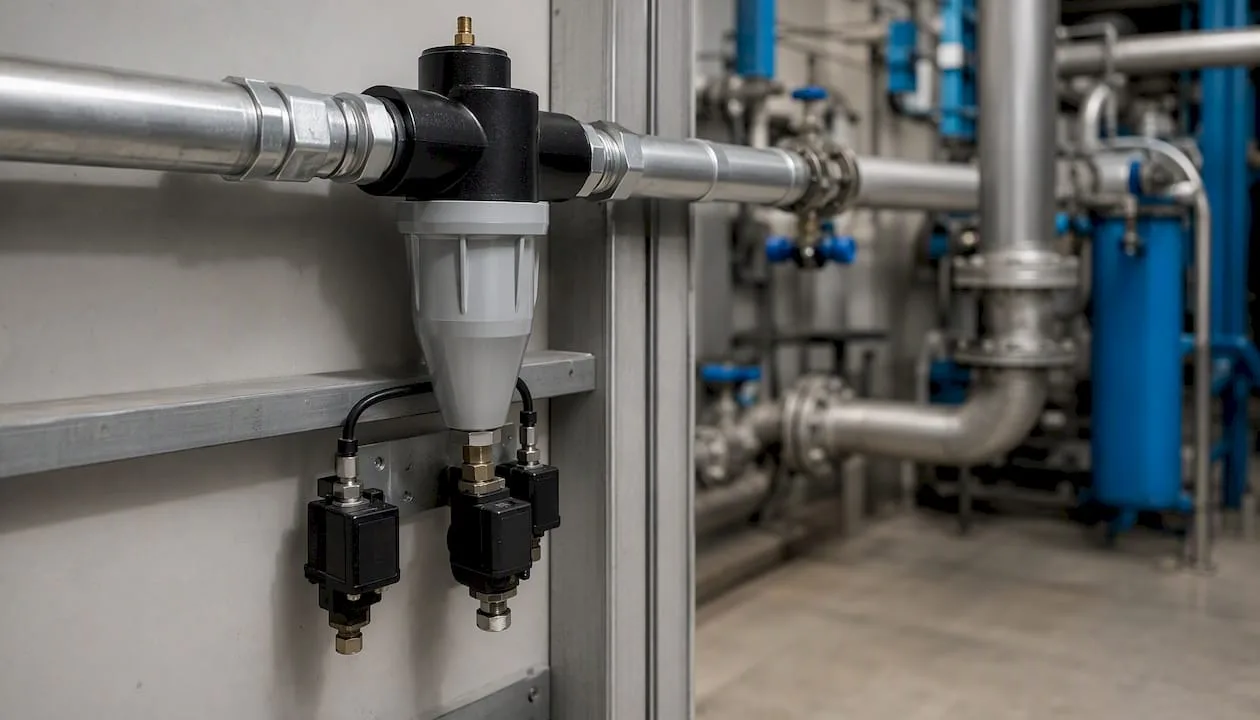
Quick modifications to distribution systems include adding a local branch from aluminium pipes with push-in polymer couplings. Such a distribution system can be assembled without welding, shortened or extended during operation, and easily adapted to changes in workshop layout.
How to choose a compressor according to the nature of consumption?
The choice is determined by the nature of consumption: stable continuous operation requires a screw compressor, while irregular or hobby consumption can be handled by a piston compressor.
Screw compressors operate with low vibration and can run continuously. Their operating economics pay off at high utilization. Piston compressors are cheaper to purchase and suitable where the compressor only runs part of the working time.
VSD (variable speed drive) adjusts the motor speed to the current air demand. In operations with variable load, VSD significantly reduces energy consumption compared to a fixed-speed compressor, which otherwise cycles between full output and idling.
Oil-lubricated vs. oil-free operation:
- Oil-lubricated compressor: lower acquisition cost, requires oil filtration in the distribution system
- Oil-free compressor: necessary for the food industry, pharmaceuticals, electronics and painting without the risk of contamination
- Operating costs: oil-free machines have a higher acquisition price, but lower costs for filtration and maintenance of the oil system
A detailed comparison of screw and piston compressors will help when selecting a specific model.
Professional tip: Before deciding on the compressor type, measure the simultaneity of consumption: record how many tools or appliances are actually running at the same time. The result may be significantly lower than the sum of rated flow rates, and thus also the required compressor output.
How to properly treat compressed air: drying, filtration and separation?
Drying and a filtration cascade are a prerequisite for the reliability of tools and technologies. Moisture in the distribution system causes corrosion, failures of pneumatic valves and degrades surface finishes.
The refrigerant dryer reduces the pressure dew point to PDP +3 °C, which is the standard target for workshop and industrial operations. It is installed after the compressor and the air tank, before the filtration cascade.
| Filtration grade | Function | Class according to DIN ISO 8573 |
|---|---|---|
| Cyclone separator | Mechanical separation of droplets and solid particles | Pre-treatment stage |
| Microfilter 0.1 µm | Capture of fine solid particles and oil aerosols | Class 2–3 |
| Microfilter 0.01 µm | Ultra-fine filtration for sensitive applications | Class 1 |
| Activated carbon filter | Absorption of oil vapours | Class 1 (oil) |
For sensitive applications (painting, electronics, food industry), diffusion or absorption purification is added after the microfilters. Electronic no-loss condensate drains (ECD) ensure automatic drainage of condensate from each filtration stage without loss of compressed air. Water-oil separators then process the condensate before its disposal in accordance with applicable legislation.
How to route piping and drain condensate?
The choice of pipe material and diameter fundamentally affects pressure losses and the reliability of the whole system. For permanent industrial operations, aluminium pipes with polymer push-in fittings are the most suitable.
The design documentation of industrial compressor stations lists 50 mm and 63 mm as typical diameters for main branches. Pipes are anchored with rubber clamps, which dampen vibrations and prevent noise transmission into the building structure. PPR piping with a slope towards drain points is used for condensate removal, while collecting PU tubing carries the condensate to the separator.
Rules for routing distribution lines:
- Keep the air velocity in the piping ≤6–7 m/s; higher velocity increases pressure losses and noise
- Prefer a ring (loop) layout, which balances pressure during draw-off from different points
- Minimize the number of elbows and fittings; each fitting adds an equivalent length of piping
- The pressure drop to the farthest draw-off point should not exceed 0.1 bar
Aluminium pipes and push-in fittings for compressed air distribution are available in various diameters and lengths.
How to control and monitor a compressor station?
Central control and monitoring save energy and reduce the number of unnecessary equipment start-ups. With multiple compressors, use sequential control, which alternates the machines according to load and evenly distributes operating hours among them.
What to measure and monitor:
- FAD (Nm³/h): the actual flow rate of the compressor at operating pressure
- Pressure on the main branch: continuous recording reveals pressure drops during peak draw-off
- Differential pressure across filters: signal for filter element replacement
- Energy consumption and running times: basis for an energy audit
Recommended alarms include dew point indication (TRB exceeded), a service signal upon reaching operating hours, and automatic disconnection of a faulty branch. The VSD controller adjusts output to current demand and eliminates idle running.
Professional tip: Connect the control system to a simple datalogger or an industrial PLC with data export. A weekly record of consumption and pressures will provide data for an energy audit and reveal air leaks that would otherwise remain invisible.
How to calculate capacity and size the piping network?
Start with a list of all take-off points and their rated air consumption (FAD in Nm³/h or l/min).
- Equipment inventory: record every tool, valve, or appliance along with its rated flow rate
- Conversion to Nm³/h: add up the flow rates of all simultaneously operating appliances
- Determining simultaneity: not all appliances run at the same time; the simultaneity coefficient is typically 0.5–0.8
- Compressor capacity selection: resulting FAD × simultaneity coefficient + 20–30% reserve
- Sizing the air tank: the air tank volume in liters roughly corresponds to the compressor output in l/min
Example for a workshop with three tools: an angle grinder (400 l/min), a pneumatic screwdriver (200 l/min), and a blower (300 l/min). Maximum simultaneous demand at a coefficient of 0.7 = (400 + 200 + 300) × 0.7 = 630 l/min = 37.8 Nm³/h. A compressor with an FAD of 45 Nm³/h and a 200–270 l air tank will cover this operation with sufficient reserve.
| Parameter | Value | Note |
|---|---|---|
| Total rated flow | 400 l/min | Sum of three tools |
| Simultaneity factor | 0,7 | Typical value for a workshop |
| Required FAD | 37.8 Nm³/h | Basis for compressor selection |
| Recommended reserve | 20–30 % | Result: compressor min. 45 Nm³/h |
| Recommended air tank | 200–270 l | Matches compressor output |
The detailed guide to selecting an industrial compressor contains practical checklist questions for sizing.

What are the installation and safety requirements?
The installation must ensure ventilation, heat removal, and safe placement of the compressor with regard to noise levels and maintenance access.
The compressor room needs a supply of fresh air and extraction of warm air. A 15 kW screw compressor produces heat that, without extraction, will raise the room temperature above operating limits and shorten the machine's service life. Recovering this heat for heating or water heating is technically feasible and economically attractive.
Checklist before commissioning:
- Anchoring the compressor on anti-vibration pads or a frame
- Tightness of all joints after assembly (pressure test with soapy water or a leak detector)
- Electrical protection: circuit breaker, grounding, motor protection
- Water–oil separator located away from the direct discharge into the sewage system
- Access to filters, drains and the dryer for regular maintenance
- Inspection of the air receiver (tank) in accordance with ČSN EN 286 and local regulations
Dew point and differential pressure measurement across the filters should be carried out immediately after commissioning, with the results recorded as baseline values for future comparison.
How to plan the costs and schedule of the upgrade?
Simple interventions such as adding an air tank or a cyclone separator can be installed within days to a week. Larger upgrades involving compressor replacement, new piping and air treatment take weeks to months, and the costs are proportionate.
- Minor investment: air tank, separator, ECD drains, local branch of the piping
- Medium upgrade: refrigerant dryer, filtration cascade, piping expansion
- Complete upgrade: new screw compressor with VSD, entire piping system, control system, air treatment
Project phases: audit → design → approval → procurement → installation → commissioning and measurement.
When planning, allow time for leak tests and control system adjustment. An operational shutdown is required at least when connecting new branches to the existing pressurized piping.
Checklist for upgrading pneumatic equipment
- Audit: measure FAD, simultaneous demand and existing pressure losses in the distribution system
- Calculation: determine the required compressor output, air tank volume and pipe diameters
- Component selection: compressor (type, VSD), air tank, dryer, filtration cascade, ECD drains
- Installation plan: schedule, compressor room insulation, ventilation, anchoring, condensate drainage
- Assembly and piping: aluminium pipes, polymer couplings, PPR for condensate, PU tubing
- Commissioning: pressure test, dew point measurement, differential pressure check across filters
- Records: baseline FAD, pressure, dew point and energy consumption values for future comparison
The most common mistakes that make modernization more expensive
Audit as the first step, air tank as the second and drying with filtration as the third. This order of priority applies without exception.
The most common mistake is skipping the audit and going straight to buying a bigger compressor. The result is usually an oversized machine that cycles while idling, or conversely, undersized piping that cannot carry the new compressor output. Undersized piping causes pressure losses, increased noise and shortened tool lifespan.
The second most common mistake is neglecting condensate drains. Float valves without inspection stop working and condensate accumulates in the distribution system. ECD zero-loss drains eliminate this problem, but they require power supply and occasional inspection.
The third mistake is making decisions without data.
Kompresory-vzduchotechnika offers expert consulting for design and implementation.
Kompresory-vzduchotechnika: tailored design, delivery, and service
Kompresory-vzduchotechnika covers the entire scope of modernization, from energy audits through turnkey design to installation, commissioning, and 24/7 service. The delivery includes screw and piston compressors, refrigerant dryers, filtration cascades, ECD drains, air tanks, and complete piping systems.
Technical consulting is part of the standard offering: specialists help with FAD calculations, pipe sizing, and selecting the correct filtration class according to DIN ISO 8573. The complete range of pneumatic accessories and piping components is available online, with the option of consultation before ordering. For piping layout planning, pipes and fittings for compressed air distribution are also available in diameters matching industrial projects. Contact the Kompresory-vzduchotechnika team for a free consultation and solution design.
Useful resources for further study
The following resources are relevant for technical sizing and design:
DIN ISO 8573 defines compressed air purity classes (solid particles, moisture, oil) and is the fundamental standard for designing a filtration cascade. Every air treatment project should specify the required purity class for the given application.
Project documentation for industrial compressor stations (for example, VOP CZ contracts) specifies concrete technical values: pipe diameters of 50 mm and 63 mm, PDP +3 °C for refrigerant dryers, filtration of 0.1–0.01 µm, and the use of ECD zero-loss drains. These values serve as a reference point for your own projects.
BCAS recommendations for air velocity in piping (≤6–7 m/s) and the rule for maximum pressure drop (≤0.1 bar) are standard design values used when sizing piping systems.
Frequently asked questions
What is the first step when expanding pneumatic equipment?
Air consumption audit: measure the FAD of all consumers, determine the simultaneity of demand, and only then design new components.
When is a screw compressor necessary instead of a piston compressor?
A screw compressor is suitable for stable continuous draw-off; a piston compressor is sufficient for irregular or hobby operation with a shorter running time.
What pressure dew point should the refrigeration dryer ensure?
The standard target for workshop and industrial operations is a PDP of +3 °C; sensitive applications require lower values achievable with adsorption dryers.
What air velocity is recommended in the distribution piping?
The recommended design velocity is ≤6–7 m/s; higher velocity increases pressure losses and noise in the distribution system.
When should a specialist be contacted for compressor station modernization?
When replacing a compressor, designing new distribution piping, or in case of uncertainties in FAD calculations and sizing, consulting a specialist, for example through Kompresory-vzduchotechnika, is the fastest way to the correct solution.
Recommended
- Pneumatic tools in 2025: trends and innovations - Kompresory-Vzduchotechnika.cz
- Pneumatic systems explained: a guide for technicians - Kompresory-Vzduchotechnika.cz
- What is pneumatic lubrication: a guide for technicians - Kompresory-Vzduchotechnika.cz
- How pneumatics works: a complete guide for industry 2026