

In brief:
- An air receiver is a closed pressure vessel designed for the safe storage of liquids or gases at a pressure higher than atmospheric. It is used to accumulate compressed air, even out pressure pulsations and reduce the number of compressor start-ups, thereby extending its service life. Legislation stipulates that vessels exceeding 0.5 bar are designated pressure equipment subject to strict inspection.
What is an air receiver and what is it used for
An air receiver is a closed pressure vessel designed for the safe storage of liquids or gases at a pressure higher than atmospheric. According to § 2 of Government Regulation No. 192/2022 Coll., this refers to a pressure vessel including components attached directly to it up to the point of connection with the pressure equipment.
In compressed air systems, an air receiver performs several key functions:
- Accumulation of compressed air to cover short-term demand peaks without the need to start the compressor immediately
- Evening out pressure pulsations arising during compression, thereby protecting connected tools and equipment
- Separating condensate from the compressed air before it is further distributed
- Reducing the frequency of compressor start-ups, which extends its service life
The working pressure (PS) indicates the maximum permissible operating overpressure of the vessel. Safety equipment, in particular the safety valve, ensures that the pressure never exceeds this limit. According to NV 192/2022 Coll., air receivers with a maximum working pressure above 0.5 bar are classified as designated pressure equipment and are subject to strict legislative inspection.
Kompresory-vzduchotechnika offers certified air receivers for industrial and domestic compressed air systems, including expert advice on selection.

Contents
- What types of pressure vessels are most commonly used?
- What legislation and standards apply to pressure vessels in the Czech Republic?
- How to choose a pressure vessel for your compressed air system?
- How to properly maintain pressure vessels and when to inspect them?
- Pressure vessels and air tanks from Kompresory-vzduchotechnika
- Key takeaways
- FAQ
What types of pressure vessels are most commonly used?
Pressure vessels are classified according to their design, method of use, and legislative categorization. Each type has specific properties that determine its suitability for a particular application.
- Stationary pressure vessels are permanently fixed at the installation site. The ČSN 69 0010-1-1 standard sets technical rules for them, defining the working overpressure and the maximum working overpressure. Typically, these are industrial air tanks with volumes ranging from tens of liters to several thousand liters.
- Portable pressure vessels are designed for mobile use. Their smaller volume and lower weight allow them to be moved around construction sites or workshops.
- Simple pressure vessels are series-produced vessels manufactured according to NV 175/1997 Sb., intended for storing air or nitrogen up to 30 bar. Their production is subject to a simplified conformity assessment procedure.
Materials of pressure vessels affect working temperatures, maximum pressure, and resistance to the environment:
- Unalloyed steel: the most widespread material, suitable for standard industrial applications
- Unalloyed aluminium and its alloys: lower weight, suitable for portable vessels and the food industry
- Stainless steel: resistance to corrosion, suitable for aggressive environments or group 1 fluids
Typical capacities and their use:
| Tank volume | Typical applications |
|---|---|
| smaller volumes suitable for home workshops and hobby compressors | |
| medium volumes used in car repair shops and smaller production facilities | |
| — | Light industry, air tanks — |
| larger volumes common for medium industrial systems | |
| large volumes suitable for extensive production halls and industrial compressors |
What legislation and standards apply to pressure vessels in the Czech Republic?
The operation of pressure vessels in the Czech Republic is governed by several binding regulations. Knowledge of these is essential for both manufacturers and operators.
- Government Regulation No. 192/2022 Coll. is the basic regulation for pressure equipment. It defines designated pressure equipment, the conditions for its safety, and the requirements for safety accessories. Vessels with PS above 0.5 bar are classified into Category I or II according to the combination of working pressure and volume.
- Government Regulation No. 175/1997 Coll. governs simple pressure vessels and sets technical limits for their series production.
- ČSN 69 0010-1-1 defines technical terms and rules for stationary pressure vessels, including working overpressure and maximum working overpressure.
- Decree No. 18/1979 Coll. and ČSN 69 0012 set the deadlines and procedures for inspections and pressure tests of vessels in operation.
Requirements for safety accessories include safety valves, pressure gauges, and shut-off valves. Each vessel must be marked with a nameplate stating technical parameters, year of manufacture, and manufacturer identification.
More detailed information on safety principles for working with pressure equipment can be found in the article on pneumatic safety in industry.
How to choose a pressure vessel for your compressed air system?
The correct choice of pressure vessel depends on the compressor parameters, the requirements of the outlet points, and the operating conditions. An incorrect choice leads to insufficient system performance or unnecessarily high costs.
- The volume of the vessel is selected according to the compressor's output and the nature of the demand. Generally, a larger air tank reduces the number of compressor switching cycles and extends its service life.
- The working pressure must match the maximum pressure of the compressor and the requirements of the connected tools. The ČSN EN 286-1 standards specify air tanks according to the European standard with precisely defined parameters.
- Material and design depend on the installation environment. Outdoor or damp environments require surface protection or stainless steel design.
- Certification and compliance with Government Regulation No. 192/2022 Coll. are a prerequisite for legal operation. When purchasing, always verify the presence of CE marking and accompanying documentation.
- Accessories: safety valve, pressure gauge, condensate drain valve, and suitable mounting are part of a complete solution.
Professional tip: The volume of the air tank in litres should be approximately equal to ten times the compressor's output in litres per minute, to ensure efficient operation during intermittent draw-off.
Kompresory-vzduchotechnika offers air tanks in a wide range of volumes, from compact tanks for home workshops to air tanks with a volume of 725 l for medium-sized industrial systems.
How to properly maintain air receivers and when to have them inspected?
Regular maintenance extends the service life of the air receiver and prevents accidents. Legislation sets specific deadlines that cannot be ignored.
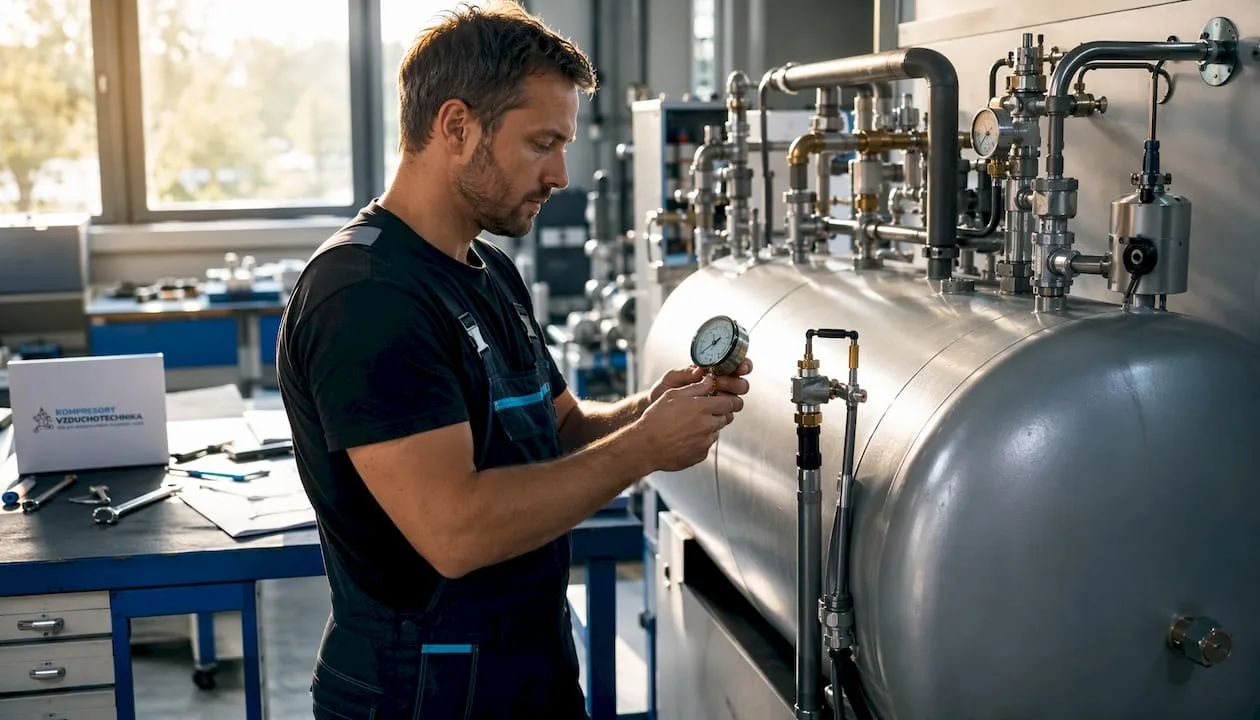
- Regular visual inspections should be carried out at least once a year. Monitor the condition of the surface, welds, flanges, and seals. Corrosion, deformation, or leaks are a signal for immediate decommissioning of the tank.
- Inspections are carried out within the periods specified by Decree No. 18/1979 Coll. and ČSN 69 0012. The standard inspection interval is one year.
- Pressure testing is generally carried out after nine years of operation. The test verifies the strength and tightness of the tank at a pressure higher than the working pressure.
- Condensate draining should be carried out regularly, ideally daily during intensive operation. Accumulated water accelerates corrosion of the inner wall of the tank.
- Cleaning and protection: protect the outer surface with paint or an anti-corrosion treatment, especially in environments with increased humidity.
- Signs of damage: hissing or air leakage around flanges, visible corrosion, deformation of the shell, or a malfunctioning safety valve require immediate service intervention.
Kompresory-vzduchotechnika provides technical support, service interventions, and advice for pressure vessel inspections.
Pressure vessels and air tanks from Kompresory-vzduchotechnika
Kompresory-vzduchotechnika offers certified pressure vessels for industrial and domestic compressed air systems with working pressures and volumes covering the full range of common applications. The range includes stationary air tanks from small volumes for hobby use up to large-capacity vessels for industrial operations, including vessels for fluid group 1 and vessels according to ČSN EN 286-1.
Each product is supplied with the relevant documentation and meets the requirements of Government Regulation No. 192/2022 Coll. Expert advice is available for selecting the correct volume, pressure, and material according to the specific application. For a complete compressed air system, Kompresory-vzduchotechnika also offers air treatment units and all accessories for distribution and filtration.
Check out the current offer of 720 l air tanks or contact the technical department for an individual solution design.
Key takeaways
A pressure vessel is a designated pressure device subject to NV 192/2022 Sb., with the correct selection of volume, material, and certification being essential for the safe and long-term operation of a compressed air system.
| Point | Details |
|---|---|
| Definition and legislation | A pressure vessel is a pressure body according to NV 192/2022 Sb.; vessels above 0.5 bar are designated pressure equipment. |
| Types and materials | Stationary, portable and simple air receivers; materials include steel, aluminium and their alloys. |
| Selection by parameters | Choose the volume as approximately ten times the compressor's minute output; the pressure must correspond to both the compressor and the tools. |
| Inspections and tests | Inspections take place annually, the pressure test is carried out after nine years of operation. |
| Compressors-fluid power | Offers certified pressure vessels in the full range of volumes with expert advice and service support. |
FAQ
What is a pressure vessel according to Czech legislation?
A pressure vessel is a closed pressure body designed to store liquids or gases under pressure, defined in § 2 of Government Regulation No. 192/2022 Coll. Vessels with a working pressure above 0.5 bar are classified as designated pressure equipment.
How does an air receiver work in a compressed air system?
The tank accumulates compressed air, evens out pressure pulsations, and reduces the number of compressor cycles. This protects both the compressor and connected tools and ensures stable pressure in the distribution system.
How often must a pressure vessel be inspected?
Inspections are generally carried out once a year, with a pressure test after nine years of operation, in accordance with Decree No. 18/1979 Coll. and ČSN 69 0012.
What volume of air receiver do I need for my compressor?
The volume of the air tank in liters should correspond approximately to ten times the compressor's per-minute output in liters per minute. Kompresory-vzduchotechnika offers air tanks ranging from small volumes for hobby use up to industrial air tanks with large volumes.
What certifications must a pressure vessel have?
The vessel must bear the CE marking and meet the requirements of Government Regulation No. 192/2022 Coll. or Government Regulation No. 175/1997 Coll. for simple pressure vessels. The delivery must include accompanying documentation with technical parameters and manufacturer identification.