
Air compressors

A compressor is chosen by two things: how much air your connected tools use and how long it will run in one go. A small machine is enough for inflating tyres; a grinder or a paint shop needs several times more. The table below runs from the smallest machines to those that keep a whole production line going.
Which series suits you
The series are listed from the smallest machines to the largest. Each shows the intake and air delivery range in litres per minute, the maximum pressure and the power supply.
| Compressor series by intake, air delivery, pressure and power supply | |||||
|---|---|---|---|---|---|
| Series | Best for | Intake | Air delivery | Pressure | Power supply |
| Black Wind | home use and occasional inflating | 160–356 l/min | 84–257 l/min | 8–10 bar | 230 V |
| ABAC Line | tradespeople, smaller workshops | 160–355 l/min | 80–277 l/min | 8–10 bar | 230 V |
| ABAC Expert Zero | where the air must contain no oil | 255–486 l/min | 165–316 l/min | 10 bar | 230 / 400 V |
| ABAC Super Silent | workshops where people talk and take calls | 140–230 l/min | 45–94 l/min | 8–9 bar | 230 V |
| ABAC Pro Line | daily use in a workshop or garage | 178–2,420 l/min | 125–1,864 l/min | 10–15 bar | 230 / 400 V |
| ABAC Silent | running next to the workplace without a compressor room | 50–1,070 l/min | 27–864 l/min | 8–11 bar | 230 / 400 V |
| ATMOS Perfect | sustained load, cast-iron pump | 420–1,500 l/min | 323–1,170 l/min | 10–12.5 bar | 230 / 400 V |
| WALTER | workshop and industry, cast-iron pump | 420–1,400 l/min | 340–1,100 l/min | 10–15 bar | 230 / 400 V |
| ABAC Tech | industry, multi-shift operation | 204–1,716 l/min | 126–1,080 l/min | 10–30 bar | 230 / 400 V |
| Screw | continuous demand, plants and production | — | 200–66,200 l/min | 7–20 bar | 230 / 400 V |
| Engine-driven | building sites and places without power | 275–1,038 l/min | — | 10–14 bar | petrol / diesel |
| Dental | surgeries and laboratories | 240–480 l/min | 125–240 l/min | 8 bar | 230 V |
Intake is the air the machine draws in; air delivery is what actually reaches your tools. On our piston machines, delivery is roughly a quarter lower than intake. Screw compressors are rated by the manufacturer for delivery only, engine-driven ones for intake only.
#showmore#
Choose by specification
For every feature there is a separate page with all the machines that have it. The counts in the tables are from our range.
By tank size
The tank (air receiver) evens out the demand — the tools take air from it and the compressor tops it up. The air also cools down in it and water condenses out, which is removed by a condensate drain.
| Compressors by pressure tank size | |||
|---|---|---|---|
| Tank | Machines | Typical air delivery | On 230 V |
| 6 l compressors | 8 | 84 l/min | 8 |
| 24 l compressors | 8 | 150 l/min | 7 |
| 50 l compressors | 36 | 208 l/min | 25 |
| 90 l compressors | 39 | 255 l/min | 14 |
| 100 l compressors | 10 | 340 l/min | 3 |
| 150 l compressors | 34 | 283 l/min | 14 |
| 200 l compressors | 43 | 350 l/min | 7 |
| 270 l compressors | 108 | 637 l/min | 6 |
| 300 l compressors | 10 | 950 l/min | 0 |
| 500 l compressors | 97 | 1,016 l/min | 0 |
| Compressors without a tank | 301 | 6,200 l/min | 2 |
The tanks on our machines range from 2.5 to 900 litres. Up to 50 litres the machines mostly run from a 230 V socket; from 200 litres upwards three-phase machines prevail and screw compressors become more common. A larger tank pays off with sudden heavy demand — blowing, spraying, sandblasting. Machines without a tank get a separate receiver from the category Pressure vessels and air tanks.
By design and equipment
| Compressors by design and equipment | ||
|---|---|---|
| What you are looking for | Machines | What for |
| Piston compressors | 360 | intermittent duty in workshops and garages |
| Screw compressors | 343 | continuous air demand |
| Scroll compressors | 21 | scrolls instead of pistons, all oil-free |
| Single-cylinder compressors | 23 | small 230 V machines for a home workshop |
| Twin-cylinder compressors | 296 | a pump with two cylinders |
| Three-cylinder compressors | 29 | oil-lubricated, belt-driven, 400 V |
| Four-cylinder compressors | 12 | oil-lubricated and oil-free |
| Two-stage compressors | 145 | higher pressure, typically 11 bar, also 15 to 30 bar |
| Oil-free compressors | 121 | oil-free air for food and surgeries |
| Soundproofed compressors | 422 | machine in a soundproof cabinet |
| Compressors with a dryer | 113 | dry air from one machine |
| Screw compressors with inverter | 207 | output adapts to demand |
| Compressors with a vertical tank | 34 | smaller footprint |
| Oil-lubricated compressors | 624 | the most common design, oil lubricates and cools |
| Mobile compressors | 183 | on wheels, moved around the workshop or site |
By power supply, pressure and use
| Compressors by power supply, pressure and use | ||
|---|---|---|
| What you are looking for | Machines | What for |
| Compressors for 230 V | 105 | ordinary socket, no three-phase supply |
| Compressors for 400 V | 610 | three-phase supply, every machine above 3 kW |
| Star-delta start | 26 | lower current surge at start-up, from 4 kW |
| Compressors with petrol engine | 18 | work without electricity |
| Diesel compressors | 4 | long shifts without electricity |
| 8 bar compressors | 180 | enough for ordinary tools, mostly screw compressors |
| 10 bar compressors | 448 | the most common pressure in our range |
| 11 bar compressors | 95 | a margin above the usual 10 bar |
| 15 bar compressors | 11 | high-pressure two-stage machines |
| 20 bar compressors | 12 | two-stage piston units and one screw compressor |
| 30 bar compressors | 6 | highest pressure in our range, on a frame without a tank |
| Hobby compressors | 10 | occasional work in the garage, 230 V |
| Semi-professional compressors | 25 | home workshop and occasional work |
| Professional compressors | 660 | daily use in workshop and production |
| Industrial piston compressors | 72 | frequent, long running at low speed |
What to look at when choosing
What decides on the right machine — from the air your tools use to noise. If you are new to compressors, the basics are in the article What is a compressor.
How much air tools use
The figures come from the tools we sell ourselves. For each type there is a range from the most economical to the most demanding model, plus a typical value. An impact wrench for wheels or an angle grinder takes more than most people expect.
| Air consumption of pneumatic tools from our range | |||
|---|---|---|---|
| Tool | Consumption | Typical | Measured on |
| Impact wrenches | 119–453 l/min | 144 l/min | 12 tools |
| Ratchet wrenches | 69.4–130 l/min | 113 l/min | 9 tools |
| Die grinders | 29–490 l/min | 169 l/min | 15 tools |
| Angle grinders | 113–490 l/min | 255 l/min | 10 tools |
| Random orbital sanders | 88–298 l/min | 109 l/min | 12 tools |
| Nibblers | 85–184 l/min | 113 l/min | 5 tools |
| Drills | 112–184 l/min | 113 l/min | 8 tools |
| Screwdrivers | 90–254 l/min | 113 l/min | 17 tools |
| Air hammers | 85–424 l/min | 167 l/min | 10 tools |
How to compare: choose a machine whose air delivery is higher than the tool's consumption, and leave a margin — a compressor should not run flat out without a break. When several tools run at once, their consumption adds up.
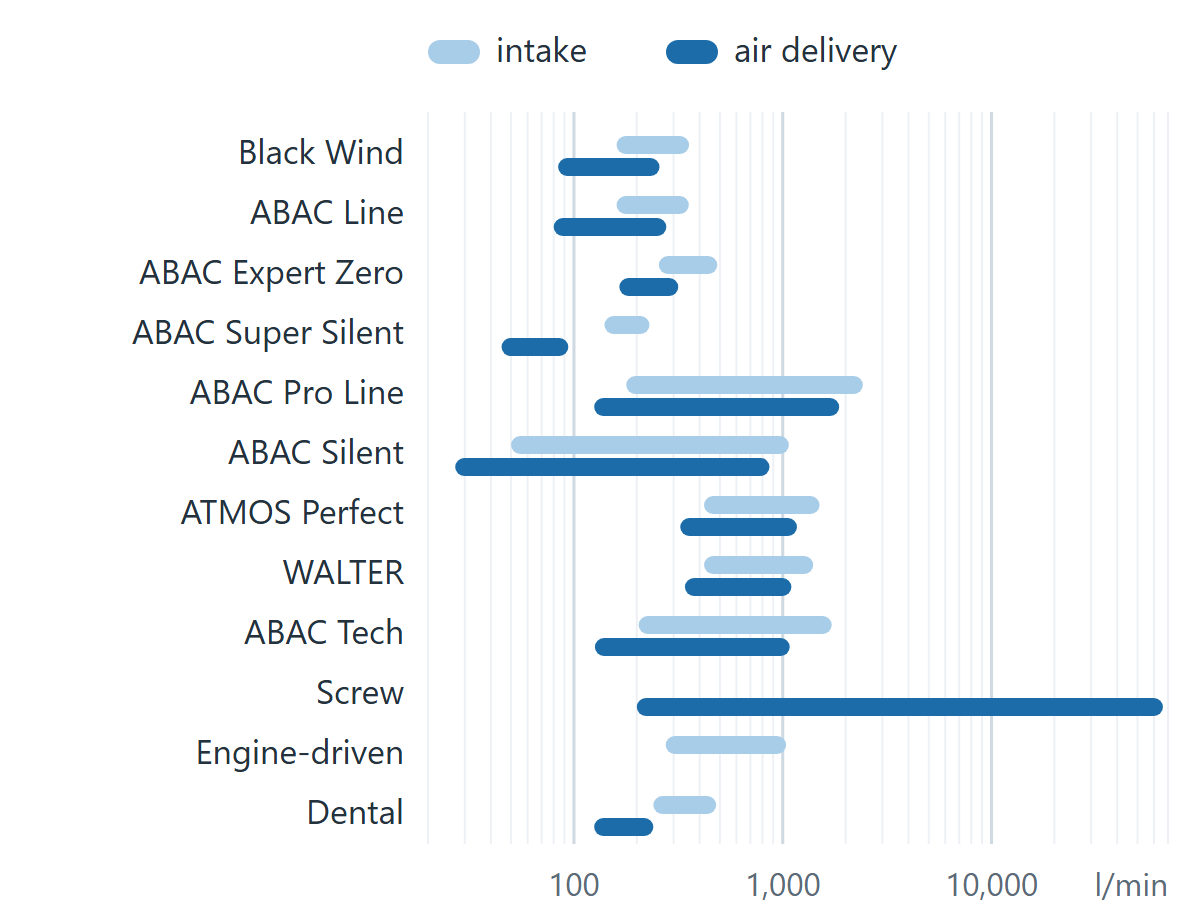
The chart shows the same for compressors: the light bar is intake, the dark one air delivery. The axis grows in orders of magnitude, so that a small inflating machine and a screw compressor for a whole plant both fit on it.
For painting, plenty of air is not enough — it has to be clean, dry and at a steady pressure. What that takes is described in the article Painting with a compressor: what is needed for it.
Piston or screw
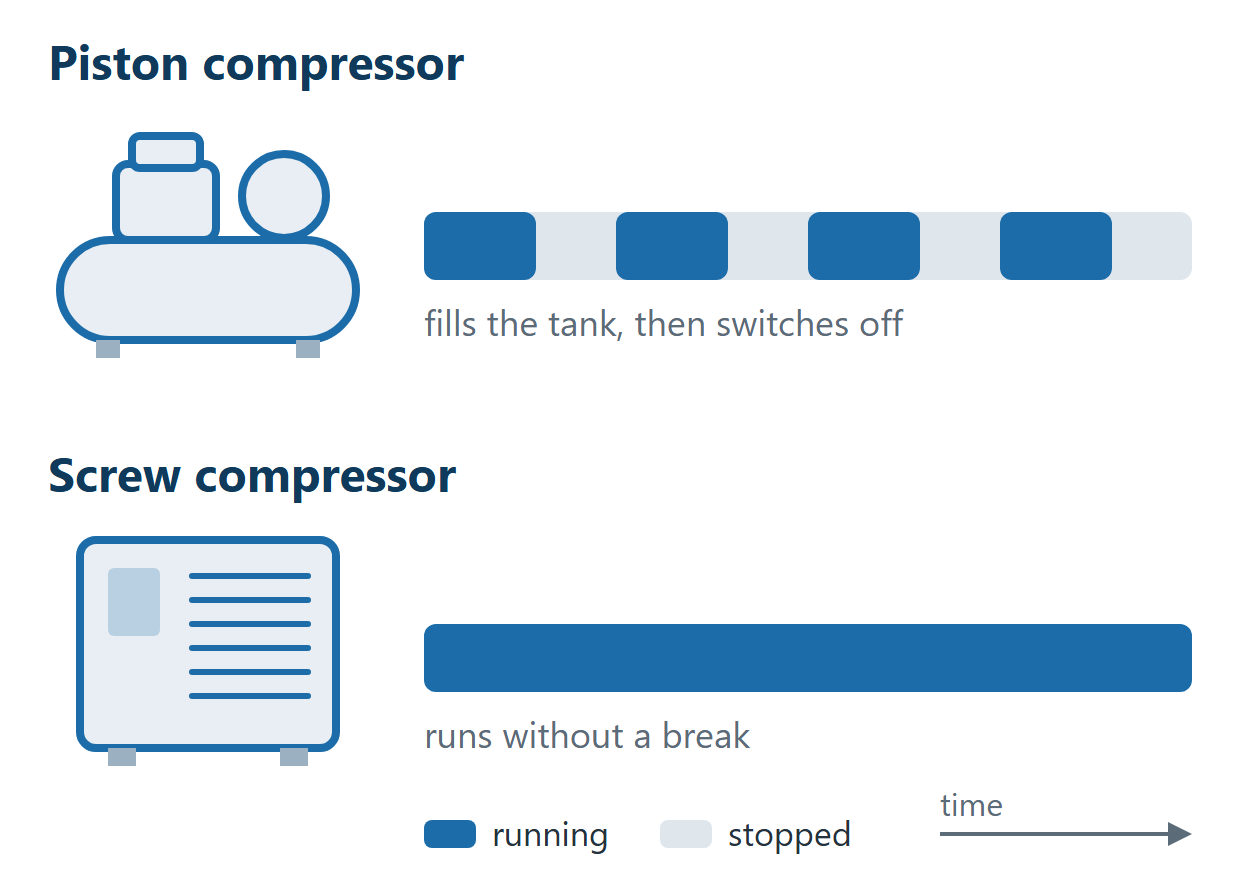
What decides is running time, not the size of the workshop. A piston compressor is built for intermittent duty — it fills the tank and switches off. If it had to run all the time, it would overheat and shorten its life.
A screw compressor, on the other hand, is built to run without a break. It pays off where air is drawn continuously — in a paint shop, at production machines, in shift work. How to run it economically is covered in the article Efficient operation of screw compressors.
How the types differ in figures is shown by a comparison of our whole range. A dash means the feature is not stated for that type.
| Compressor types in figures — from our range | ||||
|---|---|---|---|---|
| Piston | Screw | Scroll | Engine-driven | |
| Machines in our range | 360 | 343 | 21 | 22 |
| Typical air delivery | 350 l/min | 4,100 l/min | 1,200 l/min | intake 524 l/min |
| Air delivery range | 27–1,864 l/min | 272–66,200 l/min | 200–3,520 l/min | intake 275–1,038 l/min |
| Pressure | 8–30 bar | 7–20 bar | 7–10 bar | 10–14 bar |
| Oil-free | 68 | 32 | 21 | 0 |
| Soundproofed | 78 | 323 | 21 | 0 |
| With dryer | 32 | 81 | 0 | 0 |
| With inverter | — | 207 | 0 | — |
| On 230 V | 104 | 1 | 0 | — |
How much air one kilowatt gives
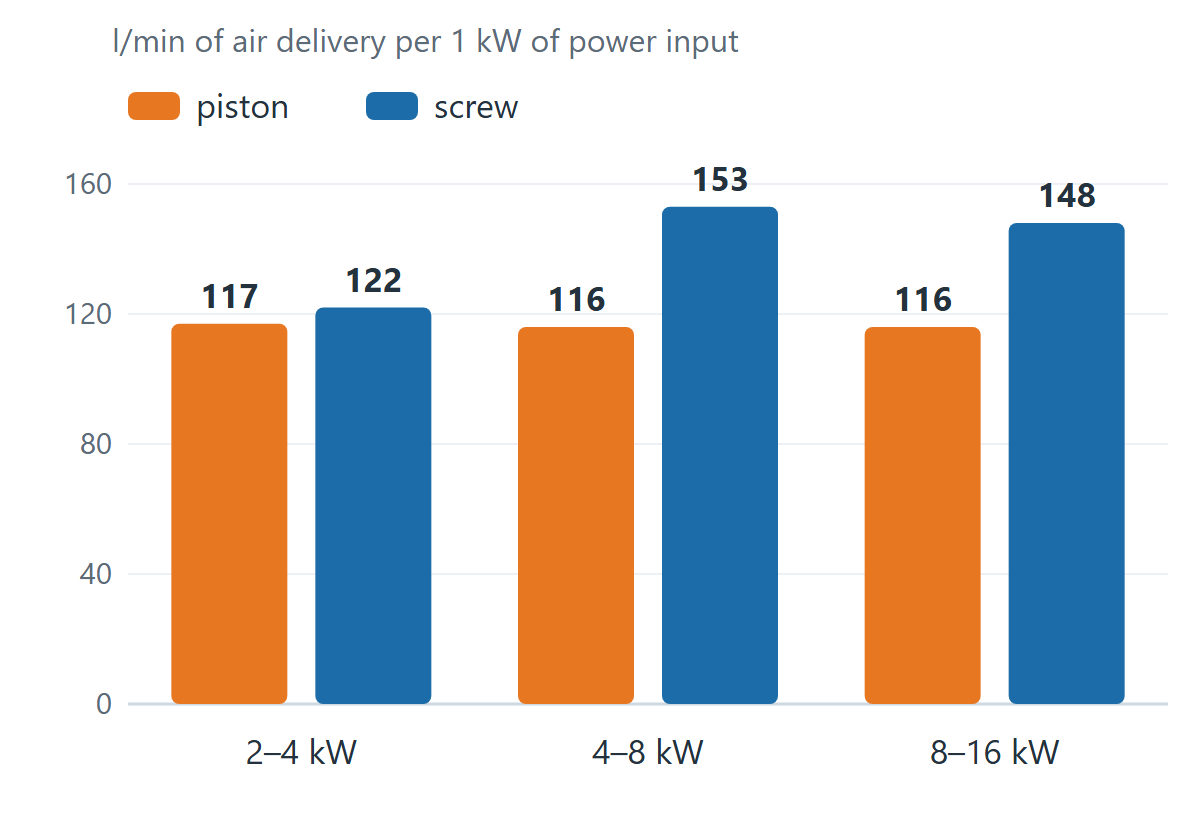
Screw compressors have a reputation for being more economical. Our data confirm it, but with a size caveat: up to 4 kW, piston and screw machines give almost the same air per kilowatt — 117 and 122 l/min. From 8 kW upwards, a screw compressor delivers roughly a quarter more, 148 against 116 l/min.
We compared only machines of the same power input; otherwise the result would be skewed by screw compressors being much larger on average. How to cut the electricity they use is covered in the article Compressor energy consumption.
Direct drive or V-belt
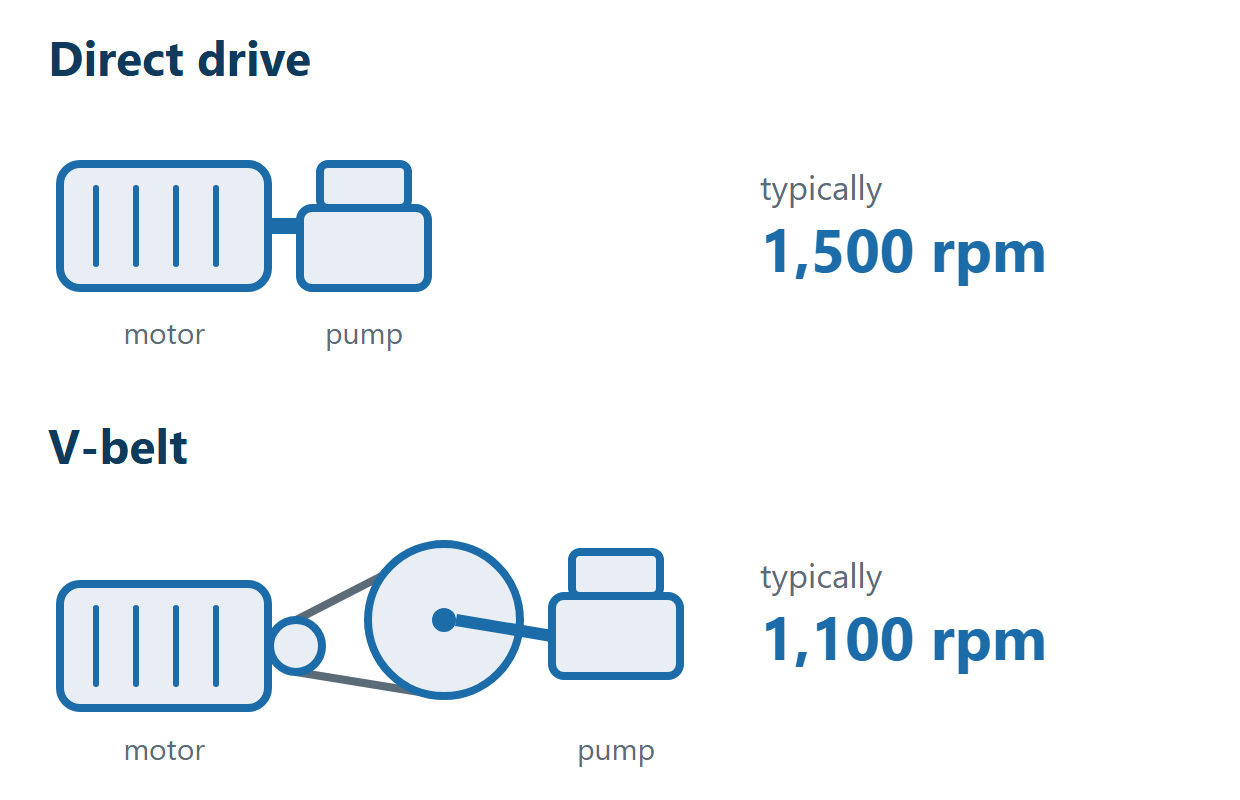
With piston compressors it also matters how the motor drives the pump. With direct drive the pump sits right on the motor shaft and spins fast — typically 1,500 rpm. A V-belt gears the speed down, typically to 1,100 rpm, and a slower pump runs cooler.
At the same power input of 1.5 to 2.2 kW, our direct-drive machines typically weigh 45 kg and deliver 174 l/min. Belt-driven ones are heavier, around 80 kg, but deliver around 255 l/min. Our range has 98 direct-drive piston machines and 246 belt-driven ones.
230 V or 400 V
Small and medium machines run from an ordinary 230 V socket — we offer around a hundred of them, and the most powerful has a power input of 3 kW. A single-phase supply cannot carry more: the motor would trip the circuit breaker on start-up.
The limit is not set by a table but by what is wired to your workshop. A three-phase 400 V supply opens up the rest of the range, all the way to industrial screw machines. If your breaker already trips, the causes are covered in the article Compressor trips the circuit breaker.
Oil-lubricated or oil-free
Oil-lubricated
Oil lubricates and cools, so the pump lasts longer and copes with longer running. But oil mist gets into the air — where it matters, it is filtered out.
Oil-free
The air is oil-free from the start. It suits food production, laboratories and surgeries and anywhere oil would spoil the result. The pump wears sooner.
We have over 100 oil-free machines: the entire ABAC Expert Zero, Super Silent and Dental series, oil-free screw compressors and individual models in other series. Air cleaning is covered in the article How to filter compressed air.
Noise and soundproofing
If the compressor is to stand right next to the workplace rather than in a compressor room, go for a soundproofed machine. The difference is clear: on our piston compressors the sound pressure level at 4 metres is typically 68 dB for soundproofed and 77 dB for the others. The ear perceives 9 decibels as almost half the noise.
The ABAC Silent and Super Silent series are soundproofed throughout, and screw compressors usually come soundproofed from the factory. How to read the noise figures on the rating plate is explained in the article Compressor noise and what to watch for.
What goes with a compressor
A compressor only produces the air. To reach your tools dry, clean and at the right pressure, it needs add-ons.
Air treatment
Compressed air always contains water. The bulk is caught by a cyclone water separator, and the remaining moisture is removed by a compressed air dryer. 113 of our compressors have a dryer built in.
Oil and dirt are caught by filters, and a regulator sets the pressure for your tools — both are in the category Filtration, regulation and air treatment. Why dry air matters is explained in the article Why and how to dry compressed air.
Air lines and connections
Almost all of our smaller machines have a DN 7.2 quick coupling outlet — 197 compressors in total. Matching couplings and plugs are in the category ES DN 7.2 quick couplings.
They go with compressed air hoses and, for blowing, blow guns.
A fixed network for several workplaces is built from compressed air piping systems. How to design one is covered in the article Compressed air distribution.
Maintenance and spare parts
A compressor lasts for years if its oil and intake filter are changed on time and condensate removal is kept in check. The right oil is in the category Compressor oil, and what to change and when is covered in the article How and why to properly maintain compressors.
Parts for the machines are gathered in the category Compressor spare parts and accessories. The compressor is switched on and off by a pressure switch. When the whole pump is worn out, it is replaced on its own — with a compressor pump unit.
Brands
The machines in our range come from five manufacturers.
- ABAC — from the Line series for tradespeople to the industrial Tech machines, including oil-free, soundproofed and engine-driven ones
- ATMOS — Perfect piston compressors with a cast-iron pump
- WALTER — cast-iron piston compressors for workshop and industry
- Black Wind — small compressors for an ordinary socket
- SCR — screw and scroll compressors

Ventilek advises
The most common mistake is a small machine on a big tool.
I will be straight with you — hang a grinder on a compressor that cannot keep up, and it is not the grinder that suffers, it is the compressor. It will run non-stop, overheat and give out before it has paid for itself. Check the consumption table and add a margin.
Frequently asked questions
- How do I know a compressor can handle my tools?
- Compare the compressor's air delivery with the tool consumption in the table above and leave a margin. Compare it with intake instead, and you will buy a machine one size too small.
- What is the difference between intake and air delivery?
- Intake is the air a compressor draws in; air delivery is what it actually supplies. On our piston machines, delivery is 15 to 50 % lower, most often by roughly a quarter.
- How big a tank do I need?
- It depends on the demand. With sudden demand, for example when blowing or spraying, a larger tank helps. With steady demand, what matters most is the machine's air delivery.
- What pressure do I need?
- Most pneumatic tools work at around 6 bar. A compressor with a maximum of 10 bar — we have 448 of them — therefore has a margin and does not have to cycle too often. Higher pressure is needed only for special uses.
- Is a 230 V compressor enough for me?
- For small and medium machines, yes — the most powerful plug-in compressors have a power input of 3 kW. More output needs a three-phase 400 V supply.
- When does a screw compressor pay off?
- When air is drawn continuously, not in bursts. A piston machine in continuous duty overheats; a screw compressor is built for it. From 8 kW upwards it also delivers roughly a quarter more air per kilowatt.
- Direct drive or belt?
- Direct drive is lighter and smaller; a belt-driven machine runs slower, copes with longer running and delivers more air from the same motor.
- Do I need an oil-free compressor?
- Only where oil in the air is a problem — in food production, laboratories and surgeries. For a workshop and tools, an oil-lubricated machine is more durable.
- Do I need an air receiver as well?
- Most piston machines have one built in. A separate air receiver is added to compressors without a tank, where demand fluctuates, or for a supply network serving several workplaces.
-
 Black Wind piston compressors
-
ATMOS piston compressors
-
Walter reciprocating compressors
-
Piston compressors ABAC
-
Piston compressors ABAC
-
Expert Zero compressors
-
ABAC reciprocating compressors
-
Quiet compressors Super Silent OS
-
INDUSTRIAL TECH compressors
-
CLR reciprocating compressors
-
Combustion compressors
-
Screw compressors
-
Pressure vessels
-
Compressor accessories
.png)


Product sorting
List of products

The genuine oil for ATMOS Perfect and Perfect Line piston compressors. The viscosity is chosen for these machines, so there is no substitute to hunt for.

A single-phase Condor that arrives set to a lower pressure than its sibling. The inlet thread is the narrower quarter-inch.

The suction filter serves as protection against dirt entering the machine and should be replaced regularly. ATMOS compressors are supplied with suction filters as standard...

Replacement suction filter insert for large round suction filter for ATMOS compressors. This filter insert is found in ATMOS Bobby series piston compressors, Perfekt line...

Miniature ball valves made of nickel-plated brass. Body - nickel-plated brass, lever - aluminium, ball - chrome-plated brass, seal - PTFE. For compressed air connections in...

A two-metre 3/4" rubber hose with straight ends for connecting a compressor, air receiver and dryer. Working pressure 20 bar; swivel nuts and two male-thread adaptors supplied.

A long 3/4" rubber hose with a 90° elbow at one end for a connection over a greater distance. Working pressure 20 bar; swivel nuts and two male-thread adaptors supplied.

The simplest switch in the range. It arrives fixed at its setting, so nothing has to be trimmed after fitting.

Pressure regulator from ABAC as an accessory for ABAC piston compressors. The regulator is suitable for mounting directly on the air tank of ABAC piston compressors in 3/8"...

Replacement suction filter insert for large round suction filter for ATMOS compressors. This filter insert is found in ATMOS Perfect series reciprocating compressors with an...

Miniature ball valves made of nickel-plated brass. Body - nickel-plated brass, lever - aluminium, ball - chrome-plated brass, seal - PTFE. For compressed air connections in...

A vertical air receiver that fits even into a narrow corner of the workshop. It stands on legs, and you can feed air into it from above, from below or from the side.

The stronger of the two single-phase Condors. It is the only one with an unloader valve included, so the motor does not start against pressure.

The LogiDrain LD202 intelligent condensate drainage system with a compressor flow rate of up to 30,000 l/min is a state-of-the-art condensate drainage system with automatic...

A one-litre bottle of the oil the manufacturer specifies for ABAC Line L/V machines and the single-stage A29 and A39. On most of them one pack covers a full change.

Silent blocks GPD5030 for compressors with pressure vessel. Designed primarily for mounting on pressure vessel attachments, they prevent vibration transmission and contribute to...

Miniature ball valves made of nickel-plated brass. Body - nickel-plated brass, lever - aluminium, ball - chrome-plated brass, seal - PTFE. For compressed air connections in...

The smallest air receiver for built-in use, a smooth cylinder without feet. You mount it with clamps in a frame, a cabinet or a small pneumatic device.

The only machine in the range for a 230 V socket: A29B pump with 2.2 kW, 320 l/min at 1,300 rpm, 10 bar, 50 l tank on castors, 58 kg. Regulator, two gauges, DN 7.2 quick...

A horizontal air receiver for places where length is limited but a slightly wider vessel is no problem. Compared with the 10-litre version, it holds 50% more air at almost the...

A horizontal air receiver with the volume typical of small compressor tanks. Placed next to the compressor, it doubles the air reserve, so the machine starts less often.

Protection for the receiver in case the pressure switch fails to cut out. Once the set pressure is passed it lets the air out and keeps the tank from being overpressured. It...

Replacement non-return valve for piston compressor. Connection to the air tank external thread 1/2". Connection to the compressor external thread 3/8". Viton seal. Prevents...

The largest air receiver for built-in use in this category, with two top connections of the same size. It suits a machine frame or assembly that needs a large air reserve...


A 10-litre cylinder without feet for a machine frame or cabinet where feet would get in the way. It has a top connection for a pressure gauge or safety valve and a bottom one...

A 1/2" rubber hose, 1.5 m long, with straight ends for connecting a compressor, air receiver and dryer. Working pressure 20 bar; swivel nuts and two adaptors supplied.

The LogiDrain LD203 intelligent condensate drain with a compressor flow rate of up to 158,333 l/min is a state-of-the-art condensate drainage system with automatic operation...

Two bottles of genuine ATMOS oil together. For Perfect machines from 4 kW upwards, where one bottle does not cover a change.

Replacement non-return valve for piston compressor. Connection to the air tank internal thread 1". Connection to the compressor external thread 1". Viton seal. Prevents backflow...

A short 1/2" rubber hose with one straight end and a 90° elbow at the other for connecting a compressor to an air receiver in a tight space. Working pressure 20 bar, two...


The new range of LD condensate drainers uses a system called capacitive drainage for its function. Compared to traditional time forgiveness, this system has several significant...


The leaner version for tanks that already have their own ports. It screws in with a single thread and nothing else connects to it.

A three-phase Condor for smaller workshop compressors. The connecting block has one inlet and three outlets, so a single port on the tank is enough.

Original ATMOS service kit N770306 for servicing Perfect 3 and Perfect Line 3 piston compressors after 2 years of operation. Major service: besides the oil, filter cartridges...

A 1" rubber hose with straight ends, 1.5 m long, for connecting a screw compressor to an air receiver or dryer. Working pressure 20 bar; swivel nuts and two adaptors supplied.

ATMOS square suction filter for Perfect 2,2kW, 3kW, Perfect line 2,2/50, 2,2/50E, 2,2/90, 2,2/200, 2,2/200E, 3,0/90X, 3,0/100S, 3,0/200X compressors. It serves as protection...

Oil-free compressor 1.5 kW with 256 l/min and a 24 l tank on wheels, 22 kg, 67 dB at 4 m. For longer work with a gun without oil in the air.