
100 litre air compressors
A hundred-litre tank marks the boundary between workshop and industrial compressors: the machines have a belt or an industrial pump and supply 245 to 495 litres of air per minute. All of them work at 10 bar. Alongside oil-lubricated twin-cylinder machines there is an oil-free four-cylinder unit, a small screw compressor and two machines with a petrol engine.
#showmore#
Which 100 litre air compressor to choose
Oil-lubricated twin-cylinder 100 l compressor
The WALTER WK430 has a cast-iron twin-cylinder pump with a belt; the ABAC A39X is a belt-driven twin-cylinder machine for 230 or 400 V. Cast iron dissipates heat better and copes well with long running; the three-cylinder WALTER WK550 gives the most air of all the piston machines here, 440 l/min. The whole range is under WALTER cast-iron compressors.
Oil-free four-cylinder machine
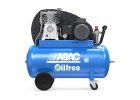
The ABAC Tech ATFS-3 has four oil-free cylinders and direct drive, for 230 or 400 V. It is meant for operations where the air must not contain oil — food production, laboratories, paint shops. We offer more four-cylinder machines; see the overview of four-cylinder air compressors.
100 l screw compressor
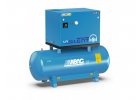
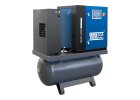
The ABAC CROSS CRS-4/10-100 is a 4 kW screw machine with an inverter that matches motor speed to demand. Unlike a piston compressor it can run continuously; in its closed cabinet it measures 59 dB at four metres, and it gives the most air of all hundred-litre machines — 495 l/min.
Petrol engine
Two Engine Air machines have a petrol engine and need no electricity — for building sites, remote cabins or work in the field. Both are belt-driven with a wheeled 100 l tank.
How much air a hundred-litre tank holds
When the compressor cuts out at 10 bar and cuts in again at around 6.5 bar, your tools take roughly 350 litres of air from the tank before the machine starts. At a demand of 100 l/min, that is about three and a half minutes of rest. The detailed calculation is in our article on pressure vessels and air tanks.
Neighbouring sizes
The closest sibling is the 90 litre air compressor — the ninety-litre size offers the widest choice, mainly from ABAC. One step up, with more machines for 230 V too, are 150 litre air compressors. You can compare every size in our range of air compressors.
Frequently asked questions
- Which 100 l compressor should I choose for a workshop?
- For longer work, a belt-driven twin-cylinder or a cast-iron machine. If your workshop has no three-phase supply, choose a 230 V version — there are three in the hundred-litre size.
- Is a 100 l compressor twin-cylinder?
- The ABAC A39X and WALTER WK430 are twin-cylinder. The WALTER WK550 has three cylinders, the ABAC Tech ATFS four, and the ABAC CROSS screw compressor has no pistons at all.
- How much does a 100 l compressor weigh?
- From 70 kg for the belt-driven ABAC A39X to 123 kg for the ABAC CROSS screw compressor. All except the screw machine stand on wheels and can be moved around the workshop.
-
 Black Wind piston compressors
-
ATMOS piston compressors
-
Walter reciprocating compressors
-
Piston compressors ABAC
-
Piston compressors ABAC
-
Expert Zero compressors
-
ABAC reciprocating compressors
-
Quiet compressors Super Silent OS
-
INDUSTRIAL TECH compressors
-
CLR reciprocating compressors
-
Combustion compressors
-
Screw compressors
-
Pressure vessels
-
Compressor accessories

Product sorting
List of products

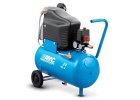
The most common choice for workshops without a three-phase supply. Its 340 l/min air delivery covers a blow gun, a ratchet and a stapler, and the tank holds pressure for short...

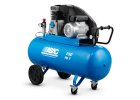
A well-balanced entry-level combination for a single workstation in a smaller workshop: a cast-iron twin with twice the air reserve of the smallest machine, so the motor...

A three-cylinder unit on a compact tank for a workshop where several tools take turns and none of them runs for long. Its 440 l/min air delivery handles an impact wrench, a blow...

A hundred-litre tank with the fast-running A39B unit. A higher intake than the slow-running version.

A hundred-litre tank with the slow-running A29B unit. The calmest machine in the large class.

The most generous machine of the range on an ordinary socket: a hundred-litre tank, four pistons and 245 l/min. It weighs 76 kg but still has wheels and a handle.

The only machine of the range with a three-phase supply. Otherwise identical to the hundred-litre 230 V version — the same output, noise, weight and dimensions.

Compressor and a hundred-litre receiver in one unit — the smallest package in the CROSS range. 498 l/min at 10 bar; the variable speed drive holds pressure steady, so a smaller...