
Professional air compressors
A professional compressor is built for everyday work in a workshop, car repair garage, paint shop or production plant. There are 660 such machines, the majority of our range: belt-driven piston units, screw units for air use throughout the shift, oil-free scroll units and engine-driven machines.
#showmore#
Piston or screw?
For intermittent air use — a workshop, a garage, a paint shop — a belt-driven piston machine with a large tank pays off; for an overview, see our piston air compressors. Where a machine or a production line draws air for the whole shift, a screw compressor is more economical.
By type of operation
Workshops and car repair garages
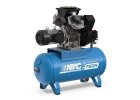
Belt-driven ABAC Pro Line twin-cylinder machines and the cast-iron ATMOS Perfect and WALTER, most often on a 270 or 500 l tank, for 230 or 400 V. For a 230 V socket there are 65 machines up to 2.2 kW. One hundred and fifty-one professional machines have wheels, so they can be moved around the workshop.
Production and continuous air use
Three hundred and forty-three screw machines from 2.2 to 315 kW: 207 with an inverter that adapts output to demand, and 113 machines of all types with a built-in dryer. The SCR, ATMOS, WALTER and ABAC ranges are grouped together under screw compressors.
High pressure and oil-free air
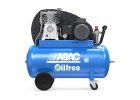
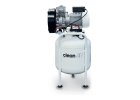
Two-stage machines up to 15 bar and 93 oil-free machines for the food industry, laboratories and surgeries — among them 21 scroll compressors and 32 oil-free SCR screw compressors.
Air treatment
Besides the compressor, a professional operation needs clean, dry air: a condensate separator, filters and a dryer. Where to fit them in is described in our guide Compressed air distribution. Compressors for operations of every size are in our overview of air compressors.
Frequently asked questions
- What is the difference between a professional and a semi-professional compressor?
- Semi-professional machines are smaller direct-drive units for a 230 V socket, up to 2.2 kW; professional ones usually have a belt, a bigger tank or a screw pump, and can handle daily use. The smaller machines are among our semi-professional workshop air compressors.
- Are there professional compressors with a combustion engine?
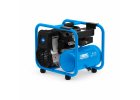
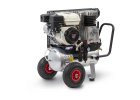
- Twenty-two Engine Air machines — eighteen petrol and four diesel — for building sites and work without mains power.
-
 Black Wind piston compressors
-
Atmos reciprocating compressors
-
Walter reciprocating compressors
-
Piston compressors ABAC
-
Piston compressors ABAC
-
Expert Zero compressors
-
ABAC reciprocating compressors
-
Quiet compressors Super Silent OS
-
INDUSTRIAL TECH compressors
-
CLR reciprocating compressors
-
Combustion compressors
-
Screw compressors
-
Pressure vessels
-
Compressor accessories

Product sorting
List of products

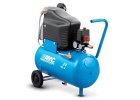
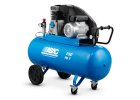
The most powerful single-stage machine in the range: A39B with 3 kW on 400 V, 486 l/min at 1,300 rpm, 10 bar, 90 l tank on castors, 94 kg. Regulator, two gauges, DN 7.2 quick...


Innovative and economical small screw compressor for up to 50% energy savings. Maximum output 950 l/min at 10 bar. Continuous speed control by inverter, direct 1:1 lossless...


The smallest pump in the A series. Suits smaller workshops where the compressor runs intermittently — blowing down, inflating and light air tools.


The highest-output single-stage pump in the range. For a workshop in daily use where one tool follows another.


The best output-to-input ratio in the range: 8 % more power than the 3 kW but 59 % more air. 510 l/min, same enclosure and weight.


Two-stage A49B pump with 2.2 kW on 400 V: 444 l/min at 1,050 rpm, 11 bar, 150 l tank on castors, 114 kg. Intercooler, aftercooler, regulator, DN 7.2 quick coupling; 91 dB Lwa /...

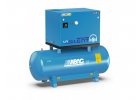
The smallest pump in a sound canopy. 64 dB(A) instead of 71, a 30 l receiver inside, 68 kilos.


A two-stage pump on the A-series pulley — the step between workshop and industrial duty. Higher pressure than the single-stage pumps and more efficient compression.

The entry-level two-stage pump of the B series. For duty where the compressor runs most of the shift and consumption is steady.
