

Tire inflation is part of basic vehicle maintenance – correct tire pressure increases driving safety, extends tire life, and reduces fuel consumption. However, from 2025, there is a major legislative change regarding tire inflators. The original Directive 86/217/EEC is expiring, and the new standard for tire inflators EN 12645:2014 is coming to the forefront. In this article, we will clearly summarize the differences between the original regulation and the new standard, explain what these changes mean for users (from tire shops to regular drivers), and advise on how to choose a suitable calibrated tire inflator. Finally, we will recommend several specific models from our range.
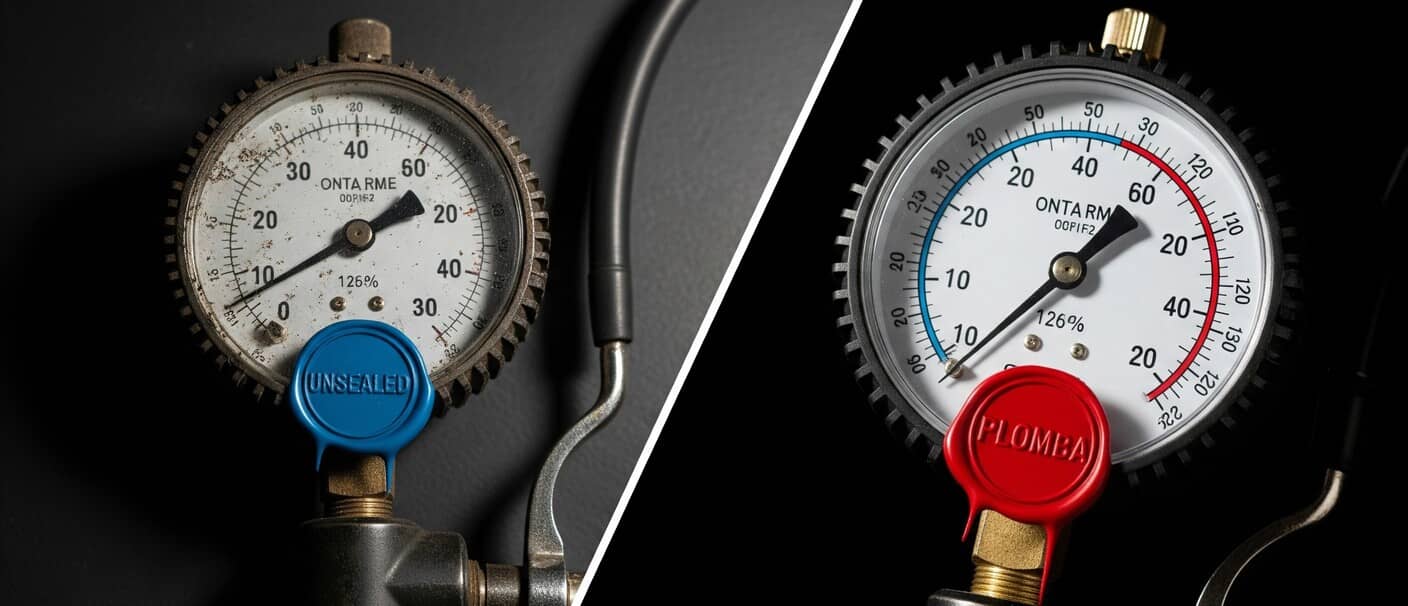
Directive 86/217/EEC – original legislation (until 2025)
Directive 86/217/EEC was European legislation in force since 1986, which set out metrological and technical requirements for tire pressure gauges (tire inflators). According to this directive, tire inflators had to undergo type approval and verification (calibration) to obtain the so-called EC mark of accuracy. The directive specified, for example, measurement accuracy in different pressure ranges, structural robustness, and the readability of the pressure gauge scale. If a device met all requirements, it could bear a conformity mark (certificate according to 86/217/EEC), and EU member states were required to recognize such a measuring instrument for use.
The existing directive contributed significantly to the unification of tire inflator quality across the EU, but technological progress and practical experience showed a need for an update. Directive 86/217/EEC has effectively served its time – it was gradually labeled as obsolete, and by EU decision, its validity ends by 2025. This means that the requirements of this directive will no longer be binding and are being replaced by a more modern standard. For users, this practically means transitioning to new standards of accuracy and control for pressure measuring instruments.
@KATEGORIE@(/pneuhustice-a-prislusenstvi/)(20,random)(slider)
New standard EN 12645:2014 – higher demands and sealing of devices
The new European standard EN 12645:2014 defines current metrological and technical requirements for tire inflators (pressure gauges for tire inflation). The standard takes into account modern designs (including digital devices) and emphasizes even higher accuracy and reliability of pressure measurement. Compared to the original directive, it brings several important innovations:
-
Accuracy and categorization: EN 12645 specifies measurement accuracy in detail for various pressure ranges and device types. Tire inflators are divided into categories based on the type of use (pressure inspection, inflation/deflation, etc.), and the standard sets metrological deviation limits for each category. Thanks to this, the user is assured that a calibrated device meeting EN 12645 provides truly reliable pressure values throughout the entire working range.
-
Modern testing methods: The standard introduces uniform testing procedures for verifying tire inflators, including tests for durability and measurement repeatability. It takes into account environmental influences (temperature, humidity) and, for example, the use of nitrogen instead of air in tires. Overall, EN 12645 reflects real-world operating conditions better than the old directive.
-
Mandatory sealing of the device: One of the most visible changes is the requirement to seal the gauge after calibration. Standard EN 12645 requires that every professional tire inflator has a calibrated manometer fitted with a lead seal, which prevents unauthorized tampering with the settings and ensures calibration stability. This requirement practically means that after official verification (certification) of the device, sealing is performed – if anyone tries to interfere with the manometer mechanism or adjust it, the seal will be broken. The user can thus easily tell if the gauge has been unauthorizedly tampered with. Sealing increases the credibility of the device, especially in commercial use (e.g., at gas stations, in car services), where an officially verified instrument is required.
Standard EN 12645:2014 was introduced several years ago, but from 2025 it becomes the reference standard. Tire inflators manufactured or newly verified for professional use must comply with this standard. For manufacturers, this means adjusting inflator designs to allow for sealing and long-term calibration stability. For users (operators), it means purchasing equipment that bears the EN 12645 conformity mark; otherwise, it may not pass mandatory inspections.
What do the changes mean for tire inflator users?
Obligations for tire shops, workshops, and gas stations
If you operate a tire shop, car service, or offer public tire inflation (for example, an inflator stand at a gas station), the new requirements apply directly to you. In the Czech Republic (and similarly across the EU), a tire inflator for commercial inflation is considered a regulated measuring instrument under metrology law. Practically, this means that the tire inflator pressure gauge must comply with standard EN 12645, be officially calibrated and sealed, and be subject to regular inspection. After the introduction of the new standard, you are obliged to ensure:
-
Use of certified devices: Inflators that do not meet EN 12645 should not be used in commercial operations. Older tire inflators can be additionally verified (if their design allows), but it will often be easier to acquire a new EN 12645 calibrated tire inflator. This will come with initial verification and a seal.
-
Regular verification (calibration): Tire inflator calibration is not a one-time matter. It must be repeated within legally defined periods – usually every 2 years. During verification, an authorized metrological center tests the accuracy of the device and renews the seal. Invalid or expired verification can lead to fines during inspections from the relevant Metrology Institute.
-
Record keeping: You should receive a verification certificate for the verified tire inflator. Keep this for inspection purposes. Furthermore, it is advisable to track verification dates and plan recalibration in time before expiration.
For professional operations, the change in legislation means the necessity of investing in high-quality gauges and adhering to calibration intervals. The good news, however, is that modern certified inflators are very accurate and durable, contributing to a better reputation for your service – customers will see that you use a calibrated gauge with a valid seal, so the measured pressure values are trustworthy.
What about regular drivers and home use?
For the average motorist who inflates tires at home with a portable compressor or at a gas station, the obligations do not change directly – the law does not require them to have a certified device at home. Home tire inflators or small compressors for hobby use can continue to be used without official calibration. Nevertheless, the positive effect of the new standard will be felt indirectly: public pressure stands and service workshops will keep their gauges accurate, so drivers can rely on the values they measure at the station or in the shop.
Even for home use, however, it is recommended to use a quality inflator with an accurate manometer. Calibrated models are not reserved only for service shops – if you are serious about car maintenance, you can get a calibrated tire inflator for your own garage. It is slightly more expensive than basic cheap inflators, but you have the assurance of accuracy. At a minimum, ensure that the home inflator shows pressure as accurately as possible (ideally with a max. deviation of ±0.1–0.2 bar) and check its functionality (by comparing it with a reference gauge or occasional testing in a service shop).
Summary: While for hobby users, calibrated inflators are more of a recommendation for peace of mind, for professionals, they are a legal necessity from 2025. Standard EN 12645 ensures that tire pressure is measured reliably and uniformly – this contributes to road safety and fair services.
Recommended tire inflators meeting the new standard (and who they are for)
@KATEGORIE@(/pneuhustice-en-12645-2014/)(5,random)(slider)
In the e-shop Kompresory-Vzduchotechnika.cz, you will find a wide selection of tire inflators and accessories – from basic models for the home to top-tier devices for continuous operation. Below we recommend several specific tire inflators in accordance with the standard, including tips on which purposes they are best suited for. (All listed models can be found in the category Tire Inflators and Accessories.)
-
TG-03A Digital Tire Inflator – for home use and hobby workshops: An affordable and easy-to-use inflator with an electronic display. Thanks to digital measurement, it allows for very precise pressure reading (resolution of 0.05 bar) and unit switching (bar/PSI/kPa). It is suitable for motorists who want to check the tire pressure of cars, motorcycles, or bicycles themselves with better accuracy than cheap analog inflators offer. For home use, the TG-03A is an ideal choice – offering modern features at an affordable price.
-
TG-63D Tire Inflator (Double-sided) – for tire shops and truck services: A robust analog tire inflator with a 63 mm diameter manometer, specifically designed for inflating dual tires on trucks, buses, or vans. It has a double-sided inflation valve on an extended attachment, so you can easily fit it onto both the inner and outer valves of dual-wheel setups. Thanks to its durable metal construction, it withstands daily use in the workshop. The TG-63D is ideal for car services and transport companies – it allows for quick and convenient inflation of all vehicle types, including those with dual wheels. The device can be calibrated according to EN 12645 (for use as a verified gauge in a tire shop) while maintaining a favorable price.
-
TG-80C Calibrated Tire Inflator – for professional tire shops and gas stations: A professional inflator with a large Ø80 mm manometer, characterized by excellent clarity (double scale bar/psi) and high accuracy. The TG-80C meets the requirements of standard EN 12645:2014 from the factory and is supplied with certification (stamp) – it is thus ready for immediate use in commercial operations as a verified gauge. A seal confirming calibration is placed on the body of the device. We recommend this model for tire shops, car services, and gas stations, where fast and reliable tire inflation for customers is key. Thanks to high-quality workmanship (metal body, rubber protective gauge cover), it withstands rougher handling in the workshop.
-
SB-3130 Digital Tire Inflator – for demanding car services and fleet operations: A top-of-the-line digital tire inflator from the M7 brand (SB-3130 series) designed for intensive professional use. This model is popular in car services and among fleet operators who require fast service and flawless accuracy. The SB-3130 features a durable body and a clear backlit display showing pressure in up to three different units (bar, PSI, kPa). It also allows for setting a target pressure with automatic shut-off once the value is reached, speeding up work. Official calibration according to EN 12645 is a matter of course – thanks to its robust construction and high-quality sensors, the device maintains stable measurements. This digital inflator will be especially appreciated by high-volume tire shops, bus fleet service centers, or car dealerships where precision and efficiency are paramount.
All the models listed above meet or exceed the requirements of standard EN 12645 and can be officially verified. When choosing a tire inflator, always consider what purpose you need it for and how often it will be used. For occasional home inflation, a simpler device is enough, while for professional services, it pays to invest in a calibrated and durable device. You can find the complete range, including other accessories (replacement hoses, valve connectors, manometers, etc.), in the e-shop category Tire Inflators.
Conclusion
Standard EN 12645 brings modern order to the world of tire inflation – it refines and unifies requirements for tire inflators and increases the credibility of measurement by introducing sealing. For service operators, it means certain additional obligations (acquiring certified equipment and regular calibrations), but ultimately it leads to higher quality services for customers. For regular drivers, the change in legislation does not cause worries; on the contrary – they can rely on the fact that pressure at pumps and in workshops is measured with correctly calibrated instruments.
When purchasing a new inflator, ensure it is a calibrated tire inflator meeting the current standard. In our e-shop, we offer verified models that will prepare you for the changes in legislation and ensure accurate tire inflation for years to come. Road safety starts with the correct tire pressure – and with a quality tire inflator, you have that fully under control.