
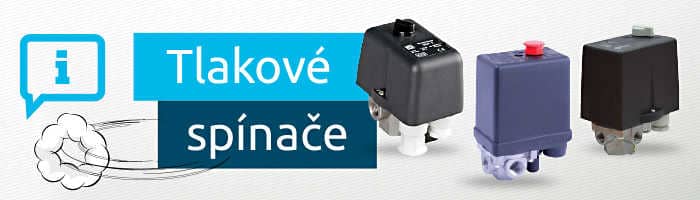
- What is a pressure switch used for in a compressor
- How a pressure switch works
- How to use a pressure switch to control a compressor
- Adjusting pressure switches
What is a pressure switch used for in a compressor
Air compressed by the compressor piston is forced into a pressure tank, also known as an air receiver. The pressure switch ensures that the compressed air in the receiver has the pressure we need. It works simply: the pressure switch monitors the pressure in the receiver, and as soon as the pressure drops below the set lower limit, the switch closes and connects the electrical circuit. This starts the electric motor driving the compressor. Once the pressure rises to the set upper limit, the pressure switch opens and the compressor stops. Due to consumption or temperature changes, the pressure in the receiver drops again. When the pressure goes below the set lower limit, the switch turns the compressor back on. And so it goes on and on.
@KATEGORIE@(/tlakove-spinace/)(10,random)(slider)
The pressure switch thus starts and stops the compressor so that the pressure in the receiver is always within the range of two set pressure values:
- cut-in pressure – the lower pressure limit at which the compressor turns on
- cut-out pressure – the upper pressure limit at which the compressor turns off
The difference between the cut-in and cut-out pressure is called hysteresis or switching differential. You can find this value among the parameters of pressure switches.
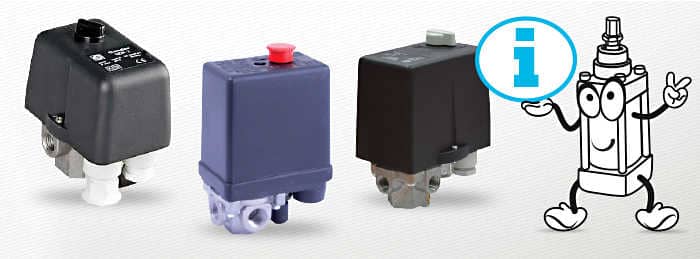
How a pressure switch works
A pressure switch, or pressurestat, is a device that switches an electrical circuit depending on the pressure level. The switch has two basic components:
- Pressure measurement sensor – a flexible element, e.g., a membrane equipped with strain gauges. Air pressure causes the membrane to deflect, changing the electrical resistance in the gauges. Since the gauges are connected to a measuring bridge, the pressure level can be determined based on the electrical signal.
- Electrical contacts, which connect or disconnect the electrical circuit according to the measured pressure.
Normally open, normally closed, and changeover contacts
According to function, we distinguish switches with normally open, normally closed, and changeover contacts. When choosing a switch, we can be guided by the symbol indicating the switch function:
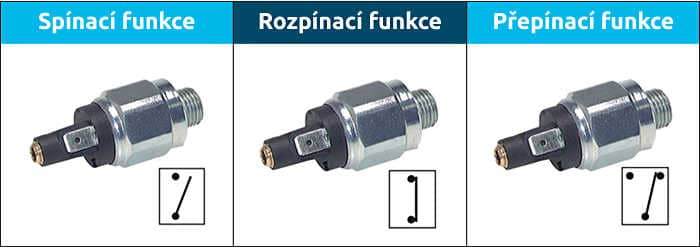
Normally open (NO) contact is open in the idle state, i.e., at low pressure (the electrical circuit is disconnected and the compressor is not running). The contact closes (starting the compressor) only when the pressure reaches the set value.
Normally closed (NC) contact is closed in the idle state, i.e., at low pressure (the electrical circuit is connected and the compressor is running). The contact opens (stopping the compressor) as soon as the pressure reaches the set value.
Changeover contacts work by switching from one contact to another. The advantage is that this switch is universal. If you are not sure which type of switch you need, get a switch with changeover contacts and use one or the other contact.
A switch with changeover contacts can also be used for fault detection. In one position, fault-free operation is signaled, and this contact can light up a green light. In the event of a fault, the switch toggles to the second contact, which lights up a red light.
@KATEGORIE@(/tlakove-spinace--elektromechanicke-42v-5a/)(10,random)(slider)
How to use a pressure switch to control a compressor
To control compressors, either simple and inexpensive pressure switches or robust, expensive switches designed for this purpose can be used.
a) Using simple switches
e.g., DRS series electromechanical pressure switches for 42 V/5A
I. Single pressure switch with normally closed contact

A simple solution utilizes a pressure switch with a normally closed contact. At low pressure, the contact is closed, so electricity flows to the motor, which turns the compressor. The pressure in the receiver rises until it reaches the set upper limit (cut-out pressure). The switch opens and the compressor stops. The air pressure then gradually decreases due to consumption. When it drops to the lower limit (cut-in pressure), the contact closes again, the compressor starts, the receiver is refilled, and the switch opens.
As is often the case, this simple solution also has its limitations:
- It is only suitable for low-power compressors because the contacts of simple switches cannot handle high current loads.
- The switching differential (difference between cut-in and cut-out pressure) may be too small. We might find that the compressor constantly turns on and off, even without consuming any air. Heated air from the compressor goes into the receiver, and as it cools, the pressure can drop enough that a switch with a small differential restarts the compressor. In simple pressure switches, the differential cannot be adjusted and is usually 15 to 20%.
II. Pressure switch with power relay
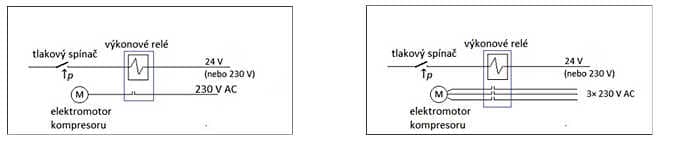
We can handle the compressor power limitation by connecting a pressure switch with a power relay or contactor. Relay contacts are designed to handle larger loads. This way, we can switch even high-power compressors. The diagram on the left shows single-phase motor wiring, and the diagram on the right shows three-phase motor wiring.
By connecting a power relay, we gain higher current capacity, but we are still unable to adjust the switching differential.
III. Pair of pressure switches with relay in self-holding circuit
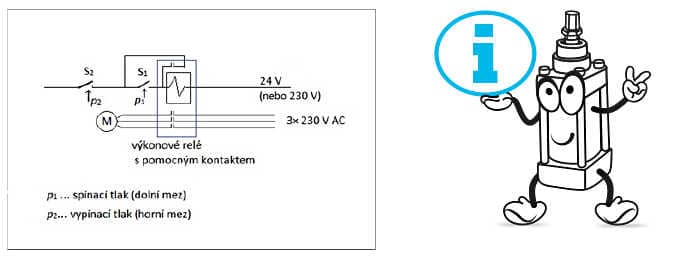
By connecting two pressure switches according to this diagram, we solve both limitations: the current capacity of contacts for high-power compressors and the adjustment of the switching differential.
How does it work?
Pressure sensor S1 has the cut-in pressure set at the lower limit of operating pressure p1 and starts the compressor motor.
Pressure switch S2 has the cut-out pressure set at the upper limit of operating pressure p2 and stops the compressor motor.
The switching differential is set as the difference between cut-in pressure p1 and cut-out pressure p2.
When the pressure in the receiver drops below the lower limit p1, switch S1 closes and the motor starts the compressor. The pressure in the receiver rises, and once it reaches the lower limit p1, switch S1 opens, but the compressor keeps running thanks to the bypass created by the relay with an auxiliary holding contact. However, as soon as the pressure rises to the upper limit p2, the second pressure switch S2 disconnects the entire circuit and the compressor stops.
The relay can have either one power contact for a single-phase motor or three power contacts for a three-phase motor, as shown in our diagram.
b) Robust pressure switch for compressor control
For controlling powerful compressors, more robust and expensive pressure switches are suitable. These switches offer the following advantages:
|
 |
- They have built-in thermal motor protection.
- If overloading or phase failure occurs, a three-phase motor could fail to start and risk burning out. In this case, thermal protection blocks the motor from starting.
Adjusting pressure switches
When purchasing a pressure switch, it is always necessary to check at what pressure it cuts in and out. If the setting is unsuitable, it must be changed. For this purpose, switches have a control element, usually an adjusting screw. A second adjusting element is found on switches with an adjustable differential.
Adjusting elements are either equipped with a calibrated ring or a slider showing pressure values. Most often, however, the switch has a screw without an indicator, so the current setting is initially unknown. To adjust the switch, a pressure gauge must be connected to the receiver to monitor pressure changes.
Adjusting the compressor cut-out pressure
The adjusting screw is generally designed so that turning right increases the cut-in and cut-out pressure, and turning left decreases them.
- Fill the receiver using the compressor and observe the pressure gauge to see when the switch opens (stops the compressor). This identifies the upper limit (cut-out pressure).
- Drain the receiver and see at what pressure the compressor restarts. This is the lower limit (cut-in pressure).
- If the setting is unsuitable, slightly change the position of the adjusting element, drain the receiver, and repeat the test.
- Repeat the process until the desired cut-out and cut-in pressures are reached.
Adjusting the switching differential
For switches with a fixed differential, you must rely on the percentage value (usually 15 to 20%). If you set the upper limit (cut-out pressure), the lower limit (cut-in pressure) will be 15 to 20% lower.
On robust and more expensive switches, there is a second adjusting screw to set the switching differential.
- First, set the cut-out pressure as described above and determine the cut-in pressure by draining the receiver.
- If the difference between cut-in and cut-out pressure is unsuitable, slightly turn the differential screw and check the change.
- Repeat until you reach the desired differential.
Note: Adjusting the differential usually shifts both limits (cut-in and cut-out). Therefore, they must be checked and readjusted if necessary.
Using a pressure regulator
If you have a pressure regulator available, you don't need to fill and drain the entire receiver. Connect the regulator to the pressure switch and use it to adjust the cut-in and cut-out pressures. Then connect the switch to the receiver and verify it works correctly. Pressure regulators are usually equipped at special workstations for adjusting pressure switches.