

Do you demand a precise result when applying paint? Let's forget about the brush and the tin; in this article, we will analyze the selection of spray guns and their main categories in detail. Since we are a compressed air shop, we will focus on guns powered by air from a compressor. This is the most widespread solution and still the best in terms of price-to-performance ratio for both hobby DIYers and professional painters.
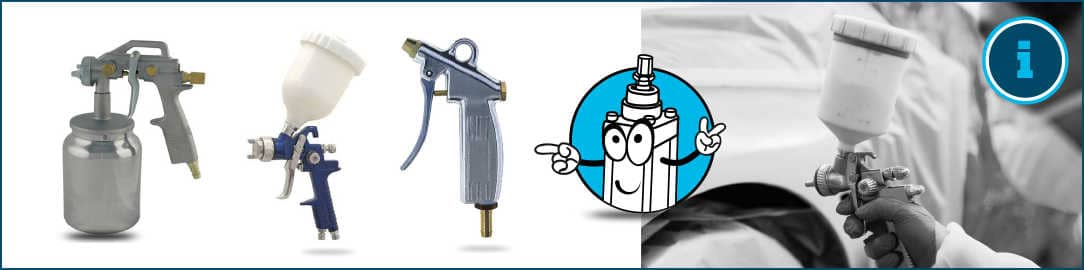
The system for spraying paint with the help of a compressor is simple - compressed air produced by the compressor travels through a hose into the spray gun, where it mixes with the paint from a cup that is part of the gun and is then discharged through a nozzle. Standard guns work with pressures up to 6 bar, low-pressure ones up to 2.5 bar, and HVLP guns then up to just 0.7 bar. We will explain what HVLP means in the section on gun classification. We should add that we may also encounter a less common, yet capable method for thick paints involving paint delivery to the gun via a low-pressure pump or a tank. Unless you are spraying paint by the gallon, this more expensive variant will likely not interest you.
Classification of guns by pressure
- High-pressure (conventional guns that have higher overspray due to high air pressure at the outlet)
- Low-pressure (exhibit lower overspray thanks to lower outlet pressure, high air consumption)
- HVLP (lowest pressure, high efficiency, lowest overspray, but also high air consumption)
*HVLP stands for „High Volume Low Pressure“
All guns from the previous classification fall under cup-type spray guns. Generally, this is a simple system where a cup is placed on the gun, from which the paint flows by gravity into the gun body, where compressed air drives it out through the nozzle onto the material. A thin paint consistency is essential for this system to function correctly. Air spray guns can be used for both solvent-based (synthetic) paints and water-reducible paints. Conversely, we do not recommend using air guns for glazes.
@KATEGORIE@(/strikaci-pistole--pro-lakovny-a-remeslniky/)(15,random)(slider)
When to use HVLP?
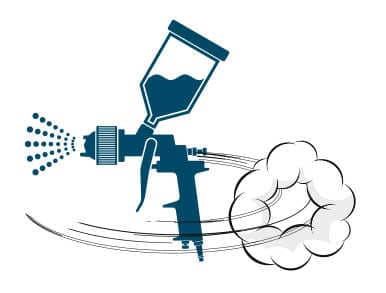
The great advantage of HVLP is undoubtedly the low overspray and thus much cleaner work. It works by having a multi-vane turbine supply the nozzle with a massive rush of air at low pressure.
The result is perfectly atomized material with very fine particles that adhere to the surface of the painted part in a much higher percentage than is the case with conventional guns. By adjusting the nozzle, you then fine-tune the spray pattern, which is ultimately detailed and precise.
What nozzle diameter for a spray gun?
The choice of nozzle diameter is crucial depending on what you plan to paint. It determines the compatibility with the paint types used, so it is good to have an overview.
|
 |
Which system is best for beginners?Since our article is primarily an introduction to the issue of paint spraying, we assume you belong among beginners. So, what equipment to choose for your first experiences? In our opinion, you will do best by starting with a low-pressure gun. A large part of the paint adheres to the surface thanks to low overspray, a modest compressor capacity is sufficient, and the minimal response to pulsation and changes in inlet pressure is pleasing. |