

At first glance, it might seem that choosing a blow gun is completely easy and that no mistakes can be made. However, thinking that all blow guns are the same or similar would be a big mistake. It is precisely for this reason that in many workplaces, we encounter inappropriately selected types of guns, the use of which can often endanger surrounding colleagues or the person using the blow gun themselves.
Due to the mistaken belief that different types of blow guns do not differ fundamentally, this article was created to help you choose the suitable model for your application. The fact that we can encounter quite different models is illustrated by the price range of individual guns in our e-shop. Simple plastic models start at prices in the range of several dozen CZK, while forged models end at the 2000 CZK mark. But do they all blow the same and do they have the same compressed air consumption?
Design
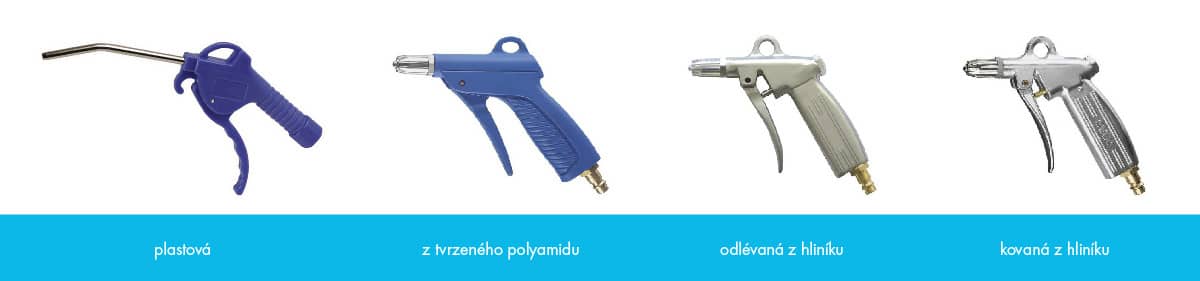
Three most common gun designs appear on the market. The body is usually made of plastic (for example, hardened polyamide), cast aluminum, or forged aluminum (maximum quality and durability). Steel is not used in this case because it would negatively affect the weight of the gun. This metal is used only for certain components that, conversely, must be maximally durable if the gun falls from the work surface to the floor and generally if it is handled roughly. We are talking mainly about the nozzle and the lever, the damage of which would affect the overall functionality of the gun.
To some, the plastic design might seem like a toy for children, but in some cases, it has many advantages. There are applications or spaces restricted by unfavorable temperatures. If the gun body were made of aluminum, this alloy could unpleasantly burn an unprotected hand or, conversely, feel uncomfortably cold. Work safety, as you surely know, in many production areas does not recommend or prohibits wearing gloves that could get caught – for example, in a lathe spindle or on a milling cutter. In such cases, purchasing a plastic product is worth considering, especially if it is exposed to unfavorable temperatures limiting operator comfort.
Guns in a plastic design, of course, do not guarantee such a long service life, especially if they are not handled gently. In a home workshop, this is naturally not a priority, but as soon as it involves use in a production hall, where, for example, castings are blown clean of chips and a poorly hung gun often falls to the floor, the plastic variant should be automatically excluded. At least workers will not constantly have to go to supervisors to request new guns. Let's stay with blowing chips for a moment in the next chapter.

Blow Gun Nozzles
If you stick strictly to a low price point when choosing a blow gun, you might miss out on the option of an interchangeable nozzle. The very cheapest models only feature a pressed-in metal extension that functions as a simple nozzle without any possibility of regulation. As you can guess, guns with interchangeable nozzles are much more practical. By changing the nozzle, you can change the shape of the jet, reduce noise, or protect yourself against flying debris.
Types of Nozzles:
- Standard nozzle (centrally located hole, uniform stream)
- Extended nozzle (straight or curved end, suitable for blowing debris out of hard-to-reach holes – commonly from holes and pockets after milling)
- Safety nozzle with air shield (side drilling divides the jet and creates a protective air shield, preventing small debris from flying back toward the operator; increases air consumption)
- Silenced nozzle (contains a special insert of coiled/sintered bronze inside that separates and slows part of the air flow to reduce noise from 90 down to 70 dB)
- Adjustable nozzle (allows setting the ideal flow for specific applications, thus reducing compressed air consumption costs)
- Flat nozzle (for process blowing in industrial applications; the flow is divided into multiple channels leading to a flat end, most commonly made of plastic)
- Injector nozzle (nozzle with extreme performance thanks to air entrainment from the surrounding atmosphere into the air stream from the gun. Using the suction effect, the air flow is then much larger)
@KATEGORIE@(/ofukovaci-pistole-trysky/)(15,random)(slider)
Levers and Blow Force Regulation
A common nuisance in many workplaces is unnecessarily high air pressure for blow guns. It's the case where the resistance of the gun toward the hand is literally felt when pressing the lever. With these symptoms, it can happen that instead of being blown away, debris is literally scattered throughout the entire workshop or jammed into very inaccessible places. Fortunately, there are several solutions to regulate the blowing. One such solution is a gun with a potentiometer/regulator. You will recognize these types immediately – they have a built-in rotary potentiometer in line with the lever piston, usually located above the handle. Because workshops often save in the wrong places, ordinary blow guns functioning on an on-off principle are the most used despite the advantages of a regulator – they either don't blow at all or blow at full force.
How to Regulate Blow Force in Other Ways?
Another negative effect of inappropriately high pressure is, of course, compressed air consumption and the additional costs associated with it. If the gun or nozzle itself does not have a regulator, we can solve the situation in another elegant way. You can simply connect a regulator to the blow gun inlet. This ensures a constant output pressure, which over time can save thousands of CZK that would otherwise flow through the nozzle. Every regulator states the maximum inlet pressure and the constant outlet pressure (listed as working pressure).
Work Safety of Blow Guns and Alternatives
A blow gun is a simple device that can just as easily injure the operator or surrounding colleagues. Wherever debris is blown under pressure, the operator should wear goggles or a shield, and everyone nearby should be warned. Properly set pressure should prevent the scattering of mechanical debris into a wide area where a chip could endanger someone. Safety nozzles or installing a deflector between the nozzle and the gun also mitigate risks. Even extended nozzles can have a deflector. If risks are still too high, it is worth considering using a brush instead of a blow gun or any other manual cleaning method. It may be time-consuming, but it creates no risk.