


Why is it so important to measure compressed air flow?
Because we can determine:
- compressor performance
- compressed air consumption
- air leaks through gaps
Not all flow is the same
The term gas flow can basically refer to three different quantities:
- velocity flow (m/s) – the mean flow velocity of the measured medium
- mass flow (kg/s) – the mass of air that flows through the pipe per unit of time
- volumetric flow (m3/h) – the volume of fluid that flows through the pipe per unit of time t.
Volumetric flow as a measure of compressor performance
Volumetric flow is found in compressor data sheets and actually indicates the compressor's performance. For small compressors, the unit l/min is used; for large compressors, the unit m3/h (1 m3 = 1,000 l). The image shows a screenshot of the e-shop www.kompresory-vzduchotechnika.cz, where volumetric flow expresses the amount of air sucked in from the atmosphere and the amount of air flowing into the air receiver (filling capacity).
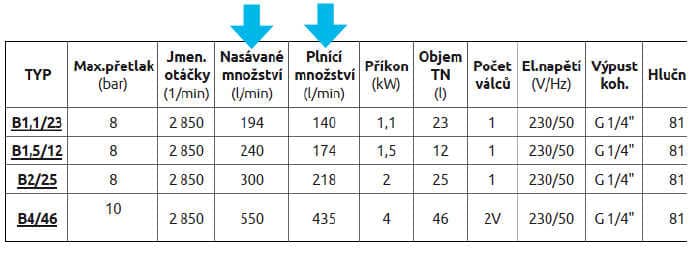
Volumetric flow also helps us compare the performance of individual compressors.
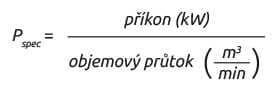
We can calculate the specific power, Pspec – it tells us how many kW are needed to produce a unit volumetric flow of 1 m3/min.
Be careful when comparing volumetric flows – temperature, pressure, and measurement location are also important
Volumetric air flows can only be compared if they are referenced to the same pressure and the same temperature. Therefore, we must be careful about the conditions under which the given flow value applies.
Conversion to standardized conditions
Flows and quantities of gases can only be compared if they are converted to standardized conditions, pressure, and temperature. However, two standards are used.
Standardized conditions for volumetric flow:
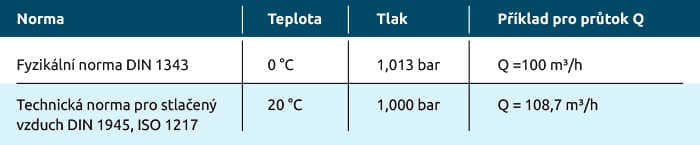
The difference between the two flows at two different standardized conditions is 8.7%. Are you measuring volumetric flow under conditions that differ significantly from the standardized ones? Only after conversion can you infer the amount of sucked gas, consumed gas, or the amount of leaked gas due to gaps.
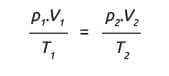
p = absolute pressure in bars, V = volume, T = absolute temperature in K (absolute temperature in K = temperature in °C + 274.15).
Properties of gases according to the equation
An important property of gases is that their volume increases with temperature – this is used, for example, in hot air balloons. The simplest description of these properties and the resulting behavior of gases is the ideal gas law:
p.V = m.R.T
where p is pressure, V is volume, m is mass, R is the gas constant, T is the absolute temperature in K (absolute temperature in K = temperature in °C + 274.15)
The equation implies that volume (measured e.g. in cubic meters) and gas density will change with pressure and temperature, but its mass (in kilograms, pounds, etc.) will not change (law of conservation of mass).
What happens during air compression
During compression, pressure and density increase and air volume decreases. Mass remains unchanged – the law of conservation of mass applies to it.
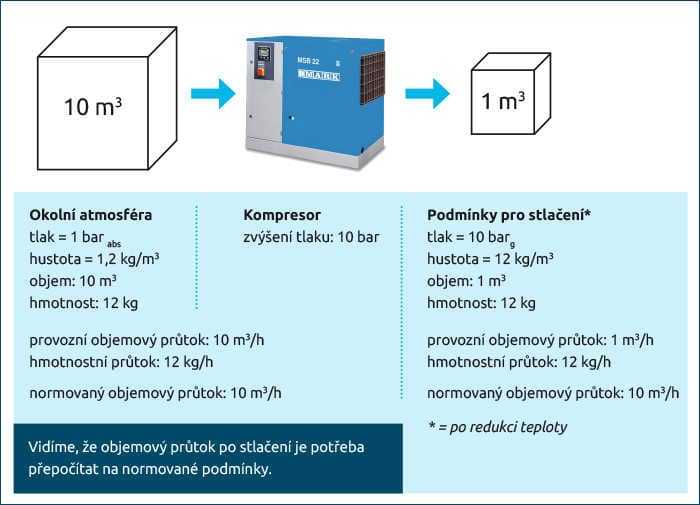
Air mass therefore remains the same. What does this mean for flow measurement?
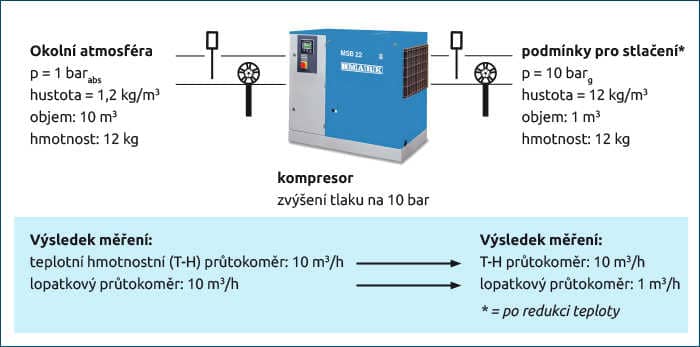
The image shows the difference between measurement with a mass meter and a volumetric meter:
- A thermal mass flow meter determines flow based on mass and always shows the same value regardless of temperature and pressure.
- A vane flow meter measures the flow velocity, which is converted to volumetric flow based on the pipe dimension. The measured value must be converted to standardized conditions.
Flow Measurement Methods
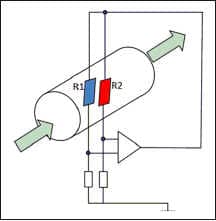
a) Mass Flow MetersThe advantage of these flow meters is that they directly measure mass flow independent of pressure and temperature, so there is no need for conversion. Thermal Mass Flow MetersA sensor consisting of two platinum resistors is installed in the air stream:
|
 |
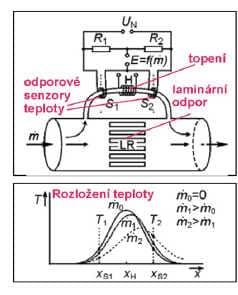
Calorimetric Flow MetersAir heating in the section between two resistance temperature sensors S1 and S2 is measured in the bypass channel of the heated channel. The heat source H is placed in the center of the channel.
|
 |
Coriolis Flow Meters
Coriolis flow meters also belong to mass meters. They also directly measure mass flow by detecting the phase shift of movements of forcibly oscillating measuring tubes. These are precise and expensive instruments.
b) Velocity Flow Meters
These measure the air flow velocity. Volumetric flow can be calculated from velocity based on the cross-section of the pipe where the measured medium flows.
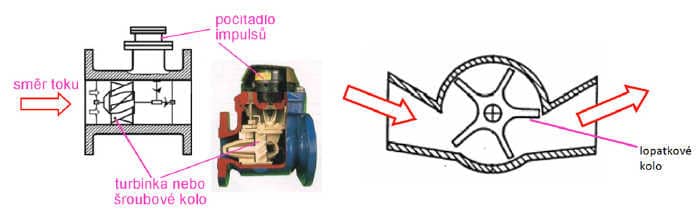
Turbine and Vane Flow Meters
- flowing air rotates a turbine, vane, or screw wheel
- rotation speed is proportional to the mean flow velocity
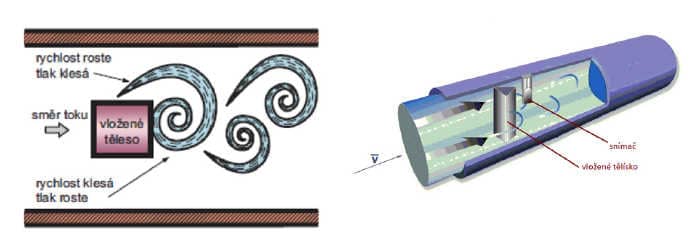
Vortex Flow Meter
An object is inserted into the pipe, causing a change in pressure and velocity. The induced change is sensed, for example, by a piezoelectric or capacitive differential sensor and converted into an electrical signal. The object in vortex flow meters can have various shapes and mountings.
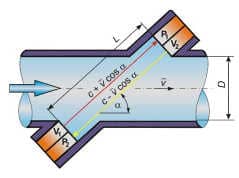
Ultrasonic Flow MeterFlow velocity affects how fast ultrasonic waves propagate in the flowing medium.
|
 |
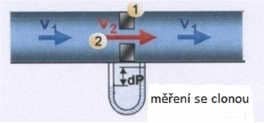
Differential Pressure Flow Metersa) Measurement with an orifice plate:
|
 |
b) Measurement with a probe
|
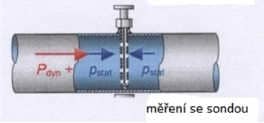 |
The measurement assembly consists of several elements:
- throttling device – orifice plate, nozzle, Venturi nozzle, Pitot tube
- differential pressure gauge – sensing the pressure difference across the throttling element
- manifold – allows connection of the differential pressure gauge, flushing, and venting of the signal lines
There are also compact meters on the market equipped with an orifice plate, valve connection, differential pressure sensor, and intelligent transmitter.
Flow Meter Installation – Selecting a Suitable Location
|
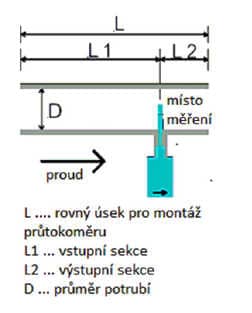
Select a straight section without fittings for flow meter installation, where there must be no turbulence. In the image we see:
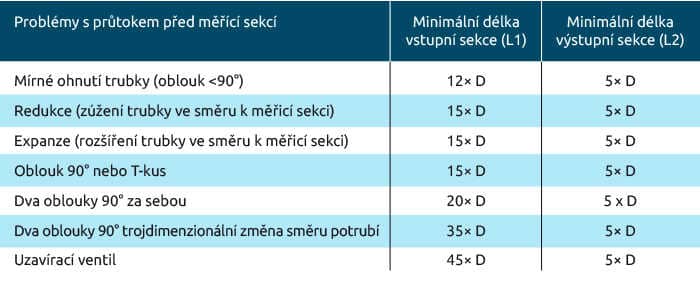
The minimum length of the outlet section L2 should usually be five times the pipe diameter, L2 = min. 5× D. The minimum length of the inlet section L1 varies for individual flow meters:
|
 |
The inlet section must be longer, up to 50× D, if an valve is installed on the pipe or if there is a bend or narrowing on it.
Always check the equipment documentation for the lengths of sections before and after the measurement point. Example of detailed instructions for thermal mass flow meters:
Flow Meter Installation – Creating a Measurement Point
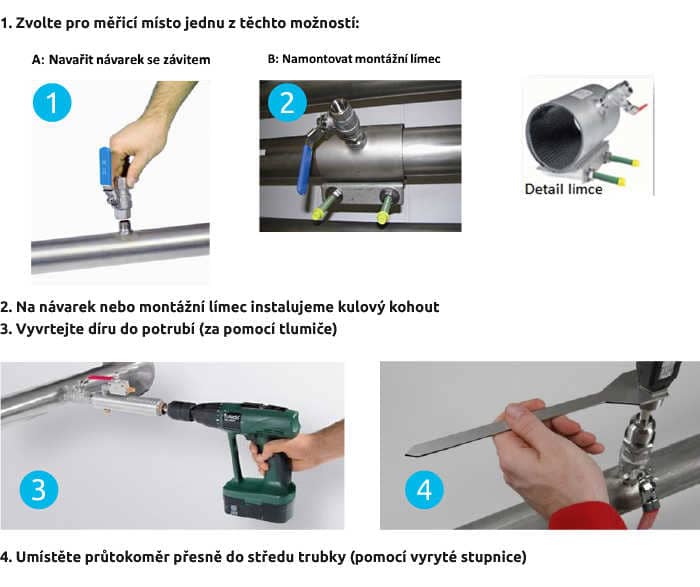
A measurement point must always be created for the flow meter. You can find a detailed description of how to create a measurement point in the instrument documentation. Here is an example of a thermal mass flow meter measurement point:
1. Choose one of these options for the measurement point:
Calibration of Flow Meters
Flow meters used for commercial purposes must be calibrated according to the metrology law.
In calibration laboratories, they verify using a more precise meter whether the flow meter's accuracy is satisfactory.