


Inside screw compressors, two interlocking screws roll against each other, and they will run smoothly only if they are well lubricated. Therefore, oil is injected directly into the compressed air. It is necessary to carefully consider which oil to choose for our compressor.
In places where oil-free types of screw compressors are running, it is sufficient to lubricate only the external parts (bearings, pins, guides).
Standard lubricated screw compressors are lubricated by injecting oil into the screw block.
Oil has three important tasks:
- to lubricate all friction surfaces,
- to dissipate the heat generated during air compression,
- to seal the moving surfaces of the compressor.
The Oil's Journey Through the Compressor
Injected oil flows along with the air between the screws. There, the air mixed with oil is compressed and also heated. The oil must then be separated from the air; therefore, the air proceeds into the separator where the heated oil is removed. Finally, the oil is cooled and returned to the circuit.
What Oil is Suitable for a Screw Compressor?
It is important to always use oil designed specifically for screw compressors. Never reach for whatever oil you happen to have on hand, such as oil for pneumatic tools, piston compressors, and certainly not oil for internal combustion engines.

If you decide to change the oil in the compressor for a different type, first clean the compressor of the old oil and flush it with the new oil. Mixing different lubricants from different manufacturers is generally not recommended.
Mineral or Synthetic?
Mineral oil is commonly used in screw compressors, but for more demanding operations, semi-synthetic or synthetic oil can be used.
Before deciding on a type of oil, find out:
- How many operating hours per year will the compressor be in use?
- Under what conditions will the compressor work: ambient temperature, dust levels, vibration, etc.
- Will the compressor be working in a food processing facility?
ROTAIR Oils
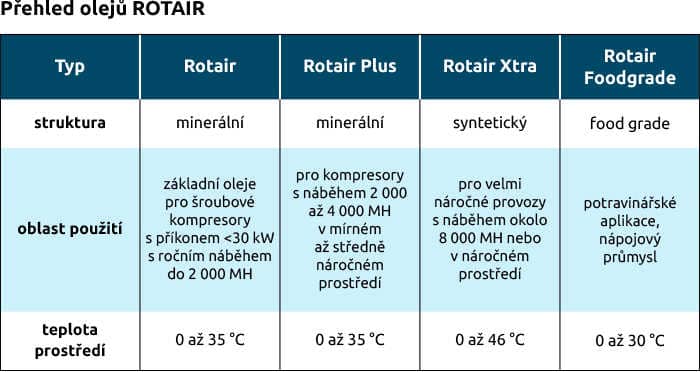
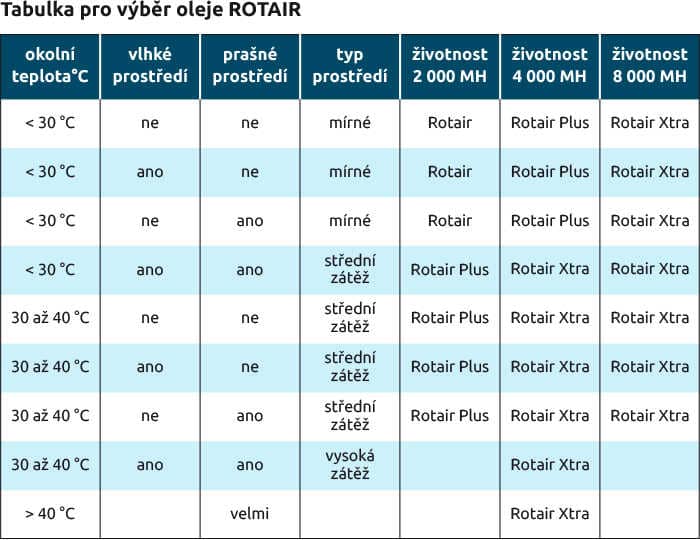
ROTAIR brand oils for screw compressors are produced in four types for different operating conditions. You can easily find the oil according to your requirements in the tables.
Lifespan of Rotair Oils Based on Temperature Impact
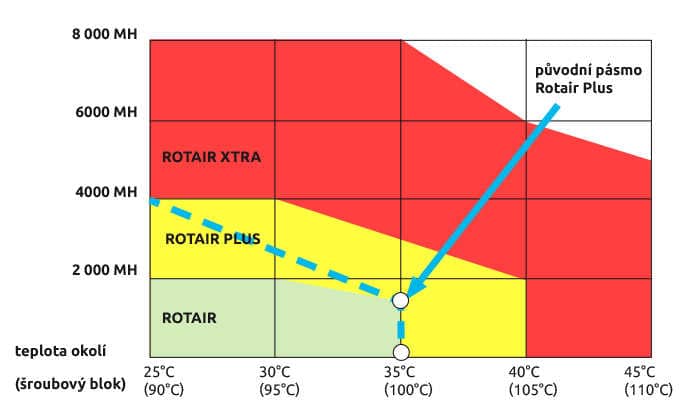
The oil in the compressor heats up from the compressed air. High temperatures are not very beneficial for oils, especially mineral oils, which degrade sooner and must be replaced. The graph shows that Rotair type oil can be used for ambient temperatures only up to 35 °C, while Rotair Plus can now be used up to 40 °C. For Rotair Plus oil, temperature resistance has been successfully improved. The graph shows that it was not as resistant previously.
If temperatures in your operation reach more than 40 °C, it is necessary to opt for Rotair Xtra synthetic oil. With this, the compressor will run long-term without failures.
What Happens to the Oil During Operation?
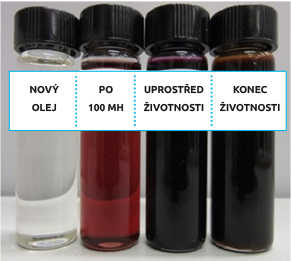
The oil that lubricates the compressor changes color during its lifespan, signaling that the moment to change the oil is approaching.
Why Does Oil Change Color?
Due to impurities: both ambient contaminants and, primarily, particles created by wear in the screw block get into the oil. A major enemy of oil is water, which can penetrate it. Water significantly accelerates oil degradation.
Due to oxidation: Oil oxidizes when exposed to the effects of air. Impurities in the oil, especially metallic ones, further accelerate oxidation. Synthetic oils have better resistance to oxidation than mineral oils.
Approximate Color Indication for Rotair Plus OilThe color of the oil provides a hint about its condition in the compressor.
The color indication is for guidance only. |
 |