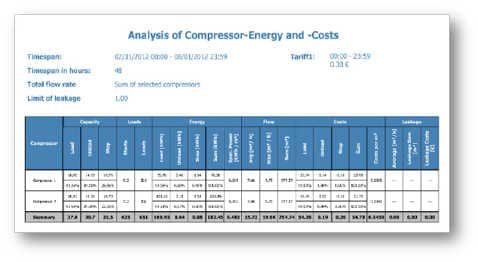


- Energy analysis of compressed air production shows how much energy compressors consume
- Methods of measuring compressor consumption
- Software modules provide an overview of consumption
In terms of electricity consumption, compressors are nearly insatiable; therefore, it is necessary to limit these "gluttons" as much as possible. A good way is to measure consumption directly on individual compressors. Only then can we find out what portion of the total factory consumption is attributed to compressed air production.
Energy analysis of compressed air production shows how much energy compressors consume
The first step toward better economy is to find out how much compressed air production costs us and where savings can be made. A company can perform the energy analysis itself or hire a specialized firm for such a service.
What measurements are necessary for an energy analysis?
|
 |
Methods of measuring compressor consumption
1. Basic current measurement on a single phase – for monitoring compressor operation
|
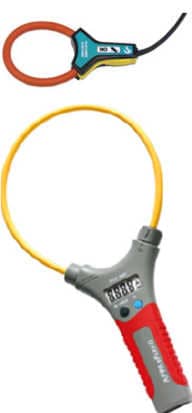
A current probe (TRMS AC meter) measures electrical current on only one phase and is very easy to use: We simply clamp it around the cable of one phase of the electric motor. It is not necessary to turn off the compressor for a long period; we only remove the cover and place the probe. The compressor can then be restarted immediately. This indicative measurement is ideal for monitoring compressor operation. Based on the current magnitude in one phase, it is easy to determine how long the compressor is under load, idling, or turned off. We can determine how economically the compressors are being used through continuous weekly monitoring. A current measuring probe is simply placed on each installed compressor. It records the electrical current entering the motor every second. Information about current and measurement time is stored on a memory card or transmitted directly to a wattmeter, where the data is evaluated by the appropriate software module. |
 |
2. Three-phase measurement provides a complete picture of compressor consumption
Current transformers for measuring current are mounted on all phases of the compressor. Voltage is determined using magnetic measuring probes. Power is then determined based on the current and voltage values.
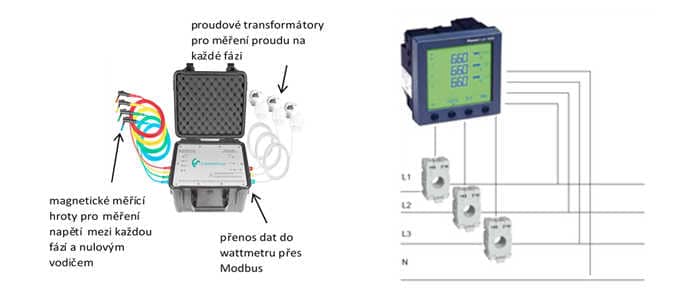
In the wattmeter, the measured values are evaluated, and other consumption-related data are derived:
- electrical current [A]
- power factor cos ϕ
- apparent power [kVA]
- reactive power [kVar]
- active energy [kWh]
- energy costs (if the price per kWh is entered)
Software modules provide an overview of consumption
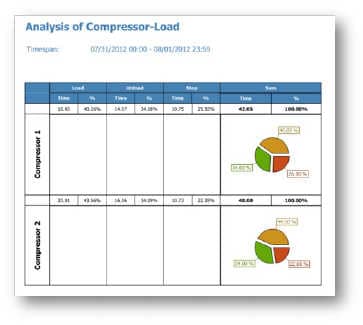
Data is evaluated in the wattmeter. To monitor compressor consumption, special software modules can be uploaded to the wattmeters. These provide a clear picture of the consumption of individual compressors.
For the software to provide correct consumption data, we must enter the correct information into it:
- compressor type (screw, piston),
- electricity price including night tariffs,
- current values corresponding to compressor operation: under load, idle, stopped.
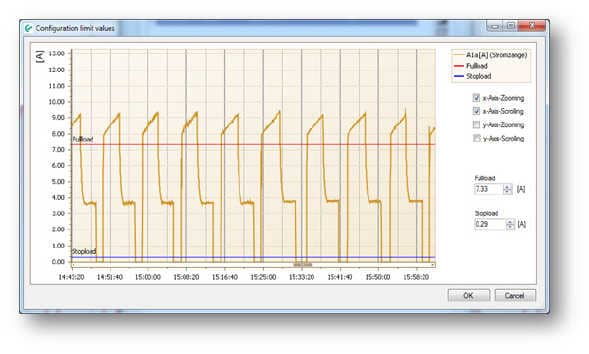
The software module will display:
|
 |