

- Connecting compressed air piping
- Quick couplings – connecting and disconnecting with one hand
- Quick coupling material affects their lifespan
- Connecting a quick coupling to a compressed air system
- Compressed air leaks through quick couplings
- Quick couplings for every application
- Quick couplings for safe work
- Prevo S1 type quick couplings for industrial use
Connecting compressed air pipingVarious types of couplings are used to connect compressed air piping:
Different types of fittings, reducers, and threaded connections are required for the connection:
|
 |
Quick couplings – connecting and disconnecting with one hand
|
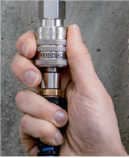
Quick couplings, as the name suggests, allow for very fast connection and disconnection of pipes or hoses, usually with one hand. Quick couplings are installed on piping in places that are frequently disconnected, typically where pneumatic tools are changed or where entire branches of a pneumatic circuit need to be disconnected. |
 |
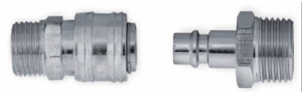
Coupling and plug create a connection
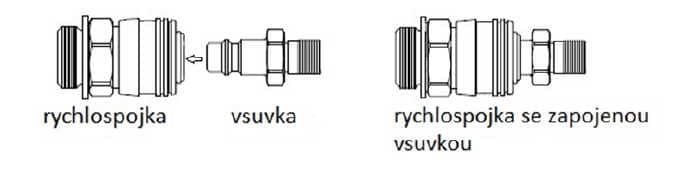
A quick coupling is mounted on the supply pipe, and a corresponding plug (nipple) is mounted on the opposing pipe or hose:
|
The plug is inserted into the quick coupling, and as soon as a click is heard, the connection is complete. The plug hits a seat with an O-ring, sealing the connection. To disconnect, it is necessary to press the quick coupling sleeve to release the plug. |
 |
Quick coupling material affects their lifespan
Quick couplings are usually made of brass, nickel-plated brass, or steel.
Brass and nickel-plated brass quick couplings
The most commonly used brass quick couplings are inexpensive. They are more suitable for small workshops than for industrial operations. Soft brass can dent or wear, leading to:
- flow reduction,
- relatively short lifespan,
- air leaks due to wear.
Stainless steel quick couplings
Stainless steel quick couplings are more expensive. They are suitable for distribution systems in industrial operations. Stainless steel is durable, giving the couplings these properties:
- long lifespan,
- good wear resistance,
- no air leaks.

Compressed air leaks through quick couplings
Quick couplings are the most common source of compressed air leaks. A typical leak in a quick coupling at 7 bar is around 1 Nm³/h.
|
With an air cost of approx. 0.30 CZK/Nm³, the cost of a leak is: per hour: 0.30 CZK |
 |
Connecting a quick coupling to a compressed air system
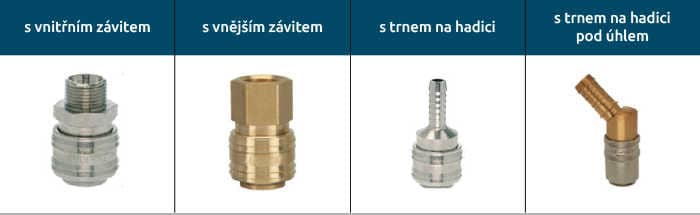
Whether you choose brass, nickel-plated brass, or stainless steel, you must select the correct type based on the connection to the pipe or hose.
Quick coupling size according to pipe diameter
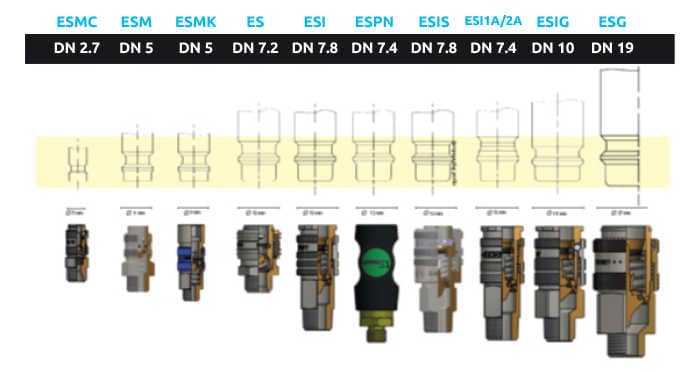
Quick couplings for plugs according to European standards are available with nominal diameters from DN 2.7 to DN 19 for various air flows:
Quick couplings for every application
A truly wide selection of quick couplings allows you to choose the right one for every application. On our portal, you will find couplings divided into many series, such as high-flow ESG series, couplings for the plastics industry, or safety versions.
Quick couplings for safe work
|
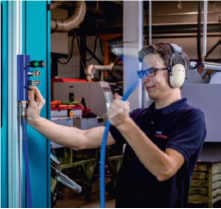
A quick coupling can disconnect a compressed air circuit very easily and quickly. A sudden and violent discharge of air can injure the operator. The hose can slip out of the worker's hand and whip around. Additionally, compressed air is wasted. To prevent the air stream from bursting out, quick couplings and plugs are often equipped with a shut-off valve. |
 |
Types of valve closures
Connection without shut-off valve

Upon disconnection, air flows from both the plug and the quick coupling.
Single-sided shut-off
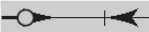
Upon disconnection, the shut-off valve in the quick coupling closes the air flow. However, air can still escape from the plug.
Double-sided shut-off

There is a shut-off valve in both the quick coupling and the plug – the air flow is immediately closed after disconnection, so no leaks occur and air remains in the pipe.
Depressurization during disconnection
For safe disconnection of a compressed air circuit, it is advisable to first depressurize the disconnected branch of the pipe, i.e., reduce the air pressure in it.
Depressurization via sleeve
ESIS safety quick couplings (complying with ISO 4414) allow for first reducing the pressure in the disconnected branch and then disconnecting the coupling.
Depressurization via button
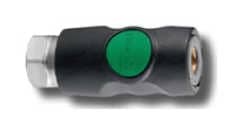
Prevo S1 type quick couplings with a button allow for depressurizing the disconnected pipe branch and disconnecting the circuit conveniently with a single press.
|
Procedure:
|
 |

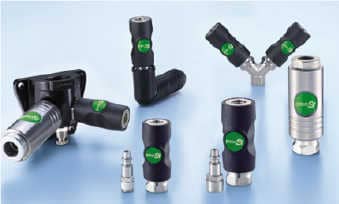
Prevo S1 type quick couplings for industrial use
| Prevo S1 industrial quick couplings | |
|
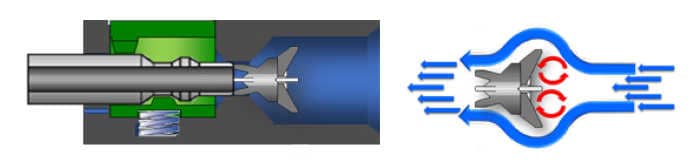
Flow rate 65% higher than standard couplings
|
 |
Standard quick coupling cross-section – the valve seat causes turbulence:
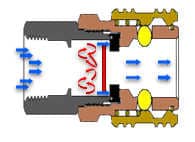
Prevo S1 quick couplings with patented valve shape allow for smoother air flow.
The Prevo S1 quick coupling is very safe.
- Meets ISO 4414 requirements.
- Depressurizes the downstream branch upon button press.
- Extremely easy to disconnect.
3-year leak-free warranty
Prevo S1 quick couplings come with a three-year warranty against air leaks. Each coupling body is marked with the year and week of manufacture.
Color coding and various sizes
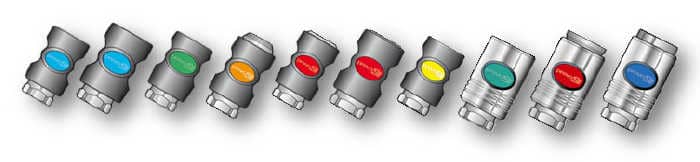
In addition to DN 7.4, various other sizes of Prevo S1 couplings are available. Choose metal versions for high flows up to 3,686 l/min. You can easily distinguish models by the button color, preventing cross-connection and ensuring you pick the right coupling for your application on the first try.