
Efficient operation of screw compressors

Choosing a screw compressor? Don't make a mistake and don't be lured by a low price for an inefficient compressor. You will save a bit on the initial purchase costs, but you will lose much more during the compressor's operation because its running costs will be unexpectedly high.
Did you know that it pays to reduce costs even for small compressors?
Annual costs for direct air production for a 15kW compressor amount to 180,000 CZK*?
- In five years, the costs climb to 900,000 CZK, and compressors are very often operated for 10 to 15 years?
* based on an electricity price of 3 CZK/kWh and an annual run time of 4,000 operating hours under load
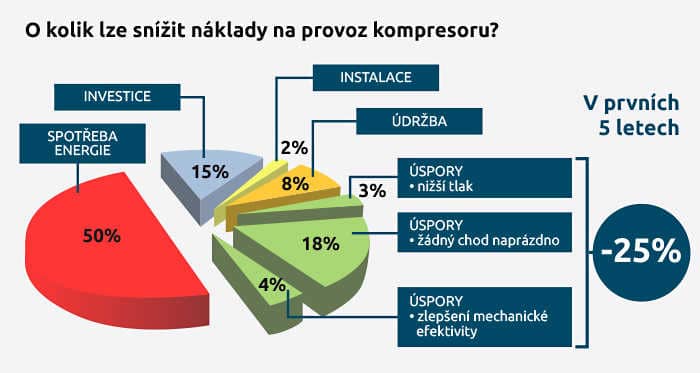
As you can see in the image, half of the operating costs consist of energy consumption. Proper design and efficient operation can bring savings of up to 25%.
Improving the mechanical efficiency of a screw compressor
If a compressor is to be as efficient as possible, its entire design must reflect that.
Which design elements of a compressor affect energy-efficient operation?
a) Connection of the screw block and electric motor
- A direct connection using a coupling is more economical than a connection with V-belts:
- low losses in driving force transmission
- efficiency is 3% higher than with V-belt transmission
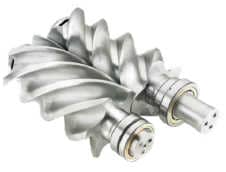
b) Screw block designThe size and structural design of the screw block affect how economically the compressor runs. Manufacturers are introducing new, more energy-efficient screw block designs. Precise machining of both screws is fundamental for the compressor's efficient operation. |
 |
No idling
How can we reduce compressor idling?
Idling means the compressor is running but not supplying air to the system. The compressor consumes electricity without producing compressed air. Therefore, idling must be limited as much as possible. Idling is used in the control of screw compressors.
Compressor control by switching between load and idle (on-off)
The goal of control is to maintain constant pressure in the compressed air system. Under load, the compressor compresses air until it reaches the set pressure. At that moment, it switches to idle – the inlet (suction valve) closes, so there is nothing to compress. Idling continues until the pressure drops to the cut-in pressure value. When that happens, the inlet valve opens and the compressor continues supplying compressed air to the system. Why isn't the compressor alternately turned on and off instead of idling? Because it is not good for the screw compressor at all – after turning off, the oil in the compressor cools down and, due to moisture, turns into an emulsion that doesn't lubricate well, thereby damaging the compressor.
Economical control using idling – advanced control units
Control units with sophisticated programs ensure that switching between load and idling is as economical as possible. They are even capable of analyzing the working cycles of machines, evaluating them, and setting the compressor operation to the most advantageous mode regarding energy consumption.
Compressor control by frequency converter
For a screw compressor driven by an induction motor, it is very economical to use a frequency converter. It directly changes the motor speed according to the consumption of compressed air. A frequency converter has a highly sophisticated control system and can be adjusted to the requirements of the given operation. This is the most economical way to control the operation of screw compressors.
Advantages of compressor control by frequency converter:
- energy savings by limiting idling,
- much smaller air pressure fluctuations (compared to on/off control),
- maximum pressure is lower, leading to significant savings and less wear
Frequency converters are usually preset by the manufacturer, making them easy to adapt for compressor control. In many converters, you can easily find a specialized control mode for a compressed air compressor.
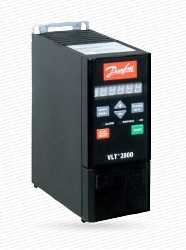 |
Frequency converterA frequency converter is an electronic device that can change the frequency of the power supply network to a desired frequency. When a frequency converter is connected to an induction motor, it can regulate its speed over a wide range. For controlling induction motors, the frequency converter is truly a revolutionary invention. After all, during regulation by alternating between switching on and off, a lot of energy goes to waste. Thus, speed regulation leads to significant savings. |