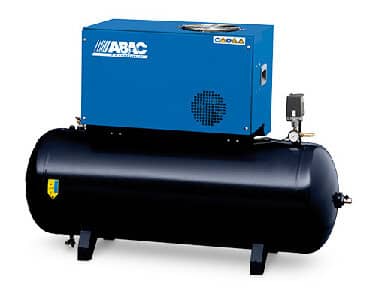

Compressor Noise – Watch out for Lwp and Lwa Markings
An air compressor is a relatively noisy machine; therefore, working in its immediate vicinity can be more than unpleasant. While every manufacturer states a "certified" dB number in their machine specifications, a frequent problem we encounter is that the customer doesn't know what kind of measurement is being referred to. To ensure the resulting "noise level" isn't an unexpected surprise, we decided to prepare this article, where we will also advise you on how to additionally soundproof a compressor.
Sound can travel through various environments, not just air. It propagates in liquids, gases, and even solids. In gases and liquids, it is a longitudinal acoustic wave characterized by the compression and rarefaction of the medium through which it travels. Acoustic waves advance from the sound source in wavefronts. The further from the source we measure the sound intensity, the lower it is. Now to the compressors. Their manufacturers are aware that the operator is never directly at the machine and likely works several meters away. Why, then, measure the sound intensity directly at the unit? And here lies the difficulty that can confuse a customer when reading the specifications…
But first things first! It is necessary to mention that decibels (dB) do not express "loudness." Loudness as a physical quantity does not exist.
Sound Pressure Level (Lp) (Lwp)
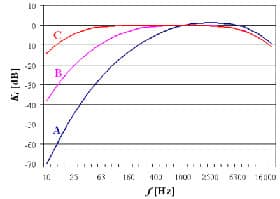
The sound pressure level is a measure of the sound energy radiated from a noise source and is expressed in decibels or dBA. If this value is provided, the measurement distance from the machine must always be stated as well. This pressure weakens with distance. Measurements are most commonly taken 4m from the machine, and if a customer is unaware of the context, they might think it refers to noise (which doesn't exist as a quantity, as we've already said) and that the compressor is actually quite quiet. However, over those four meters, the sound pressure level has partially weakened, which is why the figure is lower…
Sound Power Level (Lw) (Lwa)
The sound power level is the same quantity as the previous one but is measured under pre-defined conditions. The sound power level does not depend on the location of the equipment or the distance from the measurement point. The unit is again dB. This value is always found, for example, on the labels of ABAC compressors.
According to Directive 2000/14/EC, this value must be stated on the declaration of conformity. Measurements are carried out according to ISO 3744 or ISO 2151 and may have a deviation of ±2.5 dB.
What might the results look like for piston and screw compressors?
|
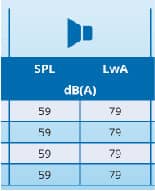
For a smaller workshop piston machine, for example: Lwp = 70 to 75 dB(A) Lwa = 90 to 95 dB(A) For a larger screw compressor with a housing, approximately like this: Lwp = 59 to 70 dB(A) Lwa = 79 to 90 dB(A) |
 |
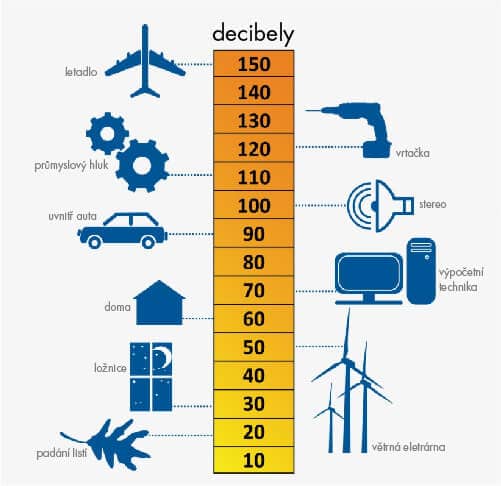 |
*A compressor driven by a V-belt is always noisier than a direct-drive machine. Noise is generated both by the air intake through the suction filter and by the movement of the piston or the whirring of the V-belt. Some parts like covers or pulley guards rattle, and even the valves are not silent.
What are the options for additional compressor soundproofing? There are primarily two variants – design modifications (lower motor speeds, using two smaller pistons instead of one, paper suction filters that allow better airflow) and the retrofitting of an original acoustic canopy specifically designed for the compressor model. Some manufacturers, such as the Italian company ABAC, offer these options, and you can consult with us about them.
However, a handy person can also use their own creative skills to handle the soundproofing. Building such a housing is especially suitable for larger machines. Acoustic foam panels can be used as insulation material, but be careful – they must not be too close to the aggregate to prevent overheating or ignition. A clearance of several dozen centimeters should be a matter of course, as should well-designed ventilation. The air inside the housing must circulate – a sufficiently powerful fan should be placed on one side, and on the other side (or preferably at the top), a pipe or mesh for air extraction. One of the disadvantages of original canopies can be their price.