

We expect a compressor to reliably and economically supply compressed air for our operation or workshop. If we have a high-quality machine and take good care of it, this expectation will be met. Those who attend to compressor maintenance are rewarded with a reliable supply of compressed air without outages.
Maintenance PlansCompressor suppliers make compressor care easier by providing maintenance plans in the documentation. The plan specifies which maintenance tasks should be performed after a certain period of operation or after the compressor has completed a specific number of operating hours. Control System Monitors Maintenance IntervalsIf our compressor is equipped with an advanced control unit, such as the ES4 000 Basic or ES4 000 Standard, we can rest easy. This unit will remind us when the time for necessary maintenance is approaching. The unit tracks how many operating hours the compressor has "worked" since the last maintenance and issues a warning message according to the set maintenance plan. In addition to temperature and pressure, control units display a maintenance deadline indicator, and any faults are clearly indicated directly on the display. The control system is also capable of blocking operation in the event of imminent damage (e.g., when exceeding oil temperature, compressor operating temperature, incorrect direction of rotation, etc.). |
 |
Maintenance of Piston Compressors
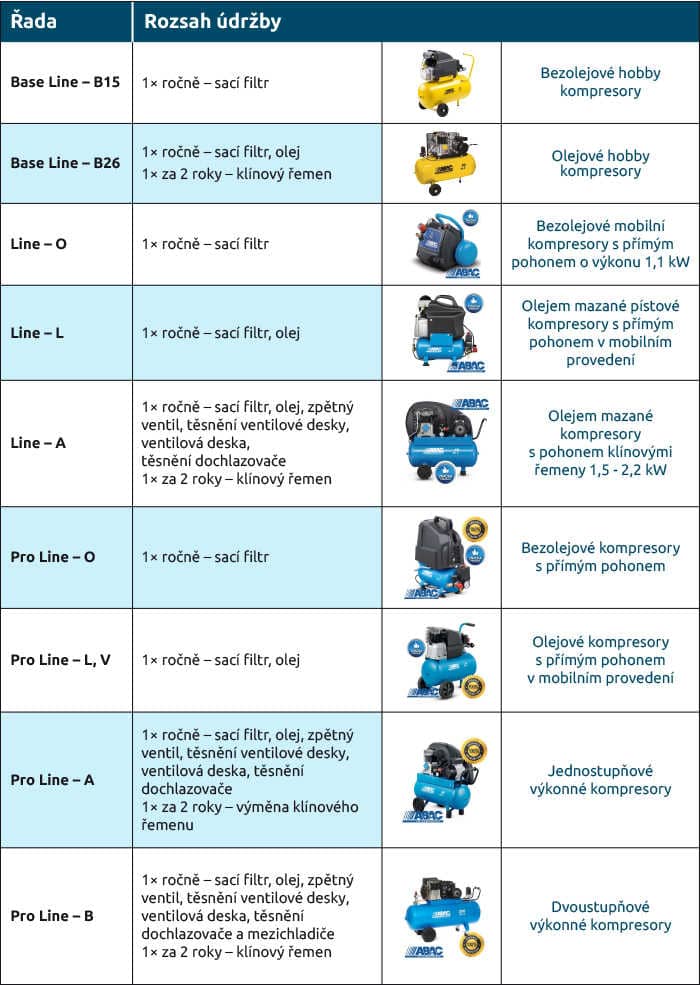
For the maintenance of piston compressors, you can follow the maintenance intervals in this table:
Suction Filters
The table shows how much attention needs to be paid to the filter on the suction side of the compressor. Air from the environment flows into the compressor through it. The suction filter must always be clean. If it is clogged with impurities, the compressor's performance will decrease. If the filter even tears, impurities can enter the compressor mechanism and damage it. Filters must be kept clean and unobstructed. Therefore, clean them regularly. If a filter can no longer be cleaned or is damaged, the filter element must be replaced. How quickly the filter clogs depends on the environment in which the compressor works. All filters can also be purchased in the Suction filters for compressors section.
Compressor OilCheck the oil level gauge or use a dipstick to ensure there is enough oil in the compressor and top it up regularly. When changing the oil, the compressor must be disconnected from the electrical network and must be "pressure-free." When draining old oil from the compressor, keep in mind that it may be hot, so proceed with caution. Use only oils recommended by the manufacturer that have the required viscosity and other properties. All oils can also be purchased in our online store in the compressor accessories section - compressor oils. |
 |
Check ValveRegular maintenance of professional compressors includes inspecting and replacing the check valve. Check valves are placed between the compressor and the pressure vessel. Their task is to prevent air from flowing from the receiver back into the compressor. In the valves and cylinders section, you will find our range of check valves: Check valves for compressors. |
 |
Valve PlatesFor professional compressors, care must be taken during maintenance to ensure that valve plates and their seals are in good condition. You can find them in the e-shop in the Service Kits section. |
|
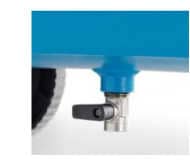
Draining Condensed Water from the Air ReceiverCondensed water can accumulate in the pressure vessel (air receiver) during compressor operation. This can disrupt fault-free and economical compressor operation because the compressor then has to switch on more frequently. Water can even enter pipes or hoses. Therefore, check the air receiver regularly and drain the water using the drain valve on the bottom wall of the receiver. If you don't want to worry about draining, install an intelligent condensate drain. This automatic element will handle the draining for you. |
 |
Maintenance of Screw Compressors
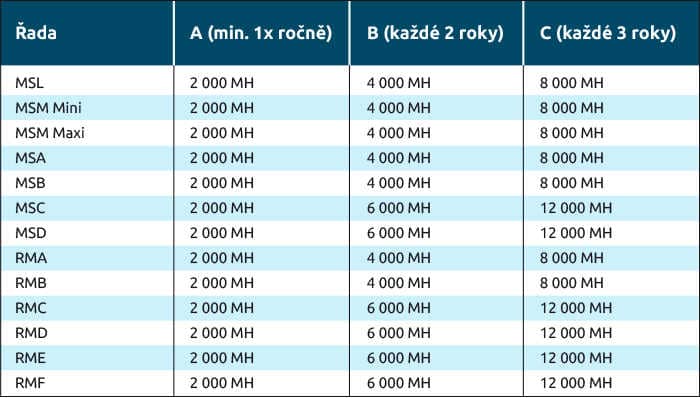
For screw compressors, three types of service are performed:
- Service A is performed once a year or after 2,000 operating hours
- Service B is performed once every two years or after 4,000 to 6,000 operating hours
- Service C is performed once every three years or after 8,000 to 12,000 operating hours
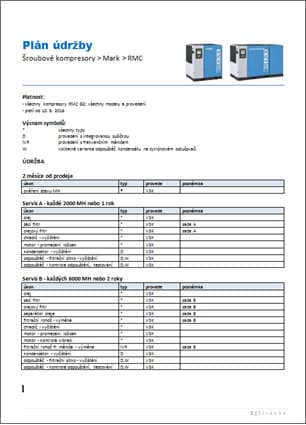
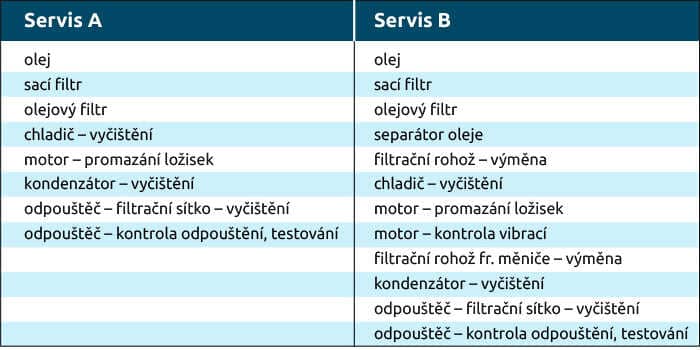
For example, for a Mark brand compressor, these operations are performed during services A and B:
Maintenance Intervals for Various Types of Screw Compressors
We usually entrust the service or repair of both screw and piston compressors to an authorized service center. They will also supply original spare parts. To book a service, please use our email: info@kompresory-vzduchotechnika.cz. If you need compressor spare parts, always provide the machine number and brand. It is best to also attach a photo of the broken part. Simple spare parts can be purchased in the section: Compressor Accessories.
Maintenance of Air Treatment Equipment
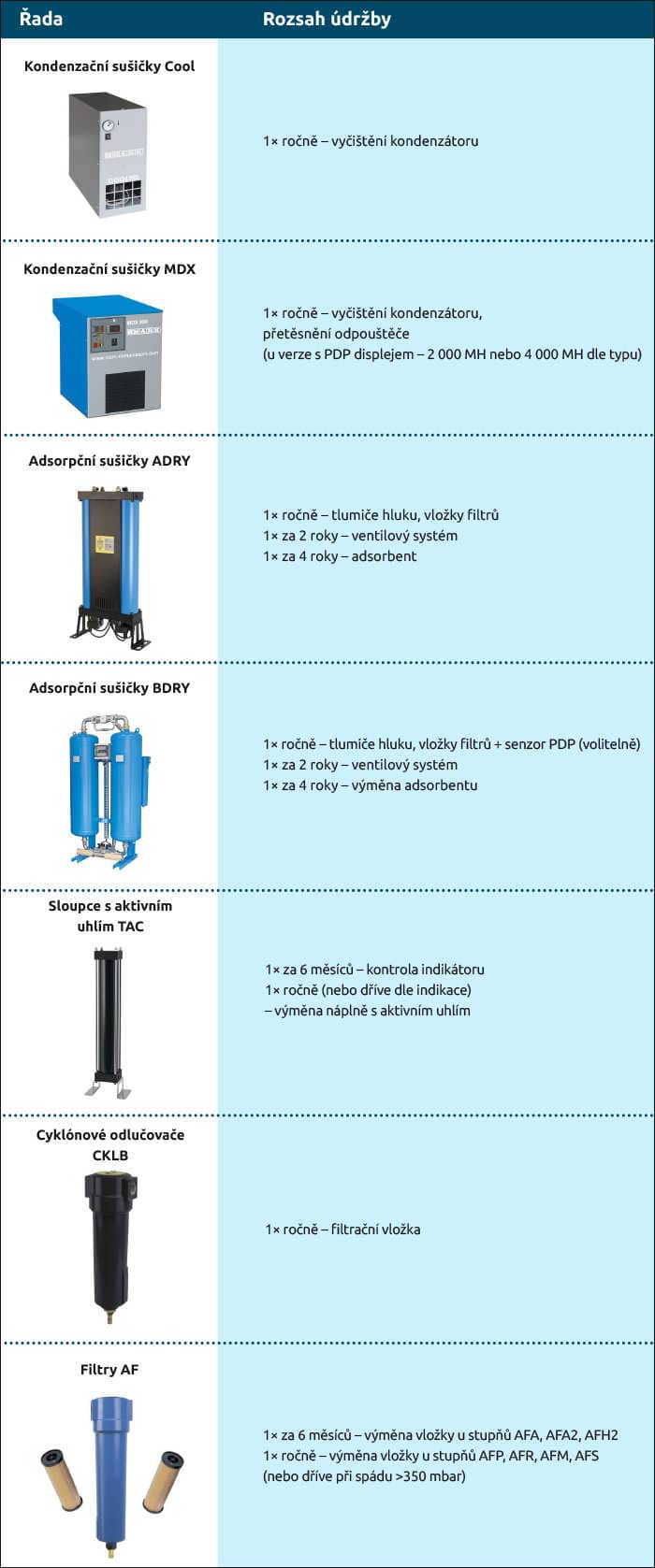
Refrigerant dryers are low-maintenance. It is sufficient to clean the condenser once a year and possibly check and replace the drain seal.
Desiccant dryers require care for silencers and the valve system. Furthermore, drying material charges (adsorbent) must be replaced regularly.
Activated carbon columns are used for drying in demanding operations (food industry). Every six months, we check the differential pressure on the indicator, and once a year we replace the activated carbon charge.
Cyclone separators can only correctly remove oil from dried air if they have a clean filter element; this needs to be changed at least once a year.
ISO 8573.1 filters are used to separate coarse impurities, oil, and moisture from the air. They can fulfill their function only if they are not clogged. Therefore, filter elements need to be replaced regularly (every six months or once a year depending on the type).
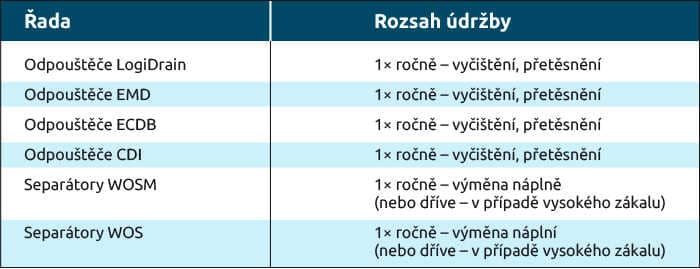
Maintenance of Drains and Separators
Condensate drains need to be cleaned and resealed regularly.
Separators, which separate water from oil, must always have a functional charge; this needs to be replaced at least once a year.
Inspection of Pressure Vessels – Air Receivers
Inspection of air receivers is not to be underestimated. Air receivers are pressure vessels, and specific safety regulations apply to them.
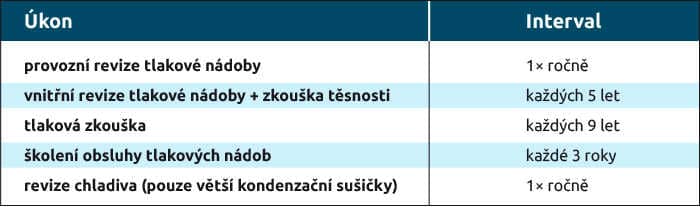
Standards for the operation of pressure vessels specify that every pressure vessel of circular cross-section with a volume greater than 5 liters and an operating overpressure higher than 0.07 MPa must be provided with a valid passport (inspection book), issued by the manufacturer, importer of pressure vessels, or a person with the appropriate authorization. For air receivers, inspection task intervals are prescribed: