
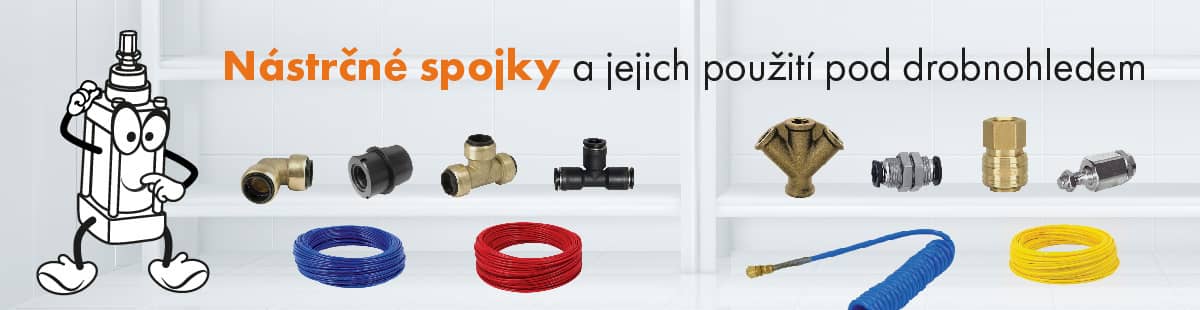
Push-in fittings and their application under the microscope
Praise to the person who invented push-in fitting systems. They revolutionized the efficient distribution of air and other media to the applications themselves. We have probably reached the maximum possible comfort of connecting and disconnecting in this regard. But are all push-in systems the same? Let's take a closer look at this method of connection.
What are the options in the range of push-in systems? Actually, they are quite identical to other systems for connecting and distributing air or other media. And we can safely start with the medium, because it matters what the surface of the fittings and hoses comes into contact with and what interactions are triggered. Therefore, pay attention to all components, whether they are, for example, suitable for chemicals – aggressive media, or conversely, permissible for contact with food. We always provide these parameters together with a description of which applications the fitting or hose is suitable for. These are mainly automation, measuring, and control technology, or pneumatic compressed air distribution lines in industry, mechanical engineering, and automotive technology. These are the most common areas where push-in systems are used on production lines.
General classification of push-in fittings regarding their application:
- standard fittings for common applications
- fittings adapted for higher pressures
- chemical-resistant fittings
- fittings suitable for contact with food
- antistatic design
- fire-resistant fittings according to DIN 5510-2
- fittings resistant to sparks from welding equipment
And what are actually the disadvantages of push-in systems, seeing how wide a range of uses they can cover and how wide a selection we have? Everything starts precisely with the correct choice according to the required parameters, which eliminates most ailments. One of the minimal disadvantages that remains after a suitable choice is generally poorer resistance to mechanical stress. Part of this is solved by the rotary design of the fittings or specially manufactured polymers from which the hoses are made. And regarding the rotary design - these special fittings can handle rotation of up to 1500 revolutions per minute thanks to ball bearings. As for a disadvantage that part of the fitting range has, it is the impossibility of using them for vacuum. Why? We will analyze this in the next section, where we will look at what the inside of such fittings actually looks like.
Disassembly of a push-in fitting
The main part of a push-in fitting is the body itself (corpus) – made of plastic or certain metal and noble materials, which hides relatively sharp "teeth" made of stainless steel behind a retaining ring (elsewhere referred to as a release ring) at least on one side. This ring must always be pressed into the fitting to open the teeth and either insert or pull out the hose. A perfectly functional and simple system is in most cases complemented by an O-ring (mostly NBR) hidden inside the fitting, against the wall of which we "push" the hose for maximum tightness, and then we release the retaining ring – the connection is complete. It could only disconnect under a vacuum.
Other systems, especially for larger diameters, use rotary closures as a retaining element. We can encounter this design in various air distribution lines across halls and operating facilities.
And what is the opposite end of a push-in fitting? There are many options – from threaded connections and identical fittings to adapters, hose tails, throttle valves, or shut-off valves, up to large manifold fittings.
And what about the hoses?
Push-in fittings are designed for elastic pneumatic hoses with a calibrated outer diameter. Commonly, this diameter starts at 4 mm and ends at 12 or 16 mm in most cases. The most commonly used manufacturing material is polyurethane - a polymer produced by the polyaddition of diisocyanates and di- or polyhydric alcohols to form a carbamate bond. The advantage of such hoses is high flexibility, but also resistance to mechanical stress. Other commonly used materials include polyamide or hoses made of branded Kynar HD4000 granulate for the most aggressive media. On the other hand, there is silicone – in most cases transparent for use in the food industry. Such hoses must, of course, be completely harmless, which is why they comply with FDA and 1935/2004 EC directives.
You can explore our entire range of hoses here: Compressed air hoses

What to add in conclusion?
The push-in system is the best friend in the field of connecting hoses and distributing media to the application. You do not need to extensively train personnel before installation, nor do you have to invest staggering amounts in acquiring components, let alone tools. Just always stick to a few basic rules and choose well according to the parameters – then the entire system will serve you for years without worries.
You can find the most popular plastic push-in fittings on our e-shop here: Push-in fittings
And all connecting materials here: Connecting materials for compressed air