

 |
A pneumatic cylinder converts the energy of compressed air into mechanical movement with a force proportional to its cylinder area and the working pressure.
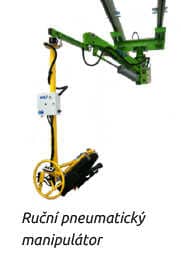
| Pneumatic cylinders serve as linear drives in simple manipulators that transport parts or semi-finished products of lower weight in a straight direction. Cylinders are capable of realizing not only linear but also rotary or oscillating movement. This is suitable for controlling grippers, robot peripheral elements, and automated workplace equipment. | 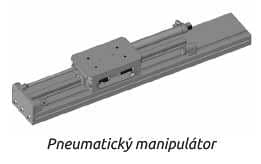 |
Pneumatic drives are widely used in the food industry, where cleanliness of operations must be ensured (which is why hydraulic systems are not suitable there).
Where to find pneumatic cylinders
|
 |
Advantages of pneumatic cylinders
|
 |
Criteria for selecting a pneumatic cylinder
1. Types of pneumatic cylinders
- single-acting, double-acting
- with magnet, without magnet
- round or non-round cross-section
- compliant with standards (ISO 6432, ISO 15 552, CNMO)
- with adjustable cushioning
- with piston rod, rodless
2. Cylinder dimensions: determine the appropriate piston diameter based on the required pulling or pushing force.
3. Piston stroke
4. Cylinder mounting method within the pneumatic system
5. Ambient environment – temperature, humidity, dust, etc.
Single-acting and double-acting pneumatic cylinder?
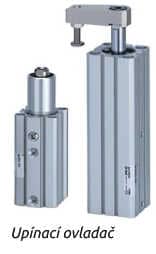
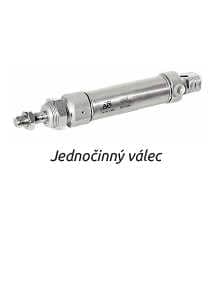
Single-acting cylinderIn a single-acting cylinder, air is supplied to the piston from only one side, so the force developed by the air pressure acts on the piston surface in only one direction. After interrupting the compressed air supply, the piston rod is returned to its starting position by spring force. Single-acting cylinders are used for strokes up to 50 mm. 3/2 valves are primarily used for their control. They are used for clamping workpieces, as ejectors, or for lifting operations. Compared to double-acting cylinders of the same size, they have lower air consumption. However, the usable force is reduced by the opposing spring force. |
 |
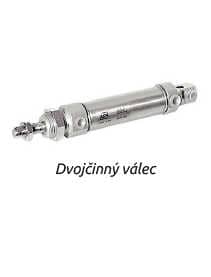
Double-acting cylinderAir is supplied to the piston from both sides, so both forward and backward movements are powered by compressed air. This allows for much longer strokes (up to 2 m). 5/2 and 5/3 valves are typically used for control. The movement is fast and uniform, and speeds can be adjusted in both directions. When retracting, double-acting cylinders develop less force than when extending because the effective piston area is reduced by the area of the piston rod diameter. This must be considered if equal load is required in both directions. |
 |
Pneumatic cylinder with magnet
| If you need to monitor the piston's position, choose a cylinder with a magnet. A position sensor is installed on the cylinder (often in a slot) to detect the magnetic field of the magnet integrated within the piston. | 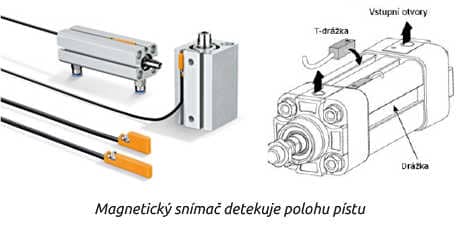 |
Adjustable Cushioning
Intense impacts at the end of the stroke can lead to failures. Adjustable cushioning allows for a soft stop. Just before the end position, a cushioning boss enters a cavity in the cylinder cap. The trapped air is compressed, slowing down the piston. To allow the piston to reach the final position, the air is bled through a small adjustable needle valve.
Rodless cylinders
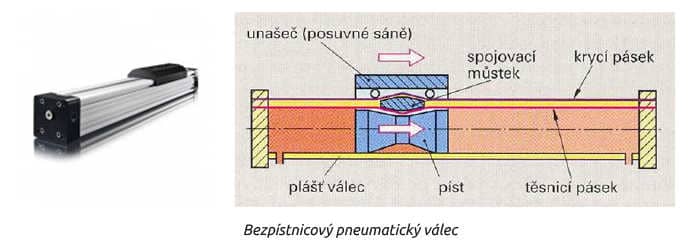
In pneumatic systems where an extending piston rod would take up too much space, a rodless cylinder is chosen. It is very space-efficient, with the piston coupled to an external carriage. Rodless cylinders are manufactured with stroke lengths up to 5.7 m.
Choosing the correct size
The key to determining the correct size is the required pushing or pulling force, which depends on the piston area and air pressure. A cylinder that is too large is expensive to buy and operate (consuming more air). An undersized cylinder may not provide the necessary force or will require higher operating pressures, increasing costs.
|
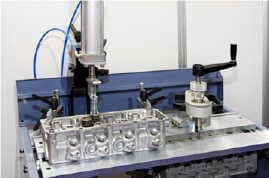
Horizontal or vertical installation? If installed vertically, the piston must overcome gravity when moving up. When moving down, gravity aids acceleration. Throttle valves are often necessary to limit speed and reduce impact energy. For vertical installations, choose a type with higher pulling or pushing force. |
 |
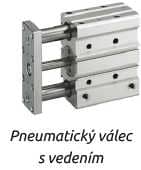
Guided cylindersPiston rods are primarily designed for axial pressure. If a radial load (perpendicular to the axis) is present, external guidance should be added. Without this "guiding" structure, the cylinder may suffer premature wear or leaks. |
 |
Overview of pneumatic cylinder range
Small round cylinders ISO 6432
(diameters 8 to 25 mm). Suitable for non-lubricated compressed air systems. Covers are crimped onto the barrel for perfect tightness. Available in aluminum or stainless steel.
Square profile cylinders ISO 15 552
Excellent bending and torsional stiffness. These are standard industrial cylinders.
Compact cylinders ISO 21287
Designed for applications with limited installation space while maintaining standard mounting patterns.
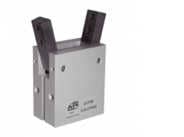
GrippersThe range also includes pneumatic components that realize gripper jaw movements:
|
 |