


- Why measure dew point
- Three quantities describe humidity
- What happens to water vapor during air compression?
- Removing moisture from air
- Measuring dew point
- Installation of humidity and dew point sensors
- Storing humidity sensors
Why measure dew point temperature?The air dew point is the temperature at which water vapor in the air begins to change into water, i.e., begins to condense. The dew point temperature depends on the air temperature and humidity: The warmer the air, the more water it can hold without the water vapor starting to liquefy (condense). |
 |
The higher the humidity of the air, the higher the dew point temperature, meaning water vapor will begin to condense at a higher temperature.
Dew point temperature is a measure of air humidity and should be monitored during both the production and consumption of compressed air. Condensed water should not reach places where it doesn't belong. Water can easily damage pneumatic tools, clog valves and orifices, and cause pipe corrosion.
Dew Point Temperature and Frost Point
Dew point is abbreviated as DP. You may also encounter the term frost point, FP. At higher temperatures, water vapor in the air condenses as droplets – "dew," while at lower temperatures it forms ice microcrystals – "frost."
"For compressed air, only the pressure dew point is significant. Atmospheric dew point is misleading and must not be used." (ISO 8573-1 standard)
Pressure Dew Point Temperature
The temperature at which vapor condenses at a given pressure. In other words, it is the temperature to which compressed air can be cooled without any condensation occurring.
To use compressed air at normal temperatures, it is advisable that its pressure dew point be 10 °C lower than the temperature in the operation or workshop.
Three quantities describe humidity
|
Maximum Humidity (g/m3) |
 |
|
Absolute Humidity (g/m³) |
 |
|
Relative Humidity (%) |
 |
Calculators assist with computations
Online calculators can be used to calculate dew point temperature from relative humidity and temperature.
Phase changes of water vapor to water and back are described by other quantities such as volume ratio, humidity degree, vapor concentration, and enthalpy. If you need to know these thermodynamic quantities, use online calculators available on the websites of various manufacturers of hygrometers and dew point transmitters.
What happens to water vapor during air compression?
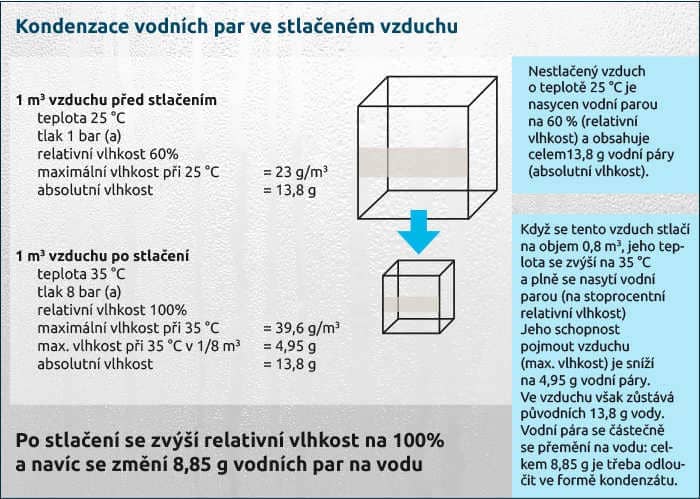
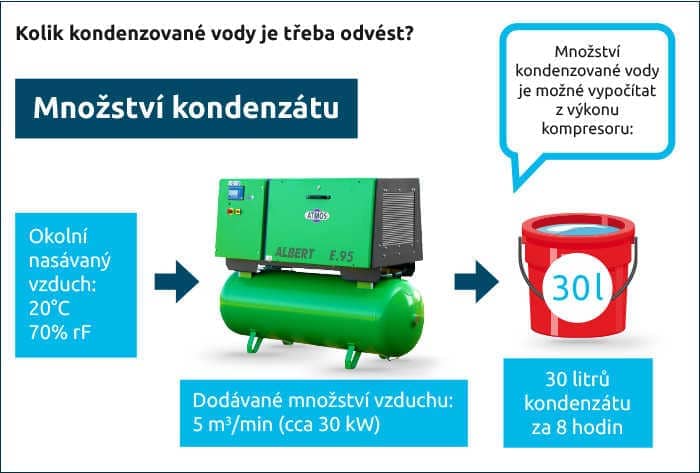
Compression reduces the air volume and increases its pressure and temperature. This reduces the air's ability to hold all contained water vapor. Part of the water vapor condenses and turns into water. The image illustrates how one cubic meter (m3) of air is compressed from 1 bar to 8 bar.
Removing moisture from air
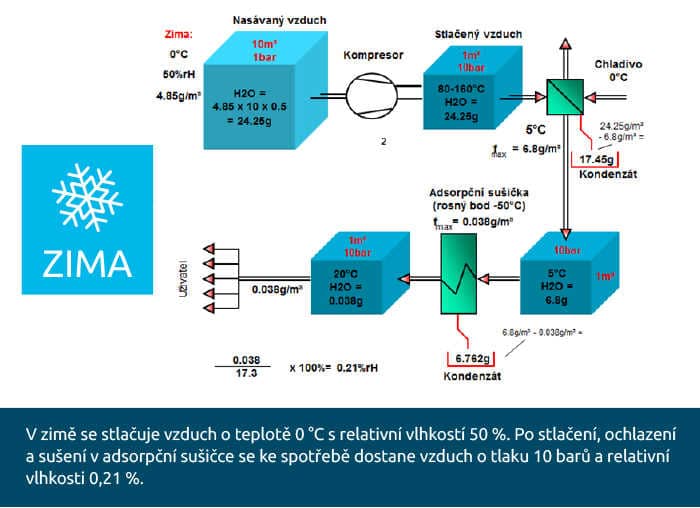
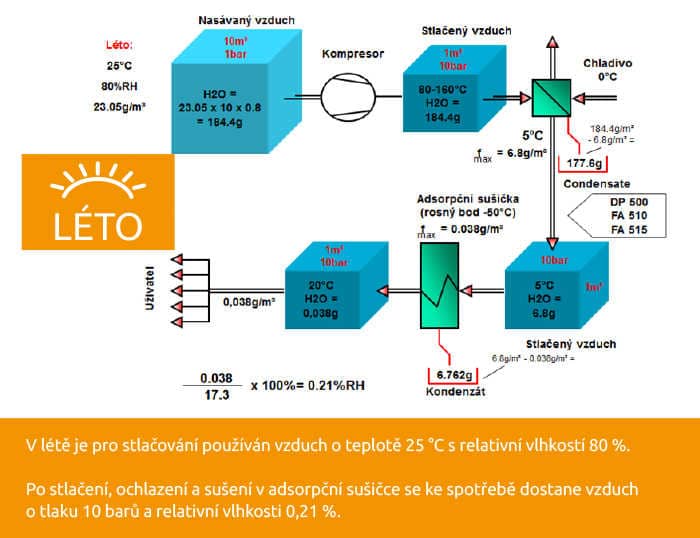
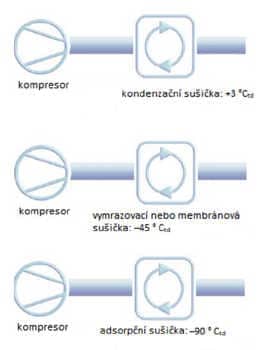
The following images show how moisture is separated from the air. they illustrate the processing of atmospheric air into dry compressed air suitable for use. Moisture is separated first during the cooling of air heated in the compressor and then during drying in a desiccant dryer.
Measuring dew point
Devices based on various principles are used to measure dew point temperature.
Optical Method
This is based on a mirror that begins to fog up as the air cools. An LED shines on the cooled mirror from one side. As soon as the air temperature reaches the dew point, the mirror fogs up and a sensor detects a drop in the intensity of the reflected light. These mirror systems are very accurate but contain a vulnerable optical system, making them less suitable for industrial operations. They are excellent for verifying and calibrating other hygrometric systems. Only the optical method directly determines the dew point temperature; other sensors measure relative humidity and temperature, from which the electronics calculate the dew point.
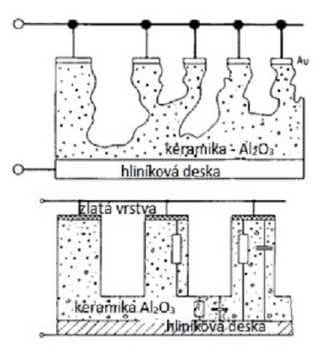
Resistive Humidity SensorsThese use materials that change their properties due to humidity, causing a change in electrical resistance. A ceramic Al2O3 layer is deposited on an anodized aluminum plate, with a gold coating forming the second electrode. Water vapor penetrates through it, causing a change in total resistance. Disadvantages:
|
 |
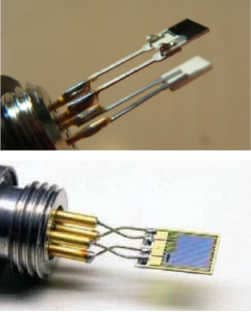
Capacitive Polymer Humidity SensorsCapacitive sensors use the properties of a hygroscopic polymer material (moisture-absorbing). The polymer forms an electrolyte layer between the capacitor contacts and has access to the air being measured. One electrode is porous, allowing air to penetrate to the polymer, which absorbs it and changes its properties, thereby changing the capacitor's capacity. Due to the high dielectric constant of the polymer, even a small amount of absorbed water is enough to manifest changes in capacity. The output is a voltage or digital signal. |
 |
Advantages: Short response time, resistance to contamination, small dimensions, and affordable price.
Dew Point SensorsDew point sensors contain two sensors:
The signal regarding humidity and temperature goes to a transmitter where the dew point temperature is derived. |
 |
Measurement result depends on correct humidity sensor selection
To determine the pressure dew point of compressed air, the correct type of sensor must be chosen. Humidity sensors are designed for different dew point temperature measurement ranges.
|
Dew point temperature is given in degrees Celsius: °Ctd In the documentation, you will always find the dew point temperature measurement range, e.g., from -45 °Ctd to +30 °Ctd. Therefore, we must find out what dew point temperature we expect at the measurement point. We are most interested in the dew point temperature at the point where air enters the appliances after compression and drying. |
 |
Various Humidity Sensor Designs
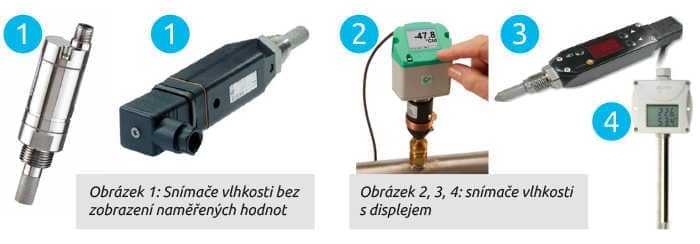
We have various humidity sensor designs to choose from. Sensors can send measured values to a transmitter or operator panel. Some designs are intended for explosive environments (ATEX).
|
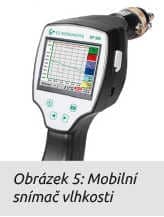
Images 2, 3, and 4 show sensors with displays. The operator can monitor the instantaneous value directly at the installation site. Image 5 shows a mobile sensor with a lithium-ion battery and integrated data logger for storing measured values. It connects to a computer via USB to transfer data. Mobile sensors are often used by maintenance staff to quickly check dew point temperatures at various points in the compressed air distribution system. |
 |
Installation of humidity and dew point sensors
|
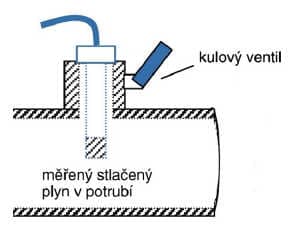
To obtain correct results, pay attention to proper sensor installation. a) Installation of a sensor with a ball valveIf the sensor is mounted using a ball valve, it can be easily handled without having to depressurize the compressed air distribution system. |
 |
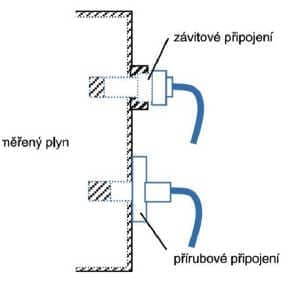
b) Installation in a main pipe branchIf the sensor is located in a branch from the main pipe, it is advantageous to use a bleed screw. Even a small gas flow in the branch ensures a faster sensor response to changes in the medium's dew point. |
 |
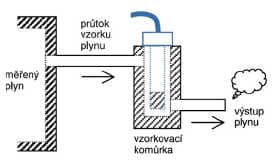
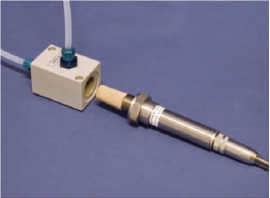
c) Sensor installation in a sampling chamberWhen measuring very low dew point temperatures, use a sampling chamber. Robust, small-sized probes that are easy to install in the sampling chamber are suitable for this. Humidity measurement using a sampling chamber » |
 |
|
Compressed air can also be fed into the measuring chamber via a tube: pay attention to selecting the correct tube material to prevent water vapor from evaporating from the outside of the tube. Suitable materials: TFE, stainless steel, copper. |
 |
Storing humidity sensors
Always store humidity and dew point sensors in a desiccant container. This protects them from moisture that could skew measurement results. When needed, simply remove the sensor from the container and it is immediately ready for measurement.