


 |
A compressed air distribution system is not something a person with a small compressor in their workshop or garage needs to worry about. However, in a professional workshop or industrial operation, it is necessary to address the distribution of compressed air to appliances using suitable pipes and hoses. A well-designed distribution system saves a lot of money and trouble.

Designing a compressed air distribution system
| Keep these aspects in mind when designing the distribution system: | |
|
 |
|
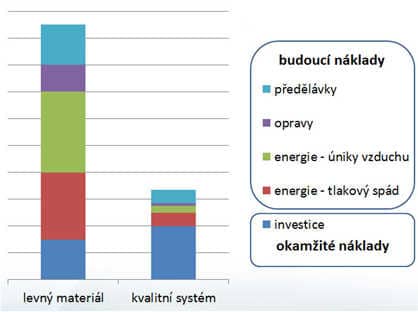
Consider which of these requirements are most important to you and choose the piping system layout accordingly. A distribution system is usually in operation for more than 10 years. As you can see on the graph, the initial investment is often not as important as the operating costs. It does not pay to save on the material and design of the compressed air piping system. |
 |
How to proceed when designing compressed air distribution
Determining the pipe size and its routing is quite complex, especially if the air is led to many different appliances. Therefore, it often pays to entrust the design of the compressed air distribution to a designer. They will prepare a project in which you will find all the necessary information: materials, drawings, and a bill of materials.
If you want to design the compressed air distribution yourself, follow the procedure below.
1. Start with a layout of your facility
Draw a floor plan of the facility with the dimensions of the spaces and mark the locations where the following are placed:
- compressors
- compressed air consumption points
- obstacles for compressed air lines (columns, structures, production machines, etc.)
Simple operations can be sketched on paper; for drawing more complex distribution systems, it pays to use special design software.
2. Choose an architecture – straight or ring
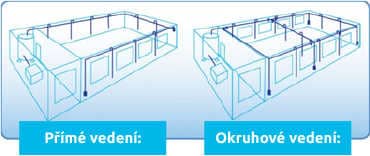
A compressed air piping system consists of a main or backbone line and connections to appliances. The main line can be designed as:
| Straight line: A simple distribution with branches – acquisition costs are lower and it is more suitable for small operations and professional workshops. Ring line: A closed loop – acquisition costs are usually higher, and it is suitable for larger operations. |
 |
Ring lines have these advantages:
|
 |
- Once you are clear about what architecture is suitable for your operation, mark the pipe routing in the plan including the dimensions of individual branches. Carefully mark the places that the piping will have to bypass (e.g., columns). Determine the dimensions of the hall walls and the lengths of individual piping sections.
3. Determine maximum consumption – the consumption of the largest takeoff point
4. Choose the distribution type
Choose a suitable distribution type according to pressure, consumption, and use. Pipes and hoses made of various materials are used for compressed air distribution, and there is a very wide range of connecting elements, fittings, and armatures. Two overviews list the most used types of piping systems: an overview of piping system types and an overview of piping connection elements.
5. Choose the diameter of the distribution pipes and connection elements
Tables and online calculators on the websites of manufacturers and e-shops with compressed air distribution will help you with the dimension of the piping and connection elements. You need to add the following to these tables:
- Air flow and pressure – according to the compressor used.
- Total pipe length – found from your distribution layout.
- Equivalent line length – count the armatures and fittings on the longest line and look up the equivalent length for each of them in the tables; add the "equivalent line length" to the actual length.
- According to these parameters, you will find the recommended dimension for pipes and fittings for the total calculated length.
Hoses are used for branches from the backbone line to the appliances. Find their dimension in a similar way as for the backbone distribution.
Account for pressure drop
Air flowing through a pipe reduces the pressure, which needs to be compensated for by higher compressor output. Therefore, when designing a compressed air distribution system, ensure that the pressure drop is as small as possible. The line length has the greatest influence on the amount of pressure drop. The longer it is, the greater the drop. It can be reduced by increasing the pipe diameter, which, however, increases the acquisition price.
Pressure drop increases due to:
- too small pipe internal diameter
- reduction of pipe internal diameter due to corrosion
- rough pipe surface
- occurrence of turbulence in fittings
Pressure drop can also be reduced by using materials with a lower coefficient of friction.
Pressure drop and pipe material
Aluminum pipes have the lowest pressure drop, followed by plastic pipes, and steel pipes have the largest drop. Pressure drop can also be reduced by creating a ring backbone line.
Installation of compressed air distribution
Several principles must be followed during piping installation:
- The piping must be accessible so that leaks can be checked or maintenance interventions performed. Do not install distribution piping in shafts or ducts, but in accessible locations.
- Install the piping with a slope of 1 to 2% in the direction of flow so that condensed vapor and impurities flow to the lowest point. A condensate collector with automatic discharge is installed at this point.
- Always place branches to appliances on the top side of the pipe so that impurities are not carried into the consumption point.
- For condensate and impurity drainage, install branches on the bottom side of the pipe.
What material to choose for compressed air distribution?
For the main backbone line, it is possible to design piping made of steel, plastic, or aluminum; exceptionally, we can also reach for copper or brass pipes. Air is led to appliances using hoses (rubber or plastic).
Backbone line material and its properties
Plastic pipes (polypropylene, polyamide) are suitable for low pressures. They are lighter, have a lower coefficient of friction, and are not threatened by corrosion.
Metal pipes (steel, galvanized steel, aluminum, brass, copper) are suitable for higher pressures.
Aluminum pipes have a very small pressure drop and a larger internal diameter with the same external diameter.
Connections to appliances
Rubber hoses are used especially in cases where a certain mobility of the supply line is required. They are more expensive and more difficult to handle than plastic hoses.
Plastic hoses (made of polyamide, polyethylene, polyurethane, and Teflon) are easily and quickly connected and are cheaper.
Overview of the most used types of piping systems
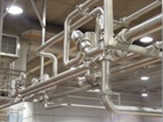
| Welded or soldered distribution systems For long-term operation, steel pipes are joined by welding and brass ones by soldering. The advantage of welded joints is tightness and low costs. The disadvantage is the formation of scale, which must be removed from the pipes. Furthermore, rust particles can fall off the welds and contaminate the compressed air. Therefore, an air treatment unit with a cleaner must be used. |
 |
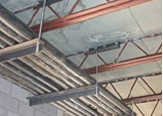
| Threaded distribution systems Galvanized steel pipes are joined by threading. With these joints, it is necessary to watch for leaks and rusting in places where the protective layer is disrupted, e.g., at the threads. Therefore, even when using threaded pipes, it is essential to use air treatment units. |
 |
|
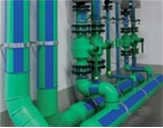
Plastic distribution systems |
 |
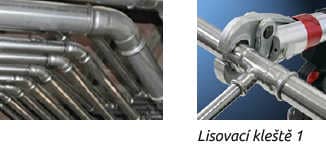
| Pressed piping systems Pressed systems are among the most used today because they have many advantages:
|
 |
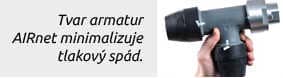
| Aluminum threaded distribution systems Aluminum pipes can be joined, for example, with plastic couplings of the AIRnet system with internal diameters from 20 to 100 mm (3/4" to 4"). AIRnet piping system |
 |
AIRnet joints are durable:
|
 |
| Aluminum pipes are supplied with a double bend for making an offset from the backbone line to the wall. AluNET aluminum pipes for maximum pressure 16 bar and maximum temperature +100°C with SZÚ certificate according to European directives PED (Pressure Equipment Directive) and CPR (Construction Product Regulation). AluNET pipes can be joined with Tectite Air, Schneider (15-28mm), John Guest, Festo, and Ingersoll Rand – SimplAir piping systems. | 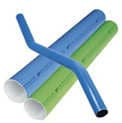 |
Piping distribution systems from aluminum profiles
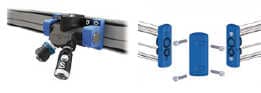
Sico Alu – aluminum distribution for workshops and laboratories
|
 |
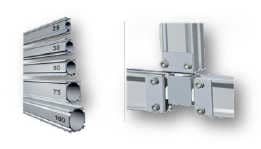
Prevost AMPS system for production operations
|
 |
Overview of piping connection elements
