
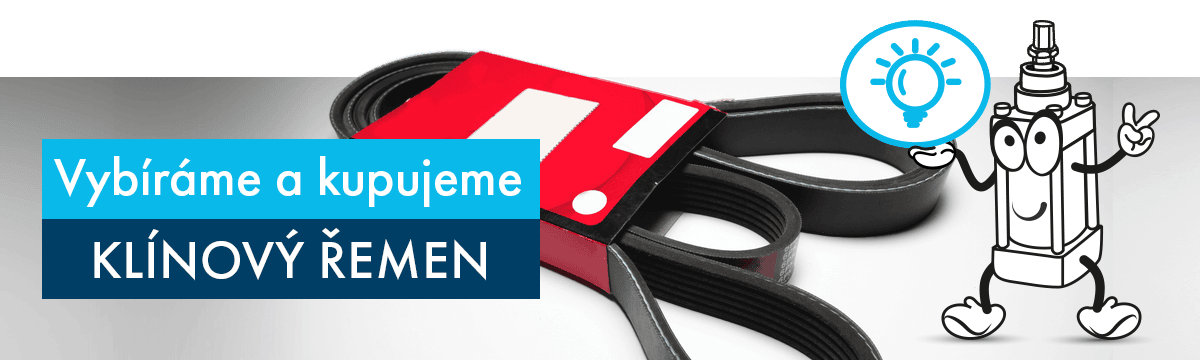
V-belts are among the common consumables not only in the field of air compressors. They find their place wherever we need to transfer torque from the driving pulley to the driven one. Such power transmission has several advantages. Therefore, we recommend never skimping on V-belts so that these advantages are truly utilized. And it's not just about the lifespan. V-belts allow the use of higher speeds and power with lower losses, have minimal belt stretch under load, ensure quiet operation, and absorb vibrations.
Today we will teach you how to shop for and choose these belts correctly. Very often we encounter situations where the user has a damaged or broken belt and doesn't know how to identify it and accordingly purchase a new one.
V-belts are usually made of highly resistant and durable rubber (e.g., SBR rubber), into which a fabric core for maximum tensile strength has been placed. Specialized materials resistant to oils or extreme temperatures are also used. However, nothing lasts forever, and even the highest quality belts eventually deserve a replacement or will snap.
Where do belts find their application?
- Compressors
- Pumps
- Aggregates
- Car engines
- Alternators
- Saws
- Washing machines, dishwashers
- Various production machines
@KATEGORIE@(/klinove-remeny/)(20,random)(slider)
V-belt identification
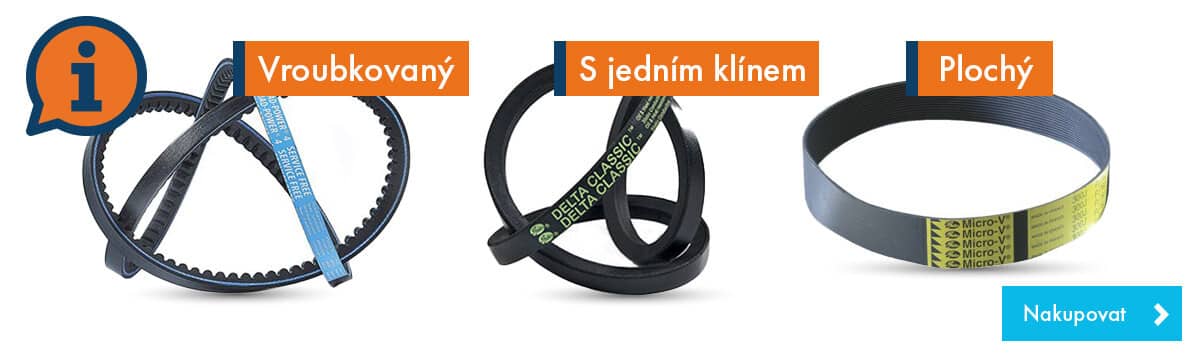
There is a vast number of belt types. Therefore, always take yours in hand and examine its construction and shape.
It can be of these constructions:
(some special belts are a combination of designs)
Determining belt dimensions
The best situation is when you have the machine with a new belt in front of you. On the outer back of every new belt, you will find data on dimensions and the manufacturer, so we recommend noting this information down as soon as possible, for example, in an inspection book or wherever you keep records of the equipment. Another advantage with some compressor and other equipment manufacturers is that you can click through to the full specification on the internet and find out what belt fits the machine.
It is hard to read anything from a worn belt, so a caliper, tape measure, and string must come onto the scene. Don't worry, we are not going to embroider anything. The string serves to easily measure the belt's length. Simply stretch the string around the circumference of the outer surface. Then just place the measured part of the string against a tape measure to determine the total belt length. But don't forget that a worn belt is stretched - elongated. This can be in the order of a few centimeters. Take this into account and find out how much tensioning reserve the belt tensioner has directly on the machine.
A caliper is needed to accurately measure the outer width (maximum width) and profile height. For belts with multiple ribs, it is also advisable to measure the spacing between the ribs. From the center of one rib to the center of the next rib (designated as p). Once you have gathered all the necessary dimension data, it is time to look at the offer on the e-shop itself.
Measurement summary
length measurement options
- inner length Li - measured along the inner surface
- outer length La - measured along the outer surface
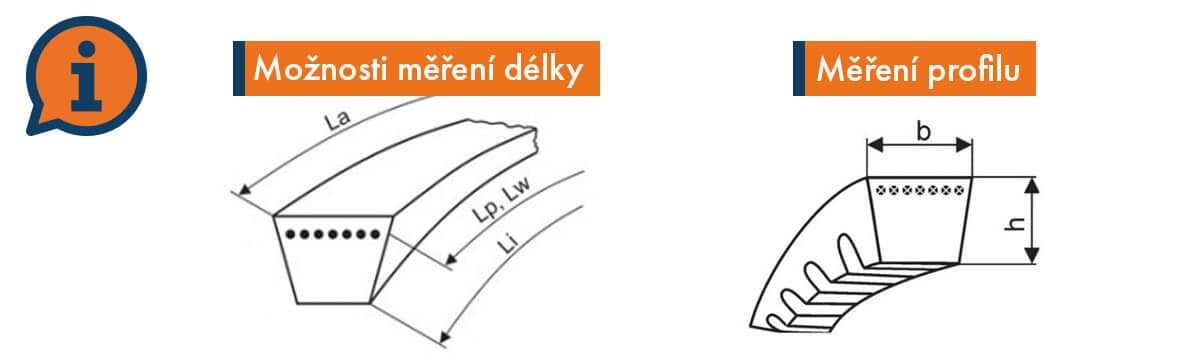
profile measurement
- belt width (b)
- wedge height (h)
- wedge angle (a)
- spacing between wedges (p) - (applies to multiple V-belts with more ribs)